


 EN
 ไทย



Customers Also Purchased
When using a sprayer, many people might not notice minor anomalies, such as water swirling in the tank when turned on, the sound of water returning through another hose, or water immediately flowing back into the tank in greater volume when releasing the spray trigger. Many assume that the valve is faulty, the pump is leaking, or pressure has escaped the system.
In reality, for many types of sprayers—especially those equipped with a Pressure Regulator, Relief Valve, or Bypass Valve—having some water return to the tank is completely normal, and in some systems, even necessary. This helps regulate pressure and prevents excessive load on the pump. The principle is that the pump may deliver more fluid than the nozzle actually requires, so the excess is routed back to the tank via a bypass line to maintain pressure at the desired level. Therefore, the question "Is water returning to the tank normal?" cannot be answered with just "normal" or "abnormal." You need to consider where it flows back from, how much is flowing, when it occurs, and whether the nozzle pressure remains normal.
In this article, we'll help you understand how water travels in a Agriculture Spray Machine sprayer, why some of it must return to the tank, and how to tell whether the returning water is part of normal operation or a warning sign of an issue that needs inspection.
First, you need to understand that water in a sprayer does not always travel straight from the tank to the nozzle.
Looking at it fundamentally, a sprayer's water path might seem simple: Tank → Pump → Spray Hose → Nozzle. Pull the trigger, and water sprays out as a mist—that's all there is to it. However, for sprayers that require consistent pressure control, the system is more complex. It includes filters, pressure regulating valves, pressure gauges, safety relief valves, and crucially, a Bypass line (a secondary fluid route) to recirculate water back to the tank. The actual water path is:
Main spray line: Tank → Pump → Pressure regulator assembly → Nozzle Return line: Pressure regulator assembly → Bypass line → Back to tank
Water continuously returning to the tank does not mean the pump is broken or malfunctioning. It is a design feature of positive displacement pumps (such as diaphragm pumps), which attempt to deliver a constant volume of water at all times. When you release the trigger or use less water, the excess water needs an outlet through the bypass line to cycle back into the tank, preventing system pressure from spiking and causing equipment damage.

Why Does a Sprayer Need to Return Water to the Tank?
The word "Bypass" simply means an alternate route that allows excess water to diverge from the main path and return to the tank. Imagine that a sprayer pump delivers 10 parts of water, but the nozzle only requires 6 parts. Forcing all 10 parts through the nozzle would cause pressure to spike and potentially damage the system. However, using a bypass system to deliver 6 parts to the actual spray while routing the remaining 4 parts back into the tank balances both pressure and fluid volume perfectly. (Note: These numbers are merely illustrative examples.)
The pressure regulator acts as a water flow organizer, discharging excess water back into the tank once the preset pressure is reached. Therefore, if you turn on the machine and see water circulating back into the tank while the pressure remains good and the spray is consistent, that is normal system operation—not a broken machine or a leak.
What Kind of Water Return is Considered "Normal"?
- Water returns, but spray pressure remains strong: The easiest way to tell is if you pull the trigger and the mist still sprays strongly, finely, and consistently despite water returning to the tank. This means the returning water is simply normal excess routed through the bypass system.
- Releasing the trigger increases water return: When the nozzle is shut off, the pump—which is still running—immediately directs all water with no other outlet through the bypass line back into the tank.
- Adjusting the regulator changes the return volume: Turning the pressure knob alters the proportion between "water to nozzle" and "water returning to tank." Changes in water volume in the return line as you make adjustments are completely normal.
- Water surface in the tank swirls continuously: The circulation of returning water helps agitate chemicals in the tank, reducing the likelihood of suspended particles settling (though chemicals must still be mixed according to each manufacturer's instructions).
What Kind of Water Return Starts to Become "Abnormal"?
This is even more important than understanding the bypass system! Although the machine is designed to circulate water back into the tank, if too much returns disproportionately, nozzle pressure will drop and spraying will become ineffective. Therefore, don't just check "whether water returns"—watch out for these 2 warning signs:
Water flows heavily back into the tank, but the nozzle has almost no pressure: If water surges forcefully into the tank while spray pressure is very weak, it indicates the pressure regulator or bypass valve is opened too wide. Water takes the path of least resistance (back to the tank) instead of building pressure to the spray hose. This is often caused by a stuck valve, worn spring/seal, or improper regulator adjustment.
Previously only a small return, but suddenly surges abnormally: Comparing with previous behavior is the best check. If using the same nozzle and pressure setting, but the return line suddenly gushes with water while spray pressure plummets, that's a warning sign of an issue with the valve, pump, filter, or waterways.
Conclusion
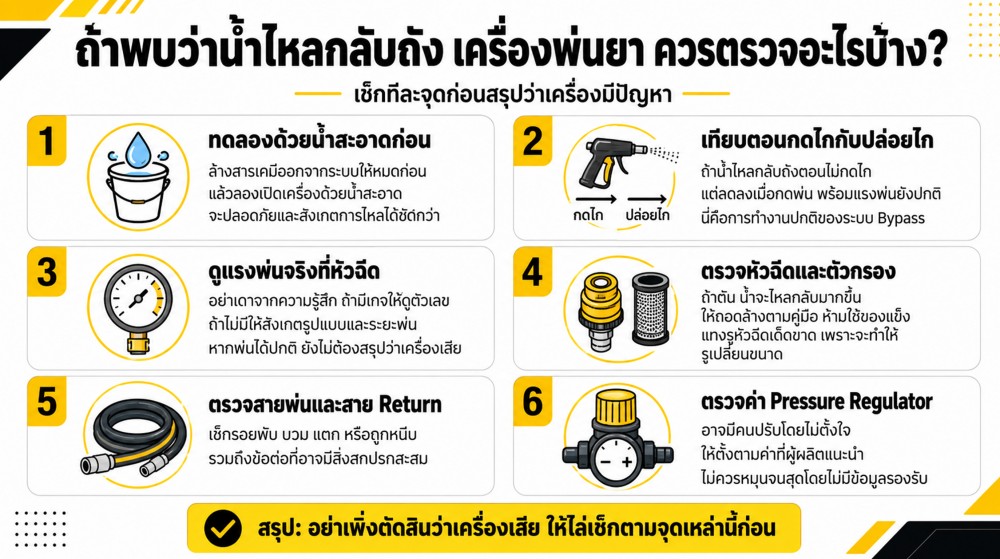
It can be normal. Many sprayer models use a bypass line to return excess liquid to the tank to regulate pressure. When the pump delivers more than the nozzle requires, the pressure regulator diverts some back to the tank. When the nozzle is shut off, some systems might bypass nearly all of it. What you need to check is whether the machine still builds normal pressure. If it sprays well, pressure is steady, there are no leaks, and the return changes as you pull/release the trigger, it's considered normal. However, if an abnormal amount of water returns, spraying pressure drops, adjustments can't be controlled, pressure fluctuates, or the pump makes unusual noises, you should inspect the nozzle, filter, spray hose, bypass line, and the pump itself. The goal isn't for every single drop to exit through the nozzle, but to maintain the right pressure and spray output for the job. Return water may simply be assisting the machine, not a sign of failure.
Select Agriculture Spray Machine to suit the application