


 EN
 ไทย


Customers Also Purchased
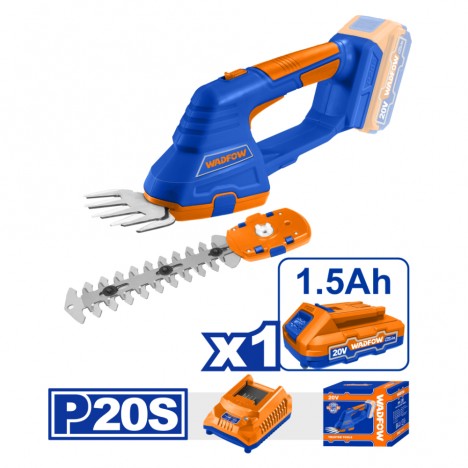


When using a cordless hedge trimmer, many people might start trimming from small shrubs in front of the house and work their way along the fence line. After a while, they feel the motor getting warmer and the battery starting to heat up, sometimes hot enough to be clearly noticeable to the touch. This leads them to wonder: is our cordless hedge trimmer having a problem? Should we stop using it? Or is it normal?
The answer is: a cordless hedge trimmer can generate heat during use, and it does not necessarily mean it is broken. The motor, transmission assembly, blades, and battery can all naturally generate heat because some energy is always converted into heat. The more continuously you cut, the thicker the hedges, or the higher the workload, the more the temperature rises. However, the term "machine getting hot" ranges from normal operating warmth to abnormal heat from overloading or internal issues. Therefore, the important thing is not just asking if it is hot, but observing when it gets hot, where it gets hot, how quickly it heats up, and whether there are other accompanying symptoms.
In this article, we will explore what causes heat in a Cordless Hedge Trimmer what is considered normal, and what warning signs indicate that you should turn off the machine and inspect it before continuing use.
Why does a cordless hedge trimmer generate heat?
First, you must understand that even though a cordless hedge trimmer has no engine or fuel combustion, it still contains internal components that operate and generate heat.
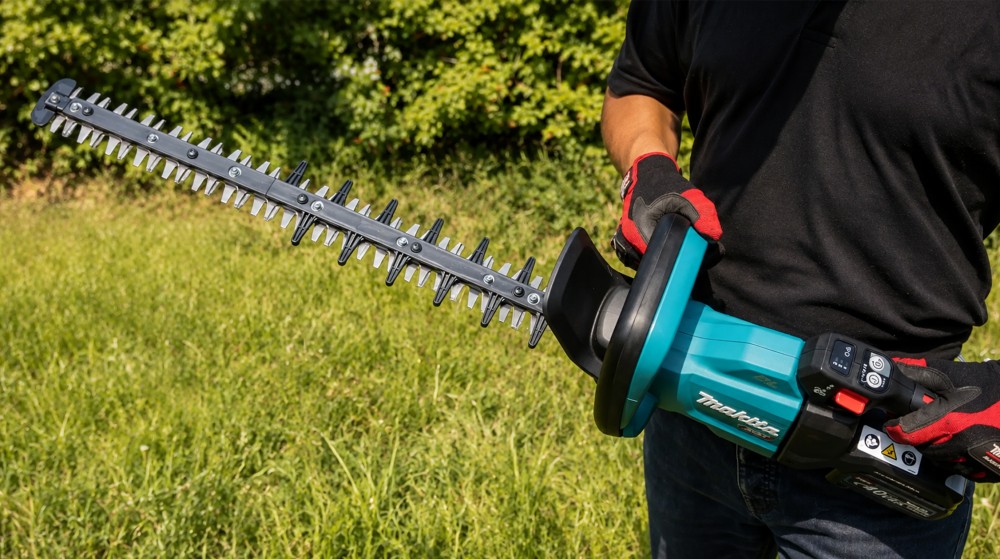
When you press the switch, the battery supplies power to the motor. The motor converts electricity into mechanical energy to drive gears and reciprocate two sets of blades in opposite directions at very high speeds. Some models operate at thousands of strokes per minute; for instance, some Makita cordless hedge trimmer models operate at around 2,700 SPM, while high-power models can reach up to 3,600 SPM. Inside the tool, electric current, motor rotation, mechanical movement, and blade friction all occur simultaneously.
Not 100% of the energy is converted into cutting force; a portion is naturally lost as heat. This follows the same principle as cordless drills, grinders, or electric saws, where the motor and battery warm up after being used for a while. Therefore, if you use the tool for a while and feel that the body or battery gets slightly warm while the tool still runs normally, without RPM drops or abnormal sounds or smells, it is generally not a cause for concern.
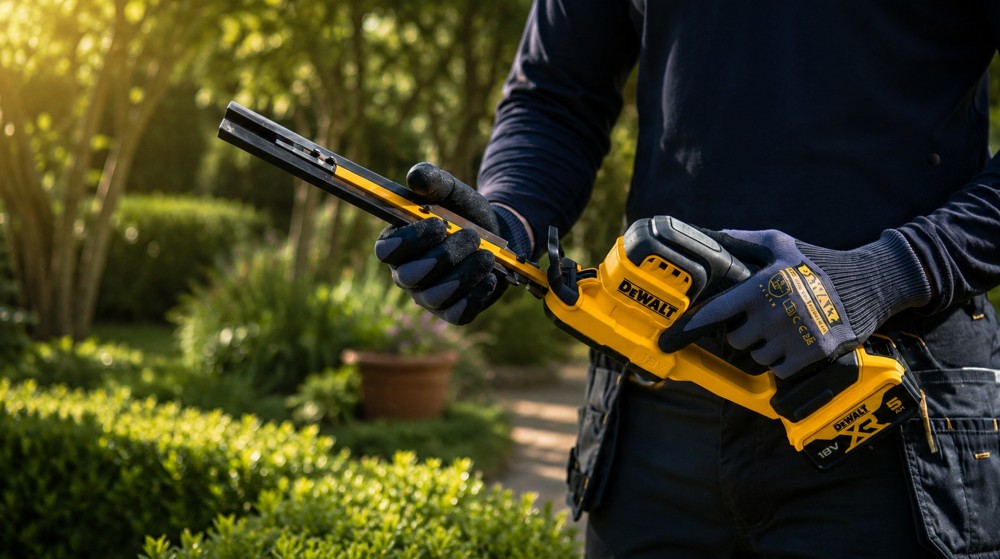
Which parts of a cordless hedge trimmer usually get hot?
When we say a cordless hedge trimmer is hot, you should first identify where it is hot, as different spots point to different causes.
- Motor housing area: It can naturally get warm because the motor must convert electricity into driving force. The more effort exerted, the higher the electrical current and the greater the heat generated. For example, trimming tender shoots and small branches may require little effort, but cutting dense, mature hedges with tough branches puts a much higher load on the motor. Even when used for the same duration, this explains why some jobs take 20 minutes without getting hot, while others get hot in just a few minutes.
- Battery: Lithium-ion batteries also generate heat while discharging current. The heavier the workload, the more current must be supplied; prolonged continuous use makes them even warmer or hotter. Many manufacturers therefore include protection systems. For instance, many Makita models feature Overload, Over-discharge, and Overheat protection circuits. If the temperature or load exceeds the limit, the tool may reduce power or shut off automatically. This does not mean it is broken; it is the protection system actively working.
- Blades: A spot many overlook. The blades move reciprocally at high speeds, creating constant friction. If properly lubricated, friction remains at a normal level. However, if the blades are dry, heavily coated with plant sap or dust, or deformed, friction will increase until the blades become abnormally hot. Bosch states in its troubleshooting guide that hot blades may be caused by a lack of lubrication and recommends lubricating them according to specified instructions.
How hot is considered normal for a cordless hedge trimmer?
This question is hard to answer with a single number because each cordless hedge trimmer model uses a different motor, battery, cooling system, and housing materials. Ambient temperature also plays a role—working in the middle of a garden on a hot afternoon naturally differs from working on a cool morning. What is easier to observe than measuring temperature is the tool's behavior: it is considered normal if, after continuous use, the tool merely feels warm, runs smoothly, maintains blade speed, cuts normally, produces no strange sounds or smells, and does not trigger any safety shutoffs.
You should stop and check if the cordless hedge trimmer heats up abnormally fast or exhibits accompanying symptoms:
- Noticeable drop in RPM or blade speed
- The tool repeatedly cuts out and stops
- Stiff or sluggish blade movement
- Whining sounds, grinding noises, or other abnormal noises
- Burning smell or plastic odor
- Battery is significantly hotter than usual
- The tool repeatedly shuts off on its own
- Cutting same-sized branches requires more effort than before
Do not force continued use thinking that "it's normal for power tools to get hot," as this could turn minor issues—like dry blades or trapped branch debris—into unnecessary strain on the motor, battery, or transmission system.
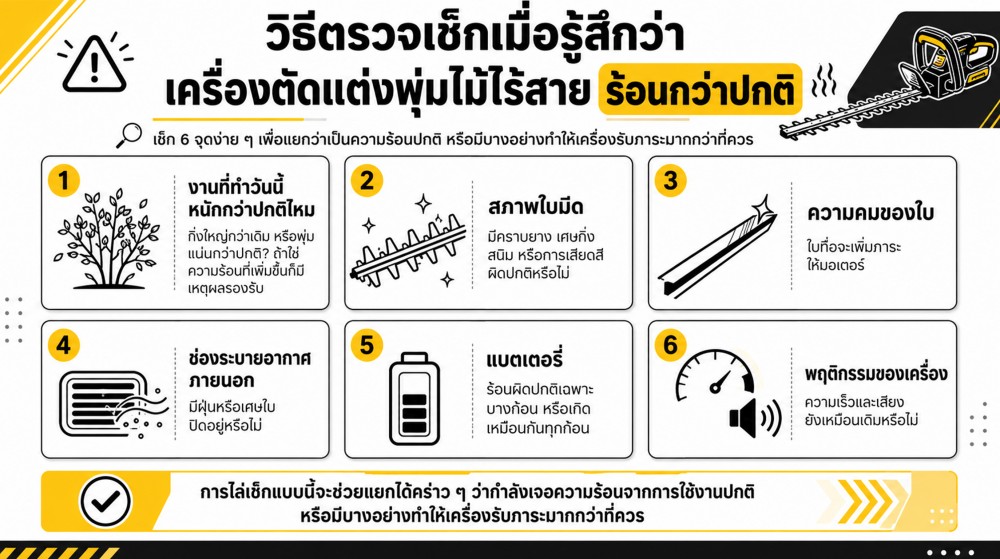
Causes of abnormal overheating in cordless hedge trimmers
- Cutting branches larger than the tool's capacity: Do not judge solely by the blade gap (tooth spacing) assuming that if a branch fits, it can be cut. You must check the tool's maximum cutting capacity specified by the manufacturer. For example, the Makita DUH607 cuts up to ~15 mm, while the DUH551 cuts ~18 mm. Forcing it to cut larger branches causes the motor and battery to draw more current and heat up rapidly. Switch to pruning shears or a pruning saw instead.
- Dry blades lacking lubrication. The blades rub against each other thousands of times per minute; if dry, friction will cause them to heat up. You should remove the battery and inspect the blades regularly, lubricating only with products recommended by the manufacturer.
- Sap buildup on the blades. Plant sap mixed with dust creates a sticky residue, preventing the blades from sliding smoothly and forcing the motor to work harder. Always clean the blades after each use (always remove the battery first).
- Blades are starting to dull. Dull blades require more cutting force. Noticeable signs include crushed, frayed branch ends, having to make multiple passes, or branches being pushed away instead of sliced.
- Twig fragments jammed between the blades. Even partial obstructions constantly increase the motor's load. If the blades jam or stop, release the switch, remove the battery, and inspect. Never use your hands to clear jammed debris while the battery is still plugged in.
- Cutting dense hedges continuously for too long. Thick hedges force the blades to engage multiple branches at once, constantly fluctuating the load. If you feel the blade speed dropping or hear frequent changes in motor sound, try cutting layer by layer from the outside rather than forcing it deep all at once.
- Hot weather and poor heat dissipation. Using the tool under the afternoon sun results in a higher initial operating temperature. Keep the ventilation vents clean and avoid leaving the tool/battery in direct sunlight unnecessarily (do not disassemble the tool to clean the interior yourself unless permitted by the manual).
- Battery under heavy load. Lithium-ion batteries heat up when discharging high current, especially if they have low capacity or are starting to deteriorate. Try swapping with another battery pack to determine whether the issue is the battery or the tool itself, but only use batteries specified as compatible by the manufacturer.
What should you do when a cordless hedge trimmer overheats?
Stop using it immediately: release the switch and remove the battery before inspecting the blade area. Check the blades for jammed debris, heavy sap buildup, dryness, or any damage. Review what you were cutting before it overheated—if cutting thick branches or dense hedges, it may have been caused by excessive load; consider changing your cutting technique or using a tool suited for that branch size.
Clean and lubricate the blades according to the manual if found dirty. Allow the tool and battery to cool down naturally in a well-ventilated area away from direct sunlight. NEVER pour water, submerge in water, or use rapid cooling methods, as this poses risks to the electrical system and battery. Once the tool has cooled down, test it on light tasks to see if the symptom recurs.
Select Cordless Hedge Trimmer here