


 EN
 ไทย



Customers Also Purchased


You've swept the floor, but dust still hangs in the air. When light beams into the room, you see tiny particles floating everywhere, or shortly after, dust settles back onto the floor. This issue doesn't necessarily mean the broom is low quality, as airborne dust during sweeping can be caused by multiple factors at once: the type of dust, the broom's bristle characteristics, the floor surface, and the force and tempo used.
What makes fine dust harder to manage than scraps of paper, hair, or large debris is that the particles are lightweight and easily carried by air currents. When the bristles Brooms sweep across the floor too fast, some of the dust isn't gathered into a pile, but is instead kicked up into the air. This effect is even more noticeable on dry floors with heavy dust buildup.
Why sweeping more can kick up even more dust
When broom bristles move across the floor, they don't just push dust forward—they also cause the air near the surface to move. Sweeping too fast, applying too much pressure, or flicking the broom tip aggressively on each stroke creates mini air currents that easily lift fine dust off the floor.
Heavier particles like sand or coarse soil are relatively easy to sweep into a pile. However, fine powder, fine soil dust, tiny fibers, or dust gathered in room corners are much more sensitive to air movement. This creates the impression that no matter how much you sweep, dust is still floating around. This is a key reason why sweeping harder does not always help. In some cases, it even scatters the dust more widely than before.

Different types of brooms handle dust differently
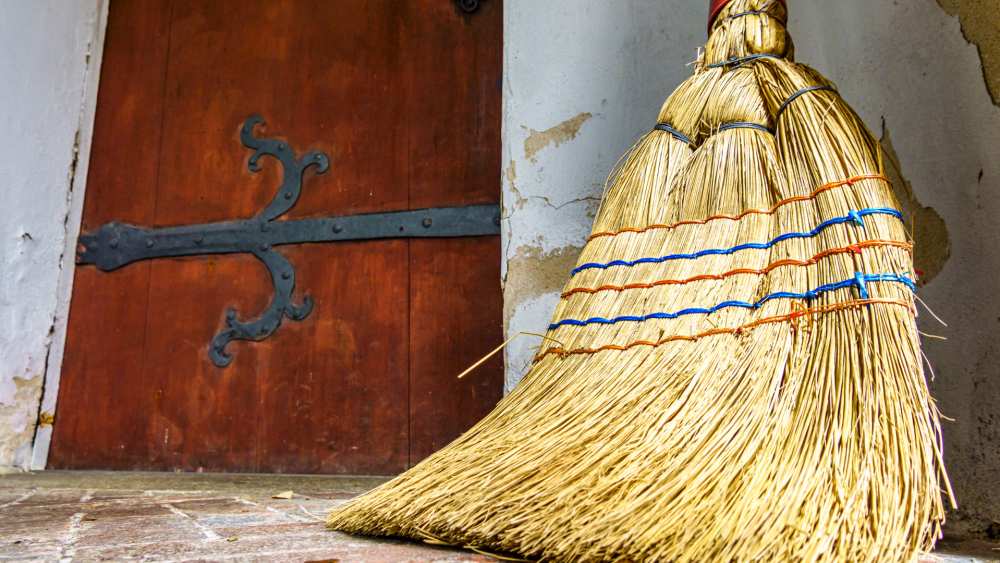
The characteristics of the broom bristles directly affect what it can sweep well. Fine, relatively flexible bristles tend to stay closer to the floor, making them suitable for fine dust and small debris on smooth surfaces. Stiffer bristles, on the other hand, are better suited for rough floors, leaves, sand, gravel, or heavier debris.
If you use an overly stiff broom on fine dust across tile or smooth floors, the bristles may flick the dust sideways instead of gathering it together. Some dust also slips through the gaps between the bristles to the back, forcing you to sweep repeatedly and increasing the chance that dust will become airborne again.
Conversely, a broom with bristles that are too soft is not suitable for every task either. If used on rough concrete or outdoor surfaces, the bristles may fail to reach into surface crevices or lack the force to pull out debris. Choosing a broom should therefore consider both the floor surface and the type of dirt, rather than simply debating whether stiff or soft bristles are better.
Sweeping fast does not equal sweeping clean
A large amount of airborne dust often comes from a sweeping stroke that is too fast and too long, especially sweeping forcefully and flicking the tips of the bristles up at the end of each stroke. This motion creates turbulence in the air near the floor and kicks up the dust that was just gathered.
For fine dust, you should slow down, use short, consistent strokes, keep the bristles properly touching the floor, and gently guide the dust into a pile. There is no need to press down hard on the broom; excessive pressure splays the bristles outward and distorts their contact with the floor, which can push dust outside the sweeping path instead.
Sweeping back and forth in multiple directions also makes dust scatter more easily. A more controlled approach is to establish a clear sweeping direction, working from edges or corners toward the central area, and then gathering everything at the dust collection point.
Smooth floors and rough floors require different sweeping methods
Tile, vinyl, or coated floors are usually easy to sweep because they do not have deep crevices where dust can hide. However, the downside is that fine dust can easily glide across the surface and become airborne if swept too quickly. Brooms with relatively fine, not overly stiff bristles are generally better at controlling dust in these areas.
Rough concrete or outdoor floors are different because dust and sand can settle more into surface textures and small crevices. If you use a very soft broom, the bristles may only glide over the top surface and leave dirt behind in the grooves. Using stiffer bristles is more appropriate, but you should still sweep with controlled strokes without flicking hard enough to scatter the dust.
As for tile floors with deep grout lines or surfaces with numerous joints, sweeping in one direction may not always be enough. You may need to change the sweeping angle to dislodge dust from the grooves first before gathering it into a pile.
When there is a lot of dust, divide the area instead of dragging one pile across the whole room
When there is a heavy buildup of dust on the floor, trying to sweep from one end to the other with long strokes often drags the dust back and forth and breaks up the pile. An easier way to manage this is to divide the area into smaller sections and gather the dust from each section into nearby spots.
Start from under furniture, room corners, or areas with heavy dust accumulation, and work your way out into open spaces. Once the dust pile gets large, scoop it into a dustpan first. There is no need to try dragging a single pile across the entire room, because the farther it travels, the more fine dust slips away from the pile and kicks back up into the air.
If a fan or air conditioner is blowing air directly onto the area being swept, you should lower or redirect the airflow first, as dust that has just become airborne will be carried further away, making it harder to clean up.
Should you sprinkle water before sweeping?
Moisture can help reduce the dispersion of certain types of dust because it makes particles clump together and gain weight. However, this should not be interpreted as meaning every type of floor should be sprinkled with water before sweeping.
Wood, laminate, or certain other types of flooring may not tolerate excessive moisture well, while on some surfaces, using too much water will turn dry dust into muddy residue that is harder to wipe clean. For indoor areas with a lot of fine dust, using a damp mop or tools specifically designed to trap dust usually controls dust better than dry sweeping alone.
Another case to be cautious about is dust from construction work or fine material powders, such as concrete dust or dust that may contain silica. Dry sweeping can cause particles to become more airborne, so general dry sweeping should not be used without considering appropriate dust control methods. For this type of work, methods that reduce dispersion should be used, such as a vacuum system suitable for the job or dust control measures tailored to the materials and location.
An old broom or splayed bristles also make dust harder to control.
Even if you chose the right type of broom at the start, prolonged use can cause the bristles to bend, splay, or lose their alignment. This results in uneven floor contact, pushing some dust sideways instead of gathering it forward. Users often try to fix this by sweeping harder, but that only causes more dust to scatter into the air.
Hair, threads, lint, and debris entangled in the bristles also affect performance, preventing the bristle tips from making full contact with the floor. Before use, trapped debris should be removed periodically, especially with brooms used on floors with a lot of hair or pet fur.
When storing a broom, avoid resting it so the bristle tips bear the full weight of the handle, as this can deform them more quickly. Hanging it or storing it without pressure on the bristle tips will help maintain its shape longer. When the bristles stay well-aligned, directing dust becomes much easier as well.
If dust still scatters when sweeping, what should you check first?
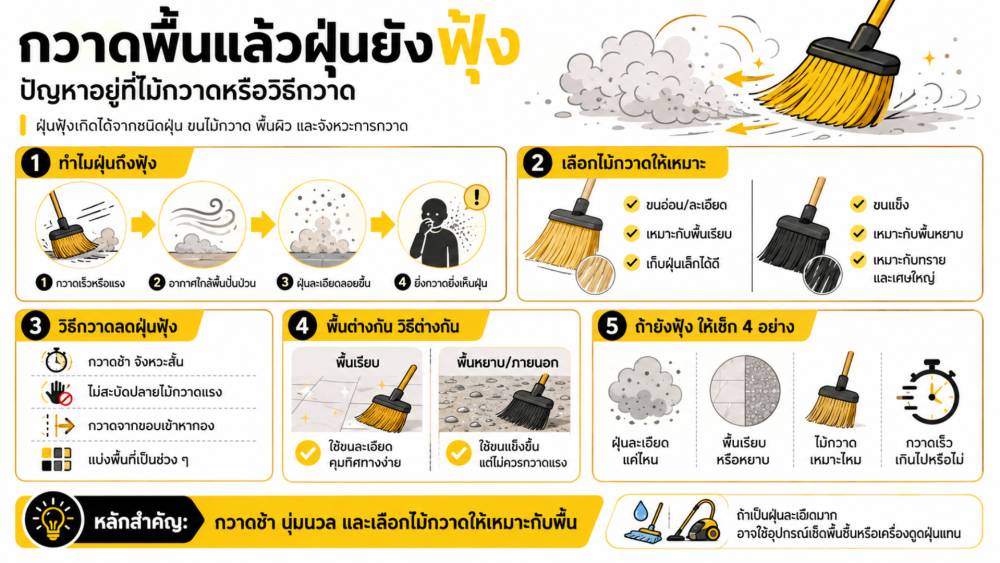
If you encounter this problem frequently, start by checking 4 simple factors: how fine the dust you are sweeping is, whether the surface is smooth or rough, whether the broom bristles are too stiff or too soft, and whether your sweeping pace is too fast or too forceful.
Often, simply slowing down, using shorter strokes, and stopping hard flicks of the broom head can noticeably reduce airborne dust. If it still doesn't collect well, then look at whether the broom matches the floor surface and whether the bristles are still in good condition or have begun to splay out of control. However, if the dust is very fine, forcing yourself to keep using a broom might not be the best solution. A vacuum cleaner or a damp-mopping tool suitable for the surface can collect dust without sending particles back into the air as dry sweeping does.
Brooms It remains a useful tool suitable for many types of tasks; it just needs to be used correctly for whatever is on the floor. If dust scatters every time you sweep, the first thing you should try changing might not be a new broom, but your sweeping pace, dust-gathering technique, and verifying whether your current broom actually suits the floor and the dust in front of you.