


 EN
 ไทย


Customers Also Purchased

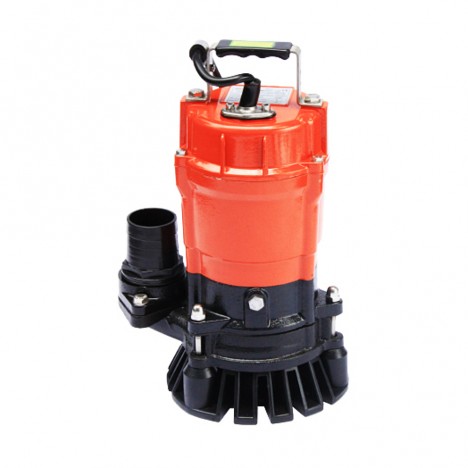
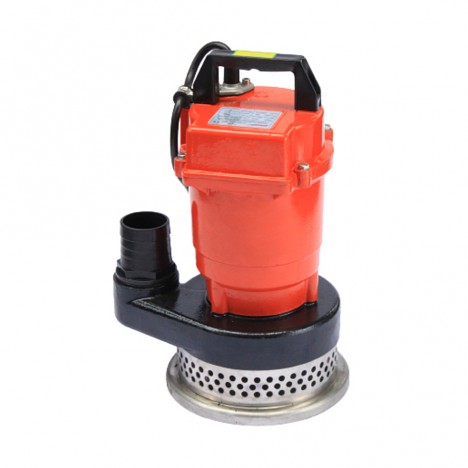
When submerging a submersible pump to pump water, expectations are straightforward: plug it in, turn it on, and water should be pumped out through the hose or discharge pipe. But one common symptom that often raises doubts is when the submersible pump appears to run normally—with motor sound and vibration—yet no water comes out of the pipe outlet, or it comes out abnormally low, even though it worked fine before.
Many people might immediately think, "Is the submersible pump broken?" But in fact, there is no need to jump to conclusions. The issue of a submersible pump running without discharging water can stem from many causes, ranging from simple issues like a kinked discharge hose, the water level in the pit being too low, or a clogged intake strainer, to air lock problems, check valves, impellers, or selecting a pump whose head rating is inadequate for the required delivery height.
Before disassembling submersible pumps or assuming the motor is broken, it is recommended to troubleshoot the simple points first. Many times, the issue is not with the motor at all, but rather that "water cannot enter" or "water cannot exit." This article will guide you step-by-step through what to check if the submersible pump is running but no water comes out, and what each symptom indicates.
First of all, distinguish how it is operating.
The phrase "the submersible pump is running" can mean different things to different people. Some hear machine sounds and assume the motor is spinning, but in reality, the motor may just be humming while the impeller is not spinning at all. Before checking anything else, observe what the symptoms actually look like.
- The machine runs and vibrates normally, but no water comes out at all.
- The machine emits a humming sound, but no water comes out.
- Water flows at first, then gradually stops.
- Abnormally low water flow
- Intermittent water flow
- Pump runs for a while then cuts out
- Water starts flowing again after lifting or moving the pump
These small details help narrow down the causes significantly. For example, if moving the submersible pump causes the water to flow again, you might suspect debris blocking the suction inlet, the pump's positioning, or trapped air inside the pump.
However, if the machine only emits a humming noise, has no pumping force, and the motor keeps getting hotter, you need to be much more cautious because foreign objects may be jamming the impeller or internal motor issues may have occurred. Once you have identified the symptoms, proceed to inspect starting from the easiest checks first.
Causes of a Submersible Pump Running but Not Discharging Water
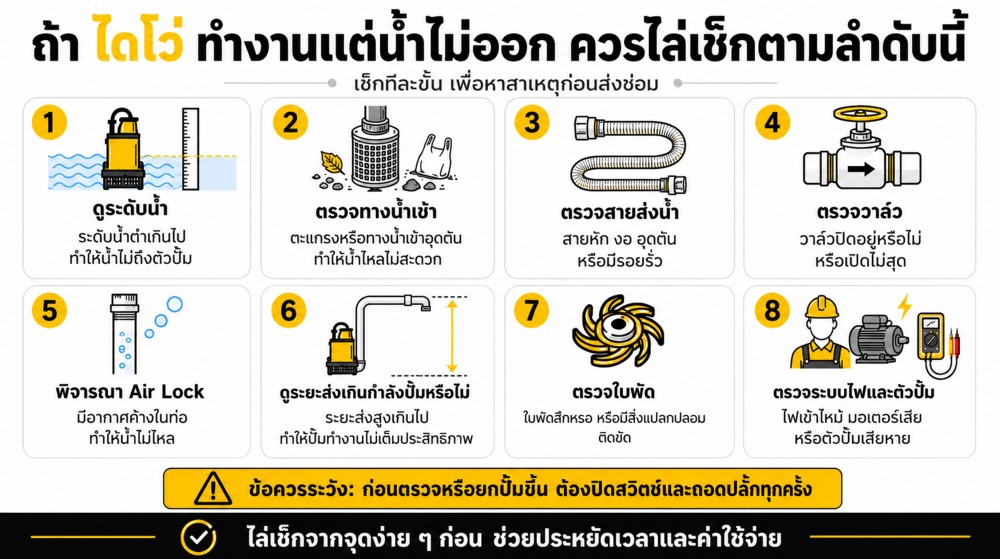
- Water level is too low — If the suction inlet is not fully submerged, the pump will draw in air instead of water. The symptom is that water discharges well at first, then becomes intermittent until it stops flowing altogether even though the motor is still running. Never let the pump run without water (Dry Run), as water helps dissipate heat and lubricates the seals.
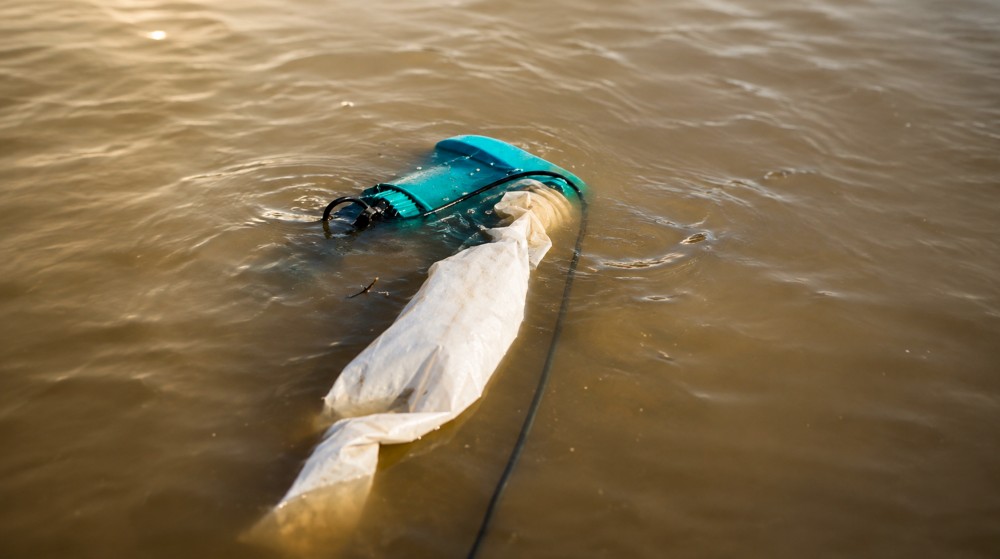
- Suction inlet is blocked — Leaves, plastic bags, ropes, rags, mud, or small debris may obstruct the water inlet. Sometimes, just a thin plastic bag sticking to the bottom of the pump can block nearly all water flow, causing an "intermittent operation" symptom. If the water is dirty, elevate the pump slightly off the ground to avoid sediment.
- Issues with the discharge hose — Folded, crushed, or twisted hoses, sediment clogs, closed valves, or stuck check valves. You should inspect the entire pipeline before assuming the pump is broken.
- Check valve stuck or installed backward — If installed backward, the valve itself effectively blocks the water flow. Always check the flow arrow on the valve first (ensure power is disconnected before inspection).
- Air Lock occurs — Air trapped inside the pump or pipe prevents the impeller from creating flow even though it is spinning. This often happens after lifting the pump in or out of the water, changing hoses, or when the water level was previously low enough to draw in air. Follow the venting procedure in the model's manual; do not drill holes based on DIY internet tips.
- Impeller jammed with debris — Ropes, fabric, gravel, or plastic tangled around the impeller prevent it from rotating at full speed, resulting in low water discharge and potential motor overheating. Never reach in with your hand while the pump is plugged in; always unplug before inspecting.
- Discharge height exceeds pump capacity (Head) — Do not choose a submersible pump based solely on wattage; you must also consider the head rating. The higher the head, the lower the flow rate. If it pumped well horizontally but barely discharges when lifting vertically, the system likely requires more head than the pump can deliver.
- Friction Loss from piping — It is not just vertical height; long pipes, small pipe diameters, and numerous elbows also increase resistance. This is why the same pump works powerfully with a short hose but exhibits weaker flow when connected to a long line.
- Reducing pipe size does not increase flow power — Reducing the pipe diameter (e.g., from 2 inches to 1 inch) does increase water velocity, but it significantly increases friction loss, lowering the overall flow rate. It is unsuitable for tasks requiring high-volume drainage.
- Voltage drop or incorrect voltage — Especially with long power cords, undersized extension cables, or when running on a generator. If the voltage is not within specified limits, the motor may lack sufficient torque or overheat. Avoid guessing the issue yourself; have an electrician inspect it.
What Not to Do When a Submersible Pump Runs but Discharges No Water
- Do not let the machine keep running assuming water will eventually flow on its own. If there is abnormally no water discharge, stop the unit and find the cause immediately. Particularly if the pump is drawing air or dry running, letting it continue will only cause damage.
- Never inspect the suction inlet with your bare hands while plugged into power. Even if the impeller is jammed, clearing the blockage could cause the impeller to start spinning immediately.
- Do not lift the submersible pump by its power cable. The power cable is not designed to support the machine's weight. If you need to lift or lower the pump, use the designated lifting points, ropes, chains, or methods specified by the manufacturer.
- Do not rush to replace it with a higher-wattage submersible pump without finding the root cause. If the issue is a clogged pipe, stuck check valve, or air lock, a more powerful pump will not help. And if the root cause is an unsuitable head for the system, you must choose based on the performance curve and operating point, not just the wattage.
- Do not modify the electrical system yourself. Since submersible pumps operate in water, electrical protection is extremely important. If you find cracked cables, damaged insulation, burnt plugs, tripping breakers, or suspect an electrical leak, stop using it immediately and have it inspected by a professional.
What should you check before buying a new submersible pump to avoid encountering the same problem?
If you inspect it and find that the original unit is too small, and you are about to buy a new one, don't just choose based on "how many watts" or "how many horsepower." You should know the following information first:
- What type of water do you need to pump? (Clean or dirty)
- Is there mud or sand?
- Approximately what size is the debris?
- How many liters per minute of flow do you require?
- How many meters is the vertical delivery head?
- What is the total pipe length, and what pipe size is being used?
- How many elbows and valves are there?
- How low do you need the water level to be pumped down to?
- Do you need an automatic float switch?
- Does it use 220V or 380V power?
This information helps select the pump curve and operating point much more accurately than just looking at motor power. What you actually need from a submersible pump is not the highest wattage rating, but the required flow rate at the actual head and operating conditions of your system.
Select submersible pumps to suit the application