


 EN
 ไทย


Customers Also Purchased
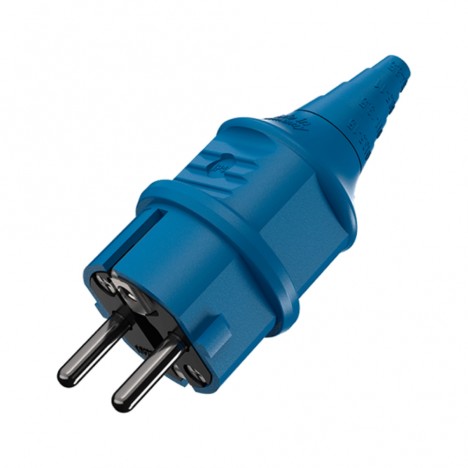


Power PlugThese are devices commonly found in factories, construction sites, power distribution panels, machinery, and applications requiring higher electrical power than standard plugs. Although different models look similar, a closer look reveals differences in color, pin count, housing size, and current ratings. These details are not just for distinguishing models or easy recognition; many directly relate to the electrical system the plug was designed for.
When choosing a power plug, you should not simply check whether it fits into the receptacle or assume a higher amp rating provides extra safety headroom. Proper selection requires considering voltage, number of phases, pin count, current rating, grounding, and the on-site environment together—especially for power plugs conforming to IEC 60309 standards, which define colors, pin positions, and mating keying to help prevent accidentally connecting mismatched electrical systems.
What is a power plug and why is it popular in industrial applications?
The term "power plug" used in technical and industrial work typically refers to plugs and sockets designed to supply power to machinery, electrical equipment, or systems that require a more robust connection suited to working conditions than standard domestic plugs. One widely used type is the industrial plug and socket family conforming to IEC 60309.
What sets this group of devices apart from standard plugs is not just their more rugged housing, but also the contact configuration, earth pin position, keying system (polarization), and clear rating specifications. When used with their matching sockets, they help prevent errors caused by interchanging plugs from different electrical systems far better than conventional plugs.
Different models of power plugs may also be designed for different environmental conditions: some for indoor use, others with higher resistance to dust, moisture, or water spray, making them ideal for factories, job sites, or harsh environments. However, the term "power plug" in the market is quite broad; not every device using this name strictly follows IEC 60309. If you need to verify color coding, pin positions, or usage configurations, always check the standards and specifications of that specific model directly.
Power plug colors are not just for model differentiation
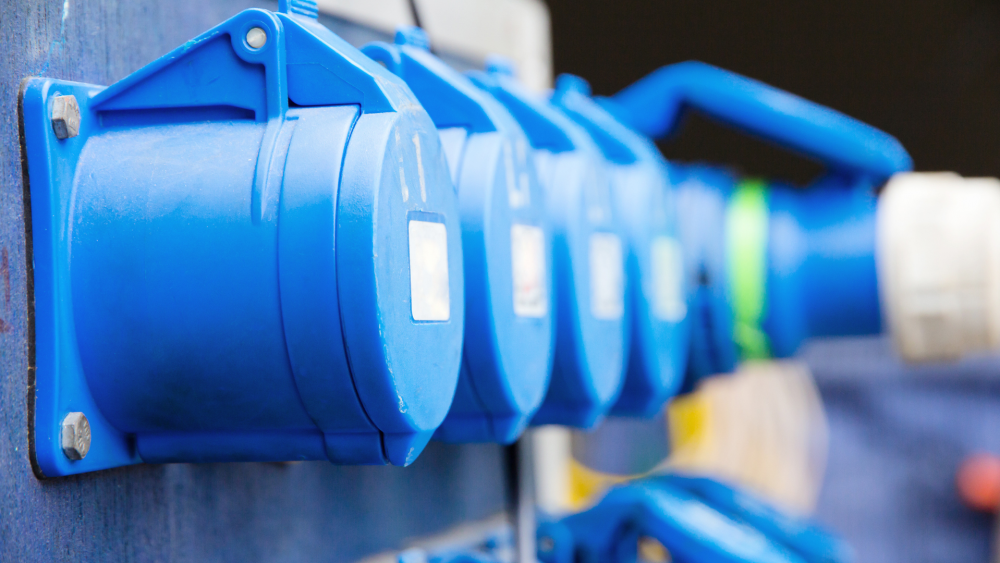
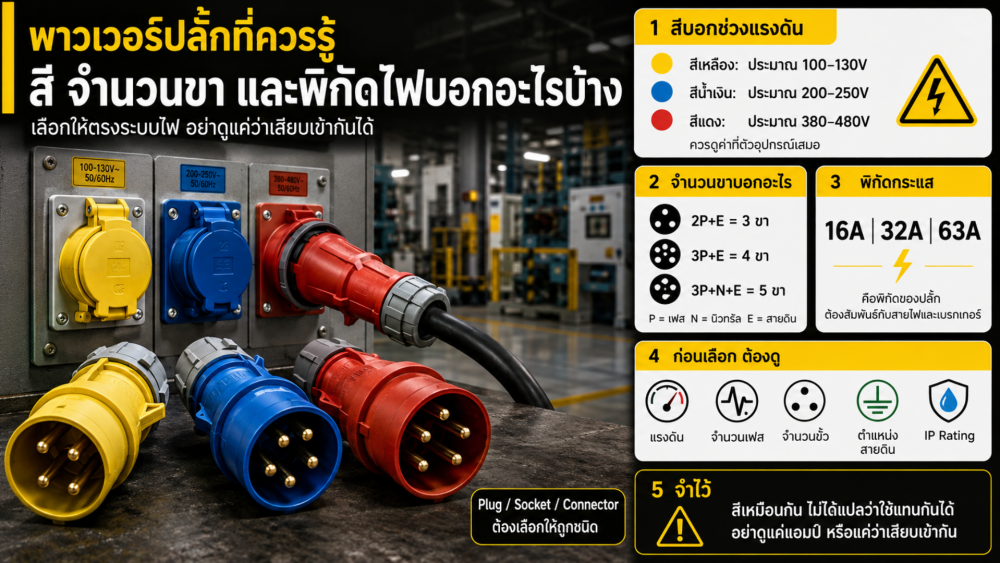
Color is one of the easiest details to notice, and in devices using the IEC 60309 color-coding system, colors distinguish the voltage range and frequency of the electrical system. Common examples include yellow for approximately 100–130 V, blue for approximately 200–250 V, and red for approximately 380–480 V, while other colors are used for other voltage or frequency ranges as defined by the standard.
Color coding helps users easily identify the electrical system group before plugging in. However, color should never be the sole criterion for deciding compatibility, as other factors are just as important—such as voltage, frequency, current rating, number of poles, and earth contact position.
If you encounter two plugs of the same color, you should not assume immediately that they are interchangeable; they may have different current ratings, pin counts, or clock positions. Reading the numbers and symbols marked on the device is therefore more important than relying on color alone.
What the number of pins reveals about the electrical system
The number of pins on a power plug corresponds to the number of conductors required by the circuit. However, you should not assume that a certain pin count always corresponds to a single type of electrical system, as pin configurations can vary depending on the system and equipment design.
Letters found in product specifications, such as P, N, and E, clearly explain the function of each terminal: P represents phase or live conductors, N stands for neutral, and E stands for earth (protective grounding).
Common configurations include, for example:
- 3-pin (2P+E): 2 current-carrying conductors and an earth wire
- 4-pin (3P+E): used for 3-phase systems that do not require a neutral wire
- 5-pin (3P+N+E): includes three phases, neutral, and an earth wire
These configurations provide an easy reference, but in actual application, you should always base connections on the specifications marked on the power plug and the machine's electrical schematic. Do not simply look at the pin count and wire based on familiarity; if a circuit requires a neutral but you choose a plug without an N terminal, or if you reverse pin functions, it can cause equipment malfunction and increase safety hazards.
Why the same number of pins does not necessarily mean they are interchangeable
Another notable feature of industrial power plugs is their built-in keying system designed to prevent incorrect mating. Particularly in IEC 60309 devices, the position of the earth pin and the mechanical keyway geometry are used to physically differentiate devices intended for different electrical systems.
The earth pin position is typically described in terms of a clock face, known as the Clock Position. This position corresponds to the specific voltage, frequency, and circuit configuration supported by the device. This is why two plugs with the same number of pins and similar colors may still not plug into each other.
This design is extremely beneficial on job sites where multiple voltage systems or various equipment types coexist in the same area, as it eliminates the risk of plugging into an incompatible socket. Never bend the pins, cut the keying elements, or modify the socket to force a fit, as doing so bypasses the safety mechanism specifically engineered to prevent cross-system connections.
What Do 16A, 32A, and 63A on a Power Plug Mean?
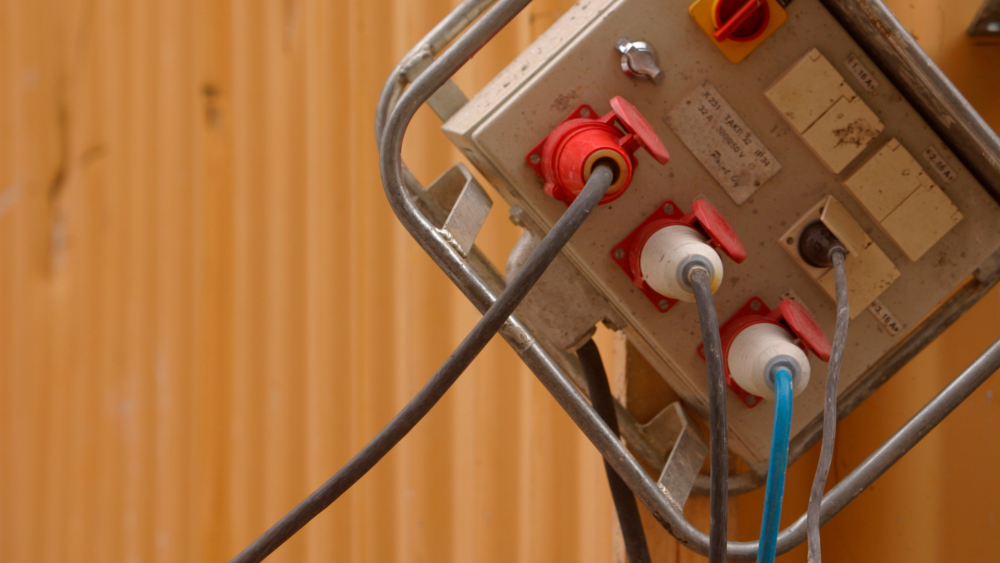
Numbers like 16A, 32A, 63A, or 125A seen on power plugs represent the current rating of the device under conditions specified by the manufacturer and relevant standards; they do not indicate that the plug will continuously supply that exact amount of current at all times.
If it is a 32A power plug, it does not mean the machine will constantly draw 32 amps. Rather, it means the plug and socket are designed to be suitable for operation at that rating, while the actual current depends on the load and operating characteristics of the connected equipment.
A common misconception is that choosing a higher ampere rating is always better—for example, upgrading from 16A to 32A to allow for more load headroom. However, an electrical system does not consist solely of a power plug; it also includes wiring, circuit breakers, connections, sockets, and upstream equipment that must all handle the current appropriately. Changing only the plug does not allow the rest of the circuit to handle higher currents.
The Current Rating Must Match the Wiring and Protective Devices
A power plug's rating should be viewed as part of an overall system, not selected in isolation. If you choose a plug with an excessively high rating while the connected wiring is inadequately sized or the protective device does not match the wire gauge, heat buildup or damage to the wiring can occur well before the plug reaches its own limit.
Conversely, having a large circuit breaker does not mean the wires and plugs can all handle that same amount of current. System design must therefore consider the ratings of every component consecutively—from the power source, protective devices, wiring, connection points, plugs, and sockets, all the way to the end load.
Therefore, when upgrading a power plug to a higher rating, always check whether the wiring, circuit breaker size, and upstream circuits can actually accommodate the new rating. You should never simply swap out the plug head and resume operation immediately.
Don't Focus on Amps and Overlook Voltage
Amperage draws a lot of attention, but voltage is just as important. Power plugs with identical current ratings can be designed for completely different voltage ranges.
A 16A plug cannot be used with just any electrical system simply because the current does not exceed 16A. You must also ensure that the voltage, number of phases, frequency, pin count, and earth position match.
A better approach is to start with the nameplate of the machinery or electrical equipment: check the required voltage, frequency, phase count, and current, then select a power plug and socket that match those specifications. Do not choose based on color or shape first and then try to adapt the electrical system to the plug later.
Why Higher-Rated Power Plugs Are Usually Larger
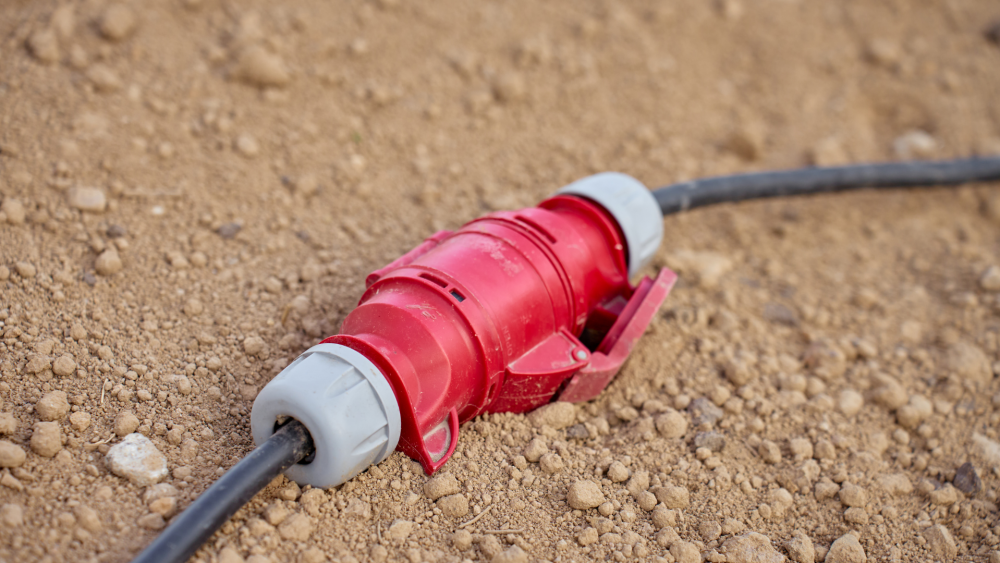
When comparing power plugs within the same product family, 16A, 32A, and 63A models usually differ in physical size because devices built to handle higher currents require contacts and components designed specifically for those ratings.
Contacts carrying higher currents must keep contact resistance and heat generation within acceptable limits. It is therefore normal for higher-rated models to be physically larger and to be paired with wiring and accessories suited to that current level.
Dimensional differences also help prevent accidental cross-mating between plugs of different ratings across various product designs. Therefore, if the existing socket is 16A, never assume a 32A power plug can plug into it simply because the voltage and pin count appear similar.
What Is the Difference Between Plugs, Sockets, and Connectors?
When talking about power plugs, people often refer to all components collectively as "plugs." In reality, industrial connection systems include male plugs, female couplers, wall sockets, panel-mounted inlets/sockets, and cable connectors.
Distinguishing the correct terminology helps prevent confusion when choosing products. Users might need a cable-mounted coupler but accidentally choose a wall-mounted socket, or pick components with identical ratings and pin counts that are designed for completely different mounting methods.
Before selecting, determine whether the device will be mounted on a cable, fixed to a wall, installed on an enclosure, or used as an appliance inlet on machinery. The mounting style affects the required component type just as much as the electrical ratings do.
An unusually hot power plug doesn't just mean it's overloaded
An abnormally hot power plug is a warning sign that should not be ignored, but an electrical overload is not the only cause. Loose connections, dirty contact surfaces, worn terminals, or improperly terminated wiring all increase contact resistance and cause heat buildup.
If the plug begins to show dark discoloration, casing deformation, a burning smell, or abnormally hot terminals, stop using it immediately and identify the cause. Do not attempt to fix it simply by swapping to a higher-amperage plug, because if the root cause is in the connection points or wiring, the problem will remain.
For continuous-duty or high-current applications, periodically inspecting the contact surfaces, terminal tightness, and cable condition is just as important as choosing the correct rating from the start.
For outdoor use, also check the IP rating
Just because a power plug is rated for industrial use does not mean every model offers the same level of water or dust protection. Protective capability must be checked directly from each device model's IP rating.
Equipment used in dry factory environments may not require the same level of protection as construction sites, outdoor areas, machinery wash-down stations, or areas frequently exposed to water spray and dust. If you choose equipment unsuitable for the environment, problems can still occur in actual use even if the voltage and current ratings are correct.
Another point to check is the conditions of the IP rating, as some devices have different protection levels when the cap is closed versus when plugged in and in use. Therefore, always read the datasheet or manufacturer manual thoroughly; do not simply assume it can withstand rain just because the casing looks thick or has a protective cover.
What to look for first before choosing a power plug
If you need to choose a Power Plug new one, a more accurate approach than starting with color or shape is to start with the electrical system specifications: determine what voltage the equipment uses, whether it is single-phase or three-phase, whether it requires a neutral, how it is grounded, and its rated operating current.
Then, check the number of pins, current rating, plug or socket style, earth pin position, and IP rating if it will be used in areas with water, dust, or harsh environmental conditions. You should also ensure that the cables and circuit protection devices are appropriately sized for the selected rating.
If connecting to machinery with a dedicated electrical system, or if you are unsure about the phase count, neutral, cable size, or circuit breaker, refer to the electrical nameplate or schematic, or consult a qualified electrician before installation. Never attempt to guess wiring connections based solely on wire colors or pin counts.
Power plugs involve far more detail than simply finding a matching plug and socket. Color helps distinguish voltage groups in systems following IEC 60309 color coding, the number of pins indicates the conductor configuration, the current rating defines the device's operating limits, and the earth pin position prevents mating incompatible electrical systems. When these details are considered alongside machinery power requirements and on-site conditions, your power plug selection will be well-matched to the application and prevent problems caused by using the wrong equipment from the start.