


 EN
 ไทย


Customers Also Purchased


When choosing a Plasma Cutting Equipment Besides the cutting current, supported steel thickness, or power supply, there is another factor that impacts cutting quality far more than many people realize. And that is the quality of the compressed air fed into the machine. Plasma cutters do not use air merely to "blow metal dross" out of the cut. Air also plays a direct role in creating and controlling the plasma arc, as well as cooling the parts around the torch head.
Therefore, even if you use a plasma cutter with adequate power, set the correct current, and choose the right consumables for the job, if the air from the air compressor contains excessive moisture, water, or oil vapor, it can significantly reduce cutting quality—resulting in rough cuts, dross on edges, an unstable plasma arc, and faster wear on the torch head and consumables.
The phrase "clean and dry air" is not a minor detail for plasma cutters; it is one of the fundamental factors that enable the machine to perform at full capacity, especially in jobs requiring continuous cutting or frequent plasma cutter use.
What does a plasma cutter use an air compressor for?
Why does using a plasma cutter require an air compressor? An in-depth look at the system and operation First, we need to understand that Plasma Cutting Equipment operates differently from conventional metal cutters, and its appearance and system are somewhat similar to standard welding machines.
The basic principle is that the machine creates an electrical arc at the torch head, then directs gas or compressed air through a small orifice in the torch. When the gas or compressed air is energized by the electric arc, its temperature skyrockets into a state known as "plasma," which accelerates through the nozzle orifice as a high-velocity, focused energy stream.
This plasma melts the metal along the cut line, while the air pressure blows the molten metal out of the kerf, separating the material.
For small and medium-sized plasma cutters commonly used in metal fabrication shops, garages, or typical production lines, air from an air compressor is mostly used as the supply source. Consequently, whatever is inside the air compressor system can travel directly into the plasma cutter if an adequate filtration system is not in place.
Air is a direct part of the cutting process in a plasma cutter, not just an auxiliary element. If the air contains contaminants, the properties of the plasma can be altered as well.
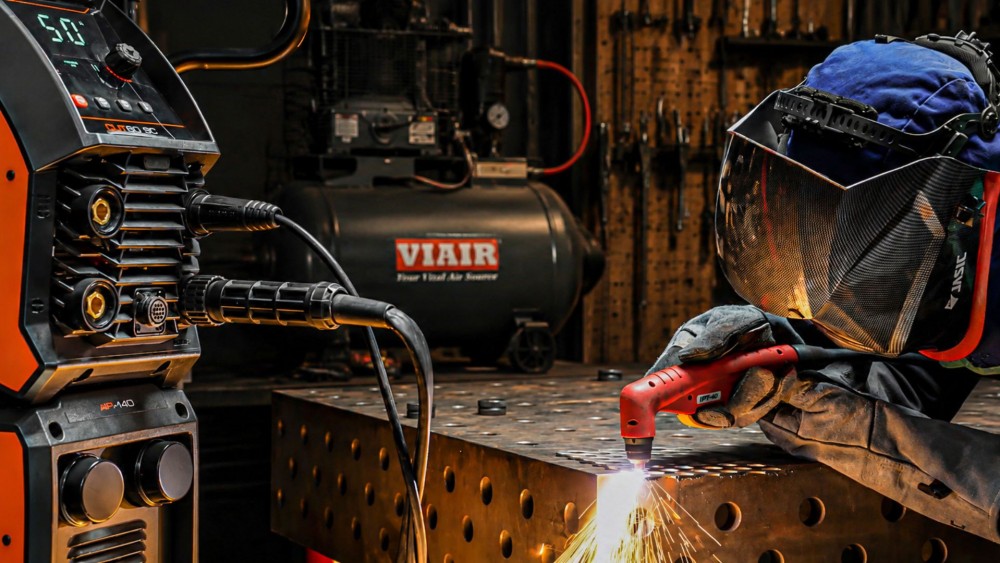
Why can there be water mixed into compressed air?
Many people may wonder: an air compressor only draws in "air", so how does water end up inside the tank?
- The air around us contains water vapor or moisture mixed in at all times, especially in hot and humid climates.
- When an air compressor draws in large amounts of air and compresses it to high pressure, the air temperature rises.
- Then, as the air flows into the air receiver tank and begins to cool down, some of the water vapor condenses into water droplets that accumulate inside the tank.
- The longer the air compressor runs continuously or the more it is used in high-humidity areas, the more condensation water can build up.
If water is not regularly drained from the tank, this moisture can enter the air hose along with the airflow and ultimately reach the plasma cutter.
You might not see visible water droplets flowing out, but that does not mean the air is dry, because moisture can exist as very fine mist, which can still affect the operation of the plasma system.
The plasma arc from the plasma cutter may become unstable
One of the possible effects when compressed air has high moisture content is reduced stability of the plasma arc.
Plasma cutters require a consistent gas flow so that the plasma can constrict and jet properly through the nozzle. When water droplets or moisture are introduced, the properties of the gas flowing through the torch change. Observable symptoms include, for example:
- Unstable arc
- Altered plasma sound
- Uneven cut paths
- Occasional stuttering or sputtering of the plasma arc
When cutting thin sheet metal, the difference might not be very noticeable, but when cutting thicker materials or making long continuous cuts, the impact becomes clearly evident.
Rough cut edges and increased dross/slag
Air quality is also linked to blowing molten metal out of the kerf. If the plasma arc is unstable or the airflow is erratic, the molten metal may not be blown completely out of the cut.
As a result, the bottom edge of the workpiece may develop Slag / Dross More buildup, beveled or uneven cut edges, and after using a plasma cutter, you may end up wasting time grinding for post-cut cleanup.
Many people might think it's because the cutting amperage is too low or the travel speed is too fast. While both can indeed be causes, air quality is another variable that shouldn't be overlooked. If you are using the same plasma cutter to cut the same material at roughly the same amperage, but one day the cut quality suddenly drops, inspecting your air system is definitely one of the things you should do.
Water can cause the torch head and consumables to wear out faster
Around the plasma cutter torch head, several parts operate under extremely high temperatures—such as the electrode, nozzle, and gas swirl components. Naturally, these are consumable spare parts with a finite lifespan that need replacing once worn down. If air quality is poor, the lifespan of these parts can be significantly shortened.
- Moisture entering the torch head can disrupt arc ignition
- causing uneven heat distribution around the electrode or nozzle,
- and when this occurs repeatedly, component wear points can develop much faster than normal.
As a result, the nozzle orifice may start to deform or expand, causing the plasma jet—which should be tightly focused—to spread out, further degrading the kerf cut quality.
This traps the plasma cutter in a vicious cycle: poor air leads to rapid consumable wear, deformed plasma jets, and worse cut edges.
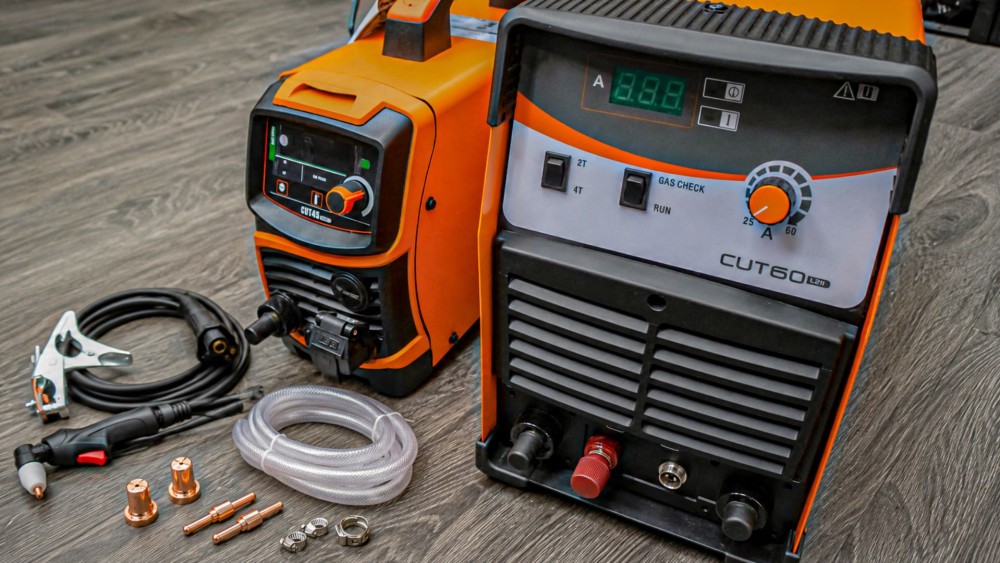
Some people replace torch heads frequently without ever checking their air system. In the end, even with a brand new torch, its lifespan remains just as short.
How does oil affect the use of a plasma cutter?
When oil vapor or oil mist enters the plasma cutter system, it can act as a contaminant inside the air passages and around the torch head. Passing through extremely high-temperature zones, this oil can burn or break down, leaving residue on various components.
As deposits build up, airflow passages can become restricted, affecting the flow pattern used to shape the plasma jet and increasing the risk of uneven consumable wear.
Oil is therefore not just a matter of "dirtiness"; it directly impacts arc quality and torch life. Especially in CNC plasma cutting operations where the plasma cutter runs for extended periods, air consistency is critical, as minor continuous anomalies accumulate into costs from consumable wear, scrap parts, and machine downtime.
Remember: "sufficient air pressure" does not mean "good air quality"
What causes many to overlook this issue is seeing that the pressure gauge reads within the plasma cutter's required range, leading them to assume the air system is fine.
- Pressure is only part of the equation
- Even if the machine requires a certain pressure and the air compressor can maintain that pressure throughout the cut, it still does not mean the air entering the machine is clean.
- The compressed air may still contain water, oil, tank rust, or microscopic debris.
- When inspecting the system for a plasma cutter, you should check at least three aspects together: pressure, flow rate, and air quality.
Even with high pressure, if airflow is insufficient, the machine can cut intermittently. And even if both pressure and airflow are sufficient, if the air is full of moisture, consumable life and cut quality will still be compromised.
Simple Ways to Maintain the Air System for a Plasma Cutter
Before using a plasma cutter, how should you prepare and what do you need? For general users, there is no need to set up a complex air system like a factory. The most critical starting point is maintaining the air compressor and filtration system ready for use.
Drain the water from the bottom of the air compressor tank regularly, depending on usage and weather conditions. If a large amount of water drains out, it indicates the system is accumulating significant moisture. Adding a water trap before the machine is therefore beneficial. Check the filter bowl for accumulated water and drain it before it gets full, and inspect the filter element periodically, as a clogged filter can reduce airflow.
If using very long air hoses, consider condensation inside the line as well, especially when warm air from the compressor travels through cooler pipes or hoses, as water vapor can re-condense after leaving the tank.
For applications requiring daily use of a plasma cutter, adding multi-stage filtration or fine filtration for oil and moisture can help reduce long-term cut quality issues far more effectively than frequently replacing torches and consumables.
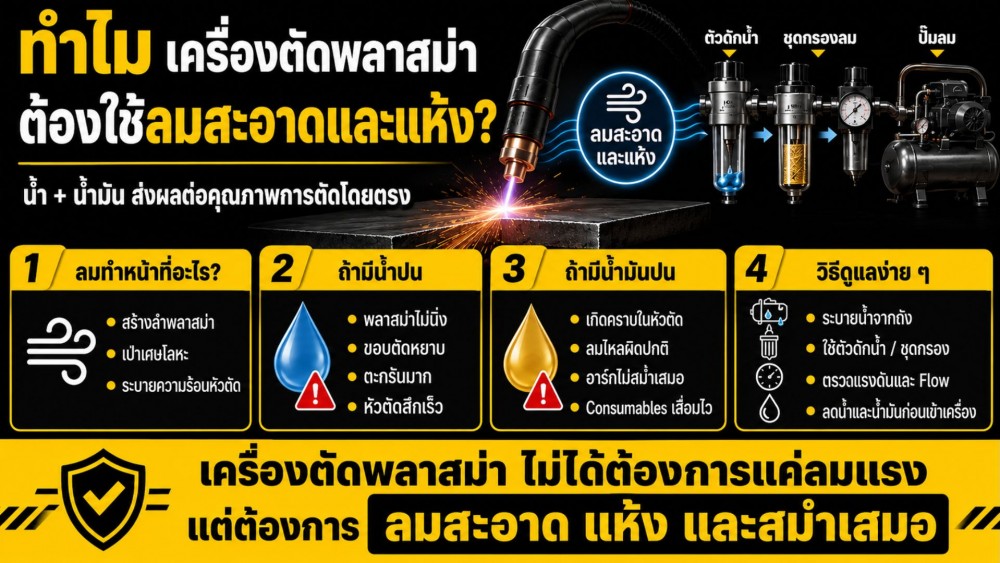
Conclusion: Clean and Dry Air Helps Plasma Cutters Operate at Full Efficiency
A plasma cutter relies much more heavily on air quality than many people realize, because the air does not just blow molten metal out of the cut, but is an integral part of generating and directly controlling the plasma arc.
If the air contains excessive moisture, the plasma arc can become unstable, resulting in rough cuts, increased dross, and accelerated wear on the electrode or nozzle. Meanwhile, oil mist can leave residue and contaminants inside the torch, affecting airflow patterns and the lifespan of consumables as well.
Therefore, to keep a plasma cutter cutting well, you should consider everything from the air compressor, air tank, air hose, water trap, filter set, down to the pressure entering the machine.
Regularly draining the compressor tank, checking filter elements, and preventing oil or contaminants from reaching the torch are seemingly small details, but they ensure consistent cut quality, reduce spare parts replacement, and keep the plasma cutter operating as close to its peak efficiency as possible.
Plasma Cutting Equipment It does not just need "strong air," but air that is sufficiently strong, consistent, clean, and dry all at once.