


 EN
 ไทย


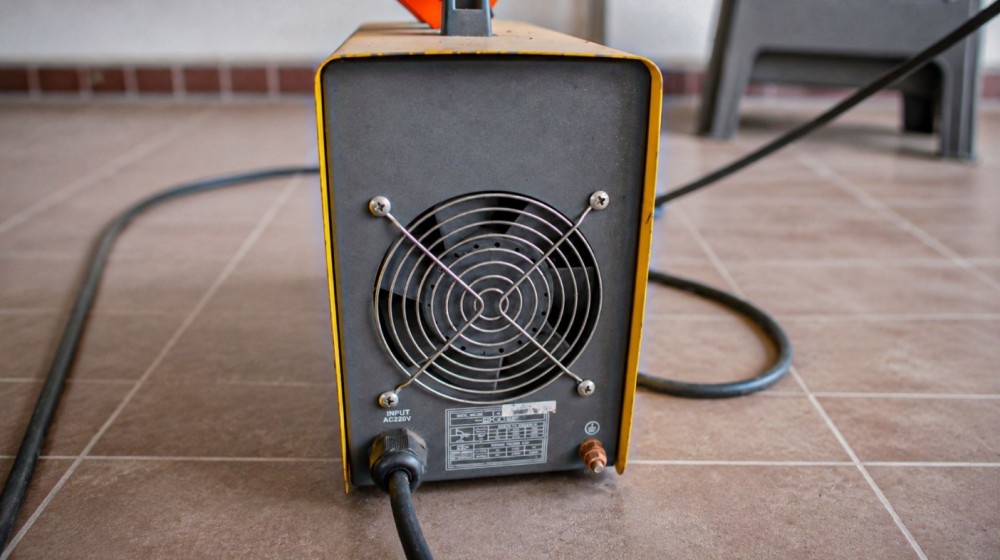
When buying Welding machine When bringing a welding machine for home use, one of the immediate questions is likely, "How many watts does it use?" Looking at the specs, we encounter various sets of numbers: amperage ratings like 130A, 160A, or 200A, Input Current, Input Power, kVA, and voltage at 220–240V. But the question is: how much power does the machine actually draw from our home supply?
The amp numbers shown on a welding machine mostly represent the welding output current, not the input current the machine draws from the household power outlet. Because a welding machine serves to convert electrical energy from household power into voltage and current suitable for creating an arc, and the Input and Output sides are entirely separate parts.
If you want to know how many watts a welder consumes, whether it can be used with household power, what size circuit breaker is needed, or whether it can be plugged into a standard wall outlet, the point to look at is not just the large amperage rating shown on the front of the unit, but you must start directly with the electrical specifications or user manual of that specific welder model.
How Many Watts Does a Welder Use? It Cannot Be Answered with a Single Number
5 Key Factors in Choosing the Current (Amps) for Each Type of Welder Different welding machines may not use the same power, and the same machine does not consume power constantly at all times, because the required power varies according to:
- Set welding current
- Welding process
- Arc characteristics
- Efficiency and internal control circuitry
When a welder is turned on and idling, it consumes some power for the control circuits, display, and fan. But once the electrode touches the workpiece and welding starts, the machine pulls more power from the electrical system. Generally, the higher the set welding current, the higher the load on the input side becomes.
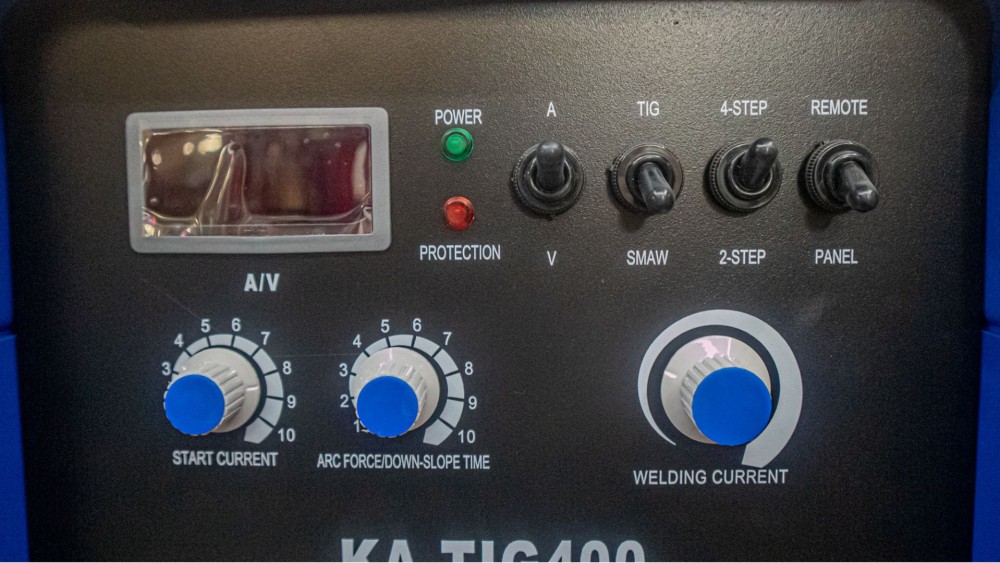
If asked, "How many watts does a 200A welder consume?", we cannot answer simply based on that 200A number alone. First, you need to know: what input voltage the machine uses, how much input current it draws, and its Power Factor or Input Power data specified by the manufacturer. Moreover, two machines with the exact same maximum welding current may draw different amounts of power from the system, depending on each machine's design.
Portable welders on the market have different input requirements, such as:
- Lincoln Electric offers stick inverter machines some models support 120/230V power and specify an input current of 16A.
- Another brand might have an inverter welder that supports 230V power;
- some models utilize circuits Power Factor Correction to better manage input power
Therefore, refer to the data of the model you will actually use rather than guessing from machine size or welding current alone.
Don't Confuse Output Amps with Household Current
A 200A welder does not mean it draws 200A of household current This is a very common misconception. Suppose the front panel of a welder says 200A; this number generally refers to the maximum welding output current the machine delivers to the welding electrode and workpiece under manufacturer-specified conditions. It does not mean the machine draws 200A from your household wall outlet.
The reason the welding current can be so high is that the welding process uses a lower output voltage than the household voltage, and the welding machine acts to convert around 230V from the power grid into a voltage and current suitable for welding. Simply put, we are trading household "voltage" for "higher current" on the welding side through the welder's power conversion circuitry.
If you want to know how many watts a welder uses, which value should you check?
The easiest way is to check whether the machine specifies Input Power it in kilowatts or kW. For example, if the machine specifications state Input Power 4.5 kW, that equals approximately 4,500 watts under the conditions defined by that specification.
However, many welding machines may not state it directly in watts. Some models specify Input Current, such as 16A, 20A, or 30A, while others specify it in kVA, which leads many people to simply multiply voltage by current immediately.
The basic principle for single-phase power is:
VA = Voltage × Current
Suppose the welder runs on 230V and specifies an Input Current of 20A, we get
230 × 20 = 4,600 VA or 4.6 kVA
However, be careful here because 4,600 VA does not always mean the machine actually consumes 4,600W of real power. For AC equipment, Power Factor is also involved. If you need to estimate real power, the concept is as follows:
W ≈ V × A × Power Factor
For example, assuming a system with a Power Factor of 0.8, the figure would be approximately
230 × 20 × 0.8 = 3,680W
Each inverter welding machine model has different circuitry and Power Factor values, especially models equipped with a PFC system or Power Factor Correction It is even less advisable to guess from average values. For accurate calculations, you should directly use the data provided by that model's manufacturer.
Can a welding machine be used with household electricity?
Many small and medium-sized inverter welding machines are designed to operate on a single-phase system or household electricity. However, just because it "can be used with household electricity" does not mean you can plug the welder into any outlet right away.
Check the Input Voltage first
The first thing to check is the input voltage, such as 220V, 230V, or the 220–240V range, as well as confirming whether it is 1 Phase or 3 Phase. If the welding machine specifies three-phase power, it cannot be plugged directly into a standard single-phase household electrical system. The low-voltage single-phase system used in Thailand is typically around 230V 50Hz as the standard in electrical systems.
Welding machines designed for 220–240V 1 Phase are the most common group for household and light-duty tasks, but you still need to check the current and the supporting circuit.
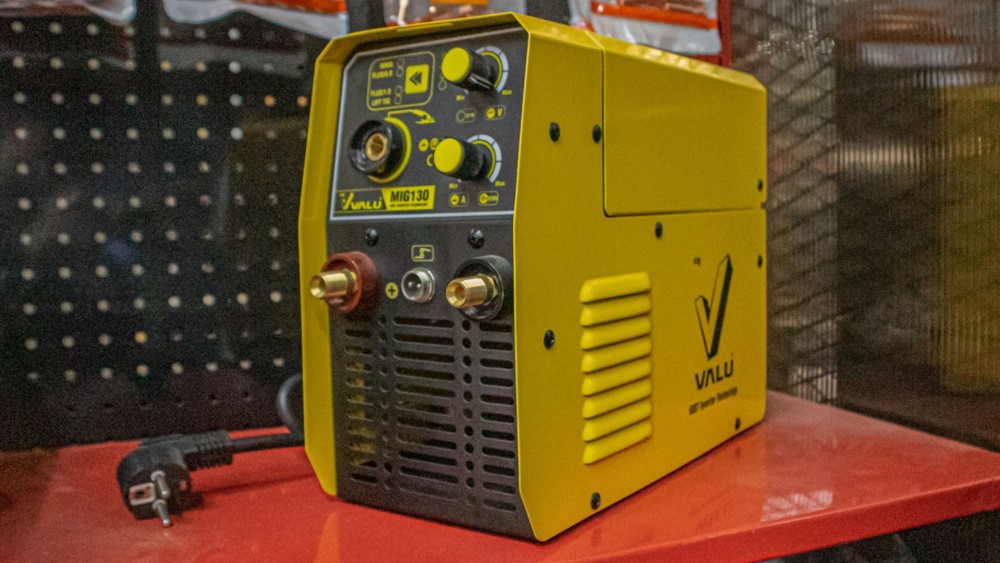
Extension cords: A small detail that can prevent a welding machine from operating at full power
A common issue when using a welding machine with household electricity is setting up the machine far from the outlet and using an extension cord to add another 10 or 20 meters, only to find that the arc is unstable, welding power feels dropped, the extension cord gets hot, or the plug becomes unusually warm.
Long and small wires: Beware of voltage drop
The longer the cable, the higher the current, or the smaller the wire's cross-sectional area, the more pronounced this problem becomes. And for welding machines, which experience significant load fluctuations during arcing, the effects of voltage drop are much more noticeable than with typical electrical appliances.
Therefore, when choosing an extension cord, you should check the rated current, wire size, length, and the recommendations in the welding machine's manual. If the manufacturer specifies an extension cord size, follow it, and do not leave the extension cord coiled on the reel under heavy load, as heat dissipation will be reduced.
160A vs. 200A welding machine: Which consumes more power?
Looking solely at maximum capacity, many might immediately answer that 200A must consume more power than 160A. But in practice, the answer is not that straightforward. The key factor is what current setting you are actually running the machine at.
Suppose you have a 200A welding machine, but actual usage is around 80–100A; the machine is not running at its full 200A rating all the time. Similarly, a 160A welding machine running near its maximum current for extended periods might place a higher input load than you'd expect.
Furthermore, each welding machine model differs in efficiency, power factor, and internal circuit design. Therefore, output amperage figures cannot be used for a 1:1 power consumption comparison.
A more accurate method is to check the specification sheets of both models and compare values such as
- Rated Input Current
- Maximum Input Current
- Input Power
- Power Factor
- Rated output conditions
These values will clearly show how much of a load each machine places on the electrical system.
What to check before plugging a welding machine into household power?
Instead of just checking whether the machine's plug fits into the wall socket, you should inspect the system from the source. Start by checking that Do the voltage and phase match the machine? Then, check the Rated Input Current or Maximum Input Current in the manual and verify whether the circuit breaker, wiring, and receptacle of the intended circuit can support it.
Why must the ground wire be in good condition when using a welding machine? An in-depth look at an essential factor you shouldn't overlook In addition to the electrical system, make sure to check the grounding system as well, because a welding machine is an electrical device used with metal workpieces in environments that may carry higher risks than typical household appliances. The work area should be dry, damaged plugs or power cords should not be used, and electrical connections should not be placed where they might be exposed to water, metal debris, or sparks from welding and grinding.
If you need to use an extension cord over a long distance, check the wire gauge based on the distance and the operating current. If you notice symptoms such as an unusually hot outlet or plug, a hot extension cord, a burning smell, severe voltage drops, or repeated breaker trips, do not force the welding machine to continue running; stop immediately and investigate the cause.
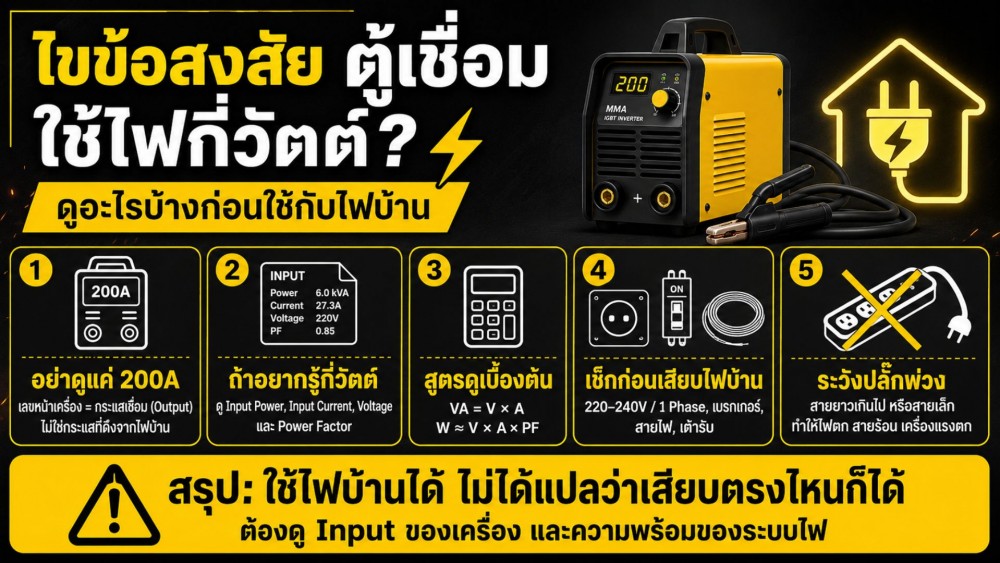
Summary: How many watts does a welding machine use? Don't just look at the amps on the front panel
The question of How many watts does a welding machine use? There is no single universal number that applies to all welding machines. Power consumption depends on the model, the operating welding current, the internal circuitry, the Power Factor, and the operating conditions of the machine. The most important thing is not to confuse: The Output Current used for welding with the Input Current drawn by the machine from the electrical system.
If the Input Power is specified in kW, you can use that value as primary information. However, if only voltage and current are specified, multiplying V × A gives VA or apparent power, which is not always the actual wattage. To determine the real power, you must also consider the Power Factor.
And if the real question is "Can this welding machine be used with household electricity?", don't stop at just seeing whether it says 220V or 230V; look further into: Input Current, breaker, wire size, receptacle, extension cord, grounding system, and other devices operating on the same circuit.
Many modern inverter welding machines are indeed designed for single-phase power and greater portability, but "it can be plugged into a home outlet" and "this home electrical point can safely support the machine at full capacity" are two entirely different things.
Checking all the information before purchasing ensures you use Welding machine it properly for the job, reducing issues like tripped breakers, voltage drops, and overheating wires, while also helping the machine operate at its intended performance.