


 EN
 ไทย


Customers Also Purchased


Have you ever experienced this? When you turn on a water pump, you hear the motor running completely ultra-smooth, but no water comes out at all! Or the pump keeps running continuously even though the water tank is empty, there is no water in the suction pipe, or air has entered the system. Many people might think: as long as the motor is still spinning, it should be fine; once the water arrives, it will prime and pump by itself.
In reality, letting a water pump run without water is a primary cause of premature pump damage. In some cases, it can cause severe damage to internal components in a short period of time, especially for pumps that rely on water for cooling, lubrication, or building pressure in the system. This condition is called "dry running," and it should never be overlooked.
In this article, we will help you understand: Water Pumps What is dry running? What causes it? Why does running without water ruin the pump? Which parts are affected? How can you spot the symptoms, and how can you prevent it? Applicable to home water pumps, centrifugal pumps, transfer pumps, and general-purpose water pumps.
What is water pump dry running?
Dry Running is a condition where a water pump is operating, but there is no water inside or too little water flowing through. Simply put, the motor and impeller are spinning, but there is no water to pump. Normally, water flowing through the pump is not only being pumped through, but also serves to:
- Dissipate heat
- Lubricate parts
- Reduce friction
- Maintain seal temperature
- Allow the impeller to operate under its designed load
Without water, a water pump turns from "a machine where fluid absorbs load and transfers heat" into "metal, rubber, and seal components rubbing against each other with no temperature control." As a result, heat spikes rapidly, and various parts can degrade or become damaged.
If there is no water in the pump, why can the motor still spin?
This is a common misconception. When the pump runs dry, we can still hear the motor running, making it feel like the machine is still normal. In reality, the motor and the water-flow generating components serve different functions. The motor generates rotational power sent to the shaft and impeller, and the impeller transfers that energy to the water. Therefore, even without water, the motor can still spin the impeller in many cases.
The issue is that the water pump is spinning, but there is no water to pump and no water to help regulate internal operating conditions. Therefore, you should not use the sound of the motor "still spinning" to judge that the pump is safe, because the machine may look like it is working normally, but internal damage may already be occurring.
Water in a water pump is not just meant to be pumped out
Water helps dissipate heat
During operation, heat is generated from various points, such as shaft rotation, bearings, seals, the motor, and internal friction. Water flowing through helps absorb and carry away heat. Without water, the temperature of these parts rises much faster than usual.
Water helps the mechanical seal function properly
A mechanical seal is a sealing assembly around the pump shaft, designed to prevent water leakage along the shaft. The seal faces rub against each other constantly while the pump is operating. Water in the system helps dissipate heat and reduce thermal buildup in this area.
Without water, the seal faces can overheat, leading to wear, cracking, or deformation. Even after water returns to normal later on, shaft leaks may start to develop, which many mistake for an aging pump or an expired seal, when the real cause might have been prior dry running.
What causes water pump dry running?
1. Water in the storage tank runs out
If the water level falls below the suction pipe, the water pump will draw in air instead of water. But if the system continues to command the motor to run, the machine will keep spinning without any incoming water. Common causes include no incoming municipal water, float valve failure, excessive water usage, forgetting to refill water, a tank that is too small, or air leaks in the suction pipe.
2. Air leak in the suction pipe system
Even if there is still water in the tank, the pump may fail to draw water due to leak points such as loose fittings, imperfect thread seals, cracked pipes, or degraded O-rings. Crucially, suction-side leaks often show no visible water drips because the pressure inside the pipe is lower than atmospheric pressure, causing it to draw in air instead. When excessive air enters, the pump loses its prime and can run dry.
3. Pump not primed before operation (Priming)
Standard centrifugal pumps require water in the pump housing before starting. If turned on while the pump housing contains only air, the impeller will spin but cannot draw water up. Do not assume that waiting a moment will bring water up on its own. If the pump is not a self-priming type, allowing it to continue spinning is dry running.
4. Foot valve / check valve issues
Non-return valves: if they leak, fail to close tightly, are clogged with debris, or are improperly installed, water in the suction pipe will flow back once the pump is shut off. This causes the suction pipe to fill with air instead of water the next time it starts. As a result, the pump will spin without drawing water and can also enter a dry-run condition.
5. Clogged suction strainer or suction pipe
Such as leaves, sediment, mud, rust, or a clogged strainer screen, significantly reducing the water entering the pump below its requirement. Even if not completely dry running, this creates an insufficient water condition that causes overheating and subsequent cavitation as well.
How does dry running damage a water pump?
1. Mechanical seal overheating and damage
The seal is extremely sensitive to dry running; the contact faces heat up rapidly without water to regulate temperature. The consequences: seal wear, burnt seal faces, cracking, hardened or deformed rubber, leading to leaks once operation resumes. Sometimes symptoms are not immediate; the pump may pump water normally at first, then gradually develop seepage around the shaft later.
2. Heat accumulation in the water pump housing
Although the motor has a cooling fan, hydraulic components rely on water. If operated continuously without water, heat accumulates in the pump housing, shaft, seals, impeller, bushings, and plastic/rubber components, which can deform under excessively high temperatures.
3. Damage to impeller and internal components
The impeller is designed to operate with water. When exposed only to air, rotational behavior and heat dissipation change. Deformities, wear, heat buildup, rubbing against the pump housing, or damage to the bushing/shaft can occur, especially if compounded by other issues like degraded bearings or debris inside the pump housing.
4. Motor overheating
Many think that no water = no load, assuming the motor works lighter. However, the motor continues to spin fast, consume energy, generate heat, and drive the shaft/bearings continuously. Furthermore, without water pressure to trigger the pressure switch, the system may never cut off, causing the pump to run non-stop instead of cycling normally.
Conclusion
A water pump operating without water or with insufficient water—even if the motor appears normal—quickly builds up internal heat, especially at the seals. Impacts include worn seals, water leaks, damaged impellers, motor strain, and shortened pump lifespan. Main causes: running out of water, suction pipe leaks, faulty check valves, failure to prime, or clogged suction lines.
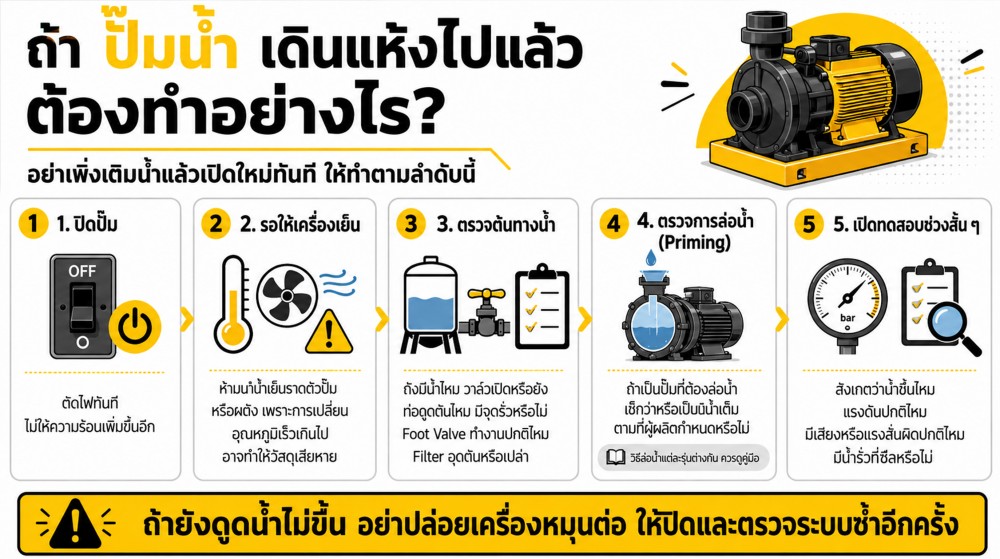
The question to ask is not "how long can it run dry?" but "how to prevent it from ever running dry?" If you encounter symptoms like the motor spinning but no water is drawn, lack of pressure, or abnormal noise, turn off the machine immediately and inspect the water system. Never leave it spinning while waiting for water to come up on its own.
Select Water Pumps to suit the application