


 EN
 ไทย


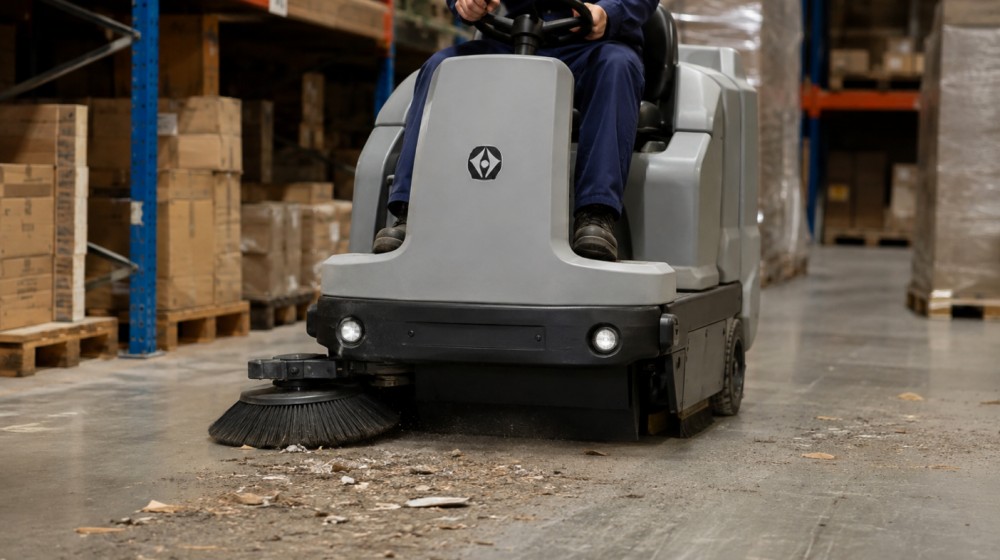
Customers Also Purchased


When choosing aFloor sweeper Many people often start by checking how many square meters the area is, then comparing which model has what sweeping width or how many square meters it can clean per hour. This way of thinking is useful to a certain extent because area size directly affects working time and machine dimensions. However, if you look only at these numbers, you might end up with a machine that looks great on paper but falls short of handling the actual dirt and debris in real-world use.
Consider two warehouses of similar size: one has only light dust and paper scraps from packaging, while the other contains sand, wood chips, plastic scraps, and debris from material handling. Although their floor areas are comparable, the sweeping requirements are completely different. A machine suitable for the first warehouse is not necessarily fit for the second.
Before looking at how fast a floor sweeper operates, you should first identify what debris falls onto the floor each day, whether it is small or large, how much of it accumulates, and where it typically originates. This information influences the brush system, dust control, hopper capacity, and the type of machine you should select.
Area size is important, but it does not tell the whole story of the job
Area size helps roughly assess whether you need a small or large machine. For smaller areas with narrow aisles, a walk-behind or manual push sweeper may offer better maneuverability. For vast spaces that require continuous, long-duration cleaning, a ride-on sweeper typically saves more operator time and effort.
However, numbers like 1,000 or 2,000 square meters do not reveal how dirty the floor gets, nor do they tell you whether what needs to be swept is fine dust, sand, leaves, wood splinters, or large debris. If a large area only gathers light dust each day, the machine's workload might not be heavy. Conversely, a smaller area that accumulates sand or material debris all day long may require a more heavy-duty machine with an appropriately sized hopper. Therefore, area size should be one of the factors used to select a machine, but it should never be the only deciding factor.
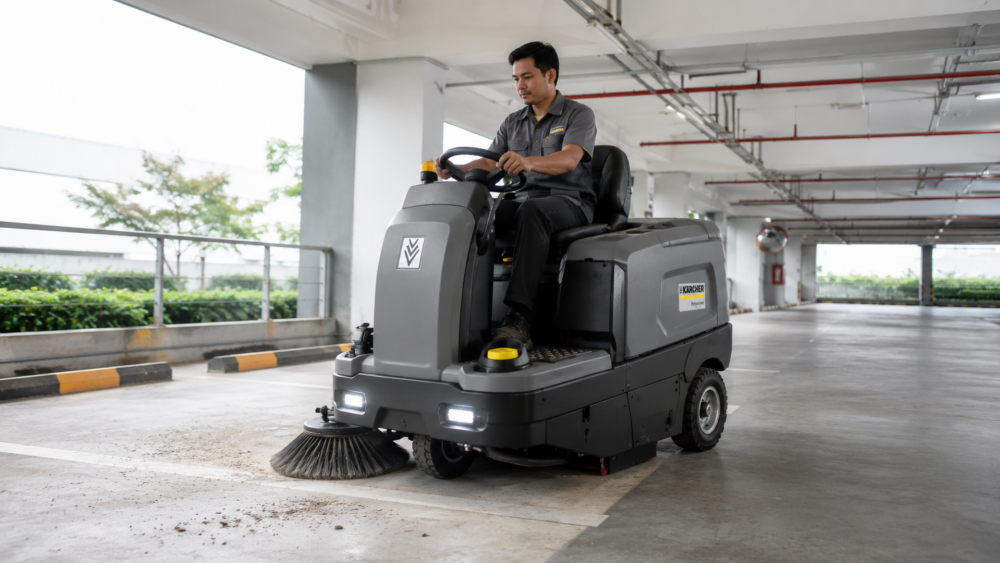
If the floor has fine dust, check how well the machine controls dust.
Fine dust clearly sets floor sweepers apart, as sweeping the floor clean may not be enough if massive amounts of dust billow into the air while operating.
Machines designed for this type of task often have a vacuum system and filter set working alongside the brushes. When the brushes sweep dust and debris into the machine, the filtration system traps dust to prevent excess amounts from being blown back into the air—ideal for enclosed areas like warehouses, factories, or buildings where fine dust regularly accumulates.
If your floor suffers from heavy dust, you should look beyond just the brush width or machine size. Also check what type of filtration system it uses, whether it is easy to clean and maintain, and whether there is a dust suppression system around the side brushes, as this is another spot where dust can be kicked up.
Sand, gravel, and granular debris: consider both the brushes and floor condition
Sand and small granular debris differ from dust because they are heavier and often settle in grooves or rough surfaces. Many floor sweeper models can handle them, but how well they sweep depends on the brush design, bristle stiffness, and the contact level between the brush and the floor.
For areas like parking lots, warehouse entrances, or semi-outdoor yards where sand regularly accumulates, check whether the machine model supports this kind of work and consider the hopper size. If there is a large volume of sand, a hopper that is too small will force you to stop and empty it frequently, wasting working time.
The floor condition also makes a difference. Sand on smooth floors is typically easier to collect than sand trapped on rough concrete or cracked surfaces. If the floor is uneven, the machine's brushes should maintain fairly consistent contact with the surface and not float too high, which would leave debris in the crevices.
If there is large debris, check whether the machine can take it in.
Some areas don't just have dust or sand, but also leaves, gravel, wood scraps, cans, or packaging debris scattered regularly. For this group of waste, you must look closely at the intake flap and the sweeping mechanism structure, as not every model can collect larger debris equally well.
Some models feature a flap or opening system that allows bulky debris to pass easily into the hopper, whereas others are suited primarily for fine dust and small particles. If your floor has coarse debris every day, verify this thoroughly before buying—do not just look at how wide the machine sweeps or how fast it runs.
While machines with good fine dust control might also handle larger debris, this capability varies widely across models. It is best to check directly against the machine's specifications and manual rather than guessing from its appearance or size.
Paper scraps, plastic, shrink film, and tape also require caution.
In warehouses and distribution centers, other commonly found items are paper scraps, plastic pieces, stretch wrap, tape, and packaging materials. Common small scraps are easily handled by sweepers, but materials that are long, stringy, or sticky can get tangled around brushes or rotating parts.
If the floor has a lot of this type of debris, picking up unusually long or large pieces before sweeping will significantly reduce issues—such as ropes, long strips of tape, film, or materials that could wrap around the brushes. Using the sweeper for standard debris afterward will result in smoother operation and minimize the need to stop and untangle debris mid-job.
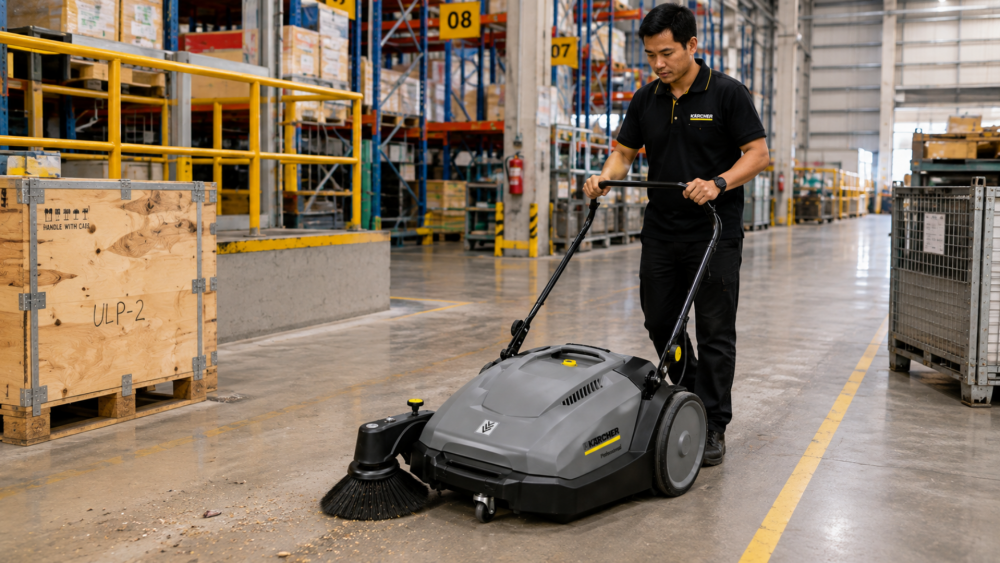
Floor sweeper brushes are not universally suited for every job.
Many floor sweeper models may look similar on the outside, but their internal brushes are not all the same. Some brushes feature stiffer bristles suited for heavy debris or rough surfaces, while others are engineered to collect dust and fine particles more effectively.
Beyond bristle stiffness, the bristle pattern and arrangement also affect debris pickup. If the types of waste on your floor are clearly defined—such as mostly sand or heavy fine dust—checking what brush options are available for that model is far more useful than merely looking at machine dimensions.
Some models allow you to swap brushes to suit different applications, offering the flexibility to use a single machine across multiple areas. However, make sure to check first that the manufacturer actually supports dedicated brushes for your specific tasks.
The volume of debris matters just as much as the type of debris.
Knowing what is on the floor alone is still not enough; you also need to look at how much there is. An area with light dust swept once a day compared to an area where dust accumulates throughout an entire shift may both be called "dust jobs," but the machine has to work quite differently.
If a large volume of debris is generated, a hopper that is too small will require frequent emptying stops. On the other hand, a larger hopper allows for longer continuous operation, but the machine itself is usually bigger and requires more space to turn.
Therefore, a larger hopper is not always better. You must consider whether it genuinely suits your space and debris volume. If a warehouse has very narrow aisles, using a larger machine just to empty the hopper less often may come at the cost of reduced maneuverability, making actual operation inconvenient.
The same area often contains a mix of multiple types of debris
In real-world work, almost no area contains just a single type of debris. A warehouse might have dust, paper scraps, and wood chips from pallets all at once, while an outdoor yard might simultaneously have sand, leaves, gravel, and dust.
A practical way to choose is to look at what occurs the most and causes the biggest problem each day. If the area mainly has fine dust while large wood pieces only occur occasionally, you might choose a machine with good dust control and pick up the large wood pieces by hand before starting work, rather than sizing up to a large machine simply to handle every single type of debris.
Conversely, if it is an outdoor yard with large amounts of leaves, gravel, and coarse debris every day, you should prioritize the capacity to collect these types of debris over high-level fine dust filtration systems. Knowing the primary problem of the area will help eliminate a lot of unnecessary options.
Don't just look at the debris; also look at whether the floor is smooth or rough
The same debris swept on different types of floors can yield different results. Sand on a smooth epoxy floor is generally easier to collect than sand on rough concrete, while dust settled in grooves or cracks is more likely to be left behind than dust on a smooth surface.
If the floor is rough or uneven, you should check how well the machine's brushes make contact with the floor. If the brushes are set too high, small debris might escape and remain on the floor; but if pressed too hard against the surface, the brushes may wear out prematurely.
For areas with columns, shelving, machinery, or narrow aisles, the machine dimensions and turning radius should also be considered together. No matter how fast a machine can sweep, if it cannot access the spots that need cleaning, it might not make the job as easy as you thought.
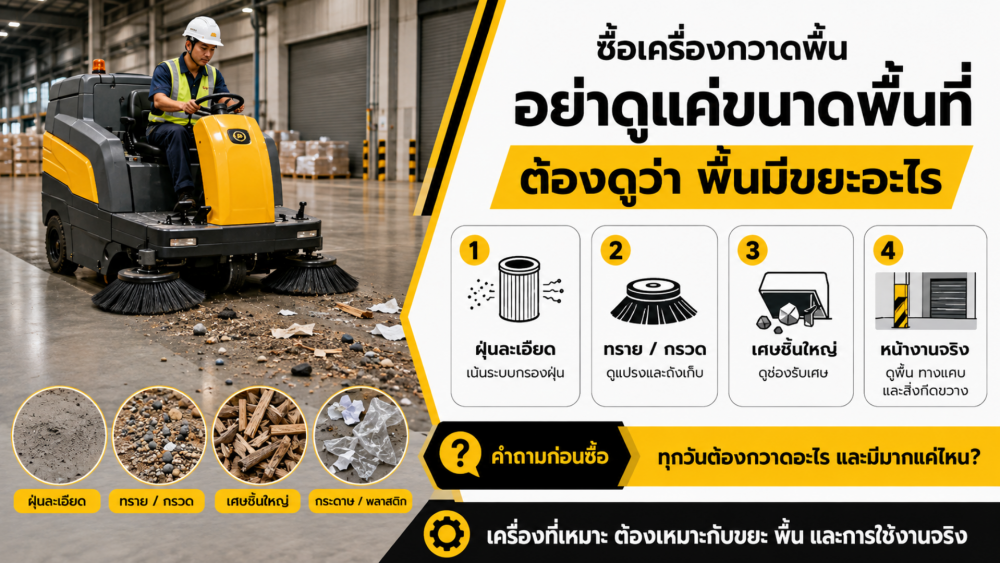
Before choosing a machine, try inspecting the area when it hasn't been cleaned yet
A simple way to choose a machine that better matches the job is to walk through the actual site when the floor is in a state close to normal working conditions, not right after it has just been swept or cleaned, because that is when you can see the area's main problems most clearly.
Take a look at what kind of dust, sand, leaves, or debris is most prevalent, how quickly debris accumulates, whether large pieces appear frequently, which spots are dirtier than others, and how smooth or rough the floor is, as well as checking whether there are many narrow aisles, pillars, or obstacles.
Once you have this information, you can then consider the area size alongside the sweeping path width, hopper capacity, filtration system, operating runtime, and whether a walk-behind or ride-on model is more suitable. This approach helps reduce the chance of buying a machine that is too big, too small, or poorly matched to the dirt encountered daily.
The right floor sweeper for the job does not necessarily have to be the largest or fastest model. More importantly, it must effectively handle what is actually on the floor, maneuver smoothly within the space, and not cause frequent interruptions during operation.
Before buying Floor sweeper You should clearly ask first: what do we need to sweep off the floor every day, and how much is there? Then, follow up with the total area size. By starting from real on-site operational data, selecting a floor sweeper will be much more aligned with actual use than simply looking at square footage numbers alone.