EN
 ไทย


Customers Also Purchased


When choosing work gloves, many people assume that the more cut-resistant, thicker, tougher, or higher the protection level, the safer they will always be—especially for tasks involving steel, sheet metal, power tools, or sharp edges. In reality, that is not always the case. Maximum protection work gloves ≠ the safest for every job. The role of work gloves is not just to protect, but also to allow you to grip, control, and feel the workpiece effectively. If gloves are too thick, stiff, or bulky to the point where fingers cannot move nimbly, tactile sensitivity is lost at the fingertips, or the tool grip becomes unstable, the risk introduced by the gloves themselves increases instead.
The issue is therefore not Safety Gloves "Is high protection good?", but rather "Does that protection level match the actual hazards encountered?" Therefore, choosing the right work gloves should not start with "Which pair offers the highest protection?", but instead ask: What are the risks of this job, and what do we actually need to protect against?
Work gloves are not just for hand protection
From the outside, work gloves may look like mere hand coverings, but in reality, they affect almost all hand control: from picking up tiny screws, gripping wrenches, controlling grinders, holding metal sheets, to using precision measuring tools. Imagine picking up a screw with bare hands; we instantly know its position, whether it is tilted, or if it is slipping. But once you put on thick gloves, this sensation decreases immediately. The right work gloves must strike a balance in 3 aspects.
- Hand protection
- Finger dexterity
- Grip and workpiece control capability
If protection is extremely high but the other two factors are lost, overall safety may not increase as expected. This is why assembly gloves are usually thin and snug, unlike gloves for handling thick steel plates, or welding gloves which are structured differently from general work gloves, because the hazards of each job are different.
What does "over-protective" work gloves mean?
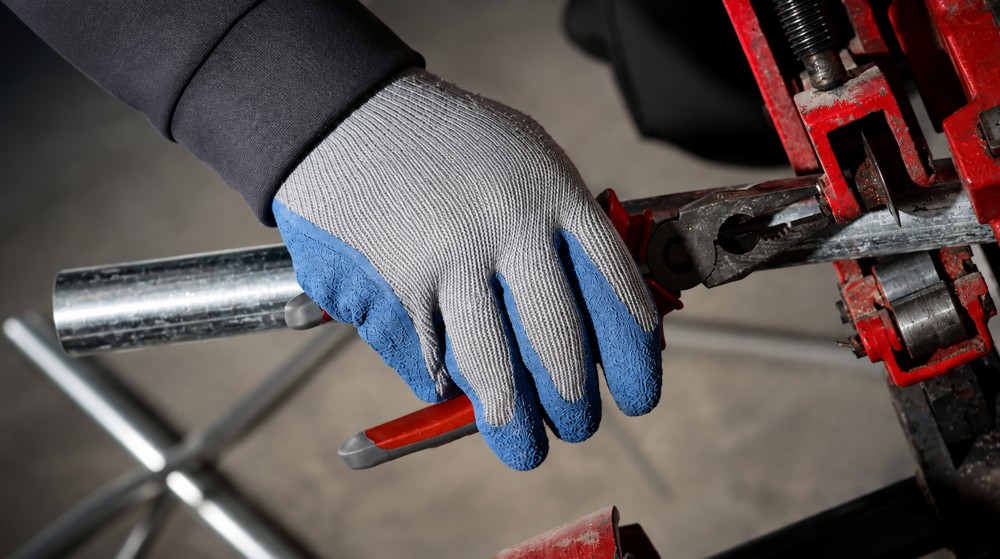
"Over-protective" does not mean that high-quality or high-standard work gloves are bad. It means choosing specifications that exceed the actual risks of the job to the point of hindering performance. For example:
- Assembling small parts with few sharp edges, but using thick, stiff, high-level cut-resistant gloves—while protection is indeed improved, you have to exert more pinch force, fingers are hard to move, and tactile awareness of the workpiece position is reduced.
- Using wrenches or tightening bolts: if gloves are so thick that the palm cannot fully wrap around the tool handle, you have to grip tighter, leading to faster hand fatigue during prolonged work.
Therefore, the word "over-" depends on the nature of the work. The exact same pair of thick work gloves may be ideal for one job, but overly bulky for another.
Gloves that are too thick prevent a secure, full-hand grip
One of the most obvious impacts of work gloves that are thicker or stiffer than necessary is grip—or the ability to hold tools effectively.
A secure grip does not come from squeezing force alone, but from the fingers, palm, and tool surface making proper contact. When gloves are very thick, the distance between the actual hand and the tool handle increases, preventing fingers from fully wrapping around the handle as they would with thin gloves. Consider gripping a screwdriver handle: with snug gloves, fingers easily conform to the handle's shape, and hand force transfers directly to the handle. With thick gloves, however, fingers cannot flex completely, and palm material may bunch up, forcing you to squeeze harder to compensate.
- You might not notice the difference during light tasks, but over extended work periods, the effects become clear:
- Hands tire more quickly
- Grip strength on tools diminishes
- Sudden kickback or resistance makes tools harder to control
- Therefore, mechanic gloves with higher protection do not always translate to better tool control.
Mechanic gloves with high cut resistance do not mean they are suitable for every job.
A clear example is cut-resistant mechanic gloves. Many people think buying the highest level of protection first doesn't hurt because it offers at least more protection. But in reality, you should choose a protection level that corresponds to the actual risk. For instance, lifting sharp-edged metal sheets might require a high Cut Level, whereas assembling tools or general repairs without severe sharp edges may not require that high a level.
If you choose a higher level than necessary, you might have to compromise on weight, thickness, or dexterity, even though many modern cut-resistant gloves now offer both high protection and better thinness than before.
So do not generalize that a high Cut Level always equals thick gloves.
Key principle to remember: Choose the protection level based on the actual hazard, not merely by the highest number.
In some jobs, "mechanic gloves" can actually be part of the hazard.
Another critical issue that must be separated from protection levels is machinery with rotating parts.
Many people think that when working near machinery, wearing the thickest mechanic gloves is the best idea. But in reality, loose materials, cloth scraps, long sleeves, jewelry, or even the gloves themselves can be caught and pulled in by rotating parts—especially in lathes, drill presses, and machinery requiring operation near rotating parts.
This doesn't mean mechanic gloves are banned from all rotating machinery, but you must adhere to the machine manual, workplace safety regulations, and task-specific risk assessments. If the manual states not to wear gloves near rotating parts, you must strictly comply.
This is a clear example that PPE is not the answer to safety in every scenario. Sometimes, eliminating hazard points or performing work the right way is more important than adding layers of protection on your hands.
Do not choose mechanic gloves solely based on the highest numbers.
When selecting protective gear, we often get caught up in numbers: higher cut resistance, thicker material, more protection seem to offer better value. However, gloves interact directly with hand movements, so numbers are only part of the decision-making process. Before delving into How do mechanic glove materials (PU, Nitrile, Latex, Kevlar) differ? Appropriate mechanic gloves should be able to answer all of these fundamental questions first:
- Does it protect against the main hazards of the job?
- Can you move your fingers easily? Can you hold tools securely?
- Can you still feel the workpiece adequately?
- Does wearing them continuously cause excessive fatigue or heat?
- Does it fit your hand properly?
If you can answer all these questions, your glove selection will be much more rational than simply trying to find the "toughest" pair.