


 EN
 ไทย


Customers Also Purchased


When buying a spirit level, many people often look at the length first—whether it is 30, 60, 80, or 100 cm—and then look at magnets, thickness, number of vials, or hand feel. But if you read the specifications more closely, you will find another set of numbers stating Accuracy ±0.5 mm/m. Many might wonder what 0.5 mm has to do with a spirit level? Why is it written per meter even though the tool itself is only 60 cm long? And is a smaller number always better?
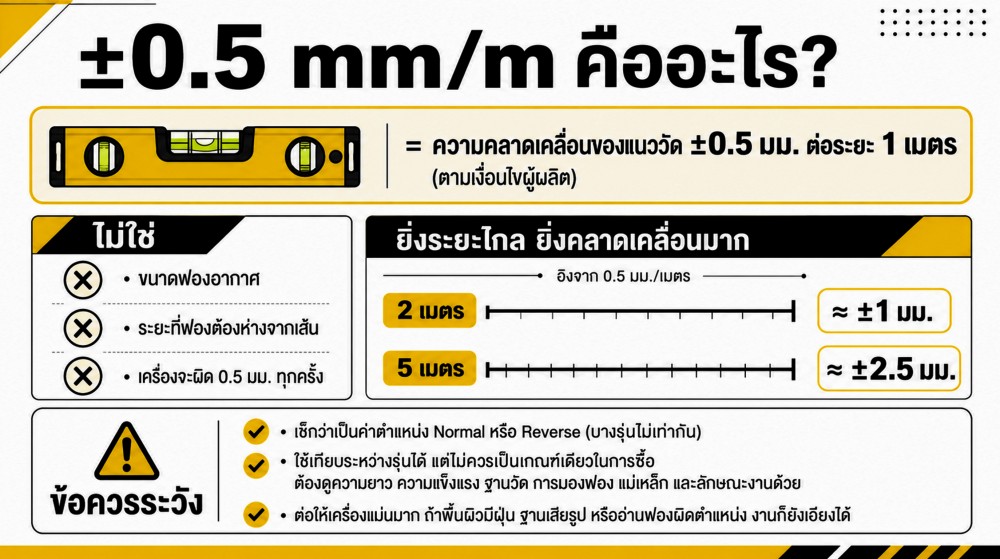
In reality, this value is not complicated; it is the leveling tolerance compared over a distance of 1 meter. Put simply, specifying ±0.5 mm/m means that the line indicated as "level" by the tool may deviate by about 0.5 mm for every 1 meter under the conditions specified by the manufacturer. This is a standard value found in many trade-grade spirit levels, such as STABILA, which also specifies a tolerance of ±0.50 mm/m.
Although the number seems very small, a fraction-of-a-millimeter tolerance affects work more than you might think, especially for long-distance tasks or continuous alignments from one point to another.
First of all, you must understand what "level" really means.
When placing a Water level on a table, shelf, door frame, steel structure, or various workpieces, what we are checking is the surface alignment relative to gravity to see whether it is level. A typical bubble spirit level has a vial filled with liquid and an air bubble inside. When placed horizontally, the bubble centers between the reference lines if the surface is level.
However, in the world of measurement, no tool is 100% accurate. Even with a high-quality spirit level, the vial, base, structure, and assembly always have a tolerance specified by the manufacturer. So rather than just saying "this spirit level is accurate," manufacturers who provide serious technical data clearly specify numbers such as Measurement Accuracy or Measuring Tolerance.
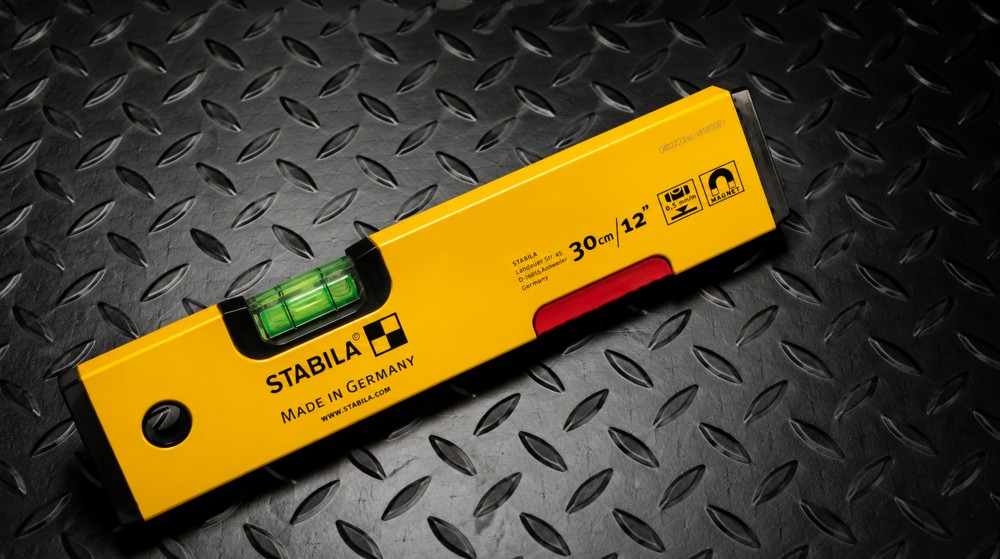
What does 0.5 mm/m literally mean?
Let's break the numbers into two parts: 0.5 mm is half a millimeter, and /m is per 1 meter distance. Combined, 0.5 mm/m = 0.5 mm per every 1 meter.
Now, imagine a straight 1-meter stick. If one end is at 0 mm and the other is 0.5 mm higher, that represents a 0.5 mm height difference over a 1-meter distance. This is such a tiny tilt angle that it is virtually invisible to the naked eye, roughly equivalent to an angle of 0.029 degrees, which some manufacturers also state in their specifications.
Therefore, when you see ±0.5 mm/m, do not misunderstand that the bubble must stay within 0.5 mm of the line. This number indicates the angular tolerance of the level reference line determined by the tool, expressed in millimeters per meter for easier understanding and convenient comparison with other models.
What does the ± sign mean?
This is very important: specifications usually state ±0.5 mm/m, not just 0.5 mm/m alone. The ± sign means the tolerance can occur in both directions—either tilting slightly upward or downward.
Suppose there is a true 1-meter level line. When using a spirit level rated at ±0.5 mm/m, the line indicated by the tool may deviate from the true line within a range of ±0.5 mm; it does not always lean in only one direction.
Thus, the key point is not that "the tool will be off by 0.5 mm every time," but rather the maximum margin of error guaranteed by the manufacturer. As long as the spirit level is in good condition, used correctly, and under the manufacturer's specified conditions, the measured value should stay within this limit.
What if the spirit level is shorter than 1 meter?
Another common question: if the spirit level is only 60 cm long, but the box says Accuracy ±0.5 mm/m, where does the "1 meter" come from? The reason is that mm/m is a standard reference unit for indicating angular tolerance, making it easy to compare spirit levels of different lengths. We simply multiply the ±0.5 mm/m value by the actual length of the tool (in meters).
- 2 meters long → 0.5 × 2 = ±1 mm
- 1 meter long → ±0.5 mm
- 80 cm long → 0.5 × 0.8 = ±0.4 mm
- 60 cm long → 0.5 × 0.6 = ±0.3 mm
- 40 cm long → 0.5 × 0.4 = ±0.2 mm
These numbers help illustrate the tolerance relative to the tool's length. It doesn't mean that every time you use a 60 cm spirit level to measure a workpiece, it will always read 0.3 mm off. It simply scales the angular tolerance relative to that specific distance.
Is a ±0.5 mm/m spirit level considered accurate?
The ±0.5 mm/m value is an accuracy commonly found in many professional spirit level models. For instance, STABILA Type 81 S and Type 83 S specify this value—Type 83 S specifies it for both normal and reverse positions. Certain SOLA models also state a Measuring Tolerance of 0.50 mm/m, or approximately 0.029°.
However, do not assume that a good spirit level must only be 0.5 mm/m, because each application demands a different level of precision. Whether it is general installation work, construction, furniture making, machine setup, or precision measurements in a laboratory—for some tasks, ±0.5 mm/m is already precise enough, but certain machinery alignment or metrology tasks may require tools that are much more sensitive and precise than standard tradesman spirit levels. Therefore, do not select based on numbers alone; always ask what the tool will be used for first.
Select Water level to suit the application