


 EN
 ไทย


Customers Also Purchased


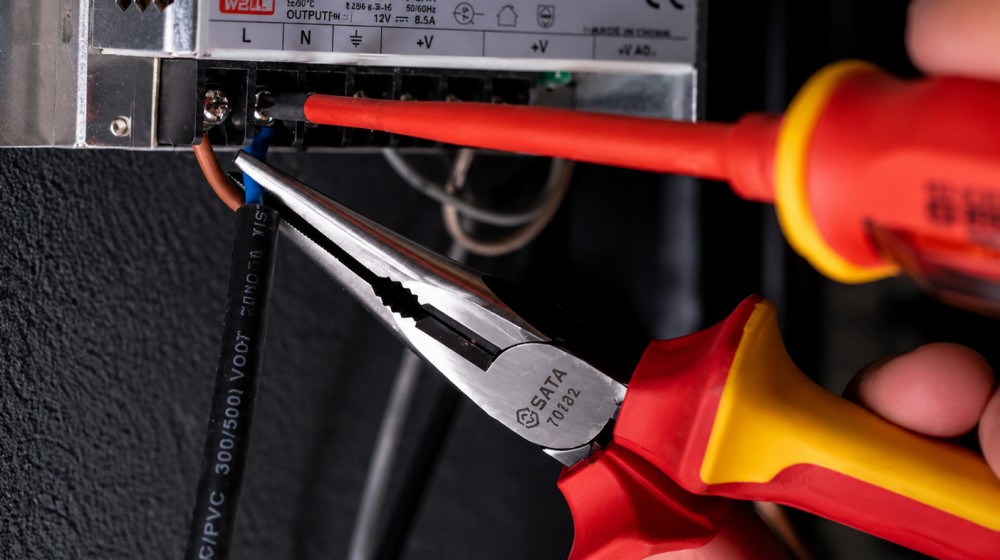
When choosing pliers to buy, we usually select the type first, such as combination pliers, cutting pliers, needle-nose pliers, or electrician's pliers. But after that, there is always another number you encounter: the length, such as 160, 180, or 200 mm. Different sizes of pliers may seem only slightly different, leading one to wonder whether a difference of just 20–40 mm really matters. Is 160 mm too small? Is 180 mm truly the standard size? Or should you just go for 200 mm because the longer handles provide more leverage?
In reality, plier length doesn't just affect the tool's physical size; it also impacts applied force, grip comfort, access to tight spaces, weight, jaw control, and suitability for various workpieces. Longer pliers are not always better, and smaller pliers are not too weak to be useful. The key is to choose the size that best fits the tasks you perform most frequently.
In this article, we'll explore Pliers / Clamp How 160, 180, and 200 mm differ, which tasks each size is suitable for, and which size you should start with if you're only buying one.
What do the numbers 160, 180, and 200 mm mean for pliers?
The millimeter measurement of pliers refers to the total length, from the tip of the jaws to the end of the handles. For example, 180 mm = approx. 18 cm, 200 mm = 20 cm. A difference of just 20 mm may seem insignificant, but... for a lever-based tool like pliers, a small increase in distance changes how it performs. Most of the added length goes to the handles: the further the handle is from the pivot point, the more force is generated at the jaws with the same hand effort. This is why heavy-duty pliers typically have longer handles than precision pliers.
However, the extra length comes at the cost of heavier weight, bulkier size, and the need for more clearance to spread the handles. Therefore, never choose pliers based solely on a "bigger is better" mindset. Additionally, we have various types of pliers available to choose from. Let's see how they compare: 30 Types of Pliers: What Are the Differences?
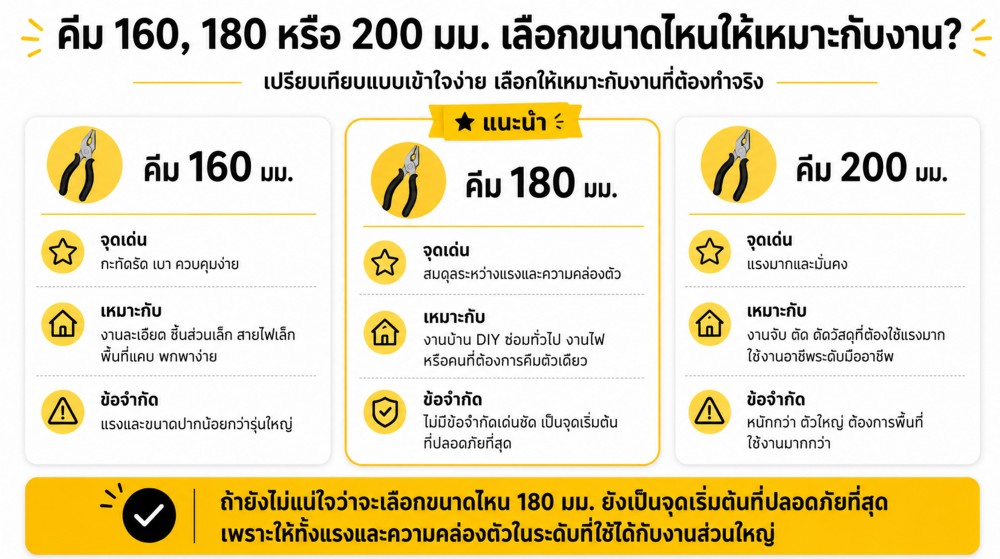
160 mm pliers: Small, but highly capable
Measuring approximately 16 cm in length, they are lightweight and easy to control because the center of gravity is close to the hand. Ideal for assembling small devices, electronics, small wiring, or working in confined spaces such as electrical panels. Easy to carry and lightweight.
- Advantages: Precise, easy to control in confined spaces, requires minimal handle spread, making it ideal for electrical enclosures or behind furniture where large pliers cannot open.
- Limitations: Generates less leverage than longer-handled pliers, with proportionally smaller jaws. Not suitable for heavy-duty work or hard wire. If you need to squeeze with both hands or hammer the handle, it means you're using the wrong size pliers.
180 mm pliers: the most common medium size
It strikes the right balance between maneuverability and leverage. Not overly bulky, yet with handles long enough to provide good mechanical advantage, it is versatile for everything from home DIY and repairs to electrical work.
- Suitable for those who are unsure what type of work they will primarily do, or who want a single pair of pliers for the home. 180 mm combination pliers provide both gripping surface and cutting edges that perform well for general tasks.
If you frequently need high leverage, such as for cutting hard wire or gripping thick materials, you should step up to 200 mm.
200 mm pliers: only 2 cm larger, but what makes the difference?
With handles just 2 cm longer, it generates more force at the jaws without requiring as much squeeze effort. Ideal for tasks that demand power over finesse, such as gripping large workpieces, bending stiff wire, cutting thicker wire/cables, or working all day long.
The jaws and gripping serrations are typically larger to match the size, making them sturdier for heavy-duty work. The trade-off is greater weight and bulk; if you need to reach into tight spaces or hold them overhead for long periods, fatigue will quickly set in.
Why does plier length affect force?
Pliers operate on the lever principle, with the pivot point as the fulcrum. Your hand applies force to the handles, which is transmitted to the jaws or cutting edges. The longer the handles, the more leverage is generated around the pivot using the same amount of hand force.
Think of opening a door: pushing near the hinge requires a lot of effort, but pushing at the handle far from the hinge makes it much easier. Pliers work similarly; with a similar design, a 200 mm pair will generally provide more leverage than a 160 mm pair.
However, emphasize "similar design," because each model features different pivot positions, jaw profiles, and leverage ratios. A well-designed 180 mm pair with high-leverage pivot placement can easily outperform a standard 200 mm pair. Length is therefore just one factor, not the sole determinant of performance.
Conclusion
- 160 mm: compact, ideal for precision work, confined spaces, and easy portability.
- 180 mm: medium size, the most balanced, ideal for general tasks and anyone wanting an all-in-one pair.
- 200 mm: greater leverage, ideal for heavy-duty jobs or regular, intensive use.
Don't choose based on length alone—jaw shape, pivot point, cutting edges, and handle grips also play crucial roles. Longer pliers aren't always better. Before buying, ask yourself: Do you need a lot of force? Do you often work in tight spots? How long will you hold them? Is most of your work delicate or heavy-duty?
If you're still unsure, 180 mm is the sweet spot for most people. Ultimately, the right pliers aren't necessarily the most powerful, but the ones you can control comfortably and reach for naturally for your everyday tasks.
Select Pliers / Clamp to suit the application