


 EN
 ไทย


Customers Also Purchased


Coping saw / Fretsaw Jigsaws are versatile power saws that have gained popularity for their ability to make straight cuts, curves, and cutouts with great agility. Compared to circular saws, jigsaws are more compact, easier to steer, and can initiate cuts from the middle of a workpiece when a starter hole is pre-drilled. Did you know that electric jigsaws aren't just for cutting wood?
At the same time, a common issue that many jigsaw users frequently encounter is The cut isn't straight: the cut line on top seems to follow the marked path, but when flipped over, the blade has drifted off to the side. The workpiece edge is beveled, or the cut gradually drifts off course.
Encountering this, we might immediately conclude that the blade is poor, the motor lacks power, or jigsaw control is inaccurate. However, the root cause may not lie solely with the blade, because the "base plate" (or shoe) of the jigsaw directly affects the direction, squareness, and accuracy of the cut.
The Jigsaw Base is More Important Than Many People Think
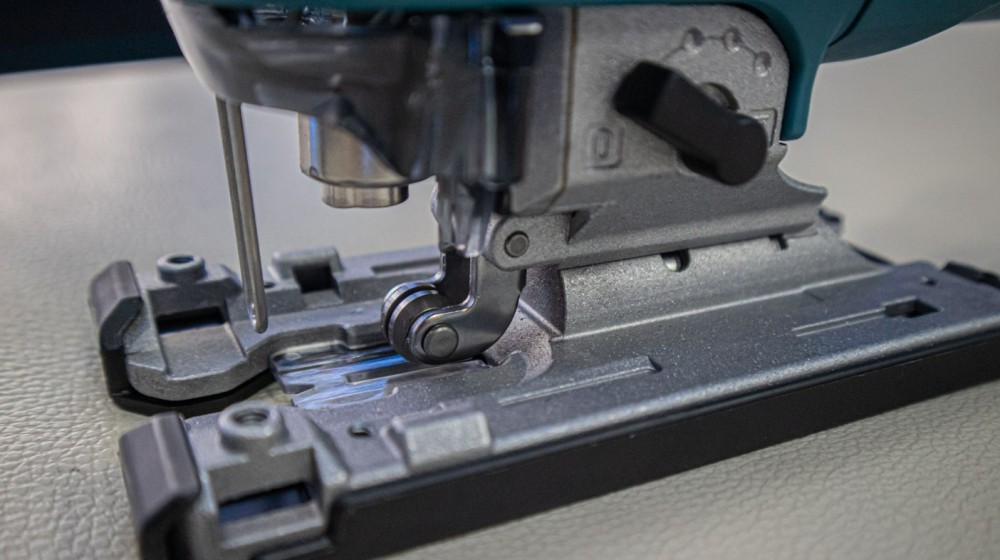
The jigsaw base, also referred to by some as the base plate, sole plate, or shoe, is the part of the jigsaw that remains in continuous contact with the workpiece surface during cutting. The base's role is not merely to support the tool on the material, but also to maintain the correct angle between the tool body, the blade, and the workpiece surface.
If the jigsaw base is precisely set at 90 degrees, the blade is much more likely to cut perpendicular to the surface. But if the base is tilted, warped, loosely locked, or has debris trapped underneath, even if the user follows the line perfectly, the resulting cut can still bevel or wander off track.
Think of the base plate as the jigsaw's reference plane. When this reference plane is uneven or not perpendicular, every component moving relative to it will be affected. Even though the discrepancy might seem very small—tilting just one or two degrees—when cutting wood 20–40 mm thick, the bevel on the bottom side of the workpiece becomes immediately obvious, especially for joints where edges must mate with other parts, or when making multiple cuts requiring identical dimensions.
How Does a Tilted Base Plate Cause Non-Square Cuts?
Many jigsaw models allow the base to tilt for bevel cuts, such as at 15, 30, or 45 degrees. The user simply loosens a screw or locking lever underneath the tool and rotates the base to the desired angle.
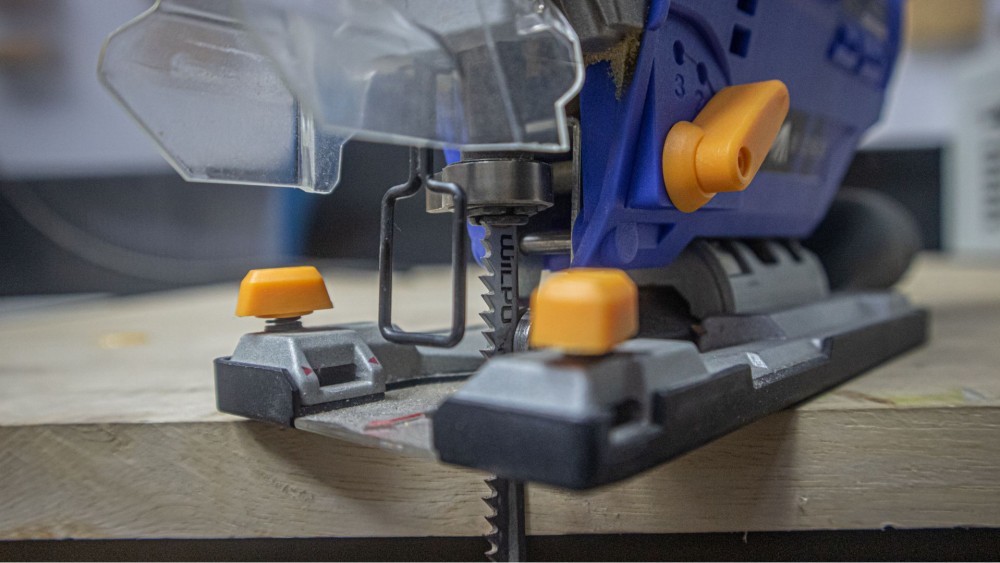
While this feature is very useful for bevel cutting, it is also a common source of problems. After making angled cuts, if the base is not returned completely flush to the zero position, or if the tool's angle scale is off, the base may look like it is at 90 degrees when it is actually tilted slightly.
This kind of discrepancy is often hard to detect with the naked eye, especially on jigsaw bases that are scratched or have small angle scales. You should verify it with an engineer's square rather than relying solely on the markings on the tool.
Here is how to check:
- Unplug the tool or remove the battery first.
- Install a blade that is straight and in good condition.
- Place an engineer's square on the base plate.
- Check whether the blade is perpendicular to the base along its entire length.
- If you see a gap between the blade and the square, loosen the lock and readjust the base until the correct angle is achieved.
Don't Rely on Detent Grooves Alone
Some jigsaw models feature detents or positive stops at 0 and 45 degrees to help adjust angles quickly, but detents do not provide the exact same precision on every machine.
Manufacturing tolerances, component wear, impacts, or uneven screw tightening can cause the jigsaw base to shift out of true alignment. Therefore, for jobs requiring precision, always verify with a square after adjusting the base—especially before cutting actual, expensive, or limited materials.
Jigsaw base bent from impact or dropping
Jigsaw bases are typically made of stamped steel, cast aluminum, or alloys designed for both strength and light weight. Even though they seem sturdy, they can still bend if the tool falls from a bench, has heavy objects placed on it, or hits the floor. The problem is that a slightly bent base might not be clearly visible, but when placed on the workpiece, it won't make full contact with the surface, causing the entire jigsaw to wobble or tilt during cutting.
When the base doesn't sit flat on the surface, hand pressure won't be distributed evenly. The tool may tilt to one side with the motion of the saw stroke, pulling the blade off track. The longer the blade, the thicker the material, or the higher the tool speed, the more obvious blade deflection becomes. The cut on the top surface might still look close to the marked line, but the underside cut will be beveled and wider than expected.
Checking if the jigsaw base is flat
- Place the jigsaw on a truly flat surface, such as a steel table, machine bed, or a thick piece of glass that can support its weight.
- Try gently pressing down on each corner of the base.
- If the tool rocks, makes a clicking sound, or any corner lifts off the surface, the base is likely not flat.
- You can use a steel ruler placed across the base to check for any bulging, bowing, or hollow spots.
If the jigsaw base is severely bent, you should not try tapping it with a hammer or bending it back without the proper tools and knowledge, as this can crack the base, deform mounting holes, or shift reference angles even further. A safer solution is to replace it with matching spare parts for your model or have it inspected by a service center.
Loose jigsaw base lock causing the angle to shift during cutting
Even if the base angle is set correctly, loose screws, nuts, or locking levers can cause the base to shift during cutting. This is especially true when using a jigsaw on hardwoods, metal, laminates, or materials that generate high vibrations. Vibrations from the reciprocating blade mechanism can cause an already loose locking point to gradually shift, resulting in a creeping change in the base angle.
A common symptom is that the initial part of the cut appears straight, but as you cut further, the cut edge begins to tilt or veer off line. Sometimes users feel they need to twist the tool to try pulling the blade back onto the line. When this happens, stop the tool immediately. Do not force the cut, as fighting the blade's direction increases the risk of bending or breaking the blade, or burning the workpiece.
Before starting work, check that the base lock is tightened securely, but do not overtighten beyond the manufacturer's specified torque, as threads, mounting holes, or the locking lever could be damaged.
If the base still moves after tightening, it may be due to a missing washer, worn threads, or damaged internal locking parts, which should be repaired before putting the jigsaw back to use.
Wood chips and dust under the base can tilt the jigsaw unnoticed
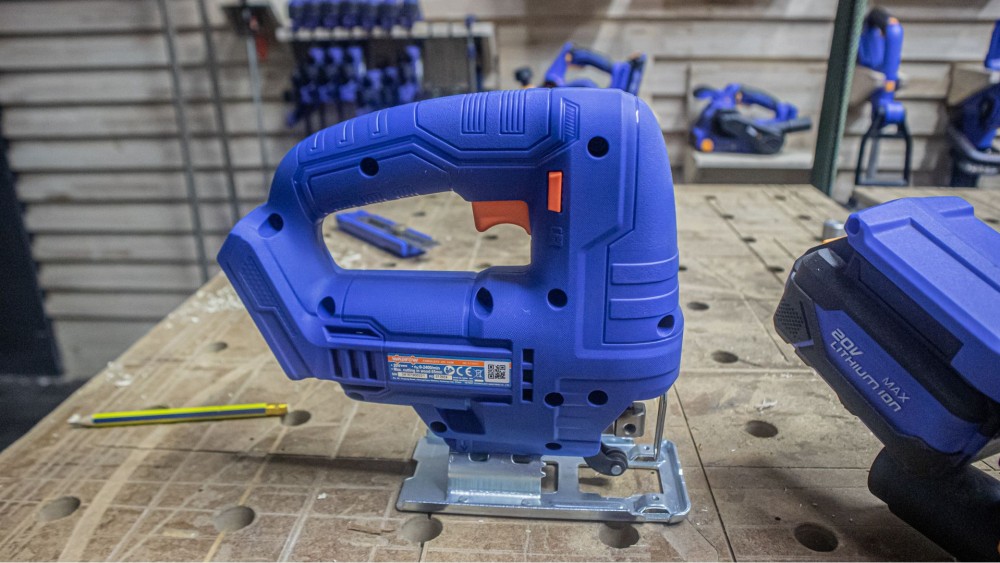
During jigsaw operation, wood chips, sawdust, metal dust, and adhesive residue can accumulate under the tool base. Although these debris particles are small, if caught near the edge of the base or in angle adjustment slots, they can lift the base off the workpiece surface. When the base doesn't contact the workpiece fully, the tool will start to tilt or wobble under hand pressure.
This problem is common when cutting materials that produce very fine dust, as well as when an anti-scratch cover plate is attached to the base, because dust particles can accumulate between the cover and the base. You should periodically blow out or brush off the base, always unplugging the cord or removing the battery first, and never brushing near the blade with bare hands since the blade teeth can still cut even when the tool is not running.
Scratches on the base surface also affect tool gliding
A base covered with deep scratches, metal burrs, or raised edges can cause the jigsaw to snag on the workpiece surface. When the base snags, pushing harder can jerk the tool forward and cause the blade to deflect sideways, especially during long straight cuts or when using a straight edge guide.
Beyond affecting precision, a base with sharp burrs can also scratch laminates, painted wood, or decorative sheet materials. Some jigsaw models therefore include a plastic base cover to help prevent scratching. Ensure the cover is securely attached, unbroken, and free of debris trapped inside. A loose cover can become the cause of base wobbling instead of protecting the workpiece surface.
The base plate is not the only cause, but it is the first place you should check
Although the base plate significantly affects whether a fretsaw or jigsaw cuts straight, a slanted cut can be caused by a combination of several factors, such as:
- Choosing a blade that does not match the material
- The blade is too thin
- The blade is unnecessarily long
- Dull blade teeth
- Setting the orbital action too high
What to consider before choosing a fretsaw? Weight, convenience, cordless or corded? When these factors combine with a tilted base plate or one that does not sit flush against the surface, errors increase even further.
Checking the base plate does not mean ignoring other causes; it means starting from the tool's primary reference point. If the base is not set correctly, replacing the blade, reducing speed, or trying harder to control your hands may still not solve the problem.
How to set the fretsaw or jigsaw base before actual cutting
Before starting work, unplug the tool or remove the battery. Then check that the jigsaw blade is inserted all the way and locked securely, is not bent or chipped, and is suitable for the material to be cut. Next, clean underneath the base plate, inspecting for dust, debris, and damage that might prevent the base from sitting completely flat.
Place a standard engineer's square on the base and align it against the side of the saw blade. Avoid placing it against the teeth, as alternating left-and-right tooth sets can make it look like the blade is not perpendicular even when the blade body is straight. If you find the angle is off, loosen the base lock and readjust. Once the desired angle is achieved, tighten the lock firmly. Then recheck, as the base may shift slightly during tightening on some models.
After setting the fretsaw base, you should make a test cut on a scrap piece of the same material first. Then inspect the top surface, bottom surface, and cut face. If the cut is still angled, proceed to check the saw blade, blade guide roller, RPM, orbital action setting, and your feed technique.
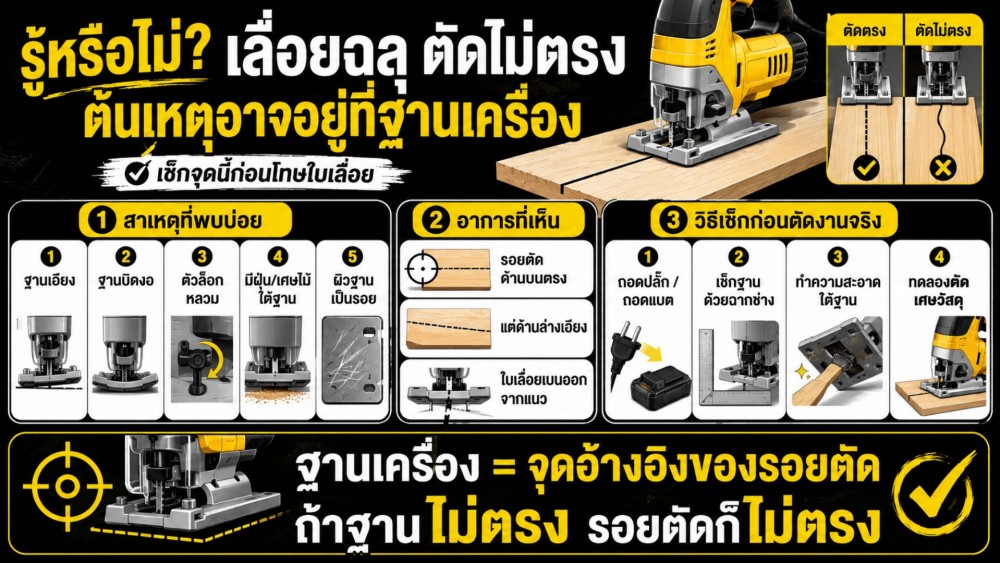
Conclusion: If your jigsaw does not cut straight, don't just blame the blade
When a fretsaw or jigsaw cuts crooked, many people immediately start by changing the blade or trying harder to force the machine along the cut line. However, a component that should never be overlooked is the base plate. The base determines the plane, angle, and stability of the machine throughout the cut. If the base is tilted, warped, loosely locked, obstructed by debris, or not in full contact with the workpiece, the cut can wander off line and bevel even if you follow the top line well.
Before starting any job, you should always check the flatness of the base, verify the angle with a square, clean the surface, tighten the lock securely, and make a test cut on scrap material before working on the actual piece.
When the base plate is in the correct condition, the right blade is chosen for the material, and proper speed and feed pressure are used, Coping saw / Fretsaw you can achieve noticeably straighter, cleaner, and more precisely controlled cuts.