


 EN
 ไทย



Customers Also Purchased
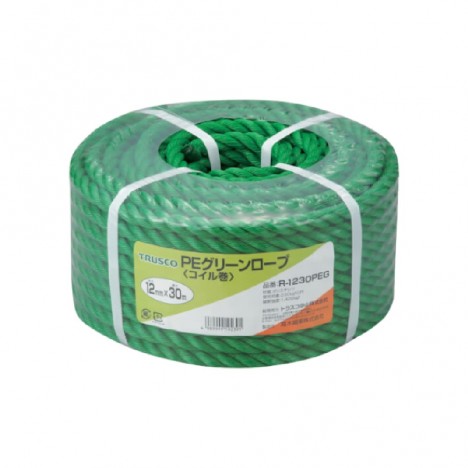


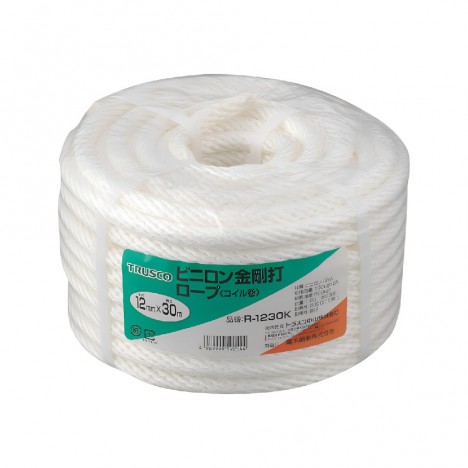
When buying Ropes we often see load rating numbers printed on labels or in product details. Some models state that the rope can withstand hundreds of kilograms, while others use terms like Breaking Strength, Minimum Breaking Strength, or Working Load Limit. These numbers might all seem to indicate how strong a rope is, but their meanings and intended applications are quite different.
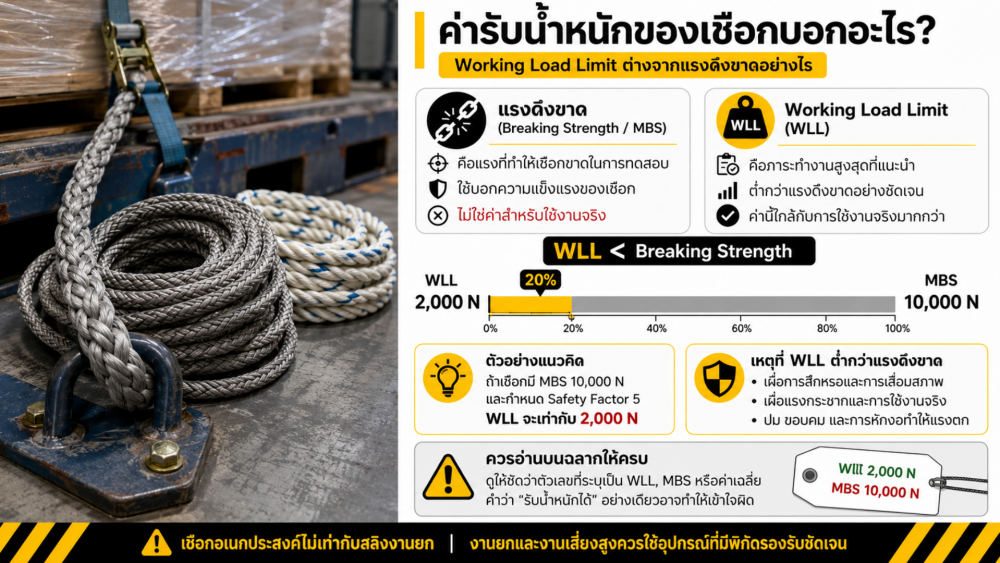
A common misconception is that when a rope states a breaking strength of 1,000 kgf, it can be used to suspend or pull loads weighing 1,000 kg. In reality, breaking strength is a value obtained from testing the rope to destruction, not the weight it is designed to handle in regular use. A value closer to actual practical use is the Working Load Limit (WLL), which defines the allowable force range under conditions specified by the manufacturer.
Reading load ratings correctly not only helps you choose the right rope for the task, but also reduces the risk of using general-purpose ropes for pulling, towing, or lifting applications requiring higher loads than the rope was designed to handle.
How breaking strength indicates rope strength
Breaking Strength or Breaking Load refers to the force that causes a rope to break during testing. Typically, a rope sample is secured in a testing machine and tensile force is continuously increased until the fibers or rope structure can no longer support the load. The measured value therefore indicates the level of force the rope can withstand under those specific test conditions.
If the product specifications state Minimum Breaking Strength (MBS), it refers to the minimum breaking strength defined by the manufacturer based on the test method. Average Breaking Strength, on the other hand, is an average calculated from multiple samples. This difference is crucial because an average does not mean every single rope will break at that same force, and it should never be used directly as the working load.
The values obtained from testing can also vary depending on the material, rope construction, termination method, sample length, loading rate, and environmental conditions during testing. Ropes of the same diameter may therefore have different load capacities; for example, nylon, polyester, and polypropylene ropes possess different fiber properties even though they may look similar on the outside.
Breaking strength figures are therefore suitable for comparing the relative strength of ropes under comparable conditions, but they should not be directly interpreted as the safe load that can be suspended, pulled, or lifted, especially when the test method and manufacturer's test conditions are unknown.

Working Load Limit is the value used for actual operation
The Working Load Limit (WLL) is the maximum load that the manufacturer or standard specifies the product can support under stated working conditions. This value is typically significantly lower than the breaking strength because it accounts not only for the strength of a brand-new rope, but also incorporates margins for material variations, wear and tear, abrasion, shock loads, and actual real-world on-site factors.
For certain types of rope, manufacturers may determine the WLL based on the Minimum Breaking Strength divided by an appropriate Safety Factor. For example, hypothetically, if a rope has an MBS of 10,000 N and the product specifies a Safety Factor of 5, the WLL will be 2,000 N. This figure is meant to illustrate the relationship between the two values; it does not imply that every type of rope should use a Safety Factor of 5.
An appropriate safety factor depends on the type of application, load characteristics, potential consequences of rope failure, and product specifications. General tie-down ropes, tow ropes, hoist ropes, and lifting slings should not automatically share the same safety factor. Users should not take the breaking strength from the product page and arbitrarily divide it by a self-chosen number to determine a new WLL. If the manufacturer specifies a working load limit, that value should be used strictly in accordance with the specified limits and usage guidelines.
The fundamental difference between WLL and breaking strength lies in their purpose. Breaking strength indicates the load level a rope can withstand before failure in a test environment, whereas WLL defines the operational limit that should not be exceeded. Just because a rope does not break when subjected to loads exceeding its WLL does not mean it remains safe; internal fibers may have suffered damage, experienced permanent elongation, or lost strength while appearing normal on the outside.
Why the Working Load Limit is Much Lower Than Breaking Strength
The margin between breaking strength and WLL is not a reserve allowance meant for users to add more weight, but rather a safeguard to account for uncertainties encountered in real-world applications. Ropes in testing laboratories are typically new, loaded straight in-line without wear, and secured using controlled end terminations. In real-world conditions, however, ropes may be knotted, passed over sharp edges, subjected to repeated bending, loaded at angles, or exposed to sunlight, heat, and chemicals.
Tying knots is a clear example. When a rope bends within a knot, the load is distributed unevenly among its fibers. The outer curve is stretched while the inner curve is compressed and subjected to friction. Consequently, the strength of a knotted rope is generally lower than that of a straight rope. The exact degree of strength reduction varies depending on the knot type, rope material, and construction, so a single percentage reduction should not be applied universally to all ropes.
Ropes run over sharp edges or undersized pulleys can degrade rapidly, as the fibers undergo localized compression, bending, and abrasive friction. Even if a rope has a high nominal strength, improper contact points can severely reduce the load-bearing capacity of the entire system. Selecting a rope must therefore take into account the sheaves, hooks, shackles, anchor points, and surfaces with which the rope comes into contact.
Shock loading is another factor that can cause tension in the rope to far exceed the static weight of the object—such as towing with slack in the line before jerking it taut, or lifting an object rapidly and stopping abruptly. During these brief moments, dynamic loads can be exponentially higher than static suspended loads. Applications prone to shock loading require rope selection based not merely on object weight, but also on movement dynamics, rope elasticity, and manufacturer specifications.

Labeled Ratings Apply to New Ropes, Not Heavily Used Ones
Breaking strength and WLL ratings generally apply to new ropes or ropes in prime condition. Through regular use, load capacity can degrade due to abrasion, cyclic bending, ultraviolet radiation, heat, chemicals, oils, or particulate contaminants penetrating between the fibers.
Ropes that show fraying, cut fibers, flattening or irregular twisting, stiffness, scorch marks, or discoloration may no longer retain the strength stated on their labels, even if unbroken. Furthermore, sand particles and fine abrasive grit can abrade the internal fibers each time the rope flexes or moves, accumulating internal damage that is difficult to detect externally.
Environmental impacts vary among different rope materials. Some synthetic fibers offer superior UV resistance, while others may absorb moisture or change physical properties when wet. It is essential to consult the material data sheet and manufacturer recommendations rather than applying a single assumption to every rope.
Before use, inspect the entire rope, connections, and all load-bearing hardware. If indeterminable damage is found, the usage history is unknown, or the rating label is missing, do not test-load the rope to see if it holds—especially in critical applications where rope failure could result in catastrophic consequences.
Read Kilogram Ratings on Product Pages Thoroughly
Many product listings state only that a rope "holds X kilograms" without clarifying whether that figure represents breaking strength, average test load, or Working Load Limit. This easily misleads buyers into assuming that the stated kilogram rating reflects the actual working capacity of the rope.
Technically, force is specified in newtons (N) or kilonewtons (kN), while kgf denotes kilogram-force, with 1 kgf approximately equal to 9.81 newtons. However, unit conversion alone does not ensure correct rope selection if the underlying category of the rating remains unknown.
Before purchasing, verify whether the specifications define Minimum Breaking Strength (MBS), Average Breaking Strength (ABS), or Working Load Limit (WLL), and confirm whether the value applies to raw rope or terminated assemblies, as well as the intended application. If a listing only states "capacity" without contextual data, it should not be used for lifting, work at height, overhead suspension, or safety-critical operations where rope failure could endanger personnel.
General-Purpose Ropes Are Not the Same as Lifting Slings
Standard general-purpose ropes sold on reels may be suitable for utility tying, agriculture, fisheries, or non-critical pulling tasks. Even if a breaking strength is indicated, it does not imply that the rope is engineered or rated for rigging machinery or overhead suspension.
Lifting operations require slings or rigging hardware engineered specifically for lifting, clearly marked with a WLL or Rated Capacity, and provided with rated capacities across different hitch configurations. Vertical, basket, and choker hitches significantly alter the tension acting on the sling, even when using the identical sling.
A lifting assembly also includes hooks, shackles, anchor points, end terminations, and load-bearing structures. If any component has a lower rating than the rest, it becomes the immediate weak link of the entire system. A high rope breaking strength alone does not guarantee that the overall system can safely lift the intended load.
How to choose a rope based on load capacity without misusing it
The starting point is not finding the rope with the highest number, but first determining what it will be used for. For general tying, you might prioritize material, flexibility, and environmental resistance. But for pulling, towing, or use with pulleys, you must also consider the working load limit, termination method, contact points, and the possibility of shock loads.
When the manufacturer specifies a WLL, you should use that value as the boundary and follow the specified conditions; never substitute it with breaking strength. If only the MBS or Breaking Strength is provided, consult the manufacturer or seller to see if there is a recommended working load limit, rather than calculating it yourself using an arbitrary safety factor.
For lifting, towing, working at heights, or applications where a snapped rope could cause personal injury, use equipment specifically designed and rated for that purpose, and inspect every component in the system. Do not judge based on rope diameter or the claim "load-bearing" alone.
Breaking strength indicates the point up to which a rope can withstand force under test conditions, while the Working Load Limit indicates the level within which it should be operated. This difference explains why a rope with a high breaking strength might have a significantly lower working load limit, and why reading all accompanying labels thoroughly is more important than merely looking at the highest number.