


 EN
 ไทย


Customers Also Purchased


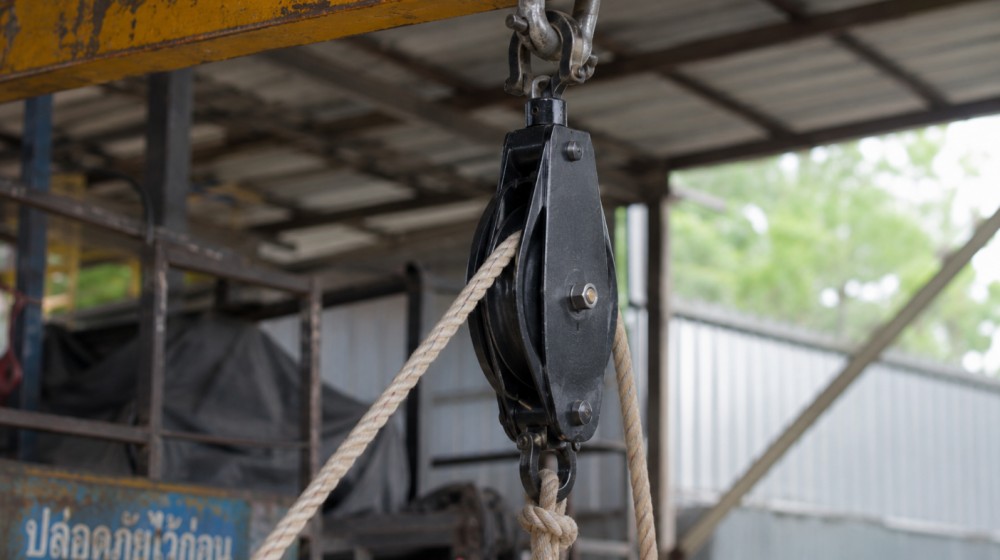
Steel Snatch Block Single SheaveThey are devices that make lifting or pulling objects more convenient, but that does not mean all types of pulleys reduce effort equally. Some pulleys simply change the direction of force, allowing users to pull the rope in a more comfortable posture, while others help distribute the load across multiple rope segments, genuinely reducing the required effort.
The key principle does not lie solely in the number of pulley wheels, but in the number of rope segments supporting the pulley block that moves along with the load. If two rope segments support the object, the weight is divided between both segments. If there are four segments, the force is divided further according to the number of segments. However, this mechanical advantage comes at the cost of having to pull the rope over a longer distance, and in practical use, friction, the pulley's own weight, and rope bending also come into play.
How Rope Pulleys Work
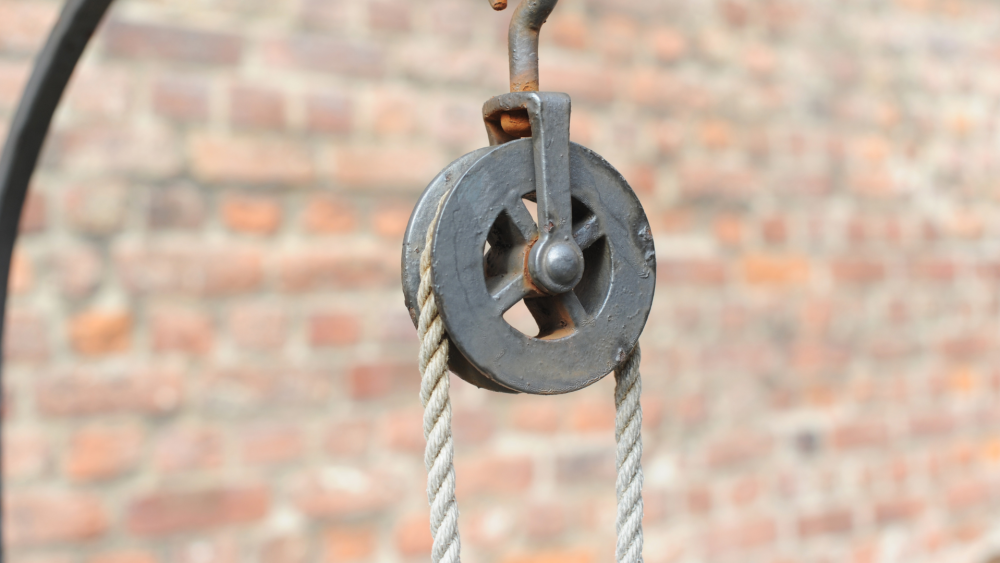
A rope pulley consists of a grooved wheel that accommodates the rope. The wheel rotates on an axle inside a pulley frame. When the rope is pulled through the groove, the wheel turns with it, helping the rope change direction smoothly and reducing friction compared to dragging the rope over a stationary edge.
Assuming the pulley rotates freely, the rope does not stretch, and there is no friction, the tension in each segment of the same rope will be nearly identical. When multiple rope segments help support a movable pulley block, the force from each segment combines to hold the load, allowing the user to apply less pulling effort.
For example, if two rope segments support the weight, each segment bears approximately half the load in an ideal system. If there are four segments, each bears roughly one-fourth. This principle allows us to estimate the mechanical advantage of a pulley system by the number of rope segments supporting the movable pulley block, rather than just counting the number of pulley wheels.
Pulleys Reduce Effort, but Require Pulling the Rope Further
Pulleys do not generate additional energy, nor do they eliminate the work required to lift an object. What changes is how the force and distance are distributed. If a system halves the required force, the user must pull the rope approximately twice the distance the object moves. If the force is reduced to one-fourth, the user must pull about four times the lifting distance.
Suppose you want to lift an object 1 meter using a system supported by two rope segments; the user would need to pull approximately 2 meters of rope in an ideal system. If using a pulley block system supported by four rope segments, you would have to pull about 4 meters of rope to raise the object the same height.
Therefore, the higher the mechanical advantage of a pulley system, the less effort the user exerts, but the longer the rope needed, the more time required to pull, and the more rope segments to manage. When choosing a pulley system, you should consider the weight of the object, the lifting height, and the installation space, rather than simply opting for the highest mechanical advantage.
Fixed Single Pulleys Help Change the Direction of Force
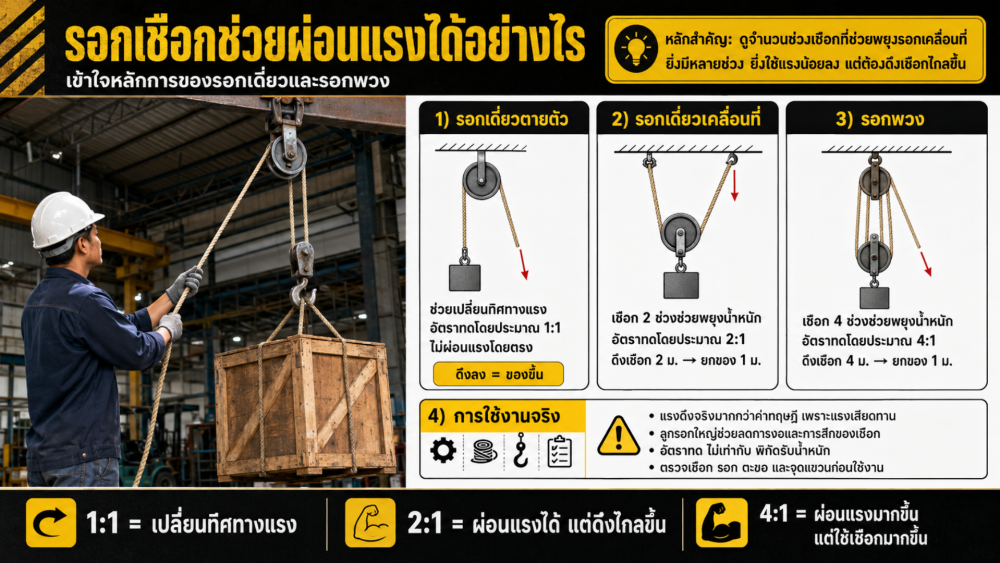
A fixed single pulley is attached to a beam, ceiling, or structure, where the pulley's position does not move along with the object. A common setup involves tying one end of the rope to the object and running the rope over the overhead pulley; the user pulls down on the other end, causing the object to move up.
This system has only one rope segment directly supporting the load, so its mechanical advantage in an ideal system is approximately 1 to 1. If the object has a weight equivalent to a force of 500 N, the user must still exert roughly 500 N when disregarding friction. The pulley does not reduce the weight, but it converts lifting straight up into pulling down on a rope, which is an easier posture to control and allows body weight to assist in pulling.
Fixed single pulleys are therefore suitable for raising flags, lifting buckets from below, pulling materials up to upper floors, or redirecting rope lines around obstacles. The primary benefit of this type of pulley is convenience and directional change, not direct mechanical advantage.
Movable Single Pulleys Help Divide the Load into Two Parts
Unlike fixed pulleys, a movable single pulley is attached to the object or suspension assembly and moves up and down along with the load. One end of the rope is anchored to a structure, then runs around the bottom of the pulley wheel, while the other end is used for pulling.
Looking at the pulley block, two rope segments support pulling the pulley up. If the tension in both rope segments is roughly equal, the load is divided between both ropes. The mechanical advantage in an ideal system is therefore approximately 2 to 1.
If the total weight of the object, pulley block, hook, and rigging accessories equals a force of 500 N, the user would theoretically need to exert about 250 N of force, but must pull about 2 meters of rope to raise the object by 1 meter. A limitation is that the pull end of the rope may need to be pulled upward, which is inconvenient in some tasks; therefore, a fixed pulley is often added above to redirect the force for easier downward pulling.
The added fixed pulley does not automatically increase the mechanical advantage. As long as there are still only two rope segments supporting the movable pulley block, the mechanical advantage remains roughly 2 to 1—it simply allows the user to pull the rope in a more comfortable direction.

Compound pulley systems provide mechanical advantage through multiple rope segments
A compound pulley, or block and tackle system, pairs an upper pulley set with a lower pulley set. The upper set is fixed to a structure, while the lower set moves along with the load. The rope is threaded back and forth between the two sets, creating multiple rope segments supporting the lower block.
To determine the mechanical advantage of a compound pulley, count the number of rope segments that actively support the moving block. If there are two supporting segments, the theoretical mechanical advantage is approximately 2 to 1; if four segments, about 4 to 1; and if six segments, it can increase to about 6 to 1.
For example, if the total weight to be lifted is equivalent to a force of 600 Newtons, an ideal system with four supporting rope segments will require a pulling force of approximately 150 Newtons. However, the user must pull about 4 meters of rope to raise the load by 1 meter.
The number of visible pulley sheaves alone does not indicate the exact mechanical advantage, as the termination point of the rope and the reeving method affect how many segments actually support the moving block. Systems with the same number of sheaves can yield different mechanical advantages if reeved differently.
Why the actual pulling force is greater than calculated values
Ratios like 2 to 1 or 4 to 1 represent ideal systems that do not account for friction and equipment weight. In real-world applications, losses occur from sheave axles, bearings, rope grooves, rope bending, and friction against the cheek plates. In addition, the lower block, hooks, slings, and rigging hardware add extra weight that the system must lift alongside the load.
During a steady lift, the actual pulling force is typically higher than the value calculated from the theoretical ratio. A 4 to 1 system does not mean you will pull exactly one-quarter of the weight every time, especially when using small sheaves, stiff bearings, stiff rope, or pulling at an angle off-axis.
Pulling out of alignment also causes the rope to rub against the cheek plates, leading to edge wear and increasing the risk of the rope jumping the groove. Installations should ensure the rope enters the groove as straight as possible and select pulleys that rotate smoothly under operating conditions.
Sheave size affects rope wear
Sheave size does not increase the mechanical advantage if the number of rope segments remains the same, but it directly affects rope bending. When rope runs through a small sheave, it is forced around a tight radius, subjecting its internal structure to higher bending stress. Under repetitive use, the rope can become stiff, flattened, deformed, or wear out faster than when using properly sized sheaves.
The sheave groove should also match the type and size of the rope. Grooves that are too narrow can pinch and deform the rope, while grooves that are too wide or heavily worn provide poor support, causing the rope to twist or chafe against the sides. Selection should be based on rope diameter and manufacturer specifications, rather than price or external dimensions alone.
Pulleys reduce effort, but do not increase weight capacity
Mechanical advantage and weight capacity are two entirely different concepts. Even if the user exerts less pulling force, the total load is still transferred through the rope, sheaves, hooks, slings, anchor points, and overhead structure. Every component must withstand the forces dictated by the system's configuration, not just the force applied by hand.
The rating of the entire system is limited by its weakest component. Do not multiply the mechanical advantage by the rope's rated capacity and assume the system can lift that much more. For example, using a rope rated for 100 kg in a 4 to 1 pulley system does not automatically mean the system can lift 400 kg; the ratings of the pulleys, hooks, anchor points, reeving arrangement, and tension on each segment must also be verified.
Pulleys intended for clotheslines, sliding doors, agricultural uses, or simple rope redirection may not have the construction or ratings suitable for overhead lifting. For lifting applications, select pulleys or pulley blocks specifically certified by the manufacturer for lifting, with verifiable load ratings.
Overhead anchor points must sometimes bear more than the load weight
The pulley anchor point is a critical component that should not be overlooked, as it must bear the resultant force of all rope segments pulling on the block. A fixed pulley redirecting a line roughly 180 degrees with similar tension on both sides can subject the anchor point to nearly twice the rope tension, though the actual force varies with the rope angle and installation setup.
Never evaluate the load capacity of beams, anchors, bolts, eyebolts, or supporting structures based solely on the weight of the object. Account for rope lines, deflection angles, rope dead-end attachments, and the actual forces exerted on the pulley assembly. For heavy loads or overhead lifting over work areas, have the system inspected by qualified lifting personnel before use.
Selecting the right pulley system for the job
If you simply want to redirect force—such as standing on the ground and pulling downward on a rope to lift an object—a single fixed pulley may be sufficient. It allows you to pull in a comfortable posture and control the load more easily, even though it provides no direct mechanical advantage.
If the load is too heavy to lift with manual effort alone, a single movable pulley or a compound pulley system will help distribute the weight across multiple rope strands. However, you must prepare sufficient installation space and rope length. Tasks requiring very high lifts may not be suitable for excessively high mechanical ratios, as the operator must pull the rope several times the lifting height and manage multiple rope strands simultaneously.
For heavy loads, continuous operation, or applications where falling objects pose a risk, use equipment specifically designed for lifting. Check the rating and condition of every component. Never substitute with general-purpose pulleys of unknown specifications, even if they appear sturdy.
Inspect the pulley and rope before use
Before lifting, check that the sheave rotates smoothly, the axle is not loose, the pulley frame is not bent or distorted, and the groove has no sharp edges, cracks, or damage that could cut the rope. The rope must be free from broken strands, flattening, stiffness, burns, or chemical degradation. Hooks, rings, pins, shackles, and anchor points must be in sound condition and suitably rated for the job.
During operation, pull the rope smoothly without jerking, keep the rope aligned within the groove, and keep hands away from the pinch point between the rope and sheave. Never stand, walk, or work beneath a suspended load, and do not leave loads suspended on a pulley system without a backstop or locking mechanism.
Loads should be secured using suitable slings, hooks, or rigging hardware. Never wrap the running line passing through the pulley directly around the object, as this can deform the rope, cause improper friction wear, and make the load harder to control.
Know how to count rope parts before using a pulley
A single fixed pulley only redirects pulling force, with an ideal mechanical advantage of about 1:1. A single movable pulley has two rope strands supporting the load, providing an ideal mechanical advantage of about 2:1. Compound pulley systems can add more rope strands to provide even greater mechanical advantage.
The key is to count the rope strands supporting the movable pulley block, not just the number of sheaves. Remember: the greater the mechanical advantage, the longer the rope you must pull. In practical use, you must also account for friction, equipment weight, and verify the load ratings of pulleys, ropes, hooks, anchor points, and all system hardware.
A pulley is thus a mechanical advantage tool that makes lifting tasks easier, but safety does not depend on the mechanical advantage alone. Choosing the correct type of equipment, aligning it properly during installation, and operating strictly within rated capacities are equally essential.