


 EN
 ไทย


Customers Also Purchased


Solar BatteriesBatteries do not suddenly fail once their rated years of service are up; instead, they gradually store less energy, deliver power for shorter durations, and handle heavy loads less effectively, until their capacity is no longer sufficient for system requirements.
The time it takes for a battery to reach that point varies widely. Some lead-acid battery banks may show capacity loss after just a few years of use, whereas certain lithium iron phosphate (LiFePO4) models are designed to withstand thousands of cycles. However, this does not mean every battery of the same chemistry will have identical lifespan.
Battery chemistry is only one factor; actual service life also depends on daily depth of discharge, ambient temperature, operating current, charger settings, and whether battery capacity is properly matched to the connected electrical loads. If a system drains the battery nearly flat every night, even a high-quality battery can degrade faster than in a system engineered with reserve capacity.
Evaluating Battery Lifespan: Both Years and Cycles Matter
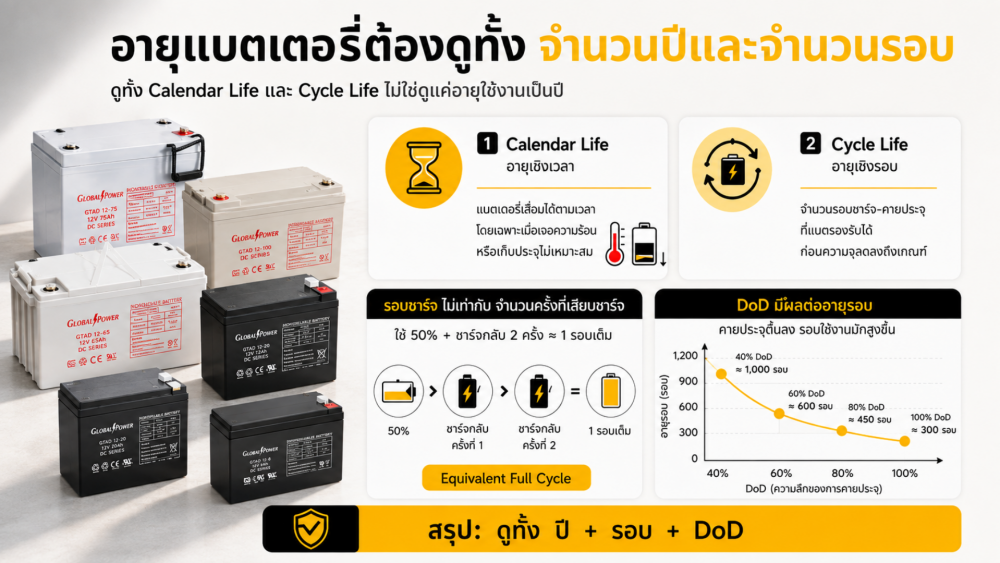
Battery lifespan data is typically expressed in two forms: calendar life (time-based life) and cycle life (charge-discharge cycles).
Calendar life refers to degradation over time. Batteries can degrade even if they are not heavily charged and discharged daily, as internal chemical reactions proceed continuously—especially when stored at elevated temperatures or improper states of charge.
Cycle life is the number of charge and discharge cycles a battery can deliver before its capacity drops to a defined test threshold, such as retaining a specific percentage of its original capacity. This number does not simply reflect how many times the battery is plugged in, but relates directly to the total amount of energy removed and replenished.
Discharging 50% capacity twice can be counted as one equivalent full cycle under the Equivalent Full Cycle concept; however, battery management systems from different manufacturers may calculate cycle counts differently, so the raw number of plug-in events should not be equated directly with cycle count.
Importantly, cycle life figures must always be read alongside Depth of Discharge (DoD), as the same battery model can yield vastly different cycle counts at different discharge depths. Victron AGM and GEL datasheets show cycle life increasing as discharges are kept shallower; for example, the same manufacturer's AGM Super Cycle battery specifies approximately 300 cycles at 100% DoD and roughly 1,000 cycles at 40% DoD under its specific test conditions. These figures illustrate the relationship between DoD and cycle life and should not be substituted directly for specs of other battery models.
So, How Long Do Solar Batteries Actually Last?
One should not generalize that every lead-acid AGM, GEL, or LiFePO4 battery will last the exact same number of years, because products within the same category can be engineered for different applications—ranging from standby backup duty with negligible cycling to daily cyclic energy storage systems.
Lead-acid batteries for solar applications can last anywhere from a few years to many years, depending on the specific model and operating conditions. For instance, Victron lists a Design Life of 7–10 years for certain VRLA AGM lines and 12 years for select GEL lines, but these are design life figures under float/ideal conditions and do not mean they will last that long in heavy daily cyclic duty.
LiFePO4 batteries are generally engineered for significantly higher cycle counts than lead-acid batteries and allow a broader usable capacity window, yet actual cycle life and usable energy still vary by model. Discover Battery offers models rated for a maximum DoD of 90%, while others allow up to 100% alongside specific energy throughput warranty terms. This demonstrates that DoD capabilities and lithium battery longevity must be verified against model-specific documentation, rather than relying on the LiFePO4 label alone.
When assessing battery lifespan prior to purchase, consider the following parameters together:
- Cycle life at a DoD matching your actual application
- End-of-life residual capacity criteria from testing
- Operating temperature specified under test conditions
- Rated charge and discharge current limits
- Warranty duration (years) and warranty terms
- Cumulative energy throughput covered under warranty terms, if specified by the manufacturer
The warranty period does not necessarily equal the total lifespan of the battery. The battery may still function after the warranty expires, though its capacity may decrease compared to when it was new, or it may degrade before the end of the period if used outside the manufacturer's conditions.
What causes solar cell batteries to degrade quickly?
Depleting the charge too low every day
Deep discharging places a greater strain on batteries, especially lead-acid types. To allow these batteries to handle more cycles, manufacturers often recommend avoiding unnecessarily deep discharges. Trojan notes that shallower discharges help prolong life, recommending a discharge of no more than about 50% for lifespan maintenance, and specifying 80% as the maximum discharge depth that should not be exceeded for applicable products. Always refer to the manual of the specific model in use.
A common cause is choosing a battery capacity that is too small. When night falls, the battery must supply nearly all of its energy to water pumps, refrigerators, lighting, or household appliances. If this occurs daily, the actual cycle count will inevitably decrease compared to a system with reserve capacity.
LiFePO4 batteries generally tolerate deep discharges better, but they must still remain within the limits defined by the BMS and the manufacturer. A 100% DoD value in product documentation refers to using the capacity range permitted by the system, not pulling the cell voltage down to zero.
Lead-acid batteries not fully recharged
Lead-acid batteries are not suited to remain in a low state of charge for extended periods, as lead sulfate crystals can accumulate on the plates, making recharging more difficult and reducing capacity.
This issue often occurs during consecutive days with little sunshine, when the solar array size is insufficient for the energy consumed, or when appliances are running so much that the next day's solar power cannot fully recharge the battery. The system thus remains trapped in an undercharged state day after day.
Deep cycle batteries are built to be discharged and recharged multiple times, but that does not mean they can be left at a low charge for long without consequence. Trojan explains that deep cycle batteries are designed to deliver power over long periods and handle repetitive discharges, but proper maintenance and recharging remain crucial to their service life.
Charger settings mismatched with the battery
Flooded, AGM, GEL, and LiFePO4 batteries require different charging profiles, including charge voltage, absorption duration, float voltage, and temperature compensation. Selecting the wrong battery type in a solar charge controller or inverter can lead to undercharging or overvoltage.
For lead-acid batteries, continuous undercharging increases the risk of chronic undercharging and sulfation. Overcharging, on the other hand, can cause heat buildup, water loss, or excessive gassing.
Lithium batteries must operate in conjunction with a BMS, which limits voltage, current, and temperature, but you should not rely on the BMS to constantly cut off the system. Inverter settings should be within the range recommended by the manufacturer so the system reduces or stops charging before triggering the final protection threshold of the BMS.
Installing the battery in an excessively hot area
High temperatures accelerate the degradation of internal battery components. Batteries should therefore not be placed in enclosed cabinets under direct sunlight, heat-trapping attics, or near inverters and equipment that continuously dissipate heat.
The U.S. Department of Energy states in an energy storage system report that malfunctions in thermal monitoring and management systems can lead to excessive heat, shorten component life, and increase safety risks.
For the climate in Thailand, select a dry location out of direct sunlight with heat dissipation compliant with manufacturer specifications. The term "waterproof enclosure" does not always mean the enclosure is suitable for batteries, as a completely sealed enclosure can accumulate significant heat if not designed with proper ventilation or temperature control.
Drawing current exceeding the battery's capability
Capacity in Ah or kWh does not indicate how much current a battery can supply. You must also check continuous discharge current, peak current, and BMS limitations.
Appliances with motors or compressors—such as water pumps, refrigerators, and air conditioners—can have starting currents much higher than their running power. If the battery is undersized, voltage may drop, the system may shut down, or heat may build up at the cells and connection points.
The same applies to charging: solar panels or chargers that supply current exceeding battery specifications can cause temperatures to rise or trigger the BMS to cut off charging. System design must therefore account for both overnight energy requirements and the maximum peak power demanded at any given time.
Connecting batteries of different models or conditions together
Batteries connected in the same bank should have similar types, models, capacities, and conditions. Connecting a new battery with an old one whose capacity has degraded can cause individual batteries to reach full charge and cutoff discharge levels at different times.
In a series connection, lower-capacity units may deplete first and cause the system to shut down even if others still have energy left. In a parallel connection, current sharing may be uneven, putting heavier stress on certain batteries.
Some modular lithium battery models support capacity expansion, but this must strictly follow the manufacturer's specified module limits, age range, firmware, and connection methods. Never connect lithium batteries simply because they share the same nominal voltage on the label.
Wiring and connection problems
Loose battery terminals, undersized cables, poorly crimped cable lugs, or unequal cable lengths between parallel battery branches can create resistance and generate heat.
When voltage drops across the wiring, the inverter may trigger a low-battery alert and shut down even though the cells still hold energy. In parallel battery banks, some units may supply more current than others and degrade faster than the rest of the pack.
Connection points should therefore be tightened to the torque specified in the manual, using cables rated for the actual current, and equipped with appropriate fuses or protective devices. Tightening terminals purely by feel can lead to under-tightening or over-tightening and damaging the terminals.
Signs that it is time to inspect your battery
Degrading batteries often still charge and supply power, but their operating runtime will be shorter. Common symptoms include:
- Reaching full charge status faster than normal, but lasting only a short time in use
- Significant voltage drop when high-power appliances are turned on
- Inverter triggering low-battery warnings sooner than before
- Continuously decreasing capacity or State of Health (SOH) reported by the system
- Large voltage differences between batteries within the same bank
- BMS cutting off more frequently due to low voltage, overcurrent, or temperature
- Abnormally hot terminals, wiring, or battery surfaces
- Lead-acid battery is swollen, leaking, smells, or has significant corrosion stains
These symptoms do not yet confirm that the battery cell is damaged, as they may stem from incorrect State of Charge settings, loose terminals, undersized cables, inverter issues, or insufficient solar panel generation. You should check the voltage of each unit, current, and temperature, and perform a capacity test under load before deciding to replace it.
If you find a battery that is swollen, leaking, overheating, emitting an unusual odor, has melted terminals, or is smoking, stop using it immediately. Disconnect the charging source following safe procedures and have an installer or qualified technician inspect it. Do not attempt to open the casing or disassemble the cells yourself.
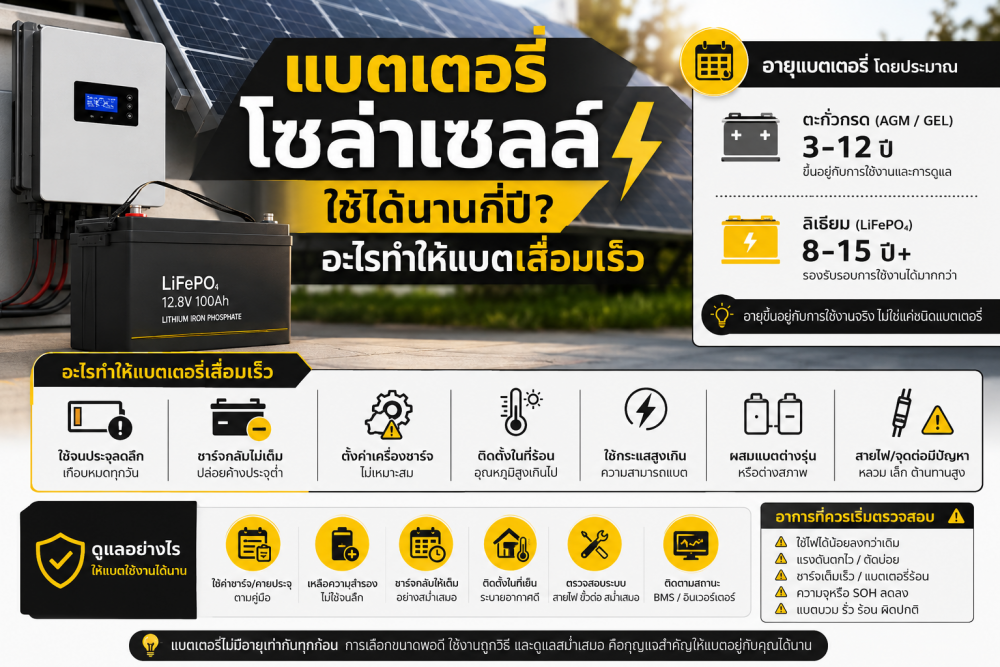
How to Care for Batteries to Make Them Last Longer
Extending battery life should begin at the system design stage, rather than waiting until after installation and trying to fix issues by limiting power consumption. Battery capacity must be sufficient for energy usage during non-sunlight hours, and solar panel capacity must be large enough to recharge the energy under actual weather conditions.
Key maintenance guidelines include:
- Use charge and discharge parameters specified in the manual for that battery model
- Set a low-voltage disconnect threshold with an appropriate reserve margin
- Avoid deeply discharging lead-acid batteries on a daily basis
- Do not leave lead-acid batteries sitting in a low-charge state
- Recharge the battery promptly when the system shuts down due to low charge
- Install in an area protected from direct sunlight and heat accumulation
- Periodically inspect terminals, wiring, fuses, and temperatures
- Do not mix batteries of different chemistries, models, or conditions arbitrarily
- Check alert logs and history from the BMS and inverter
- Avoid running high-power appliances simultaneously beyond the system's capacity
Solar BatteriesTherefore, there is no single lifespan in years that applies to every system. A more reliable way to evaluate is to look at cycle life at a DoD close to actual usage, check temperature conditions, current limits, and the warranty of that specific model, then consider them alongside the site's power consumption patterns.
A battery with a high cycle rating can degrade prematurely if operated in a hot enclosure, discharged nearly to empty, or charged with improper parameters. Conversely, a battery that is properly sized, has reserve capacity, and is correctly installed has a much better chance of maintaining its capacity and achieving a lifespan close to the manufacturer's designed performance.