EN
 ไทย


Customers Also Purchased


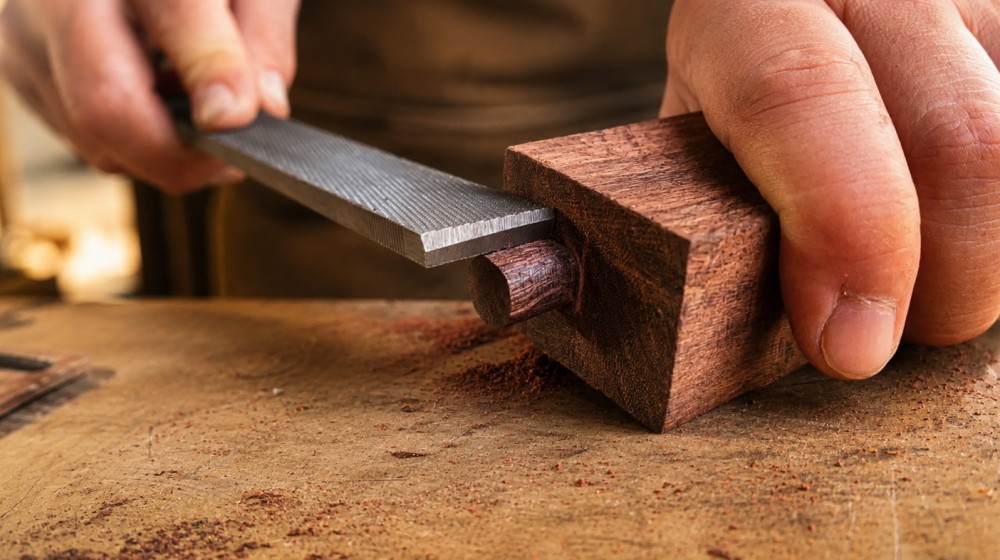
A file is a basic hand tool used for deburring, edge dressing, enlarging holes, breaking corners, and smoothing metal surfaces. Even without a motor or moving parts, it can remove material because it has numerous small cutting teeth arranged across its surface.
After extended use, many people notice that the file removes material more slowly, requires more effort, or rubs across the surface with hardly any metal chips coming off. This raises the question: can a dull file be resharpened, like a knife or a drill bit?
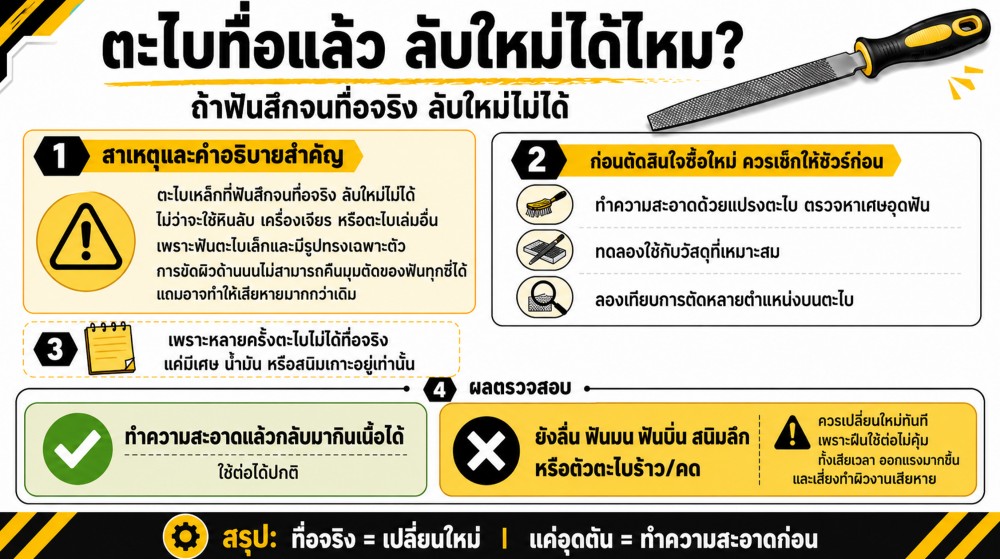
The answer is Rasps In general, files cannot be easily resharpened by yourself. Using a sharpening stone, grinder, or another file to dress the teeth is not suitable because the file's teeth are extremely small and must be aligned at specific angles and spacings. Furthermore, the entire file is specially heat-treated for hardness. If the teeth are truly worn, rounded, or chipped, restoring them to their original condition requires specialized industrial processes.
However, before concluding that a file is dull and must be replaced, you should inspect it first. In many cases where a file seems dull, it is actually just clogged with material trapped between its teeth.
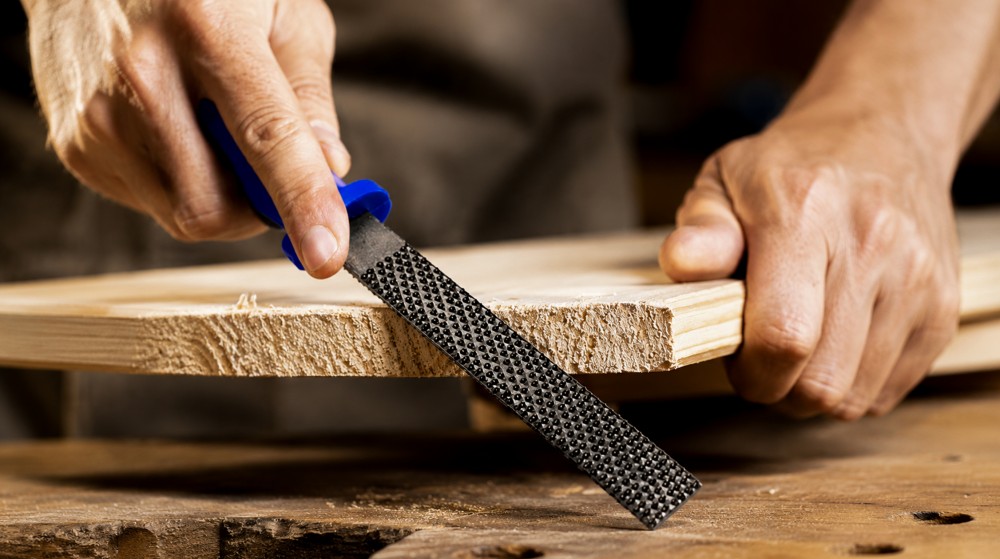
How Does a File Cut Material?
A file does not work like sandpaper, which uses abrasive grains to rub surfaces; instead, it works like a cutting tool with countless tiny cutting edges aligned together. As you push the file across the workpiece, each tooth shears small chips off the material. Cutting performance depends on tooth sharpness, tooth pattern, file coarseness, applied pressure, and the type of material.
File teeth come in various types, such as single cut, double cut, cross cut, milled cut, or diamond coated. Coarse files are used for rapid material removal, while fine files are used for finishing and precise dimensional control. Manufacturers design the number of teeth and edge geometry to suit each application. Files are made from alloy steel, with the teeth formed while the steel is still soft, and then hardened through heat treatment afterward. According to Grobet, file teeth may be formed by chiseling, milling, or specialized edge forming, depending on the required precision.
Unlike a knife, which has a single continuous cutting edge and can be easily resharpened by grinding two converging bevels, a file has hundreds or thousands of individual cutting points. Resharpening it requires restoring the profile of every single tooth without compromising height, cutting angles, and chip-clearing gullets—which is vastly more difficult.
What Are the Signs of a Dull File?
The most common sign is that the file begins to slip over the surface of the workpiece instead of biting into the material. You might hear a high-pitched scraping sound, but fewer metal shavings will come off, forcing you to apply more pressure or make multiple extra strokes to achieve the same result.
Another sign is that the file still cuts well in certain areas, but the frequently used sections are no longer sharp. For example, a flat file may wear down heavily in the center from repetitive strokes while the tip remains sharp. If you shift your stroke to another part of the file and it still cuts well, this indicates localized wear rather than a completely dull file.
When a file begins to wear out, users often apply excessive downward pressure, which can cause the file to rock or cut unevenly, leading to wavy surfaces or distorted edges. Therefore, you should maintain moderate pressure and keep your strokes steady rather than forcing the cut with excessive force.
However, keep in mind that these symptoms do not definitively prove that the file's teeth are genuinely worn down. Trapped metal chips, oil, rust, paint, or soft materials packed between the teeth can also temporarily prevent the file from cutting.
How to Check If a File Is Actually Dull
- Clean the file thoroughly before inspection every time to remove any debris that might be clogging the teeth.
- Inspect under raking light cast across the file's teeth. Sharp teeth appear crisp, distinct, and uniform. Worn teeth appear rounded, flat, or reflect light as bright shiny bands (inspecting with the naked eye is not as accurate as using a magnifying glass, but it is enough to compare worn versus unworn areas).
- Test filing on clean, non-hardened mild steel, pushing with normal force. If chips come off continuously and the teeth grip the surface well, the file is still sharp. The issue may be that the material is too hard, coated, or the wrong type of file was chosen.
- Test multiple positions across the face of the file (near the handle, in the middle, near the tip). If some spots bite into the material distinctly better than others, the file has worn unevenly. You can still use the sharp portions, but be cautious of deforming the workpiece surface.
- Conclude that the file needs replacement only after you have completed all the steps above (cleaned it + tested on suitable material + tried every part of the file) and it still feels slippery with almost no chips coming off.
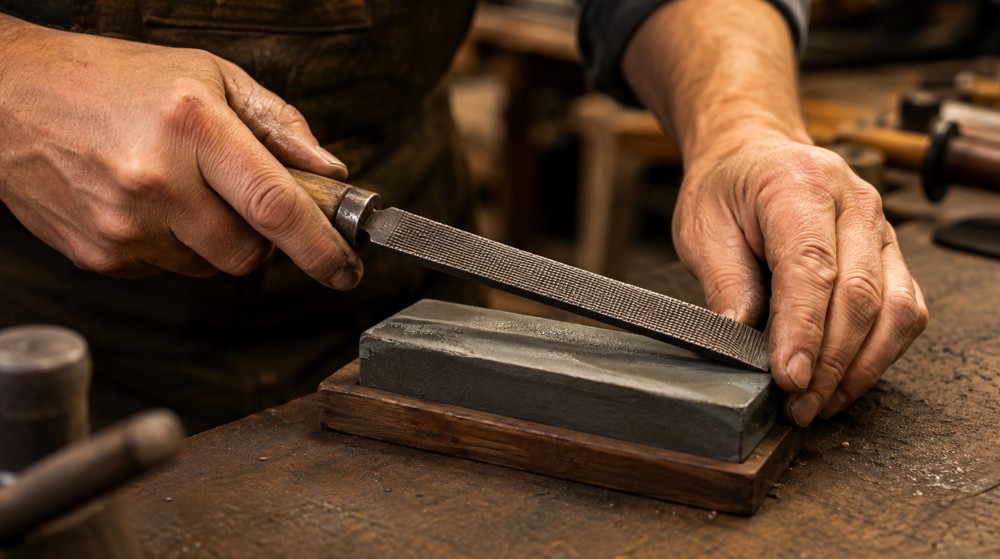
Can a dull file be sharpened with a whetstone?
The answer is no. Many people might think they can rub a file on a whetstone like a knife or chisel. But in reality, a whetstone contacts multiple tooth tips simultaneously. This kind of grinding does not create new cutting angles for each tooth; instead, it tends to flatten the tooth tips and make them duller than before. Why is it different from a knife?
- A knife has a single continuous cutting edge. Simply grinding both sides until they meet at the proper angle can restore its sharpness.
- A file features deep gullets and individually separated cutting angles. Restoring sharpness requires reshaping the tooth face, the back of the tooth, and the chip clearance gullet in coordination at every point. Rubbing a single flat surface against a sharpening stone therefore cannot restore the original tooth geometry.
Why do files become dull faster than they should?
- Choosing a file that doesn't match the material hardness. The main cause is using a standard steel file on materials as hard as or harder than the file's teeth, such as hardened steel, tool steel, or hard weld beads. When the teeth cannot bite into the surface, they rub and wear down instead of cutting. If a file slips from the very first stroke even when brand new, do not apply more pressure — it may be that the material exceeds that file's limits. Switch to a diamond file or a specialized tool for hard materials instead.
- Applying incorrect pressure. Pressing too hard → teeth bite off large chips, clog easily, and leave deep scratches on the work surface. Pressing too lightly → teeth skate across the surface without cutting, causing the tooth edges to round off quickly. Use moderate pressure so you feel the teeth cutting steadily without slipping or bogging down.
- Applying pressure on the return stroke. Standard files are designed to cut only on the forward push stroke. On the return stroke, ease up on the pressure or lift the file slightly. Pressing hard both back and forth causes unnecessary friction on the teeth and accelerates wear (except for specialized techniques like Draw Filing, which use different principles).
- Leaving chips lodged in the teeth for too long. Metal chips clogging the tooth gullets force the remaining teeth to bear a heavier load. Users often compensate by applying more pressure, causing further damage. Brush away chips periodically during work rather than waiting to clean the file all at once at the end.
- Allowing files to bang against each other. Tossing files together in a drawer causes the teeth to collide and chip invisibly. Store them separately on a rack, hang them up, or keep them in compartments that prevent the teeth from hitting one another.
- Rust forming on the file teeth. Even a light layer of rust can destroy the cutting edges, leaving them uneven and prone to crumbling. Always store files in a dry place.