


 EN
 ไทย


Customers Also Purchased
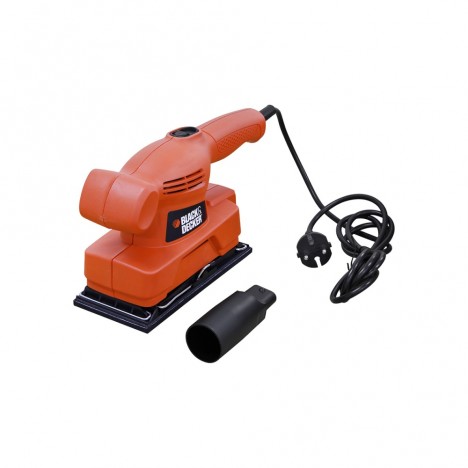




Orbital Random Sander It is a popular power tool used for sanding wood, stripping paint, finishing furniture, and preparing surfaces before painting. The tool is compact, easy to control, and delivers a more consistent finish than hand sanding.
However, many jobs involve more than just wood—especially home renovation projects like sanding plaster walls, smoothing putty, blending joints, or removing old paint stains. This leads to the question of whether we can use a random orbital sander on concrete or plaster, or will subjecting a wood sander to concrete/plaster dust cause premature damage to the tool?
The answer is that some models of random orbital sanders can be used on masonry/plaster surfaces, but they are only suitable for light surface finishing, detail work, and applications that do not require heavy material removal. They are not intended for grinding hard concrete, leveling large height discrepancies, or removing thick ridges like dedicated concrete grinders or planers can.
Additionally, you must choose the right sandpaper, connect a dust extractor, and control the downward pressure properly. Fine plaster and concrete dust can penetrate and accumulate inside the motor, bearings, vents, and hook-and-loop backing pad much more easily than typical wood dust.
How does a random orbital sander work?
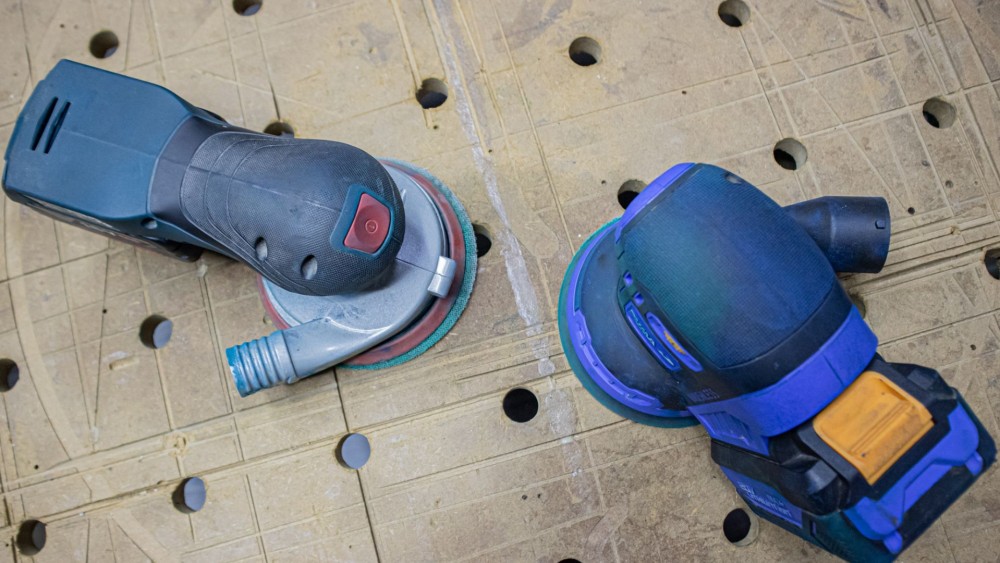
Common round disc sanders are typically Random Orbital Sanders, which combine rotation of the sanding pad with eccentric orbital movement. This dual action helps minimize swirl marks repeatedly forming in the same spot, resulting in a smoother, more natural finish than using a purely rotary tool. Consequently, it can be used for everything from coarse sanding and paint stripping to fine finishing before coating, simply by changing the sandpaper grit suitable for each step.
Besides How does the Random Orbit system of a round sander actually work? It is important to understand that not all round sander models are designed the same.
- Some models are specified for use on wood, paint, plastic, metal, or putty fillers.
- Some models support mineral surfaces.
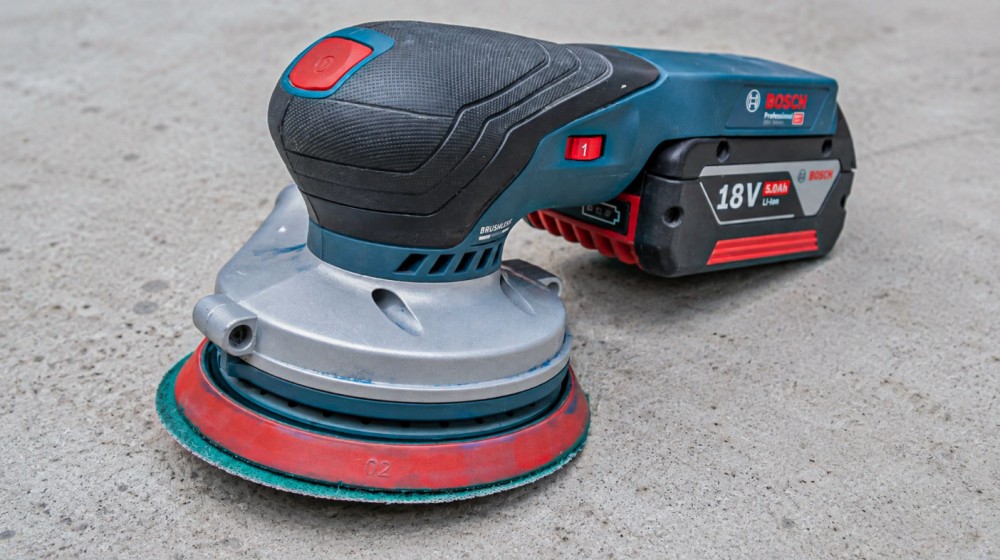
- Certain Bosch random orbit sander models can be used for sanding putty fillers, as well as mineral surfaces and acrylics.
This specification is unique to particularly designated models and does not mean every round sander is suitable for plaster or concrete. Therefore, before using a machine to sand plaster, you should check the manual or the intended application scope of that specific model.
So, how much plaster can a round sander handle?
Tasks that a round sander handles relatively well include sanding skim coats, putty, drywall mud, or completely dry coating materials, such as:
- Blending joints between newly skimmed areas and existing walls
- Smoothing out trowel marks
- Feathering edges of putty or filler
- Surface preparation before applying primer
These types of jobs do not require aggressive material removal, so the sander can save time and deliver a more uniform finish compared to hand sanding.
Crucially, the plaster or filler must be completely dry. If the surface is still damp, dust will clump on the sandpaper and clog it, preventing it from abrading the surface, causing stubborn buildup on the backing pad, and potentially allowing moisture to enter internal components of the round sander. Rushing to sand freshly applied plaster does not necessarily speed up the job; instead, it risks tearing the plaster, causing it to peel off in sheets, or creating deep gouges that require patching again.
A round sander can be used to remove old paint from walls in certain cases
A round sander can be used to scuff old paint, dull glossy finishes, or remove cracked, flaking paint in small areas. However, it is essential to distinguish between "scuffing/keying the surface" and "stripping all paint." If the existing paint still adheres firmly, you may only need to sand it to a matte finish to provide tooth for the new coat—there is no need to grind paint away until bare plaster is exposed everywhere.
If old paint is peeling in sheets, has trapped moisture, or the underlying plaster has deteriorated, the root cause should be resolved first—such as finding leaks, scraping away loose material, and repairing the substrate. Pressing a round sander against deteriorated plaster can enlarge the damaged area, and the resulting dust will quickly overwhelm the tool's compact dust collection system.
A round sander is not suitable for heavy leveling of cured, hard concrete
Even though a random orbital sander can sand mortar or plaster, that does not mean it can replace a concrete grinder. If the surface has high ridges, thick seams, hard concrete, or level differences of several millimeters, using a random orbital sander will be very slow, wear out sandpaper quickly, and may cause you to unintentionally press down harder on the tool. When excessive pressure is applied, the pad speed drops, motor load increases, and heat builds up without helping you sand any faster as expected.
For this type of work, tools specifically designed for material removal on concrete should be used, such as:
- Angle grinders fitted with diamond cup wheels and dust shrouds
- Concrete grinders
- Floor grinders suited to the size of the area
A random orbital sander should be used in the steps after ridges have been knocked down or primary leveling is complete, to smooth out marks and prepare the surface for painting or coating.
Concrete dust is dangerous to both people and tools
The major problem with using a random orbital sander on concrete isn't just fast sandpaper wear; it's the concrete dust generated during operation. When these materials are cut, drilled, ground, or sanded, fine dust that can enter the respiratory system may be produced, increasing the risk of respiratory diseases. Controlling dust with a dust extraction system or appropriate control methods for the job is recommended.
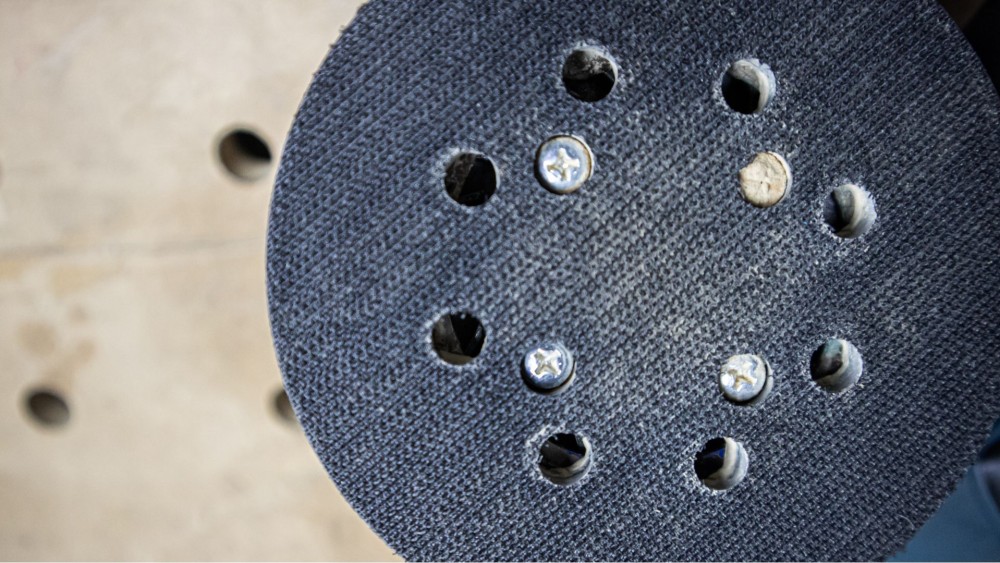
Concrete dust also directly affects the tool itself. Fine dust can pass through ventilation slots and settle on the motor, carbon brush assembly, switches, and bearings. As it accumulates, heat dissipation decreases, rotating parts may wear out faster than normal, and switches may jam. As for the sanding pad area
concrete dust adhering to the hook-and-loop system prevents sandpaper from sticking securely, which may cause it to detach or slip during operation. Therefore, you should not use a random orbital sander relying only on a small dust box when sanding walls or mortar for extended periods.
How to safely use a random orbital sander on mortar and concrete
If the tool has a dust extraction port, connect it to a workshop vacuum or a vacuum rated for fine dust. An effective dust extraction system also helps pull dust away from the abrasive surface, keeping the abrasive grains in continuous contact with the material, reducing clogging, and making scratch marks more visible. Many high-quality sanders prioritize pad hole patterns and dust extraction efficiency because good dust removal extends the life of both sandpaper and backing pads.
No need to apply heavy pressure
The proper way to use a random orbital sander is to keep the pad flat against the surface and let the tool's weight and pad motion do the work.
If you ask whether What factors determine whether a random orbital sander sands fast or slow? One answer is that pressing harder does not always speed up sanding; instead, it slows down the pad rotation, generates heat, and causes uneven sandpaper wear. If material is not being removed, switch to a coarser grit or a different abrasive type rather than simply applying more pressure.
Start at low to medium speeds
For variable-speed tools, start testing at low to medium settings. Higher speeds can sand faster, but they generate more dust and heat, clog sandpaper quicker, and make sanding marks harder to control, especially with coarse grits. Testing on a small area helps determine the right speed without damaging the mortar surface.
After sanding, shine a light at an oblique angle across the wall. Raking light reveals waviness, edge ridges, and residual sanding marks much more clearly than direct head-on lighting. If deep grooves are found, do not attempt to grind down the entire surrounding area; instead, patch and spot-fill, let it dry, and sand it smooth again.
Never wet sand unless the random orbital sander is designed for it
Although using water helps reduce dust in cutting or grinding certain types of construction materials, you should not spray water on the wall and immediately sand it with a standard electric sander—unless the manufacturer clearly states that the tool and accessories support wet sanding. Water can enter the motor, switch, and electrical systems. Moreover, some hook-and-loop sanding discs are not designed to get wet; when exposed to water, they may detach from the pad or deteriorate faster than usual.
When Should You Switch to a Dedicated Masonry Sander?
If you need to sand an entire room's walls, ceilings, high areas, or dozens of square meters, a long-reach drywall sander is more suitable because it has a larger contact surface, reaches high areas, and features a dust extraction system designed specifically for joint compound or gypsum dust. As for concrete floors, hardened mortar, or ridges that require substantial material removal, you should use a concrete sander or an angle grinder fitted with a diamond grinding wheel and a dust shroud.
Random orbital sanders remain very useful for edge detailing, spot repairs, areas around door frames, pillars, wall corners, or spots hard to reach with larger machines. However, you must also consider the amount of material to be removed, surface area, mortar hardness, and desired post-finish surface quality.
Signs Indicating You Should Stop the Machine Immediately
While sanding mortar, if you feel the machine overheating unusually, notice dropping speed, a burning smell, louder bearing noises, or abnormal vibration, you should stop operating immediately and unplug the cord or remove the battery before inspecting. The causes may include:
- Clogged sandpaper
- Dust extraction holes not aligned with the pad
- Clogged vacuum hose
- Applying too much pressure
Do not force continued use, as heat and dust accumulation can damage the motor.

In Conclusion: Can a Random Orbital Sander Sand Masonry?
A random orbital sander can be used for sanding masonry in certain applications. It is ideal for finishing plaster, sanding filler compound, feathering trowel marks, scuffing old paint, and prepping walls before painting. However, you must verify beforehand whether that random orbital sander model supports plaster, filler, or mineral-based surfaces, while also choosing the right sandpaper for the job, connecting a dust extractor, and avoiding excessive downward pressure.
If the job requires leveling hardened concrete, aggressive material removal, or working on large surface areas, a random orbital sander will not be the most efficient choice. You should switch to a drywall sander, mortar grinder, or concrete surface planer designed directly for such tasks.
Selecting tools like a Orbital Random Sander matched properly to the nature of the work will help you finish faster, achieve a consistent finish, and reduce potential damage to both the tool and the wall.


