


 EN
 ไทย


Customers Also Purchased
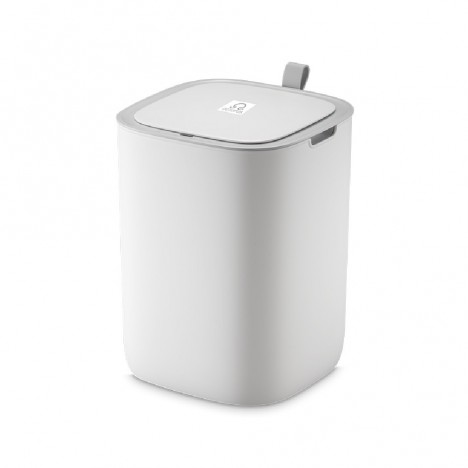
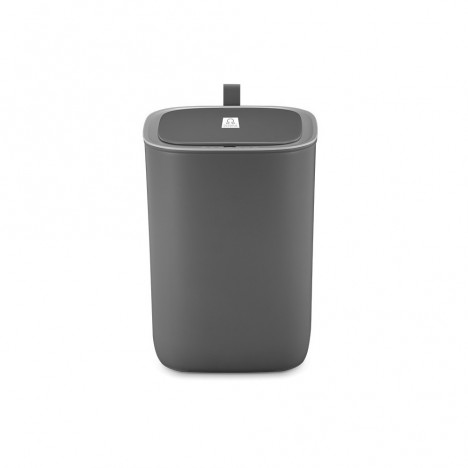
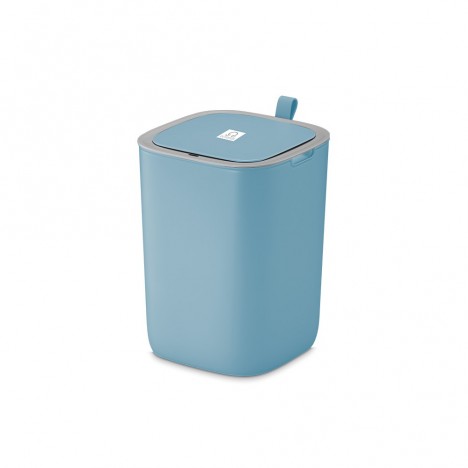
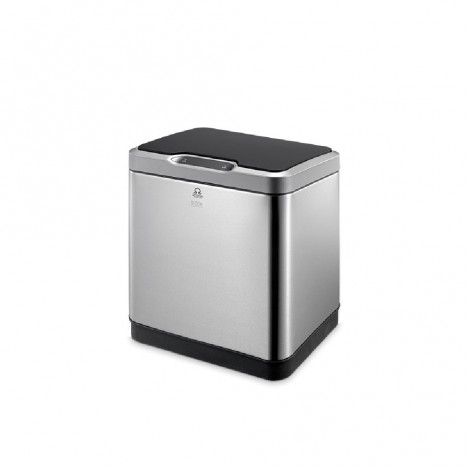
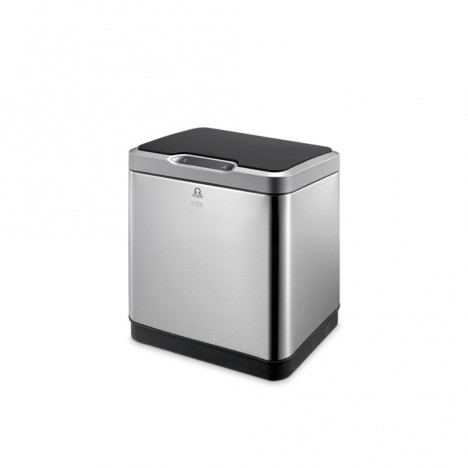
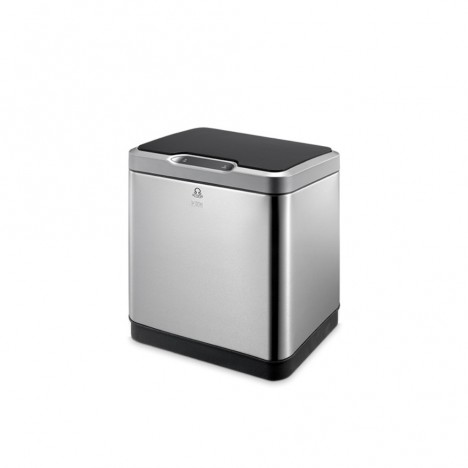
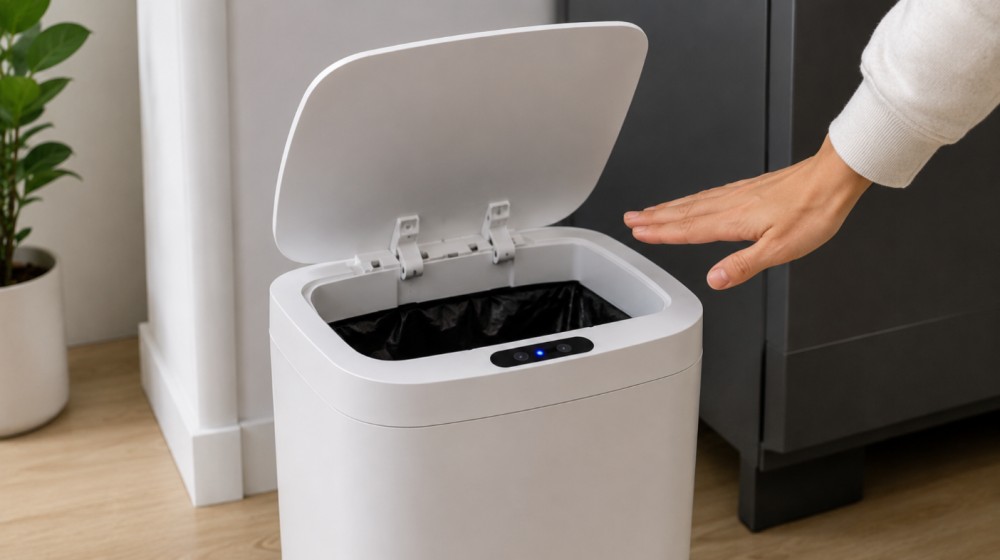
Automatic Trash CansIt looks like a simple device: just reach your hand close, the lid opens, and it closes by itself once you are done tossing your trash. But behind this brief motion, sensors, a control board, a motor, and gear sets must all work in seamless harmony.
The most common sensor found in household automatic trash cans is the reflective infrared sensor. It detects whether a hand or object is positioned above the lid. Once the circuit detects a signal matching its preset conditions, it triggers the motor to open the lid and then close it after a set period of time.
Although many sellers refer to it broadly as a "motion sensor," technically, most trash cans do not see motion like a camera does, nor do they detect body heat directly. The sensor simply emits invisible light and detects the light reflected back from a hand or object in front of it.
What Is Inside an Automatic Trash Can?
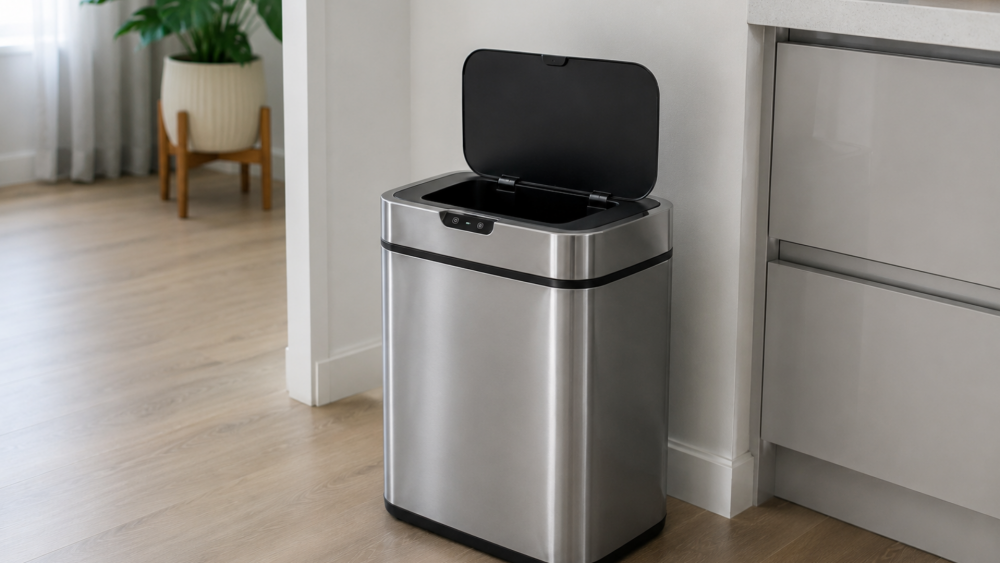
A typical automatic trash can consists of just a few main parts: a detection sensor, a control board, a motor, gear sets, the lid, and a power source—which may be dry cell batteries, a rechargeable battery, or a power adapter, depending on each model's design.
The sensor is mounted on the front or top of the lid to detect a hand before it touches the can. When an object is detected within the set range, the sensor sends a signal to the control board, which then supplies power to the motor to turn the gear set and lift the lid.
Once a hand is no longer detected in the sensing area, the circuit delays for a brief moment before signaling the motor to reverse or releasing the mechanism to let the lid close. This delay gives users time to dispose of trash without having to keep their hand hovering over the sensor the entire time.
Some models feature a button to keep the lid open, ideal when disposing of multiple items or changing trash bags. More advanced models may include low-battery alerts, motor overload protection, or automatic stopping if an obstruction is encountered.
How Reflective Infrared Sensors Work
A reflective sensor consists of an emitter and a receiver placed close together. The emitter projects infrared light forward. When a hand or object enters the range, a portion of the light reflects back to the receiver. If the amount of received light exceeds a preset threshold, the circuit determines that an object is present.
This principle falls under the category of diffuse-reflective photoelectric sensors, which detect objects based on changes in the light returning to the receiver without requiring a reflector mounted on the opposite side.
The advantages are a simple structure, compact installation space, and short-range hand detection that is fully sufficient for opening the lid. Manufacturers can also adjust sensitivity and detection range to suit the lid size and mounting location.
However, the amount of reflected light also depends on the object's color, surface texture, and angle. A hand, light-colored clothing, glossy surfaces, or objects aligned directly with the sensor may yield different signals than dark or matte objects. Basic sensors do not necessarily measure precise distance, but rather check whether the reflected light intensity reaches the circuit's defined threshold.
Infrared Does Not Mean a PIR Motion Sensor
The term "infrared sensor" might make many people think of the motion sensors used in porch lights or home security systems, but the two types operate quite differently.
PIR (Passive Infrared) sensors detect changes in thermal radiation from people or animals moving across the detection zone. They are ideal for detecting whether someone has entered an area, but not for precise short-range hand detection like a reflective sensor is.
Most automatic trash cans therefore use active infrared sensors, meaning they emit their own light and wait to detect the reflection. This operates at close range and responds accurately to the position directly above the lid. For this reason, calling a trash can't sensor a "hand-detection sensor" or "proximity sensor" is more accurate than calling it a human motion sensor.
Distance-limited detection sensors help reduce false openings
Standard reflective sensors can be affected by distant objects or backgrounds. If the sensitivity is set too high, the lid may open when someone walks past or when there is movement nearby.
Some sensors address this problem by designing the optical transmission and reception paths to intersect only within the desired range. Objects are effectively detected when they enter the convergence zone of both optical paths. This method limits the detection area and reduces background interference, although actual performance depends on the lens assembly geometry and the circuit tuning of each product.
For trash cans, setting an appropriate distance is critical. If the distance is too short, users may need to bring their hands so close to the lid that they almost touch it. On the other hand, if detection reaches too far, the lid may open every time someone walks by. A well-designed bin should therefore only detect the area directly above or in front of the lid, without being so wide that it encroaches on the surrounding walkway.
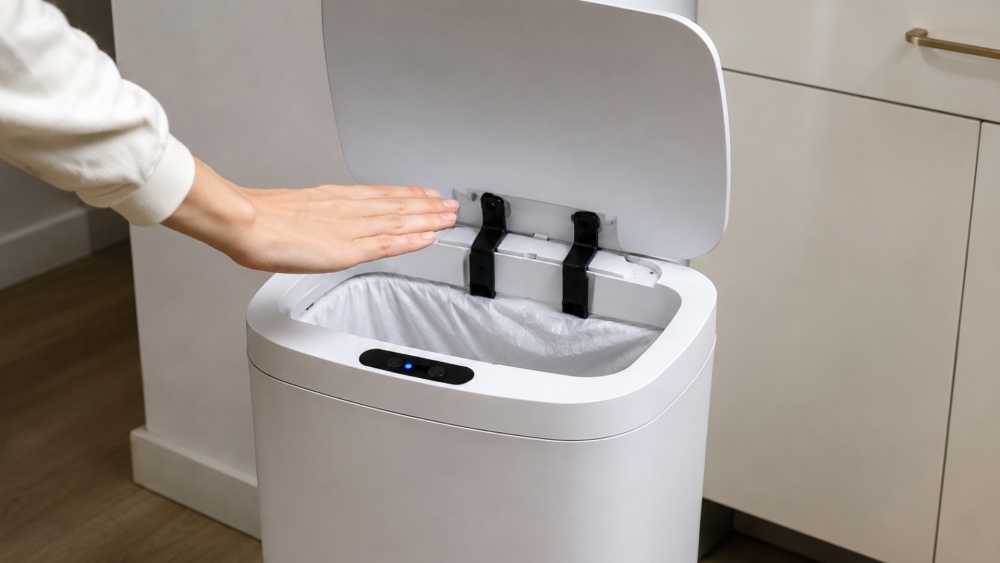
Time-of-Flight sensors offer more accurate distance measurement
Some high-end smart trash cans or automated devices may use Time-of-Flight (ToF) distance sensors instead of relying solely on reflected light intensity. The principle of ToF is to emit light and measure the time it takes to travel to an object and reflect back, thereby directly calculating the distance.
The advantage is that the measurement results are less affected by the color and reflectivity of the object compared to basic reflective sensors. For example, STMicroelectronics' ToF sensors use 940 nm infrared light and are designed to measure actual distance based on photon travel time rather than merely estimating it from reflected light intensity.
This type of sensor allows for more refined trigger conditions, such as opening the lid only when an object is detected within a preset distance while ignoring objects behind it. Although it provides better accuracy and resistance to ambient light conditions, the cost of the components and control circuitry is typically higher.
For general household trash cans, reflective infrared sensors are still sufficient for the job. ToF sensors are ideal for models requiring precise distance control, reduced false openings, or multi-gesture command support.
Ultrasonic sensors can be used, but are not the primary choice for small trash cans
Another technology that can be used for object detection is ultrasonic sensors, which emit high-frequency sound waves and measure the echo return time. This method detects objects without relying on surface color or reflectivity.
However, ultrasonic modules typically require openings for the transmitter and receiver transducers, have a relatively wide detection angle, and can easily pick up surrounding objects in tight spaces. For small trash can lids, infrared sensors are easier to integrate, look more seamless, and allow more convenient definition of the detection zone in front of the lid.
Ultrasonic sensors are more commonly found in fill-level monitoring systems for large waste bins, where they are mounted at the top to measure the distance down to the trash pile. When the distance decreases to a set threshold, the system signals that the bin is nearly full. This application differs from lid-opening sensors, even if both are used in the same bin.
Why do trash cans sometimes open on their own?
An automatic trash can that opens by itself without anyone waving a hand does not necessarily mean the sensor is broken. A common cause is the presence of an object in the detection path, such as a table edge, fabric, bag tie handle, or a wall that is too close.
Strong sunlight and certain types of lighting can also interfere with infrared receivers, particularly on bins using basic sensors or with dirty sensor windows. Dust, water stains, and scratches on the front plastic cover can scatter light in the wrong directions, causing the system to read erratic signals.
Another cause is placing the bin too close to a walkway. When people walk by, an arm, clothing, or a leg may briefly enter the detection zone, triggering the lid to open even without any intention to dispose of trash.
Troubleshooting should start by wiping the sensor area with a soft cloth, moving the bin away from objects near the front, avoiding direct sunlight, and ensuring the trash bag rim does not block the sensor window. If the model allows sensitivity or detection range adjustment, reduce the distance gradually until it suits the operating location.
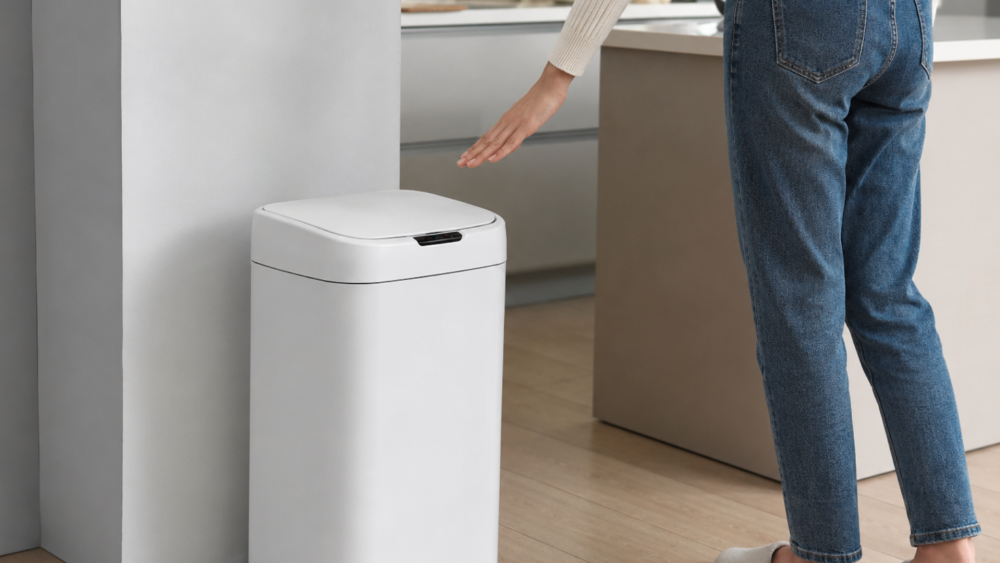
Why doesn't the lid open when waving a hand?
If the lid does not respond, the first thing to check is the power source. Low batteries may still power the indicator light, but not enough to drive the motor to open the lid. Dirty battery contacts or incorrectly inserted batteries can also cause the device to malfunction.
Next, check the sensor area to see if there is dirt, dust, or stickers covering it. Try approaching your hand from the front along the direction specified in the manual, as some models detect well only at a specific angle and do not cover the entire area around the lid.
Dark hands or objects may reflect less light in some sensor systems, so moving your hand closer or changing the angle may help it detect. If the sensor light indicates detection but the lid still does not move, the problem could be with the motor, gear assembly, or a lid jammed by the edge of the trash bag.
Do not force the lid open with excessive force, as the internal plastic gears could be damaged. Remove the batteries or turn off the switch before checking whether trash or the bag is trapped in the hinges.
Lid style affects motor operation
Automatic trash cans differ in more than just their sensors; the lid design also affects speed, noise, and energy consumption.
Single-sided lift lids have an uncomplicated structure, open wide, and make bag replacement easy, but they require sufficient overhead clearance. Butterfly lids (split left and right) use less vertical space and are suitable for placement under certain counters, but have more hinges and moving parts.
Some models use sliding lids, which do not lift the entire weight of the lid, but the sliding tracks must be clean and free of trapped debris. Regardless of the lid type, the motor operates through a gear assembly, so avoid placing items on the lid or pushing down against it while the motor is running.
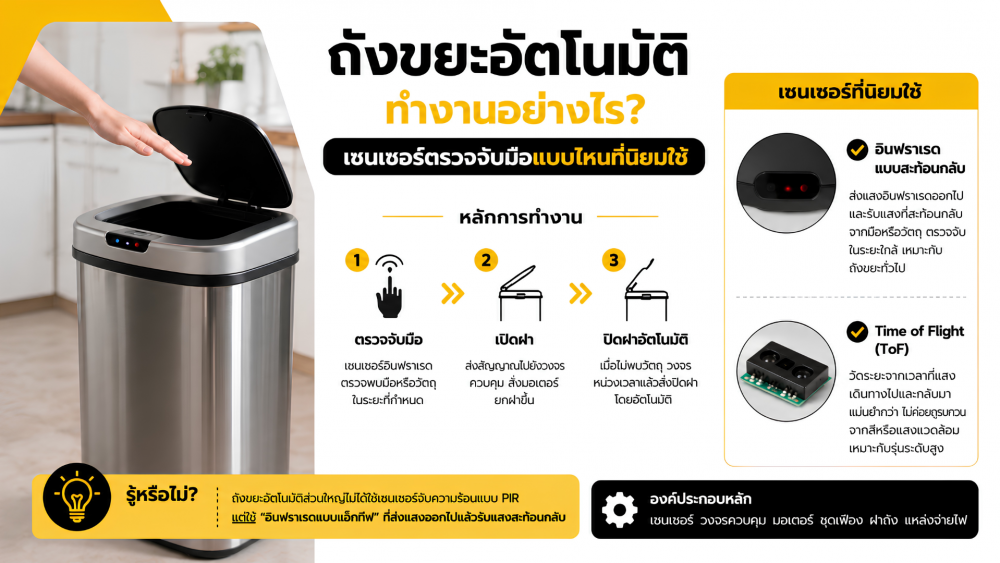
Choosing an automatic trash can involves more than just the word "sensor"
When selectingAutomatic Trash Cans The term "infrared system" alone does not tell the full story about performance quality, because infrared sensors come in various types, and the results depend on mounting placement design, signal filtering circuits, and detection range settings.
Factors to consider together include whether the detection range suits the placement location, whether the lid opens quickly without slamming hard, whether there is a stay-open mode, whether the automatic system can be temporarily turned off, and how easy it is to replace batteries and clean the sensor area.
- For the kitchen, choose a lid that seals relatively tight and has a capacity suitable for the amount of waste.
- Bathrooms or bedrooms may prioritize a compact size, quiet motor noise, and a sensor that doesn't trigger when someone simply walks past.
Automatic trash cans do not have circuitry as complex as large home appliances, but good performance relies on several details: the sensor must detect hands at an appropriate distance, the circuit must separate the true signal from ambient light interference, and the motor must open the lid without consuming excessive power.
Reflective infrared sensors remain a suitable choice for home trash cans due to their small size, low cost, and fast response. Meanwhile, ToF range-finding systems are a more accurate alternative increasingly found in higher-end products. However, regardless of the sensor type used, placement location, sensor window cleanliness, and power supply condition are always crucial factors for reliable operation.