


 EN
 ไทย


Customers Also Purchased


When looking at the specifications of a Bandsaw We may encounter one thing that differs entirely from other power saws: the use of the term "meters per minute," whereas other saws or rotary tools like drills and grinders almost exclusively specify speed in revolutions per minute, or RPM. It is not surprising that, besides What is a band saw? What is it used for? Many people may wonder why band saws do not use RPM like other tools, and how this distance-per-minute number relates to the actual cutting speed.
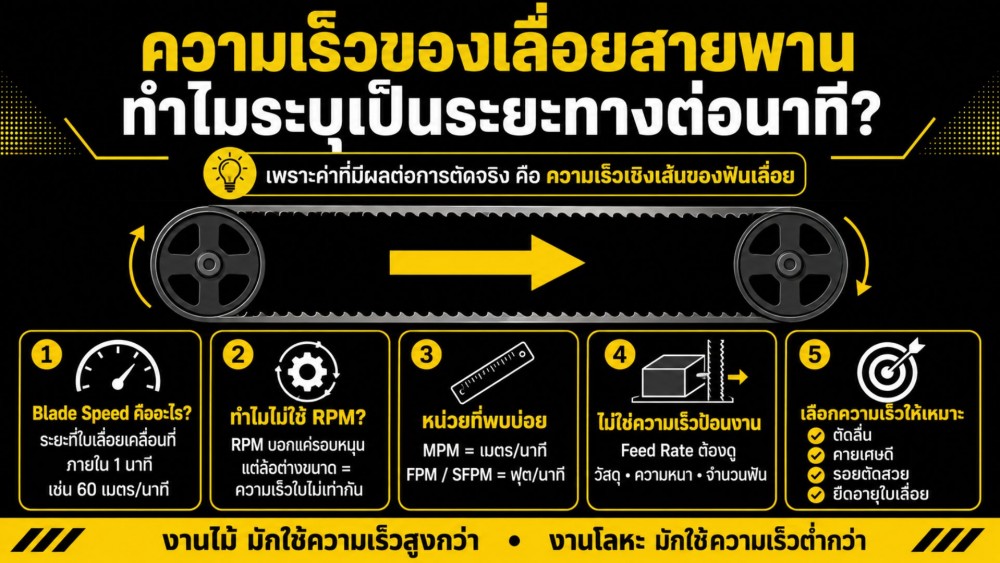
The main reason is that the cutting part of a bandsaw does not rotate in place in a circle; instead, it is a long continuous blade moving past the workpiece. The speed that directly affects cutting is not the revolutions per minute of the motor or wheels, but the distance the saw teeth travel across the material's surface over a given period. Specifying it as distance per minute makes it much clearer how fast the blade's teeth are traveling when contacting wood, steel, aluminum, plastic, or other materials.
Let's explore what bandsaw speed in distance per minute really means, how it differs from RPM, and why choosing the right speed for the material affects cutting speed, blade life, and cut quality.
What Is Bandsaw Speed?
Speed, or bandsaw blade speed, refers to the distance the blade travels in one minute. If a machine specifies a speed of 60 m/min, it means: In 1 minute, a single point on the blade travels a total path of approximately 60 meters. It does not mean the machine can cut a 60-meter-long workpiece in one minute, because this speed is not the feed rate, which is an entirely different matter.
- A bandsaw blade is a long metal band joined into a continuous loop.
- Once the machine is turned on, the wheels drive the blade continuously.
- Each saw tooth passes through the cutting zone repeatedly.
- Therefore, the number of meters per minute indicates the linear speed of the blade at the point where it contacts the workpiece.
For some bandsaw brands, you may see the unit MPM, which stands for Meters per Minute, or FPM and SFPM, which stand for Feet per Minute or Surface Feet per Minute.
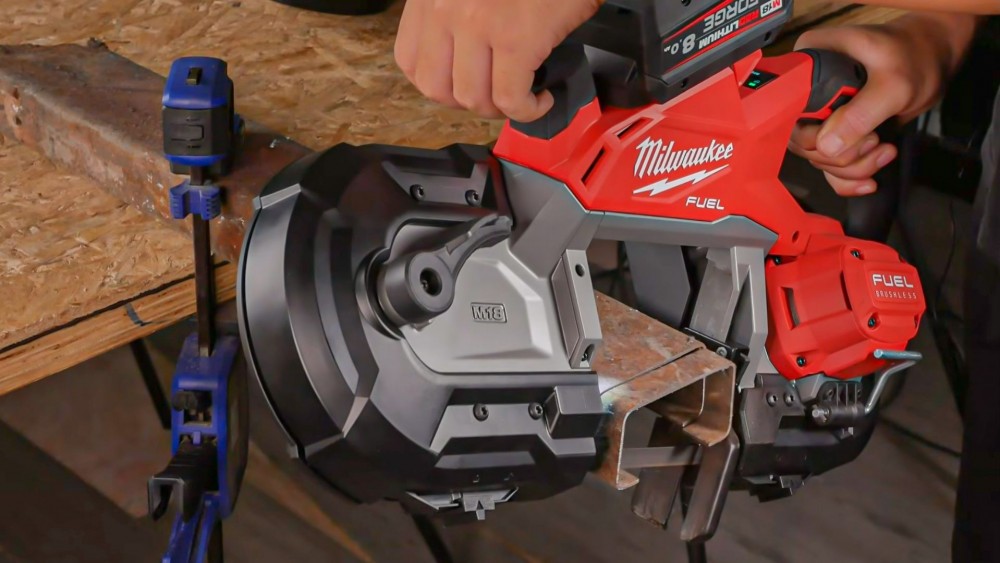
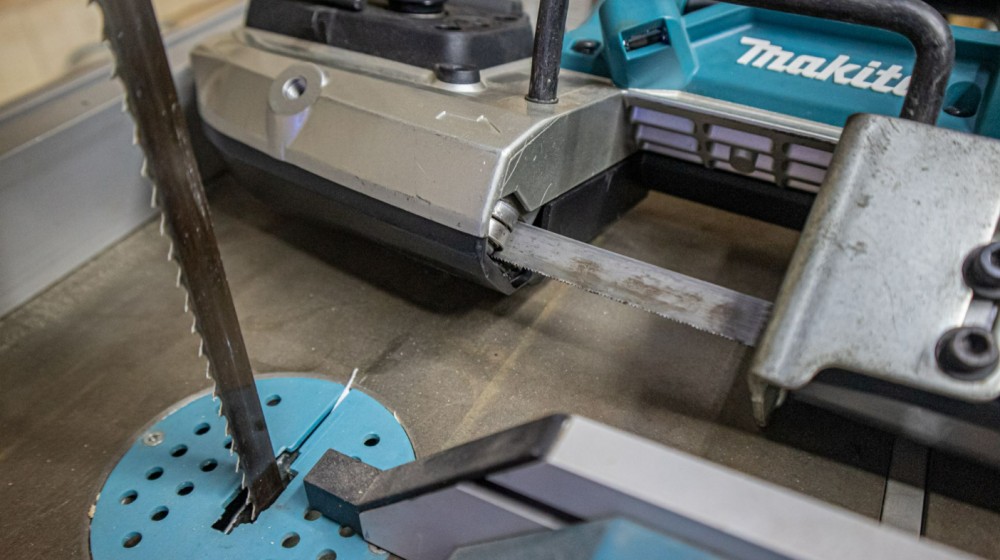
The principle is entirely the same: it indicates the distance the surface or cutting edge travels in one minute, simply using meters or feet depending on each country's measurement system.
Meters per minute is not the speed at which you push the workpiece.
Another misconception about bandsaw blades that beginner craftspeople often make is seeing a high blade speed of several hundred meters per minute and assuming the machine must cut through material extremely fast. However, the speed indicated on the machine is not the speed at which the workpiece passes through the blade.
In actual cutting operations, you must control the feed rate to match the material type, workpiece thickness, tooth count, and machine power. Even if the blade runs at high speed, when cutting thick, hard materials or large cross-sections, you still need to feed the workpiece slowly and steadily so the teeth have time to cut and clear chips from the kerf.
Feeding the workpiece too fast can cause the blade to wander, teeth to wear prematurely, the motor to overload, and cuts to be misaligned. Conversely, feeding too slowly causes teeth to rub against the material rather than actively chip away at it, generating heat buildup and dulling the teeth prematurely as well.
Why Don't Bandsaws Specify Speed in RPM?
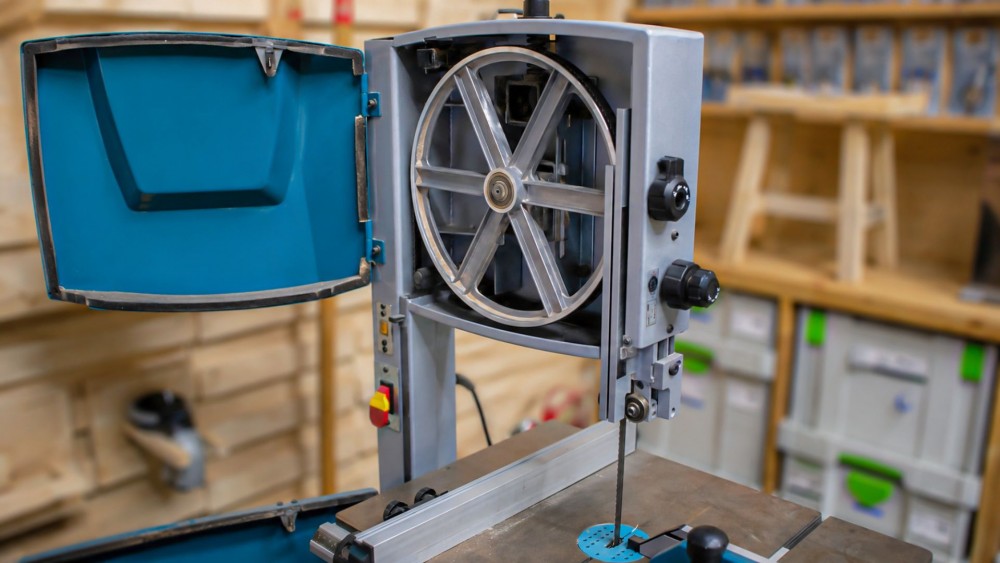
Bandsaws have several rotating components, including the motor, pulleys, and wheels. Technically, the speed of these parts can be expressed in RPM (revolutions per minute). However, the RPM of the wheels alone does not indicate how fast the blade is moving, because wheels of different sizes generate different blade speeds even if they rotate at the same RPM.
For example, if a large wheel and a small wheel both rotate at the same 500 RPM, the larger wheel moves the saw blade a greater distance per revolution due to its larger circumference. Therefore, a blade running on a larger wheel has a higher speed in meters per minute than on a smaller wheel, even though the RPM figure is identical.
Specifying blade speed as a distance per minute eliminates variables like wheel diameter, belt reduction ratio, and motor RPM. We don't need to know how fast the motor rotates, what the wheel diameter is, or how the drivetrain reduces the speed; simply looking at the actual bandsaw blade speed allows us to compare it against the material and application requirements.
Same Motor RPM Does Not Mean the Same Blade Speed
Motors in many bandsaw models may have similar rotational speeds—such as electric motors around 1,400 or 2,800 RPM—yet the machines can produce drastically different blade speeds. This is because pulleys, belts, sprockets, or gearboxes are placed between the motor and the bandsaw wheels to change the gear ratio.
A metal-cutting bandsaw may need to reduce the motor speed significantly so the blade moves slowly enough for cutting steel, whereas a woodworking bandsaw requires a much higher blade speed. Thus, they use different gear ratios even when equipped with motors of similar RPM.
If a manufacturer only specified the motor RPM, users could hardly determine whether the machine is suited for woodworking or metalworking. But when it is stated in meters per minute, the operational characteristics of the machine become much clearer.
How Is Bandsaw Blade Speed Calculated?
The principle of calculating bandsaw blade speed is straightforward: it relies on the wheel circumference and the number of revolutions the wheel makes per minute. For each rotation of the wheel, the blade travels a distance roughly equal to the wheel's circumference. Multiplying the distance per revolution by the RPM gives the linear speed of the blade.
As a simple example, if the bandsaw wheel has a circumference of approximately 1 meter and rotates at 500 RPM, the blade will move at about 500 meters per minute.
In an actual bandsaw, there may be slight differences due to the true measured wheel size, the thickness of the wheel tires, belt slippage, and rotational speed under load (Load Speed vs. No-load Speed).
This is why manufacturers pre-calculate and specify the blade speed, so general users do not need to calculate it from motor RPM themselves—unless you want to modify the gear ratio, change pulley sizes, or verify whether the machine is operating according to its design specifications.
How Are Bandsaw Blade Speed and TPI (Teeth Per Inch) Related?
Every time the blade passes through a workpiece, each tooth cuts out a small chip of material.
- The faster the blade moves, the greater the number of teeth that pass through the cut point per minute.
- Using a blade with a high tooth count (high TPI) combined with very high blade speed allows many teeth to contact the material in a short period. While this yields a finer cut finish, it also generates more heat and friction.
- Coarse-pitch blades feature large gullets for chip clearance; however, if used on material that is too thin, too few teeth will engage the workpiece simultaneously, which can cause snagging, violent vibration, or chipped teeth.
- Blade speed must work in balance with the tooth count.
- Even if the blade is well-suited to the material, running it at the wrong speed will cause rapid wear and poor cutting performance.
- Even if the speed is set correctly, using an improper tooth count for the material thickness can lead to chip clogging, machine vibration, and crooked cuts.
What Are the Benefits of a Variable Speed Bandsaw?
A variable-speed band saw increases operational flexibility, especially for metal-cutting band saws or cordless models that must handle a wide variety of materials. You can reduce the speed when cutting stainless steel or hard steel, and increase the speed when cutting aluminum or materials that are easier to cut.
The speed adjustment system may use stepped pulleys with multiple belt positions, gear sets, variable-speed drives, or motor-controlling inverters. However, regardless of the system used, the value the user needs to focus on is still the blade speed in meters per minute, not the RPM generated by the motor.
Some machines display speeds in steps, such as 20, 30, and 50 meters per minute, while others are continuously variable, such as 20–80 meters per minute, allowing for finer selection. Still, you should consult the band saw blade manufacturer's recommendation chart and perform test cuts, as optimal values may vary depending on the workpiece's thickness, shape, and condition.
A higher maximum speed figure does not always mean the machine cuts faster.
When comparing two band saws, many people might choose the machine with the higher meters-per-minute rating because it seems to work faster. However, maximum blade speed alone cannot be used to measure cutting performance. The machine must also have:
- Sufficient motor power
- A rigid structure
- Precise blade guides
- The ability to maintain speed under actual cutting loads
When choosing a band saw, you should look at the speed range suitable for the job rather than just the maximum value. If focusing on cutting various types of metal, select a machine with a versatile speed range. For woodworking, consider speed alongside motor power, wheel size, cutting height capacity, and structural stability.
Some band saw models specify speeds in meters per minute, while others use feet per minute. Before comparing figures, ensure they are in the same units to prevent misunderstandings that one machine is many times faster than another.
Conclusion: Why Is Band Saw Speed Expressed as Distance per Minute?
The reason band saw speed is specified as distance per minute is that the value directly affecting actual cutting is the linear speed of the saw teeth as they pass through the workpiece, not the RPM of the motor or the band wheels. Wheels of different sizes can produce different blade speeds even when rotating at the same RPM. Using distance per minute units allows us to see the blade speed directly and makes it easier to match with the material.
A high band saw blade speed does not necessarily mean it will cut faster or better, as it must be considered in conjunction with the material type, tooth count, workpiece thickness, feed rate, motor power, and cooling system. High speed also means teeth can heat up and wear down quickly, but if it is too low, the blade may not cut the material efficiently and will require more feed pressure.
The value specified in distance per minute, or linear speed, helps you truly know: Bandsaw What kind of work it is suited for, enabling the blade to bite into the material continuously, clear chips effectively, provide easy cutting control, and maximize blade life.