


 EN
 ไทย


Customers Also Purchased
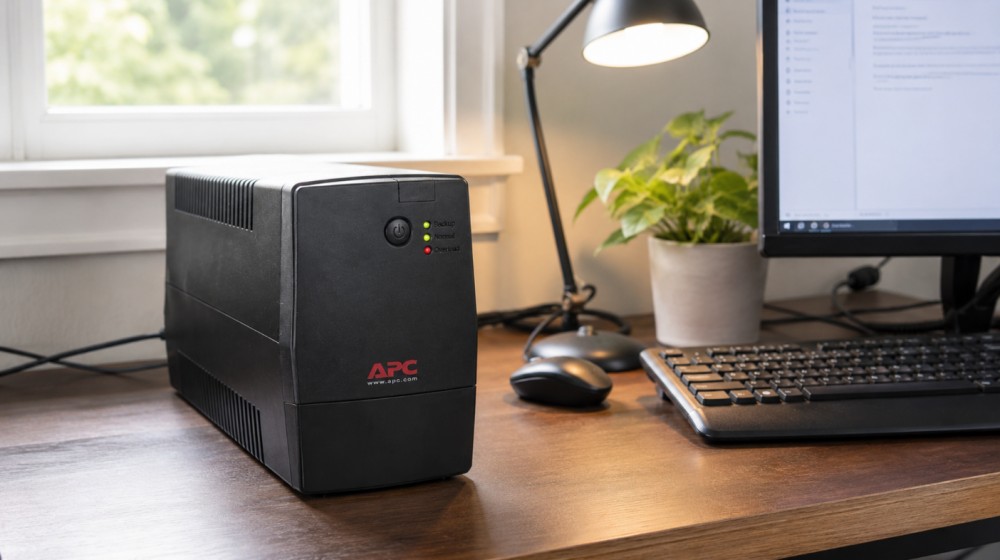
UPSUninterruptible Power Supplies (UPS) differ not only in size, VA rating, or backup runtime. Internally, their operating topologies also differ, which directly impacts their ability to handle power outages, sags, voltage fluctuations, and power quality issues.
Commonly found UPS systems are divided by their operating topology into 3 main types: Standby (or Offline), Line Interactive, and Online Double Conversion. Each type has its own strengths, limitations, and levels of protection. Selection should therefore be based on equipment requirements and local power conditions, rather than price or capacity alone.
A UPS does more than just back up power during an outage
The primary function of a UPS is to supply battery power to keep equipment running temporarily during a power outage, allowing users time to save their work, shut down computers properly, or wait for a generator to start up.
However, electrical systems suffer from more than just power outages; they can also experience voltage sags, surges, voltage fluctuations, or electrical noise. Each type of UPS handles these problems differently.Some focus on basic backup power, some feature automatic voltage regulation, while others continuously regenerate output power to ensure the connected load receives much more stable electricity.
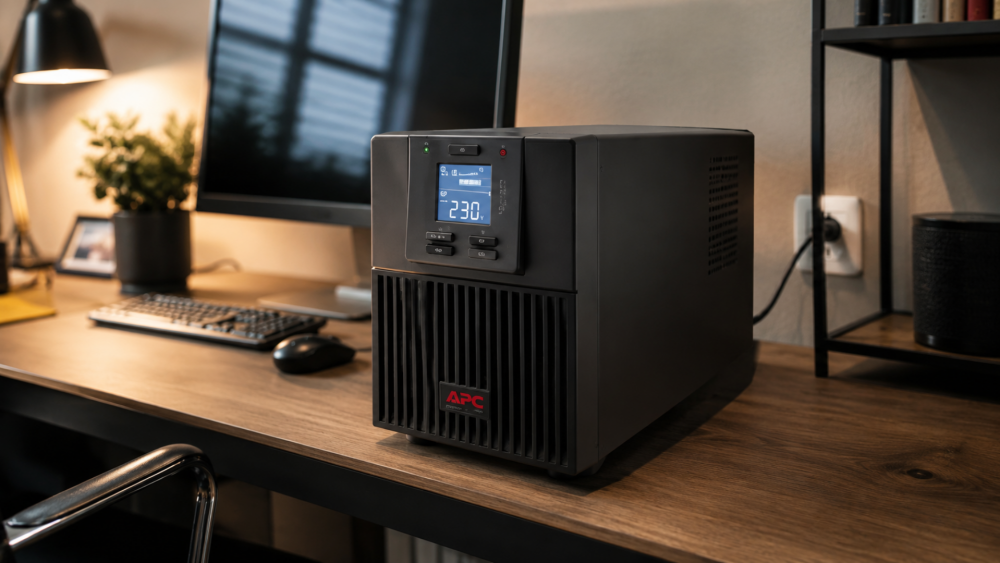
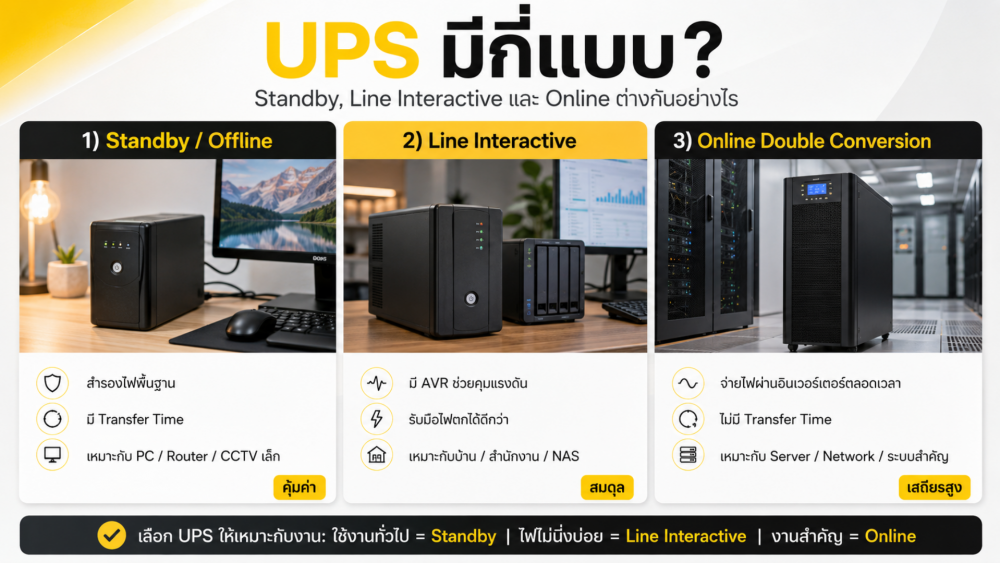
1. Standby UPS or Offline UPS
A Standby UPS has a simple design and is usually the most affordable. During normal power conditions, it supplies main utility power to connected devices, possibly passing through noise filtering or surge protection circuits depending on each model's design. The battery and inverter remain on standby. When the unit detects a blackout or voltage outside the specified range, the system switches to battery power.
This switchover is not completely seamless; there is a brief duration known as Transfer Time. General computer equipment can usually tolerate this delay because internal power supplies can temporarily sustain the voltage. However, power-sensitive systems or critical equipment that cannot tolerate any interruption may require other types of UPS.
Advantages of Standby UPS
A Standby UPS is relatively affordable, compact in size, and has low energy loss during normal power conditions because the inverter is not continuously powering the load.
Suitable for equipment requiring basic backup power, such as:
- General-use computers
- Monitors
- Routers and modems
- Small CCTV recorders (DVR/NVR)
- Cash registers or general office equipment
Limitations of Standby UPS
Voltage regulation capabilities are generally more limited than Line Interactive and Online UPS units. In areas with frequent brownouts or voltage fluctuations, the unit may frequently switch to battery power, leading to increased battery usage.
Therefore, a Standby UPS is suitable for areas with relatively stable electrical systems that only require protection against occasional blackouts, rather than applications requiring precise power quality control.
2. Line Interactive UPS
A Line Interactive UPS operates on a basic principle similar to a Standby UPS, where it uses main utility power during normal conditions, but adds a voltage compensation or regulation system, commonly referred to as AVR or Automatic Voltage Regulation.
When the voltage is lower or higher than normal within the supported range, the UPS boosts or trims the voltage without immediately switching to battery. Circuit topologies may vary depending on the manufacturer and model, but the goal is the same: to maintain the output voltage within a more optimal range.
Advantages of Line Interactive UPS
A major advantage is its ability to handle voltage fluctuations better than a Standby UPS without drawing power from the battery every time. This reduces unnecessary battery wear and is well-suited for areas prone to periodic brownouts. Line Interactive It is therefore a popular choice for homes and offices, offering a great balance between cost, protection level, and performance.
Suitable devices for this type of UPS include:
- Office computers
- Computers for graphic design
- Workstations
- Small servers
- NAS or storage devices
- Routers and network switches
- CCTV DVR/NVR recorders
- POS systems and cash registers
Limitations of Line Interactive UPS
Although Line Interactive regulates voltage better than Standby, during normal power conditions most loads still receive power directly from the main utility line, thus not completely isolating devices from power anomalies.
During power outages or when voltage falls outside the compensable range, the unit still needs to switch to battery power, resulting in a Transfer Time just like Standby, although it is generally short and sufficient for most IT equipment.
3. Online Double Conversion UPS
The Online UPS referred to in this article means an Online Double Conversion system, which is an architecture that continuously converts power twice. AC power from the utility is first converted into DC power, then the inverter converts it back into AC power to supply the load. Connected devices therefore receive power through the inverter at all times in Double Conversion mode.
When a power outage occurs, the battery immediately supplies power to the same DC bus. The inverter continues to feed power to the load uninterrupted, resulting in zero Transfer Time when switching from utility power to battery in this mode.
The term "True Online" found in some product specifications is often a marketing term. To verify the actual topology, check whether the unit is an Online Double Conversion type according to manufacturer documentation.
Key Features of Online Double Conversion
Online UPS can regulate output voltage and frequency more precisely than the other two UPS types, because the load does not receive power directly from the main utility line in Double Conversion mode. This architecture helps reduce the impact of voltage sags, voltage fluctuations, electrical noise, and various power anomalies, making it ideal for mission-critical equipment that must not experience any downtime, even momentarily, such as:
- Servers and data center systems
- Core network systems
- Communication equipment
- Industrial computers
- Certain types of control systems
- Measuring instruments sensitive to power quality
- Security systems requiring continuous operation
Certain medical devices may require a UPS that provides high power quality, but standard IT Online UPS units should not be used immediately. Always verify the equipment manufacturer's requirements, relevant standards, grounding systems, and leakage current values first.
Limitations of Online Double Conversion
Online UPS systems feature more complex circuitry and are typically more expensive. Because power is converted continuously, energy loss and internal heat generation occur within the system. However, it should not be assumed that all Online UPS models consume high power or run very hot. Actual efficiency depends on the unit's technology, load capacity, and operating mode. Some newer UPS models offer high efficiency and improved power management systems.
Medium or large Online UPS units may have cooling fans running continuously. Therefore, noise levels, installation locations, and ventilation should also be taken into consideration.
Which type of UPS should a home or office choose?
For general-use computers, a Standby UPS may be sufficient if the area has relatively stable power quality and only needs time to save work or safely shut down during a blackout.
If a home or office experiences brownouts, voltage fluctuations, or the UPS frequently switches to battery power, a Line Interactive UPS is usually more suitable because it can regulate certain voltage fluctuations without draining the battery each time. Meanwhile, Online Double Conversion is ideal for servers, data storage systems, or mission-critical equipment requiring continuous power and high sensitivity to power quality. Using it with general computers is possible, but you should consider whether your system's requirements justify the higher cost, noise, and increased power consumption.
Factories and control systems should consider more than just the UPS type
Factories house various types of equipment, ranging from office computers, PLCs, and measuring instruments to motors, pumps, and inverters. The power consumption characteristics of these devices differ significantly, so a UPS should not be selected solely based on the labels 'Online' or 'Line Interactive'.
Control systems, industrial computers, communication devices, and certain measuring instruments may be well-suited for an Online UPS if continuous, high-quality power is required. However, always verify the power capacity, surge current, and equipment compatibility beforehand.
Motors, compressors, pumps, heaters, or devices with high inrush current are typically not suitable for general computer UPS units, even if their running wattage seems low, because starting currents can be several times higher than normal.
UPS type is not the only thing to consider
Even after choosing the right type of UPS, you still need to check other details, as UPS units of the same type can vary significantly in capabilities across different models.
Information to check before making a purchase includes:
- Power capacity in both VA and Watt ratings
- Total power consumption of the connected devices
- Required backup runtime
- Inrush current / starting current of the equipment
- Output waveform in battery mode
- Number of battery backup outlets
- Battery replacement or expansion capabilities
- Alert systems and shutdown management software
- Noise level and heat dissipation
- Operating temperature and installation environment
The output waveform is another critical factor not to be overlooked. Some UPS models provide pure sine wave output, while others supply a simulated sine wave when running on battery. Compatibility should be verified against the connected equipment's specifications, especially for high-performance PCs, devices with specialized power supplies, and sensitive electronic instruments.
Choose a UPS that matches the criticality of your workload
UPSStandby, Line Interactive, and Online Double Conversion each have distinct advantages; no single type fits every application.
- Standby is suitable for basic power backup in areas with relatively stable power quality.
- Line Interactive is ideal for homes and offices that need protection against both power outages and voltage fluctuations.
- Online Double Conversion is best suited for mission-critical systems or equipment requiring uninterrupted power and high-level power quality control.
The right selection strategy is to first determine whether the equipment can tolerate transfer interruptions, how frequently power dips occur in the area, and how severe the impact would be if the system goes down. Then, select the appropriate VA capacity, wattage, output waveform, and backup runtime tailored to your actual usage.