


 EN
 ไทย


Customers Also Purchased


Ball bearingThis is a component where many choose quality because they know a failure could impact the entire machine. However, a common issue is that shortly after replacing the bearing, it starts making noise, overheating, binding, or failing to the point of needing another teardown and replacement. This naturally leads to the question: why are bearings still failing so quickly even after choosing a reliable brand?
The term "broken bearing" commonly used by technicians does not always mean the internal components have shattered into pieces. It can also refer to premature failure, unusual noise, overheating, increased clearance, or rough rotation—symptoms that are not solely caused by bearing quality.
A bearing manufacturer explained that actual service life also depends on the choice of bearing type, installation, lubrication, shaft and housing conditions, as well as dust, water, and heat in the operating environment. No matter how well a bearing is made, if surrounding conditions are improper, it can fail much sooner than expected.
Choosing the right part number, but it may still not match the application
When purchasing replacement bearings, many people simply match the old part number or measure the bore diameter, outer diameter, and width, assuming that identical dimensions mean full interchangeability. However, bearings with the same part number can differ in crucial details—including seal type, internal clearance, cage material, and suitability for specific speeds or temperatures.
Different bearing types handle loads differently: some are designed for radial loads perpendicular to the shaft, while others are better suited for axial thrust loads. If an improper bearing type is used for the prevailing load direction, even if it fits perfectly and runs initially, its internal contact surfaces will endure excessive stress.
Machinery subjected to shock loads, vibration, or frequent start-stop cycles places a much heavier demand on bearings than continuous operation at constant speeds. Selection should therefore consider not only dimensions or maximum RPM, but also real-world operating patterns.
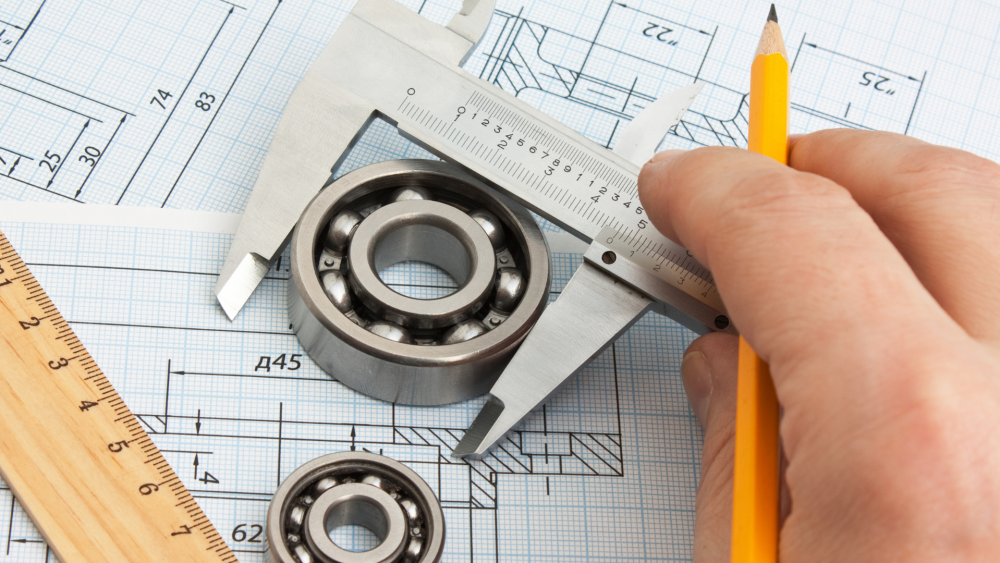
Improper installation can damage the bearing before it even runs
A new bearing can be damaged right during the installation phase. Striking it directly with a hammer, applying force to the wrong ring, or using ill-fitting tools can transmit impact forces through the rolling elements into the raceways, causing tiny indentations.
These indentations may be invisible from the outside, and the bearing might rotate normally after assembly. Over time under operation, however, these marks progressively turn into noise, vibration, and flaking—leading to the misconception that the bearing was defective.
A simple rule of thumb: when fitting an inner ring onto a shaft, the mounting force must be applied directly to the inner ring, never transmitted through the rolling elements from the outer ring. If press-fitting or thermal mounting is required, use controllable tools and techniques—never apply direct flame or rely on guessed impact force.
Too little grease causes fast wear, but overfilling causes overheating
Grease reduces friction between the rolling elements and raceways. If the quantity is insufficient, metal-to-metal contact increases, causing the bearing to heat up, wear rapidly, and become noisy sooner than expected. Conversely, completely packing a bearing with grease is not necessarily protective. The rolling elements constantly churn through the excess lubricant, creating drag and heat buildup—especially in high-speed applications.
The problem lies not only in the quantity but also in the type of grease. Grease formulated for low-speed, heavy-load applications may be unsuitable for high-speed electric motors. Likewise, general-purpose grease degrades rapidly when used near industrial ovens or other high-heat equipment.
Another frequently overlooked issue is mixing incompatible grease types. Even if they share similar colors or textures, their thickeners and base oils may clash, causing the mixture to soften, harden, or bleed oil—drastically compromising lubrication.
Dust, moisture, and fine metal debris cause severe bearing damage
Internal bearing clearances are minute, meaning microscopic dust or metallic particles can cause severe damage. When these contaminants get trapped between rolling elements and raceways, repeated over-rolling indents and wears down the surfaces.
Contamination can enter right from unboxing—by resting bearings on dusty benches, using dirty gloves or tools, or later from worn seals and covers. Bearing replacements should always be carried out in a clean workspace, and packaging should not be opened until immediately before installation.
Water and moisture also accelerate failure, particularly in washdown areas, outdoor setups, food processing plants, or steam-rich environments. Moisture causes raceway corrosion and degrades grease, even if the bearing is shielded, sealed, or mounted inside a housing.
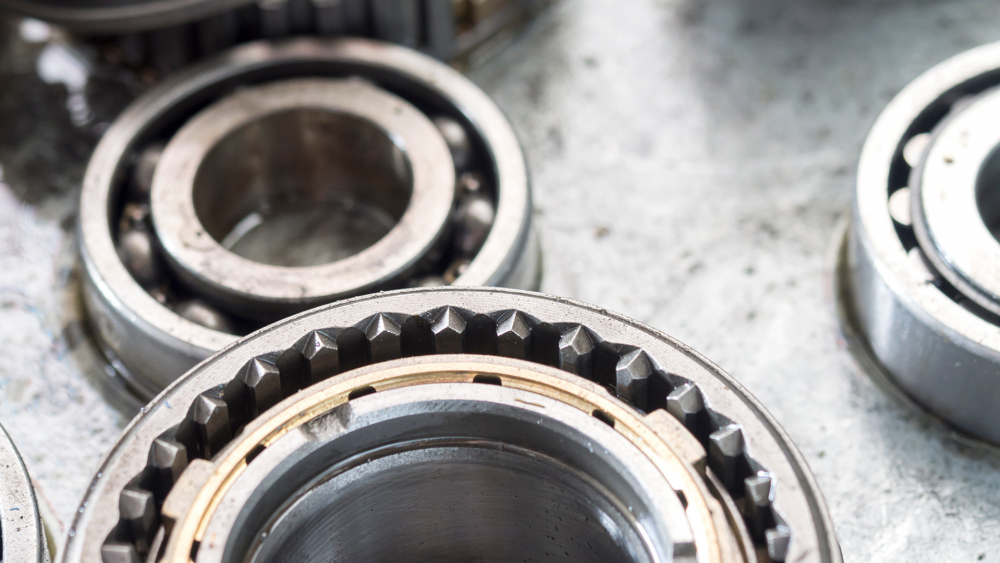
Damaged Seals: Replacing Bearings May Still Lead to Repeated Failures
Seals are not just meant to keep grease from leaking out; they also protect against dust, water, and contaminants entering the bearing. If a seal becomes hardened, torn, twisted, or worn out to the point where it no longer fits snugly against the shaft, the internal environment will gradually become contaminated again. Sometimes bearings fail repeatedly because only the bearing itself is replaced, while the old seal or cover continues to be used despite being deteriorated. As a result, grease leaks out and contaminants continuously enter.
If grease stains are found around the shaft, dust forms a ring, water accumulates inside the housing, or the seal is hardened and deformed, these issues should be resolved at the same time. Otherwise, the new bearing will operate in the same poor environment and face a high risk of failing again.
Worn Shafts, Loose Housings, and Misalignment
Bearings do not operate alone; they rely on the shaft, housing, shoulders, and surrounding components to maintain their proper position. If the shaft is worn, the housing is loose, or mating surfaces are out-of-round, the bearing rings may shift or creep in areas where they should be firmly secured.
Repeated micro-movements during operation generate heat, metal debris, and wear marks on both the shaft and the rings. Even if a new bearing is installed, the problem will return shortly. Shaft misalignment also has a significant impact, as forces are not distributed evenly across the raceway but instead concentrate on one side, overloading certain sections of the bearing. Symptoms may include high temperatures, whining noises, or vibrations that persist even after replacing the bearing.
Before installing a new bearing, inspect the condition of the shaft, housing, shoulders, and alignment, rather than simply looking at the old damaged bearing and replacing it.
Operating Beyond Designed Capacity
Each bearing model has specific limits regarding load, speed, and temperature. If a machine's production output is increased, RPM is raised, heavier loads are added, or it runs continuously longer than before, the actual operating load may exceed the original machine design specifications.
In some cases, the bearing might not carry a heavy load all the time, but experiences shock loads during startup, emergency stops, or work material jams. These short-duration forces can create indentations on the raceways and accelerate damage. Therefore, both original operating conditions and subsequent modifications should be evaluated. If a machine previously ran well but bearings begin to fail frequently after increasing speeds or loads, the root cause may not lie solely with the bearing.
Continuing to Run While the Bearing Is Noisy or Overheating
Bearings usually give warning signs before catastrophic failure, such as abnormal noise, increased operating temperature, higher vibration levels, or discolored grease leakage. If the machine is left running, minor damage will gradually spread to the rolling elements, raceways, and cage.
Once the internal surfaces begin to spall, metal flakes disperse through the grease and create new wear marks. A bearing that could have been repaired or replaced in time then turns into severe damage that affects the shaft, housing, or adjacent components.
Critical machinery should have regular checks for noise, heat, and vibration. Even without dedicated measuring instruments, simply observing changes from normal running conditions can help reduce the chances of sudden bearing failure.
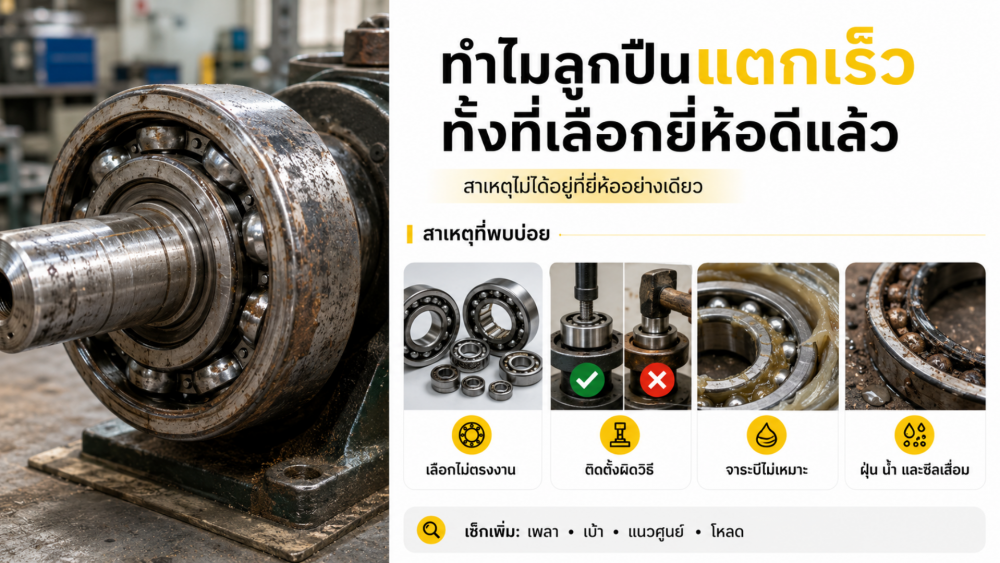
What to Inspect Before Replacing with a New Bearing
When a bearing fails, do not rush to remove and discard it immediately. Wear patterns, grease color, rust locations, and marks on the rings can reveal the root cause. Cleaning or polishing the parts before inspection may erase crucial evidence.
Items to inspect concurrently include:
- Do the bearing number and type match the application?
- Is the internal clearance suitable for the operating temperature and shaft fit?
- Is the grease the specified type?
- Are the grease volume and re-lubrication intervals appropriate?
- Are the shaft or housing worn, loose, or deformed?
- Do the seals and covers still effectively protect against dust and water?
- Are the shaft alignment and drive components properly centered?
- Does the installation method involve hammering or applying force through the rolling elements?
- Has the machine experienced an increase in load, speed, or operating hours compared to before?
A thorough inspection helps reduce the chance of replacing the bearing only for it to fail again in the same position.
A good bearing must work with a proper system.
Choosing a reliable brand reduces risks related to material and manufacturing quality, but it does not mean the bearing will endure under all conditions. If incorrectly selected for the application, improperly installed, poorly lubricated, or allowed to be contaminated with dust and water, its service life can be significantly shortened.
IfBall bearingfails repeatedly at the same point, what you should do is not continuously switch brands, but inspect down to the root cause—from the shaft, housing, seals, lubrication, and alignment to the actual load on the machine. Once the root cause is resolved, the new bearing will be able to perform close to its intended service life.