


 EN
 ไทย


Customers Also Purchased


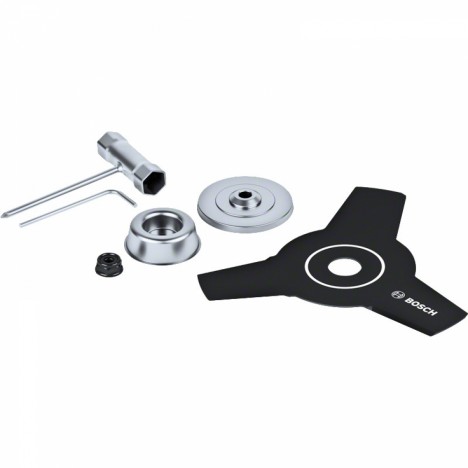
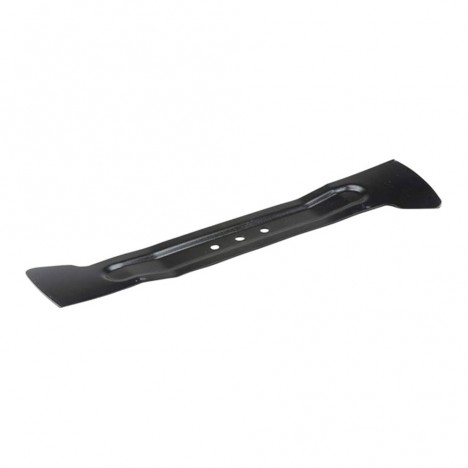
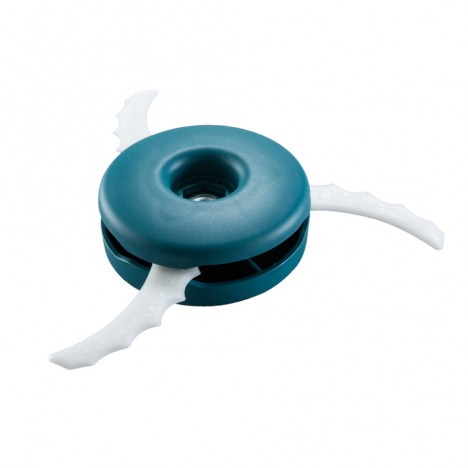
When shopping for a lawn mower blade, you often encounter various sizes—whether 10, 12, 14, or 18 inches—leaving you wondering how they differ. Does a bigger blade cut faster? And can your current machine take a larger blade? The most obvious difference is the blade length: an 18-inch blade sweeps a wider area than a 10-inch blade, making it seem like it would finish the job faster. However, blade size affects more than just the cutting width.
The larger the blade, the greater the weight and cutting resistance. The engine or motor has to work harder to spin the blade, placing more strain on the gear head and drive shaft, making the machine harder to control. Furthermore, if the blade strikes a hard object, the kickback force can be significantly more severe. Therefore, the "best" blade is not the largest one, but the size that matches your machine's power, blade type, weed conditions, terrain, and the manufacturer's safety specifications.
In this article, we'll take a detailed look Blade grass cutter at what tasks 10, 12, 14, and 18-inch blades are best suited for, and what you should check before replacing a lawn mower blade—so you can cut grass quickly without adding unnecessary strain or risk!
Before comparing, what does "blade size" actually mean?
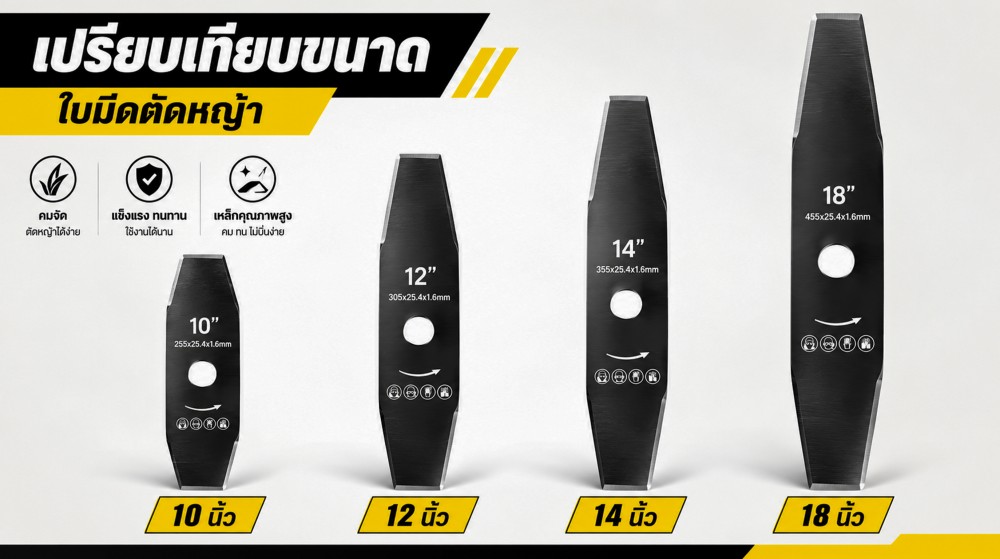
Lawn mower blade sizes—such as 10-inch, 12-inch, 14-inch, or 18-inch—generally refer to the diameter, or the distance from one tip of the blade to the opposite tip through the center of the blade. Converted to millimeters, the approximate sizes are as follows:
- A 10-inch lawn mower blade is approximately equal to 254 mm.
- A 12-inch lawn mower blade is approximately equal to 305 mm.
- A 14-inch lawn mower blade is approximately equal to 356 mm.
- An 18-inch lawn mower blade is approximately equal to 457 mm.
The size figure only indicates the diameter of the lawn mower blade, not its weight or application. This is because lawn mower blades come in many shapes, such as double-edged straight blades, 2-tooth, 3-tooth, 4-tooth, multi-tooth blades, circular saw blades, brush cutter blades, or shredder blades. Sometimes a thick 10-inch blade may even be heavier than a 12-inch blade with weight-reduction cutouts. Therefore, in addition to size, you must also consider shape, thickness, weight, tooth count, arbor hole size, and intended application.
What changes as lawn mower blades get larger?
- Simply put, the cutting width increases. Larger lawn mower blades sweep a wider area with each swing. For example, a 12-inch blade has a diameter about 5 cm larger than a 10-inch blade. However, the increased area does not always mean working time decreases proportionally, as you may need to swing the machine slower, control the distance more carefully, or pause when engine RPM drops.
- The load required to accelerate the blade increases. A larger blade with mass located further from the center requires more force to reach operating RPM, resulting in slower acceleration or RPM dropping easily when hitting dense grass. This can be observed from the engine bogging down, failing to reach full RPM, overheating quickly, or the cutting head responding more slowly.
- The tip speed changes. At the same RPM, the tip of a larger blade moves faster than that of a smaller blade. However, this does not mean a large blade can be mounted on just any machine; the blade must be engineered to handle that rotational speed, and the machine must also support that size. Otherwise, stress on the blade and mounting points may exceed design limits.
- Kickback and impact forces may increase. When a large blade strikes rocks, tree stumps, fences, or wires, the kickback force transferred to the gearbox and handle becomes more severe, especially with heavy blades or those spinning with high momentum. Machine manuals therefore specify selecting blades suitable for the material being cut, using designated safety guards and harnesses, and strictly prohibiting the use of warped, cracked, chipped, or damaged blades.
Let's look at each lawn mower blade size!
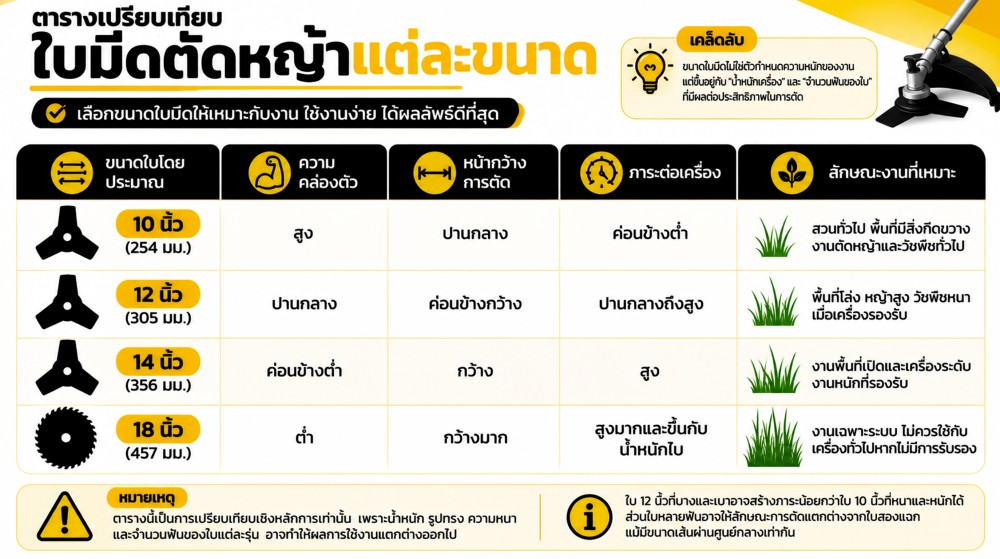
10-inch lawn mower blade
Measuring approximately 250–255 mm, it is commonly found on shoulder-type and cordless brush cutters. Each manufacturer specifies compatible blade, guard, and harness combinations for specific models; not every machine supports every blade.
- Highlights: High maneuverability, easy directional control, suitable for areas with many obstacles. Being lighter than larger blades, it allows the tool to rev up easily and respond quickly, making it ideal for cordless machines with power constraints.
- Suitable for: General grass trimming, garden work, and small-to-medium areas requiring precise blade control. Two- to four-tooth blades can handle tall grass, but should not be used to cut hard tree branches.
- Limitations: Sweeps less area than larger blades. However, in dense grass, a small blade that maintains its RPM well may actually work faster than a large blade that frequently bogs down.
12-inch lawn mower blade
Measuring approximately 300–305 mm, this size transitions from general use to thick weeds and larger areas. Some models can only be used on brush cutters or clearing saws with sufficient power capacity.
- Key highlights: A balance between cutting width and maneuverability, reducing the number of walking passes and swings. Suitable for tall grass and dense weeds. Some 3-point blades can handle hard stems, but be sure to check the materials the blade is designed to cut.
- Load on the machine: Overall, it puts more load on the engine than a 10-inch blade. If used with a small engine, it may accelerate slowly and drop RPM easily. Just because it fits the arbor hole does not mean it is suitable; you must verify that the machine, guard, and transmission system support it as well.
- Suitable for: Medium to large open areas, agricultural orchards, and plot borders. If there are many rocks, metal debris, or tree stumps, the cutting width advantage diminishes because you have to be more cautious.
14-Inch Brush Cutter Blade
Measuring around 356 mm, this size is considered large for handheld/backpack brush cutters. It is supported only by certain heavy-duty models and should not be installed on general-purpose machines.
- Key highlights: Sweeps a wide area, ideal for open spaces with thick weeds, reducing the number of walking passes.
- Caution required: The wider radius requires more clearance around the cutting head. A heavier cutting head with high inertia can quickly fatigue your arms, shoulders, and back. If the blade is unbalanced or bent, vibrations will be significantly more noticeable than with smaller blades. Never straighten a bent blade for reuse; always replace it as recommended by the manufacturer.
- Suitable for: Users of heavy-duty machines explicitly rated for this blade size, working in wide-open areas with proper experience. It should not be used simply to finish faster, nor should it be fitted on small or cordless machines without manual certification.
18-Inch Brush Cutter Blade
Measuring around 457 mm, this is extremely large compared to standard blades, which typically range from 200–350 mm. Do not assume it can be used on general-purpose machines unless both the machine's manual and the blade manufacturer explicitly specify compatibility.
- Why is it available on the market? It is designed for specialized applications, machines, or mounting systems. Some are local market designs that are not certified under standard international machinery guidelines. Just because it is sold does not mean it fits every machine. You must check the maximum RPM, arbor size, weight, thrust washer/cup, and supported machine models.
- Advantages: When used with a properly compatible system, it sweeps an extremely wide path in open areas—ideal for soft grass on flat ground free of obstacles. However, if the grass is dense, the engine bogs down, or the area has many stumps and rocks, it may not actually save time.
- Limitations: Extends far from the gear case, easily catching obstacles and making cutting height difficult to control. The weight and inertia place excessive stress on the gear case, drive shaft, and clutch. If the machine is not rated for it, components can wear out prematurely. The factory-installed guard may be too small. Never remove the guard, as it protects against flying debris and accidental blade contact.
Precautions Before Switching to a Large Brush Cutter Blade
- Machine manual: Must clearly specify the permitted blade sizes and types.
- Protective guard: Must be designed for the appropriate metal blade size. Do not substitute a trimmer head guard if the manual specifies different guards.
- Handle and harness: Some metal blades require a bike-handle handlebar and a full-body harness to help control the machine in the event of kickback.
- Blade mounting hardware: Must assemble the drive plate, washer, stabilizer cup, and nut in the correct order. Never use modified or improvised parts.
- Blade condition: Must be free of bends, cracks, chips, deep rust, or deformed mounting holes. Never straighten and reuse an impact-damaged blade.
Conclusion
- 10 inches (250–255 mm): Agile, easy to control, suitable for general use, around the house, and in orchard furrows.
- 12 inches (300–305 mm): Wider cutting width, suitable for open areas and thick weeds. Must be used specifically with machines that support this size.
- 14 inches: Large blade, suitable for heavy-duty machines and wide-open areas. Even if the arbor hole matches, it should not be used on general-purpose machines.
- 18 inches: Exceeds the standard for general shoulder-mounted trimmers. Can only be used when both the machine and blade manufacturers confirm compatibility.
Most importantly, a larger blade does not always mean faster cutting. If it causes the RPM to drop, makes control difficult, or causes vibrations, actual efficiency will decrease. Before purchasing, check your machine model and manual for the specified blade type, size, arbor hole, guard, and harness, then choose according to the grass type and terrain. The best blade is one that keeps the machine balanced, maintains RPM well, and can be controlled safely — not the largest one.
Select Blade grass cutter to suit the application