EN
 ไทย


Customers Also Purchased


Many people might think that using Concrete Cutters isn't very complicated: just mount the blade, turn on the machine, press the blade down onto the concrete floor or wall, and guide the machine along the marked line. But in actual use, some machines quickly overheat, drop RPM, cut more slowly, or stall mid-operation, even when the machine is brand new or has only been used a few times. We might wonder: is the concrete saw poor quality, is the motor underpowered, or is it because the concrete cutting blade is suboptimal?
What type of work requires a concrete cutter, and what work only needs an angle grinder? In reality, the service life of a concrete saw motor doesn't depend solely on the wattage or machine quality. It also depends on how we control the "load" placed on the motor throughout the cutting process. Concrete saws
If you use a large machine but press down too deep, force the cut too fast, use the wrong type of blade, or lack sufficient power, it can overheat and suffer damage just like a smaller machine. Conversely, a lower-powered machine used at the right pace, with gradually increased depth and consistent RPM, can work longer and cut more efficiently.
Using a concrete saw without straining the motor is not about avoiding heavy work entirely, but about ensuring the machine handles the load continuously and evenly—also known as "constant-load operation." This means
- maintaining the motor's load within a range where the machine can maintain its RPM,
- without fluctuating between revving high under no load and sudden, heavy RPM drops.
- Does not force the motor to draw high current continuously, preventing excessive heat accumulation
What is constant load, and how does it extend concrete cutter motor life more than you think?
Working under a constant load means controlling the resistance from the workpiece to remain at a consistent level throughout the cut.
You need to listen to the concrete cutter's sound, watch for RPM drops, and adjust the feed or pushing speed to match the concrete's hardness, cut depth, and blade condition.
- The motor will not suffer from jerky, fluctuating loads.
- The current flowing through the coils remains consistent.
- Accumulated heat is easy to manage.
- The machine's internal ventilation system can still function normally.
- The cutting blade can maintain an optimal speed for grinding concrete.
The result is that the concrete cutter runs continuously, cuts are smoother, the blade does not kick back, and the lifespan of the motor, carbon brushes, bearings, and gear sets is extended.
Choose a concrete cutting blade that matches the material
One reason why a concrete cutter motor overheats, even without pressing down hard, is using a cutting blade not suited to the material. Diamond blades are not all designed the same. Some models are suitable for general concrete, some for reinforced concrete, and others for brick, stone, or asphalt. How do different diamond blade rims perform in actual use?
For example, using a blade with a bond that is too hard on hard concrete can cause blade glazing, where new diamond grits are not exposed. The blade merely rubs against the concrete surface instead of cutting into the material. The machine will become loud, generate high heat, and easily drop in RPM—even if the segments still look thick.
A dull or glazed blade makes the machine seem underpowered
A concrete cutting blade used for a while may look like it still has life left because segments remain, yet it cuts slowly and requires more downward force. This can be caused by blade glazing—the segment surface becomes smooth and the diamond grits that should cut the material are not properly exposed. When the blade is dull, the concrete cutter motor must work harder to push the blade through the concrete, increasing heat in both the blade and the motor.
Do not solve this by pressing down harder on the concrete cutter, as this will only increase friction against the material. Check the blade manufacturer's recommendations on whether the blade can be dressed using an abrasive material. If the blade is cracked, has loose segments, or is warped or unevenly worn, stop using it immediately. Do not force continued use just to save on blade costs, as the damage caused to the spindle, bearings, and motor could cost many times more than a replacement blade.
Do not cut to full depth on the first pass
A common misconception is that if a concrete cutter supports a certain cutting depth, you should press down to that full depth right on the first pass to save time. However, this method can place a very high load on the motor, especially when cutting hard concrete surfaces, long spans, or reinforced concrete.
Plunging the blade deeply increases the contact area between the segments and the concrete. The blade must clear a large volume of debris all at once, which increases friction and heat. If the blade cannot evacuate debris quickly enough, the RPM will drop rapidly. A better method is to make a shallow initial score to establish a straight guide groove, and then increase the depth step by step according to the machine's power and the hardness of the material.
There is no fixed number of passes; it depends on the machine, the cutting blade, and the condition of the concrete. But a simple rule of thumb is that if the concrete cutter still maintains its RPM, doesn't sound bogging down, and doesn't require excessive pushing force after increasing the depth, it indicates that the load is within an optimal range.
Cutting in multiple passes may seem like it takes more time, but overall it is often faster because the concrete cutter can maintain a consistent cutting speed continuously, doesn't require cooldown breaks due to overheating, and reduces the chance of the blade binding in the groove.
Control the feed rate in relation to the machine's RPM
Feed rate is the speed at which we move the concrete cutter along the cut line, not the speed of the blade itself, as most concrete cutters operate at a fixed RPM. However, if you push too fast, the blade has to bite off a large amount of material in a short period, subjecting the motor to high loads, dropping the RPM, and potentially causing the blade to wander off line. On the other hand, moving too slowly causes excessive friction at the same spot for longer than necessary, which can cause heat buildup and abnormal segment wear as well.
The optimal speed is not a fixed value, but must be adjusted according to the sound and behavior of the concrete cutter. Let the machine dictate the pace. Examples of an appropriate speed include:
- Motor pitch drops slightly but remains smooth
- Cutting blade advances steadily
- Minimal pushing force required
If the sound bogs down, the RPM drops, or the concrete cutter starts to vibrate, you should slow down immediately instead of forcing it forward with more pressure.
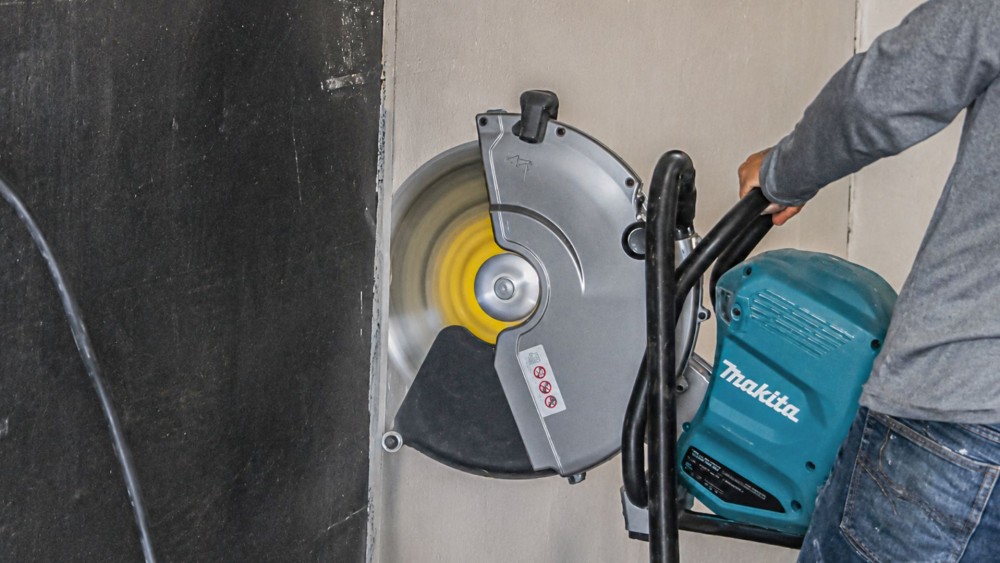
In certain sections, the concrete may have uneven hardness, or the blade may encounter large aggregates or rebar. Maintaining a constant load means adjusting your feed speed so that the motor's workload remains relatively uniform along the entire cut.
Learn to listen to the concrete cutter's sound before checking the specs
Some concrete cutter models may have RPM control systems or load indicator lights, but many do not have these features. Therefore, you should train yourself to listen to the motor's sound. At idle, the pitch is high and steady. When you start cutting, the pitch drops slightly, which is completely normal. However, if the pitch drops significantly, sounds choked, or vibrates flutteringly, it indicates that the RPM is dropping too low.
You should not wait until the machine stalls or the thermal overload protection trips before taking a break, because before reaching that point, the windings or other components may have already accumulated excessive heat. If you begin to notice an unusual smell or the machine becomes very hot, stop using it and inspect it.
Do not force the cut when the blade binds or the line starts to wander
Concrete cutting blades are designed to rotate and move forward in a straight line; they are not designed to handle lateral bending forces. Trying to steer the machine while the blade is still sunk in the floor, or using force to wrench it back onto the line when the cut starts to wander, will pinch the blade from the sides, generate high friction, and transfer the load back to the motor—causing the machine to vibrate, RPM to drop, the blade to make abnormal noises, or kick back.
When you feel that the concrete cutter is starting to deviate from the line, stop feeding, lift the blade out of the groove, wait for it to stop spinning according to the machine's procedure, and then realign. Attempting to correct the line while the blade is still under load can cause the blade to warp, damage the segments, bend the arbor shaft, and cause premature bearing wear.
Additionally, the kerf can pinch the blade when the slab shifts or if the workpiece is not properly supported, especially when cutting concrete slabs that are about to separate. Plan the cutting sequence and workpiece support before starting, and never stand in a position where severed pieces could drop or shift toward the machine.
Let the machine reach full RPM before contacting the concrete
Starting a cut before the concrete saw motor reaches full speed causes the blade to contact material while torque and blade speed are not yet optimal. The machine takes on an immediate load from the start, similar to starting a car in high gear. Therefore, turn on the machine according to the proper steps, wait for the RPM to stabilize, and then gently ease the blade into the cut line instead of slamming it down onto the material.
At the end of a cut line, you should also reduce the load before shutting off the machine. Safely lift the blade out of the material and let it spin free without load for a brief moment as instructed in the manual to help clear debris and dissipate heat. Then turn off the machine and wait until the blade comes to a complete stop. Never set the concrete saw down while the blade is still spinning or press other materials against the blade to stop it faster.
A powerful machine does not mean you can push it to the limit all the time
High-powered concrete saws offer advantages in torque and RPM maintenance, but that does not mean they can handle continuous overloading. Every machine has limits regarding heat, electrical current, and transmission drivetrain strength. The larger the blade, the deeper the cut, and the faster the feed rate, the higher the load placed on the motor.
For heavy-duty jobs, choose a concrete saw rated for that type of application. Do not use a smaller machine and compensate by running it at full load all the time, as repair costs and downtime could end up costing much more.
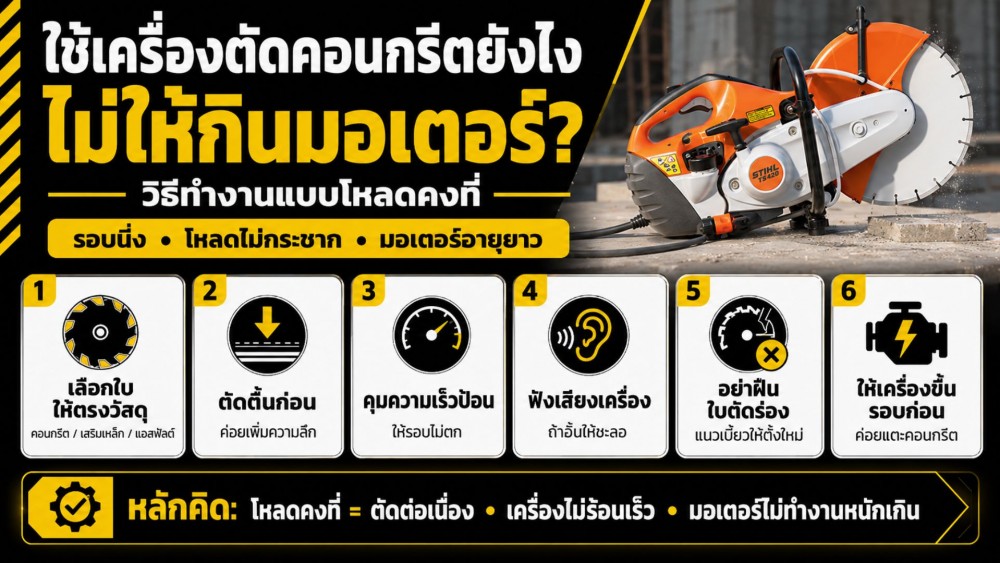
Summary: How to use a concrete saw without wearing out the motor?
The key principles of using a concrete saw without wearing out the motor are:
- Do not force the machine to work faster than the capacity of the blade and motor
- Choose a cutting blade suited for the material
- Start cutting at a shallow depth and make multiple passes to increase depth
- Control feed rate based on the machine's sound and RPM
- Keep the ventilation vents clean
The term “constant load” does not mean you must feed the machine at the exact same speed from start to finish, but rather adjusting the cutting pace so the motor experiences a consistent load throughout the line. Where the surface is harder, slow down; where it is easier to cut, gradually increase speed. When the RPM starts to drop, reduce the applied pressure instead of forcing it harder. When the blade starts to dull, inspect or replace it rather than forcing the machine to compensate for the blade.
Finally, Concrete Cutters Performing well does not rely solely on wattage, but on the harmony between the motor, cutting blade, material, electrical system, cooling system, and user pacing.