


 EN
 ไทย


Customers Also Purchased
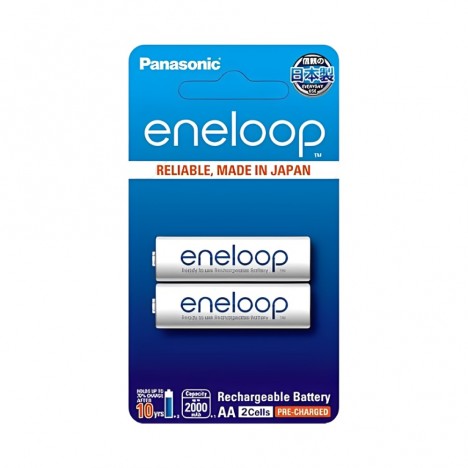
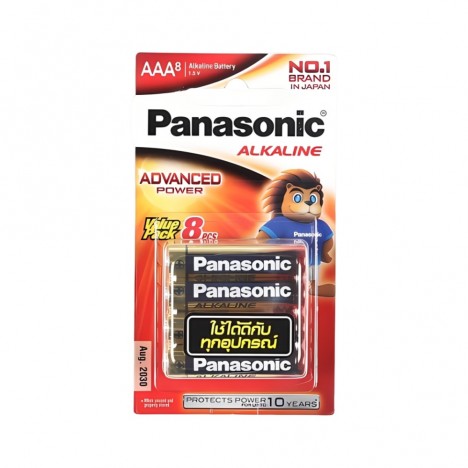
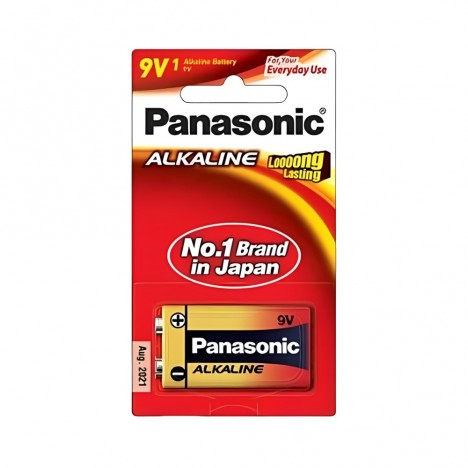
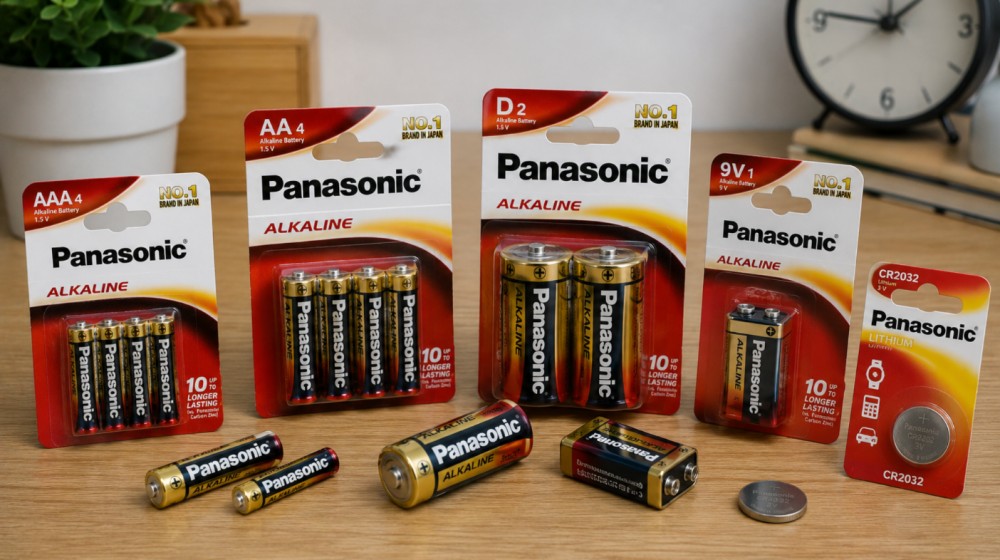
Flashlight Batteries They are basic essentials that many households always keep on hand, as numerous small devices around us still require batteries—whether TV remotes, air conditioner remotes, wall clocks, wireless mice, flashlights, weighing scales, children's toys, wireless microphones, or certain small electronic devices.
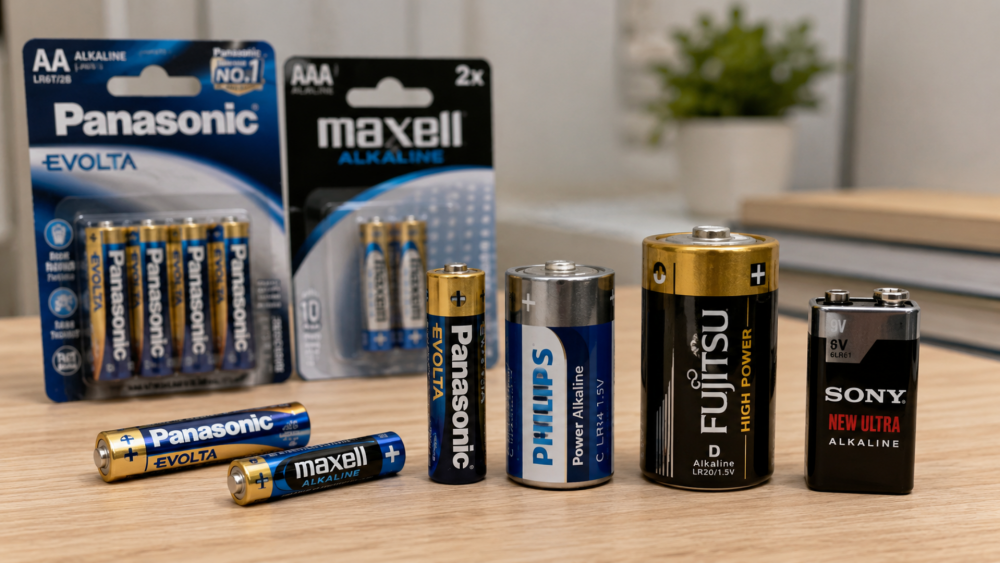
However, when buying a pack of batteries, you might not just see the term "flashlight battery," because the shelves feature AA, AAA, C, D, 9V, carbon-zinc, alkaline, lithium, rechargeable batteries, as well as button cells like CR2032, CR2025, and CR2016, which look very similar but cannot be used interchangeably in all cases.
Understanding battery types helps you choose more accurately for your devices—not just selecting a cell that fits into the battery compartment, but also checking whether that battery type suits the application, provides the correct voltage, lasts long enough, and what precautions apply, especially for frequently used devices, items stored for long periods, or devices that require specific battery codes.
Battery Size and Battery Chemistry Are Not the Same Thing
Battery Size refers to the physical shape and dimensions of the battery, such as AA, AAA, C, D, 9V, or button cell code CR2032, whereas Battery chemistry refers to the internal chemical composition or power delivery system, such as carbon-zinc, alkaline, lithium, NiMH rechargeable, or Li-ion batteries. For example, an AA battery does not automatically mean it is an alkaline battery, as AA batteries come in carbon-zinc, alkaline, lithium, and rechargeable versions. Likewise, rechargeable batteries do not only come in AA size, as there are AAA, 9V, and other rechargeable battery sizes as well. Therefore, when buying batteries, you should check at least 3 things: what size battery the device requires, what battery chemistries it supports, and whether the voltage matches the device's requirements.
If you want a quick rule of thumb to remember: general household devices usually run well on alkaline batteries; frequently used devices with frequent battery changes are best suited for NiMH rechargeable batteries; while button cell and Li-ion batteries should primarily be chosen based on the original code or device specifications, not just their appearance.
Common Battery Types by Size
AAA Batteries
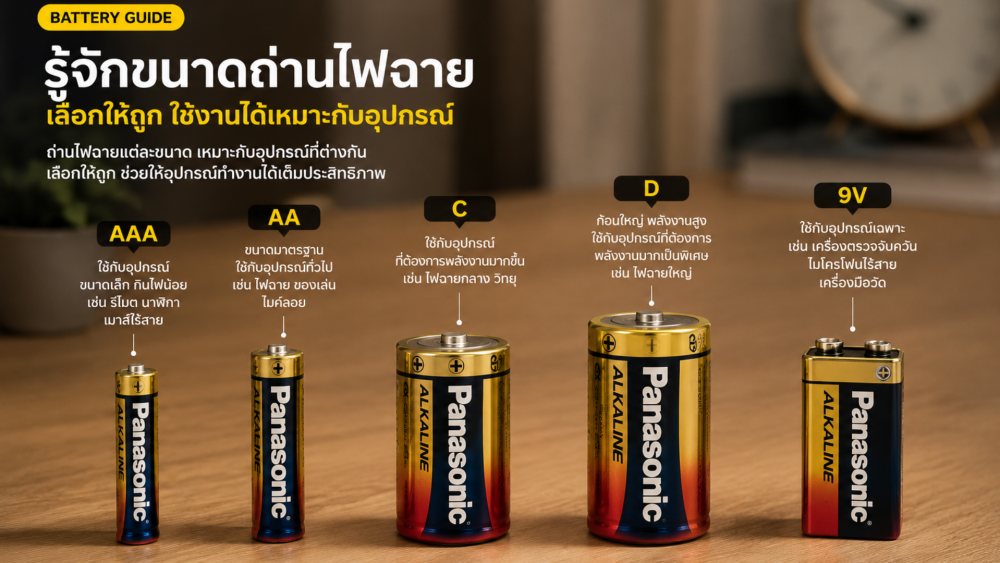
AAA batteries are small cylindrical batteries, typically used in low-power devices or devices with limited battery compartment space, such as TV remotes, air conditioner remotes, wireless mice, small flashlights, calculators, wireless gadgets, and certain portable items.
AAA batteries come in both disposable and rechargeable types. For standard remote controls, alkaline or carbon-zinc batteries will suffice, but for frequently used devices such as wireless mice or small flashlights, AAA rechargeable batteries can save more money in the long run.
AA Batteries
AA batteries are the most common size found in homes, used in a wide variety of devices such as flashlights, wall clocks, children's toys, mice, keyboards, wireless microphones, certain camera models, and general electronic devices.
AA batteries offer many options, including carbon-zinc, alkaline, lithium, and NiMH rechargeable batteries. For general household items, alkaline batteries cover most needs. However, for frequently used or high-drain devices like motorized toys, flashlights, or wireless mics, high-quality rechargeable batteries may be more cost-effective in the long run.
C Batteries
C batteries are larger than AA but smaller than D batteries. They are typically used in devices that require more power, such as medium-sized flashlights, portable radios, certain toys, and devices that need to run continuously longer than smaller batteries can support.
Today, C batteries may not be found in everyday household items as often, because many devices have transitioned to built-in rechargeable batteries. However, they can still be found in flashlights, radios, or certain specialized equipment.
D Batteries
D batteries are large batteries suitable for devices that require high power and long runtimes, such as large flashlights, large boomboxes/radios, emergency lights, large toys, and certain camping equipment.
The standout feature of D batteries is their greater energy capacity compared to smaller batteries, allowing them to last longer in devices designed for them. However, actual capacity still depends on the battery chemistry, quality, and usage patterns—not just physical size alone.
9V Batteries
9V batteries are rectangular batteries with positive and negative terminals on top. They are typically used in specialized devices such as smoke detectors, wireless microphones, certain measuring instruments, some toys, and electronic devices requiring 9 volts.
9V batteries are available in both disposable and rechargeable types. However, before using a rechargeable 9V battery, check if your device supports it, as some rechargeable 9V batteries may deliver a slightly different actual voltage than 9V alkaline batteries, which could affect the operation of certain devices.
Button and Coin Cell Batteries: Look Similar, but the Code Must Match
Button or coin cell batteries are small, flat, and round batteries typically used in compact electronic devices such as car key fobs, scales, calculators, watches, computer motherboards, small toys, blinking LED lights, certain health devices, and small wireless gadgets.
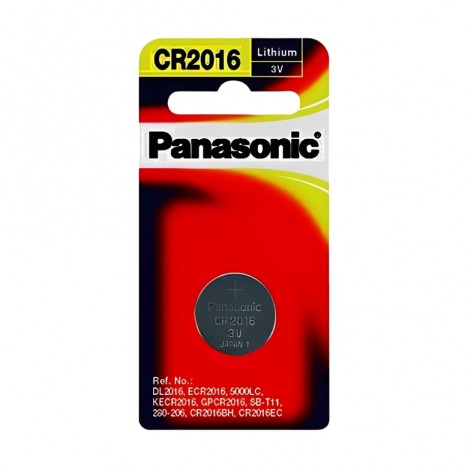
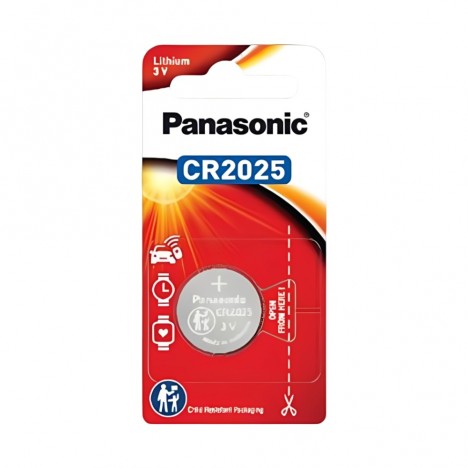
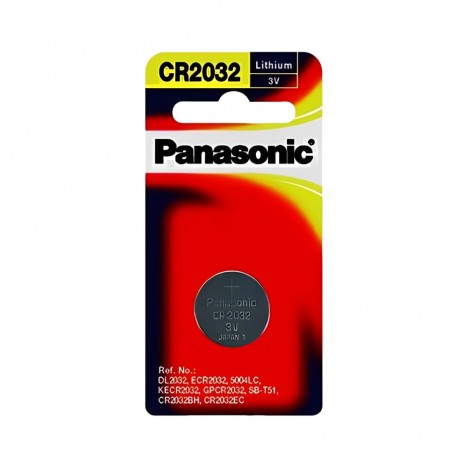
There are many codes for button cells, but the ones most commonly encountered are CR2032, CR2025, and CR2016. All three are lithium coin cells, typically with a nominal voltage of around 3 volts and sharing the same diameter of approximately 20 mm, but they differ in thickness and capacity.
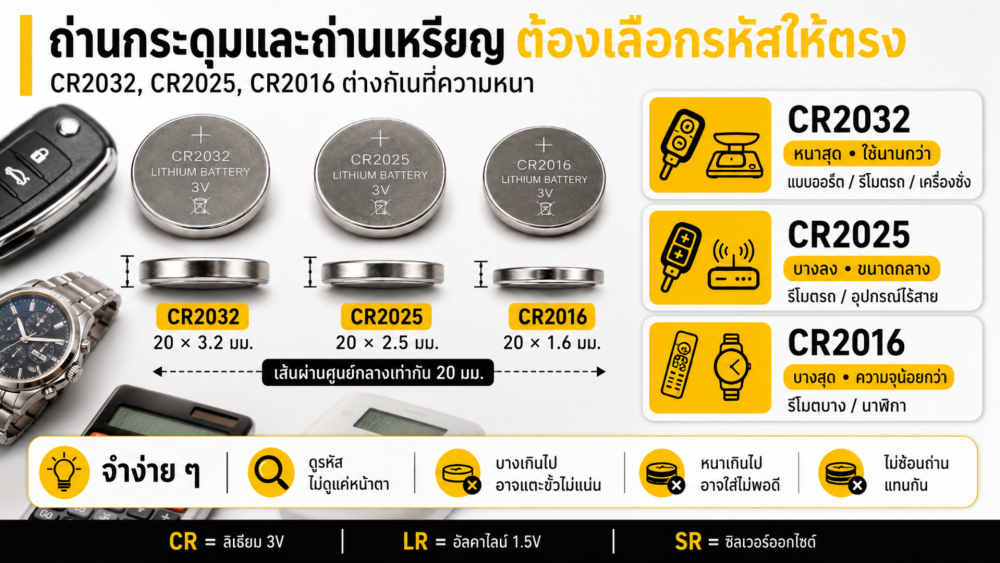
The numbers on the battery help indicate its size; for example, CR2032 refers to a lithium coin cell battery with a diameter of approximately 20 millimeters and a thickness of about 3.2 millimeters, while CR2025 is about 2.5 millimeters thick, and CR2016 is about 1.6 millimeters thick.
Although CR2032, CR2025, and CR2016 look very similar, they should not be interchanged based on appearance alone, as the difference in thickness affects terminal contact inside the device. If a battery that is too thin is inserted, it may not make solid contact with the terminals, causing the device to cut in and out or not work at all. Conversely, inserting a battery that is too thick may prevent the cover from closing properly, exert excessive pressure on the battery terminals, or damage the battery compartment.
Another practice to avoid is stacking multiple button cell batteries to substitute for another size on your own, such as using two CR2016 batteries in place of a CR2032. Even though the thickness might be similar, the total voltage will change, which could damage your device.
Beyond the CR20xx series, other commonly found button cell battery codes include LR44, AG13, SR626SW, CR1632, and CR2450. Each code differs in size, voltage, and application. Therefore, you should match the code on the original battery as closely as possible and avoid purchasing based on visual estimates.
Button cell batteries are not all lithium-based. Codes starting with CR are usually 3V lithium batteries, while LR codes are typically miniature 1.5V alkaline batteries, and SR codes are usually silver oxide batteries used in watches or devices requiring relatively stable voltage. Matching the code precisely to the original is therefore very important.
Types of flashlight batteries by chemistry
Zinc-carbon batteries
Zinc-carbon batteries are economical, disposable batteries suitable for low-drain devices that are not used heavily, such as remote controls, wall clocks, small radios, or flashlights that are only used occasionally.
The advantages are their low price and widespread availability, but the limitation is that they do not last as long as alkaline batteries—especially when used in high-drain devices such as motorized toys, high-powered flashlights, or continuously operated equipment. The battery may drain quickly, and leaving depleted batteries inside the device for long periods can lead to leakage.
Alkaline batteries
Alkaline batteries are widely popular disposable batteries because they deliver better power than zinc-carbon batteries, last longer, and are suitable for many types of devices—ranging from remotes, clocks, toys, and flashlights to moderate-drain equipment.
Standard alkaline batteries generally deliver 1.5 volts per cell, identical to zinc-carbon batteries, but offer better overall performance. If you are unsure which battery to choose for everyday household items, alkaline batteries are usually the simpler, more versatile option.
Disposable lithium batteries
Disposable lithium batteries come in various formats, such as AA lithium, AAA lithium, CR123A, and coin cells like CR2032. Their key advantages are lightweight design, long shelf life, high power delivery, and better temperature resistance compared to some standard batteries.
Lithium AA or AAA batteries are ideal for devices requiring stable performance, such as certain camera models, flashlights, outdoor equipment, or devices where you prefer not to change batteries often. Meanwhile, lithium coin cells like CR2032, CR2025, and CR2016 are commonly used in compact devices that require flat, slim batteries.
A key precaution is that different lithium battery models vary in voltage. For example, some AA lithium batteries are 1.5 volts, whereas CR123A or CR2032 coin cells are typically 3 volts. They should not be used interchangeably unless the device explicitly specifies compatibility.
NiMH rechargeable batteries
NiMH (Nickel Metal Hydride) rechargeable batteries are very popular in AA and AAA sizes. They are well-suited for frequently used devices such as wireless mice, keyboards, flashlights, children's toys, wireless microphones, certain cameras, and equipment requiring frequent battery replacements.
Standard NiMH rechargeable batteries typically have a voltage of around 1.2 volts per cell, which is lower than the 1.5 volts standard for alkaline batteries. However, they still function normally in many devices because rechargeable batteries deliver current efficiently and are well-suited for continuous drain.
Nevertheless, some devices may show a low-battery indicator prematurely when using rechargeable batteries because their battery gauge relies primarily on a 1.5-volt scale. For critical devices, it is advisable to consult the manual or test them in real-world use first.
Li-ion Rechargeable Batteries
Li-ion batteries are rechargeable cells found in many modern devices, such as high-power flashlights, power banks, laptop batteries, cordless power tools, and various electronic equipment. Common sizes include 18650, 21700, 14500, and 16340.
A critical point to keep in mind is that Li-ion batteries typically provide around 3.6–3.7 volts per cell, which is significantly higher than standard AA or AAA batteries. In particular, the 14500 size is similar in dimensions to an AA battery, but it is not a 1.5-volt AA battery. Inserting one into a device designed for standard AA batteries may damage the device.
Li-ion batteries should only be used in devices explicitly specified to support them. You should also use a charger designed specifically for Li-ion batteries, and never attempt to charge them in standard AA/AAA chargers unless that charger is explicitly designed to support them.
NiCd Rechargeable Batteries
NiCd or Nickel Cadmium rechargeable batteries are an older type once widely popular. They provide around 1.2 volts and handle heavy-duty use well in certain applications. However, they are less common today because they contain cadmium, which requires careful handling and disposal, and they have maintenance limitations. For everyday users, NiMH rechargeable batteries are generally a better choice because they are easier to find, more convenient to use, and more suitable for household devices.
NiZn Rechargeable Batteries
NiZn or Nickel Zinc batteries are rechargeable cells with a higher voltage than NiMH, typically around 1.6 volts. They are well-suited for certain devices requiring a voltage closer to 1.5-volt alkaline batteries. However, this type is not as widely available as NiMH and requires a dedicated charger. Unless you have a specific requirement, NiMH rechargeable batteries remain the more user-friendly and suitable option for most users.
How to Choose the Right Battery for Your Device
For TV remotes, air conditioner remotes, wall clocks, or other low-drain devices, carbon-zinc or alkaline batteries will work. However, if you want longer runtimes and fewer frequent replacements, alkaline batteries are preferable.
- For computer mice, keyboards, children's toys, flashlights, or devices requiring frequent battery changes, NiMH rechargeable batteries are a more cost-effective choice because they can be recharged multiple times, helping save money in the long run.
- For devices stored for long periods—such as emergency flashlights, outdoor gear, or backup equipment that is rarely turned on—disposable lithium batteries are often a better fit due to their long shelf life, lightweight design, and reliable power output.
- For devices that use button/coin cells, such as car key fobs, weighing scales, or computer motherboards, always match the exact original battery code, such as CR2032, CR2025, or CR2016. Do not choose based on similar physical appearance alone, as differences in thickness can cause the device to malfunction or damage the battery compartment.
- For high-power flashlights or devices specified for Li-ion batteries such as 18650 or 21700, strictly use batteries according to manufacturer specifications. Do not substitute similarly sized batteries without verifying their voltage and chemistry.
Safety Precautions When Using Batteries
- Do not mix old and new batteries in the same device. Because individual cells will have different energy levels, this can cause some batteries to malfunction and increase the risk of leakage.
- Do not mix different battery chemistries—such as alkaline with rechargeable, or carbon-zinc with lithium—in the same device, as each chemistry has different voltage and discharge characteristics.
- Do not attempt to recharge non-rechargeable batteries. Disposable batteries are not engineered for recharging, and doing so can cause them to overheat, leak, or pose serious hazards.
- If a device will not be used for a long time, the batteries should be removed—especially from remote controls, flashlights, toys, or items kept in drawers. Depleted batteries may leak, causing terminal corrosion or damaging the equipment.
- Rechargeable batteries should be used with chargers that support their specific chemistry. For example, NiMH batteries require a NiMH charger, while Li-ion batteries require a Li-ion charger. Never use the wrong type of charger.
- Batteries that are swollen, leaking, emit an unusual odor, or have white residue or rusted terminals should not be used any further. Dispose of them properly and wash your hands after handling leaking batteries.
- Button and coin cell batteries should be kept out of reach of children and pets, as their small size makes them easy to swallow. This is especially true for lithium coin cells such as CR2032, CR2025, and CR2016. If accidentally swallowed, seek immediate medical attention at a hospital—do not wait to observe symptoms.
Once batteries are depleted, how should they be disposed of or separated?
Batteries should not be thrown away with general household waste unnecessarily. This is especially true for rechargeable batteries, lithium batteries, and those prone to generating heat or containing hazardous chemicals. They should be placed in a separate bag or container and dropped off at e-waste collection points, battery disposal stations, or battery take-back programs available in certain areas.
For lithium batteries or rechargeable batteries with exposed terminals, cover the terminals with tape before disposal to reduce the risk of short circuits during collection or transport.
Choosing the right battery for the job ensures peace of mind during use
Flashlight Batteries Each type differs not only in size, but also in battery chemistry, voltage, capacity, lifespan, and compatibility with devices. Using the wrong battery may result in short runtime, failure to power on, intermittent operation, or in some cases, damage to the device.
Before buying batteries, always check the required battery size, the chemistry suited to your usage, and the voltage supported by your device. For general household items, alkaline batteries usually cover most needs. For frequent use, NiMH rechargeable batteries can be more cost-effective. For button cells and Li-ion batteries, match the exact model code of the original or refer primarily to the device manual to ensure safe operation without risking equipment damage.