


 EN
 ไทย


Customers Also Purchased


When we talk about Electric motor many people think of devices used to drive water pumps, fans, blowers, machinery, conveyor belts, grinders, mixers, or various factory equipment. But… a question many people wonder about just as much as horsepower and RPM is: How much electricity does an electric motor consume? And if it runs for several hours a day, how many THB will the electricity cost approximately?
This question is very important because some electric motors only run for a few minutes a day, such as residential water pumps, while others operate continuously for hours or all day, such as ventilation fans, blowers, conveyor belts, or factory motors. Without knowing how to calculate electricity costs, it's easy to misjudge operating expenses.
The good news is that calculating electricity costs isn't as difficult as you think. Just understand terms like watts, kilowatts, units (kWh), operating hours, and rate per unit, and you can calculate it roughly yourself. This article will explain it simply with examples of how much power 1, 2, 3, or 5 HP motors use and what factors to consider before estimating actual costs.
Before calculating, you must first understand: What is "1 Unit" of electricity?
Electricity providers bill based on the amount of energy consumed, measured in kilowatt-hours (kWh), commonly known as "electricity units" (units), rather than counting the number of electrical appliances directly. Put simply: a 1,000-watt electrical appliance running for 1 hour = 1 unit of electricity used. For example:
- 1,000 watts running for 1 hour = 1 unit
- 500 watts running for 1 hour = 0.5 units
- 2,000 watts running for 1 hour = 2 units
- 1,000 Watts running for 5 hours = 5 units (kWh)
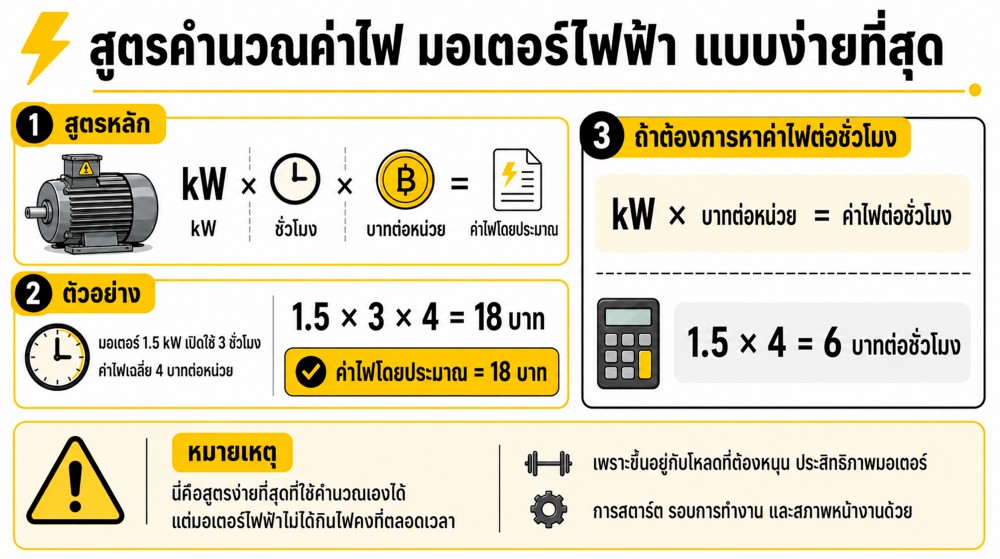
The basic calculation principle is: Power (Watts) × operating hours × electricity rate per unit. For Thailand, the actual electricity bill includes not only the base tariff, but also the Ft charge, service fee, and 7% VAT. In this article, an estimated calculation method is used for easy understanding. It is recommended to substitute the actual electricity rate per unit from your own bill into the formula for greater accuracy.
Electric Motors: Look at HP or kW? Which value should be used for calculation?
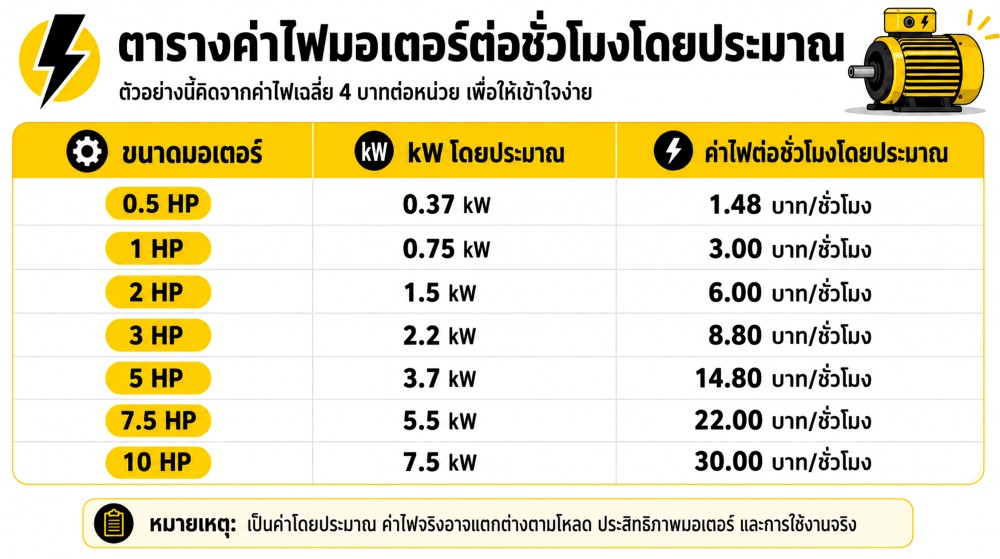
Electric motors usually specify power in HP (horsepower) or kW (kilowatts), with kW being more convenient for calculating electrical energy, where approximately 1 HP ≈ 0.746 kW.
However, in actual operation, a 1 HP motor will always draw slightly more than 0.746 kW due to energy losses in the windings, heat, bearings, and internal components (motor efficiency).
For most people, you can start calculating directly from the kW value on the motor nameplate. But for higher accuracy, Amp, Volt, Power Factor, and Efficiency should also be taken into account.
Using the kW value from the motor nameplate is sufficient for a rough estimation of electricity costs, but it should always be noted as an "estimated value", not 100% of the actual electricity cost.
Calculation Example: Electricity Cost of a 1 HP Motor
Assuming a 1 HP motor is approximately 0.75 kW and the average electricity rate is 4 THB per unit (kWh):
If operated for 1 hour: 0.75 × 1 × 4 = 3 THB
Therefore, a 1 HP motor will cost approximately 3 THB per hour to run.
If operated for 5 hours per day: 0.75 × 5 × 4 = 15 THB per day
If operated for 5 hours per day for 30 days: 15 × 30 = 450 THB per month
This example illustrates that if a 1 HP motor is run for only short periods, the electricity cost might not be very high. However, if operated for several hours every day, the monthly electricity cost increases noticeably.
Why Electric Motors with the Same Horsepower Might Have Different Actual Electricity Costs
- Electric Motor Efficiency – High-efficiency electric motors convert electrical energy into mechanical energy better and have less heat loss, thus consuming less power for the same workload.
- Actual Load Handled – Light loads consume less power, while heavy loads consume more. For example, a water pump operating at excessive pressure, with clogged pipes, or outside its optimal duty point will consume more power and run hotter than normal.
- Machine Condition – Stiff bearings, overtightened belts, bent shafts, or misaligned drive systems force the motor to work harder even though its size remains the same.
- Electrical System – Improper voltage, voltage drops, or wiring issues can cause the motor to draw higher current and accumulate heat.
- Therefore, looking solely at HP or kW provides an initial estimate of electricity costs, but to determine the actual electricity cost, real operating conditions must also be considered.
Do 1-phase and 3-phase electric motors consume different amounts of power?
Many people wonder whether a 1-phase or 3-phase electric motor with the same horsepower consumes more power. The answer is that it depends on several factors; it cannot be determined by the number of phases alone.
Generally, 3-phase electric motors are suitable for continuous and industrial applications, run more smoothly, and are popular for high-power machinery. Meanwhile, 1-phase motors are suitable for general applications and areas with standard 220V household electricity.
When comparing electric motors of similar size, similar quality, and operating under the same load, electricity costs might not differ significantly based on the number of phases alone. However, a 3-phase system is usually better suited for heavy-duty applications and factory control.
For general users, the key is to choose one that matches your existing electrical system and application. You should not switch from 1-phase to 3-phase or from 3-phase to 1-phase on your own without consulting an electrician, as it involves the electrical system and safety. To better understand why the electrical system has such a major effect on machine power, let's dive deeper. working principles of electric motors you might not have known before further.
How to calculate electric motor electricity costs per month
If you want to calculate monthly electricity costs, use this formula:
kW × operating hours per day × number of operating days per month × electricity rate per unit = approximate monthly electricity cost
For example, a 3 HP motor (approximately 2.2 kW) running 6 hours a day, 25 days a month, with an average electricity rate of 4.5 THB per unit: 2.2 × 6 × 25 × 4.5 = 1,485 THB per month.
If you have multiple motors, calculate each one individually and add them together, for example:
- Water pump motor: 1.5 kW, running 3 hours a day
- Blower motor: 2.2 kW, running 8 hours a day
- Conveyor motor: 3.7 kW, running 5 hours a day
Once calculated separately and combined, you will have a clearer picture of your motor system's electricity costs, ideal for shops, factories, or anyone planning monthly expenses.
How to reduce electricity costs from using electric motors
Reducing electricity costs from electric motors isn't just about choosing a smaller motor, but ensuring the system operates optimally without unnecessary energy loss. Effective ways to reduce electricity costs include:
- Select a motor size that matches the actual load
- Do not oversize the motor for the job
- Maintain bearings, belts, and drive systems
- Clean ventilation slots
- Check that the load is not jammed or stiff
- Reduce unnecessary idle running
- Plan on-off schedules appropriately
- Use inverters in suitable applications
- Check for voltage drops or electrical system abnormalities
Conclusion
Actual electricity costs may vary from the example, as they depend on the actual electricity rate per unit, load, motor efficiency, electrical system, machine condition, and operating hours. For accuracy, refer to your actual electricity bill or have a technician measure the power and current.
Don't just look at an electric motor's horsepower; also consider operating duration, load characteristics, and abnormal symptoms. A properly selected and well-maintained motor not only lasts longer, but also helps control electricity costs and reduce long-term expenses.
Select Electric motor to suit the application