


 EN
 ไทย


Customers Also Purchased


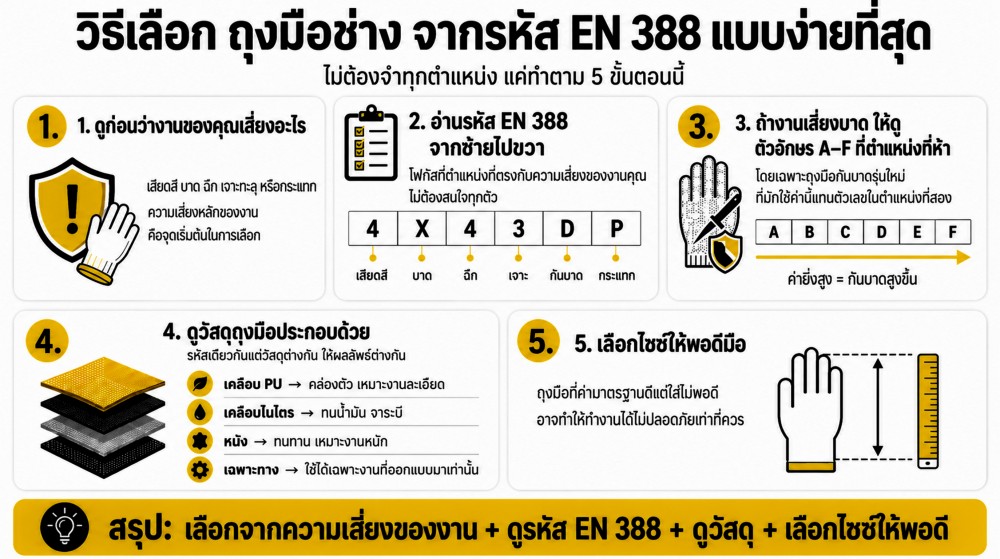
Many people choose to buy Safety Gloves based on shape, thickness, or advertising claims on the packaging such as "cut-resistant," "non-slip," or "durable," without noticing the shield symbol and alphanumeric code—like 4131X or 4543C—printed on the work gloves.
These codes are not SKU numbers; they are test results according to the EN 388 standard that indicate levels of protection against mechanical risks, including abrasion, cut, tear, puncture, and impact. Put simply, the EN 388 code tells you what kind of tasks the gloves are suited for, such as lifting rough objects, handling sheet metal, or general maintenance.
In this article, we explain how to read EN 388 codes in an easy-to-understand way for everyone—from homeowners and DIYers to procurement teams—without requiring any prior knowledge of safety standards.
What is EN 388?
EN 388 is a standard for work gloves designed to protect hands from mechanical risks, including abrasion, cuts, tears, punctures, and impacts. Related tasks are commonly encountered in real-world scenarios, such as handling steel or metal, construction work, automotive repair, machinery maintenance, warehouse operations, woodworking, furniture making, and factory environments where materials are handled regularly.
Therefore, EN 388 is not meant solely for large industrial plants; it applies to anyone working with sharp materials, rough surfaces, or potential hand-injury hazards.
The key thing to understand is that EN 388 does not mean work gloves are safe for every job; it indicates which tests the gloves passed and the level achieved in each category. Users must know how to read the code and match it to their specific work conditions.
Why Should You Read EN 388 Codes Before Buying Work Gloves?
Many people choose work gloves based on feel—such as feeling thick, looking tough, or fitting snugly. However, these impressions do not tell the whole story. A glove that looks thick may not offer good cut resistance, while certain thin gloves utilize cut-resistant fibers that deliver higher protection ratings. Reading the EN 388 code helps you select gloves more accurately across 4 key areas:
- Reduces choosing the wrong type: for example, avoiding thin fabric gloves for handling sharp sheet metal or not using non-slip gloves for tasks that require high cut protection.
- Makes product comparisons easier: two glove models may look identical, but different EN 388 numbers immediately tell you which one is built for heavier-duty tasks.
- Enables task-specific procurement: different departments face different risks; reading the codes helps you select the right gloves for each type of work rather than purchasing a single type for everyone.
- Reduces misunderstandings regarding "cut resistance": cut-resistant gloves do not all offer the same level of protection. The code indicates whether a model is suited for low-risk, medium-risk, or high-risk tasks involving sharp objects.
What Does an EN 388 Code Look Like?
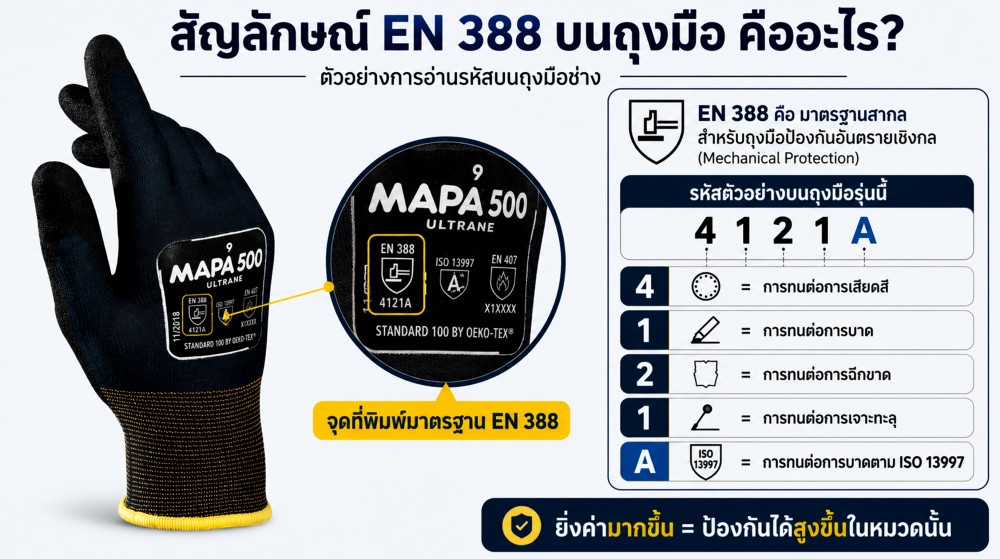
The EN 388 code is usually displayed near a shield or hammer symbol on the glove itself, product tag, or packaging. Common formats include EN 388: 4131X or EN 388: 4X43D. Each digit and letter has a distinct meaning, typically read from left to right as follows:
- Position 1: Abrasion Resistance
- Position 2: Circular Blade Cut Resistance or Coup Test
- Position 3: Tear Resistance
- Position 4: Puncture Resistance
- Position 5: Cut Resistance according to ISO 13997 method (uses letters A-F)
- Position 6: Impact Protection (uses letter P if passed)
Some models may have only the first 4 characters, while others may include additional letters, depending on the standard version, relevant tests, and the glove's specific properties.
Digit in Position 1: Abrasion Resistance
The first digit in the EN 388 code indicates Abrasion Resistance. Abrasion occurs frequently in technical and manual work, such as lifting rough objects, dragging boxes, handling raw metal, wood, bricks, concrete, stone, or materials with abrasive surfaces. Gloves with good abrasion resistance keep the palms from wearing out quickly and help extend glove lifespan.
- Level 1: Suitable for light tasks, general work, or non-continuous use
- Level 2: Suitable for general material handling
- Level 3: Suitable for tasks with relatively high abrasion
- Level 4: Suitable for tasks requiring high durability, such as warehousing, construction, or regular handling of rough materials
If your gloves suffer from rapid palm wear, quick fraying, or early coating peeling, the first digit is what you should pay special attention to. However, gloves with a high abrasion rating do not necessarily provide high cut resistance, as abrasion and cutting are entirely different risks. Some gloves resist scuffing very well but are not designed to withstand sharp blades or metal edges directly.
Digit in Position 2: Circular Blade Cut Resistance
The second digit is the traditional cut resistance value, often referred to as the Coup Test, which is conducted using a rotating circular blade.
- Level 1: Suitable for low cut-risk tasks
- Level 2: Suitable for general work with minor exposure to sharp edges
- Level 3: Suitable for tasks requiring moderate protection
- Level 4-5: Suitable for tasks with higher risks from sharp edges
However, an important point to note is that many modern cut-resistant gloves use high-performance fibers—such as ultra-strong fibers or specialized material blends—meaning the circular blade test may not be suitable for complete evaluation, as the blade can become dull during testing.
This is why some glove models display the letter X in the second position and instead use a letter rating from A to F in the fifth position, which indicates cut resistance according to the ISO 13997 method. Therefore, seeing a code like 4X43D does not mean the glove is not cut-resistant; rather, you need to check the letter in the fifth position instead—in this example, Level D.

3rd Digit: Tear Resistance
The third digit indicates Tear Resistance. Tearing occurs when a glove is pulled, snagged, or subjected to sudden jerking forces—such as handling materials with snagging edges, or catching on wood splinters, pointed steel, nails, wire, or certain machine parts.
- Level 1: Suitable for light-duty work
- Level 2: Suitable for general work
- Level 3: Suitable for work with moderate pulling or snagging forces
- Level 4: Suitable for work requiring high tear resistance
Tear resistance is more important than many people realize, as some gloves fail not directly from cuts, but from small tears that gradually spread until the glove is unusable. If your work involves handling rough, sharp-edged, or angular materials, or poses frequent snagging risks, you should pay attention to the third digit. However, be aware that a glove with high tear resistance might not necessarily offer high puncture or cut resistance—it must be evaluated alongside the other positions.
4th Digit: Puncture Resistance
The fourth digit represents Puncture Resistance. Puncture here refers to force exerted by sharp-pointed objects or small pressure points, such as wire, sharp steel ends, metal shards, nails, or hard-tipped materials pressing against the glove.
- Level 1: Suitable for general, low-risk work
- Level 2: Suitable for work with a slight chance of encountering sharp objects
- Level 3: Suitable for mechanic work, maintenance, or handling rough materials
- Level 4: Suitable for work requiring higher puncture protection
However, it is important to understand that the puncture resistance rating in EN 388 does not mean it can always protect against needles or all types of sharp objects. Extremely fine-tipped objects, such as needles, may require specialized gloves designed specifically for that application. If your work involves metal shavings, wire tips, nails, or pointed materials, the fourth position value is crucial, but it should not replace specialized gloves without verifying the product specifications.
5th Character: Cut Resistance according to ISO 13997
The fifth position is a letter—A, B, C, D, E, or F—used to indicate the level of cut resistance according to the ISO 13997 method. This is a very critical rating for modern cut-resistant gloves, as it provides a cut evaluation method better suited for high-performance materials. Generally, the levels are ranked from low to high as follows:
- A = Entry-level cut resistance
- B = Low to moderate cut resistance
- C = Medium cut resistance
- D = Medium to high cut resistance
- E = High cut resistance
- F = Very high cut resistance
If your work involves general tasks such as handling boxes, light assembly, or DIY projects, Level A or B may be sufficient in many cases.
If you are handling sheet metal, glass, stainless steel, doing maintenance work, or dealing with sharper edges, you may need to look at Level C, D, or higher. If the work involves a very high cut risk, such as continuously handling sharp materials, specialized industrial work, or dealing with severe sharp edges, consider Level E or F along with recommendations from the manufacturer and your safety department.
However, keep in mind that Level F gloves are not always the best choice for everyone. Higher cut resistance often comes with increased thickness, stiffness, or reduced dexterity. For very detailed work—such as picking up small screws, assembling tiny components, or using tools that require fingertip sensitivity—gloves with excessively high cut resistance may make tasks cumbersome.
In technical and mechanical work, the "hands" are the most important tool. Choosing gloves isn't just about looking at the highest letter for Cut Level, because the coating and knitting materials of each glove type offer different advantages and operational limitations. Therefore, let's take a look at: How do mechanic glove materials (PU, Nitrile, Latex, Kevlar) differ?
The 6th Character: Impact Protection
The sixth position usually relates to impact protection. If the glove has passed this test, the letter P will be shown. For example: EN 388: 4442EP
The letter P at the end of the code means that the glove model has passed the impact test according to standard requirements. Gloves with impact protection are often found in jobs where the back of the hand or knuckles are prone to impacts, such as maintenance work, machinery assembly, material handling, heavy industry, or tasks requiring hands to reach into tight spaces where they might hit hard parts.
However, the absence of the letter P does not mean the glove is of poor quality; it may simply mean it was not designed for impact protection or was not tested in this category. If your job carries no risk of impact to the back of the hand, the letter P may not be a primary factor in your selection.
What does the letter X in the EN 388 code mean?
Many people see the letter X and mistakenly think it means "poor" or "failed". In reality, X usually means not tested or cannot be appropriately tested using that method.
For example: EN 388: 4X43D
The second position is X because the rotating circular blade cut test result may not have been used, but an ISO 13997 cut resistance rating at Level D is provided instead.
Therefore, when you see an X, you shouldn't immediately assume the glove is poor quality. You need to check which category that position represents and whether an alternative test value is provided instead.
However, if a glove has an X in multiple positions and lacks additional product information, exercise caution, as it can be difficult to evaluate its suitability for the job. You should review the product documentation, manufacturer details, or consult the seller before actual use.
Select Safety Gloves here