EN
 ไทย


Customers Also Purchased


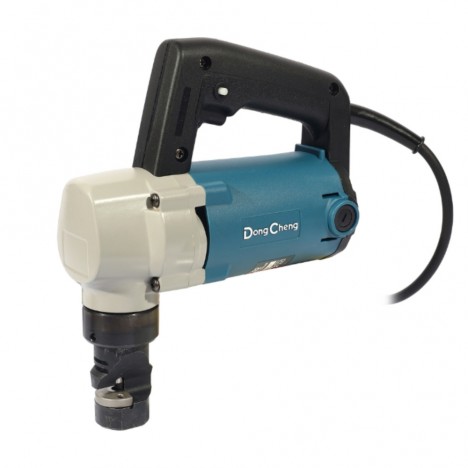
When talking about Jigsaw and Shear We often think of the tool itself first, don't we? Whether it's a circular saw, jigsaw, reciprocating saw, band saw, or cordless power saw—because the tool is the most prominent element, determining cutting power, handling, and cutting method.
However, what makes a power saw work better, more accurately, cleaner, and with far more versatility is power saw accessories. Because sometimes, we don't necessarily need a new tool; we might just need the right accessory for the job, such as a cutting guide for straighter cuts, a clamping table for better workpiece control, or a dust extraction adapter for a cleaner and safer workspace.
Accessories might seem like small items, but they impact work quality more than you'd think. A single power saw can perform a wide variety of tasks depending on which base plate or attachments you choose. For instance, adding a cutting guide to the same jigsaw helps you make better straight cuts, or mounting it to a jigsaw table changes the workflow by letting you guide the workpiece rather than the tool. As for reciprocating saws—often thought to be only for cutting pipes, wood, or metal—choosing the right accessories allows them to scrape, sand, file, or strip old materials as well, making a single power tool vastly more cost-effective.
Types of Power Saw Accessories You Should Know
Get It Right: What Are the English Names for Various Types of Power Saws for Tradespeople? Naturally, the most important element for any power saw, regardless of type, is Saw blade the saw blade, because it's the part that directly contacts the workpiece. Different types of blades are designed to suit different materials and applications.
Differences in tooth count, tooth geometry, blade thickness, and blade material affect cutting speed, surface finish, and blade lifespan. If your priority is fast cutting, a coarse-toothed blade may be used; but if you need a smooth surface finish and clean edges, choose a finer-toothed blade.
Guide rails or cutting guides help keep cuts straight and easier to control
Cutting guides are ideal for anyone needing consistent cut lines—especially for repetitive cuts, long rips, or work requiring precise dimensions. A cutting guide reduces reliance on visual alignment alone and helps the saw glide smoothly along the line.
Without a guide rail or cutting guide, you can use a ruler, framing square, or a piece of wood as a straightedge fence. While this works, the convenience and stability might not match accessories designed specifically for the job.
- Which Power Tools Can Use Guide Rails for Cutting?
When paired with compatible adapters, guide rails can be used with jigsaws, circular saws, electric saws, or other power tools that need to be guided along the workpiece.
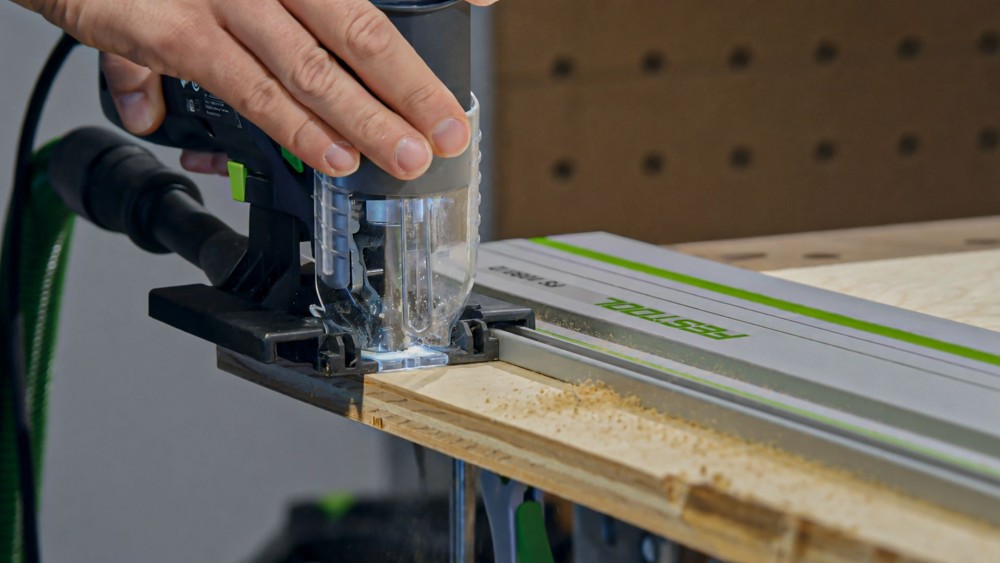
Dust extraction adapters keep work clean and cutting lines visible
Dust is inevitable in sawing tasks, especially with woodworking. Fine dust creates a messy workspace, obscures the cut line, and can pose health risks when inhaled over long periods. A dust extraction adapter is therefore an essential accessory, especially for those working indoors or in workshops where cleanliness is a priority.
The advantage of connecting a vacuum or dust extractor to a power saw is reducing airborne dust during operation, cutting cleanup time afterward, and giving the entire job a more professional appearance. Having the right dust extraction accessories for your tools directly enhances a tradesperson's credibility.
Saw tables and clamping bases: Add stability for small workpieces
A saw table or clamping base can significantly transform the operation of certain types of saws. For example, with a jigsaw—which normally requires holding the tool and guiding it along the workpiece—using a jigsaw table allows you to guide the workpiece into the blade instead. This makes it much easier to control small workpieces or certain curved cuts, such as model making, small woodworking projects, decorative crafts, pattern cutting, or tasks that require higher precision than typical cutting jobs.
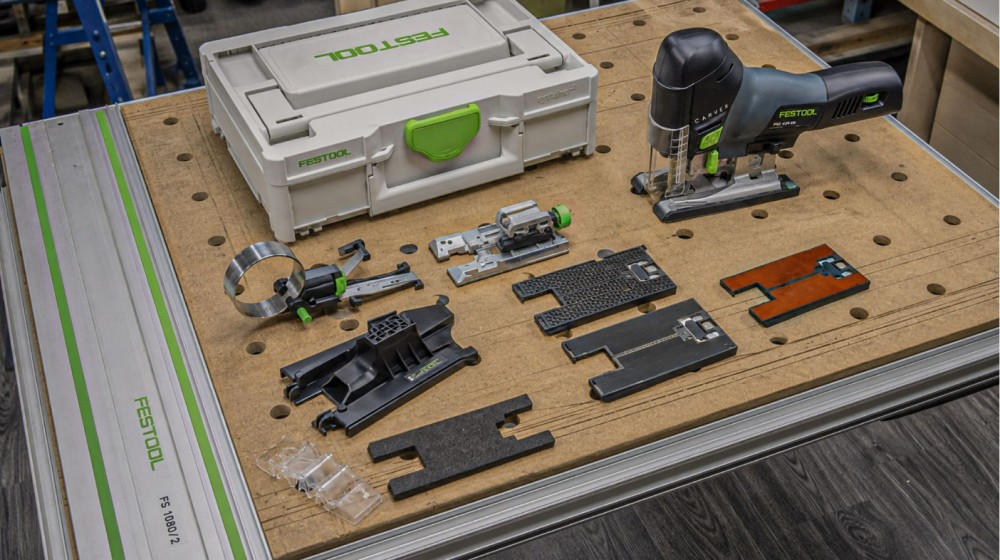
Festool Power Saw Accessories
Beyond its prominence in woodworking innovation and track saws, Festool also offers cutting-edge accessories for jigsaws that make them more versatile and precise, such as:
- Angle table WT-PS 420
- Base adapter ADT-PS 420
- Guide rail adapter FS-PS/PSB 300
- Accessories Systainer Set ZH-SYS-PS 400
Reciprocating Saw Accessories
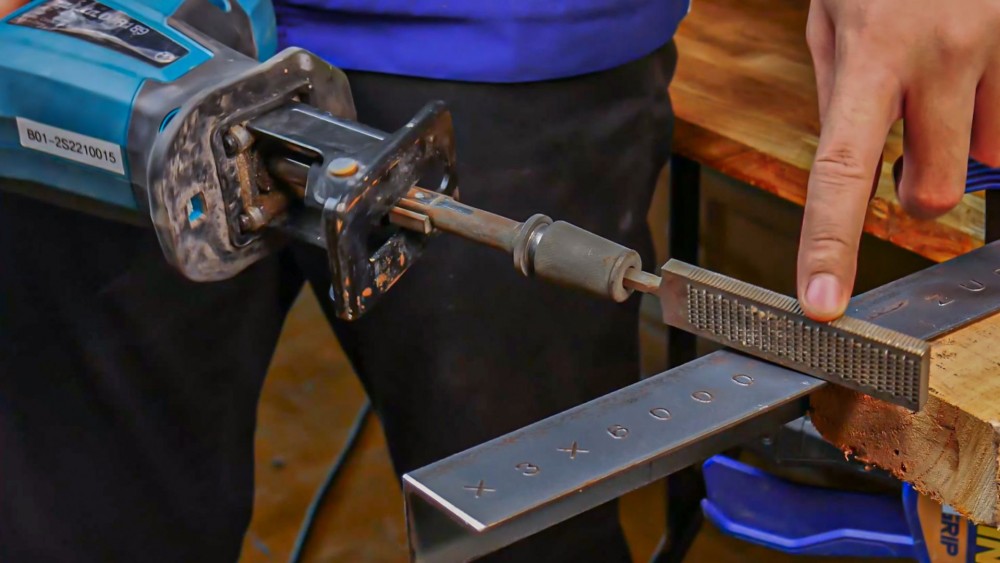
The RECIPROTOOLS range consists of accessories that expand reciprocating saws beyond cutting wood, metal, or pipes, allowing them to be used for scraping, filing, sanding, and surface cleaning as well, such as:
- Multi-purpose scraper blades for reciprocating saws, sizes 2 inches and 4 inches
- Round files, rasp files, and various needle/round files
- Brush adapter heads
- Wire brushes, nylon brushes, and cleaning brushes for reciprocating saws
- Abrasive pads and sanding sheets
Choose the Right Power Saw Accessories for the Job
Before choosing accessories, ask yourself what the primary material to be cut is. Wood, steel, plastic, acrylic, foam, laminate, or stainless steel each require completely different accessories. If you ask whether Can power saws generally be used to cut concrete, and why are they rarely supported? Because hard materials require durable blades suited for the cutting forces, thin materials require blades that don't snatch or tear, and coated materials require blades or accessories that minimize chipping.
Meanwhile, soft materials like foam or sponge need proper blade support to prevent the cut line from wandering. Starting with the correct material makes selecting blades, guides, and base attachments much easier.
Start with the material to be cut
Many people choose accessories based on the tool model first, which is definitely something that needs checking. However, focusing solely on the tool model without considering the material can result in accessories that fit the tool but fail to meet the job's demands. For instance, the blade might fit the machine, but the teeth are too coarse for a finish requiring a smooth surface, or a guide can be attached but is unsuitable for very small workpieces.
Therefore, a good sequence is: check the material, consider the nature of the task, and then verify the compatibility of accessories with each electric saw model.
Consider the nature of the electric saw task: prioritize speed, a smooth finish, or precision.
Different tasks have different goals. For demolition, cutting old water pipes, cutting framing timber, or cuts where surface appearance is not critical, choose accessories that prioritize speed and durability. However, for furniture making, built-in cabinetry, component assembly, or cutting sheets where edges are clearly visible, choose accessories that focus on neatness and accuracy, such as fine-toothed blades, cutting guides, or anti-splinter devices.
If the job requires repetitive cuts across multiple pieces, cutting guides and clamping devices are extremely useful because they ensure consistent dimensions, reduce remeasuring, and minimize errors from freehand control. On the other hand, for curved or intricate cuts, accessories that provide better workpiece control—such as a jigsaw table—are a better fit. Choosing accessories that match the nature of the job ensures you get the most out of your electric saw's full capabilities.
Check accessory compatibility with your electric saw before purchasing
Some accessories are compatible across multiple models, but others are strictly model-specific. This is especially true for auxiliary saw bases, adapters, certain guide types, specialized blades, or accessories that attach directly to the tool. Before purchasing, verify the tool model, SKU, and mounting system. Accessories that look similar may not be interchangeable. Buying the wrong item can result in an impossible fit or loose mounting, creating safety hazards while operating that electric saw.
For those owning electric saws across multiple brands, accessories should be organized by model or kept in dedicated storage boxes. Small items like mounting screws, base plates, guides, or adapters are easily misplaced. For frequent on-site work, keeping them stored in designated sets reduces search time and ensures readiness every time you head to a job site.
How do accessories make electric saws more cost-effective?
Buying new tools isn't always the answer. If your current tool still runs strong and operates normally, adding the right accessories can help your existing electric saw handle more diverse tasks at a more cost-effective budget, such as:
- Adding a cutting guide for straighter cuts
- Adding high-quality blades for better performance on specialized materials
- Adding a dust extraction adapter for a cleaner workspace
- Adding an extension table for easier precision work
This approach elevates work quality without needing to replace your entire tool system.
From a professional contractor's perspective, accessories save time, reduce rework, and yield a cleaner finish—all of which directly impact costs and customer satisfaction. From a general user's perspective, accessories make work easier without demanding the high skill level required for freehand control.
Precautions when using electric saw accessories
Even though accessories enhance the performance of an electric saw, they must always be used properly. Before starting work, ensure the accessory is securely attached, free of cracks, and the saw blade is not chipped or warped and is rated for the tool's speed. For accessories that attach directly to the tool, such as guides, base plates, or saw tables, install them according to the manual and perform a brief test run at low speed before actual operation. Additionally, always wear appropriate personal protective equipment, such as safety glasses, dust masks, and task-appropriate gloves.
Never force the electric saw beyond the limits of the tool and its accessories, such as using the wrong blade for the material, applying excessive pressure, or using a cutting guide on an unsecured workpiece. These can cause kickback, workpiece ejection, or tool damage.
Choosing the right equipment is one thing, but using an electric saw correctly is just as important.
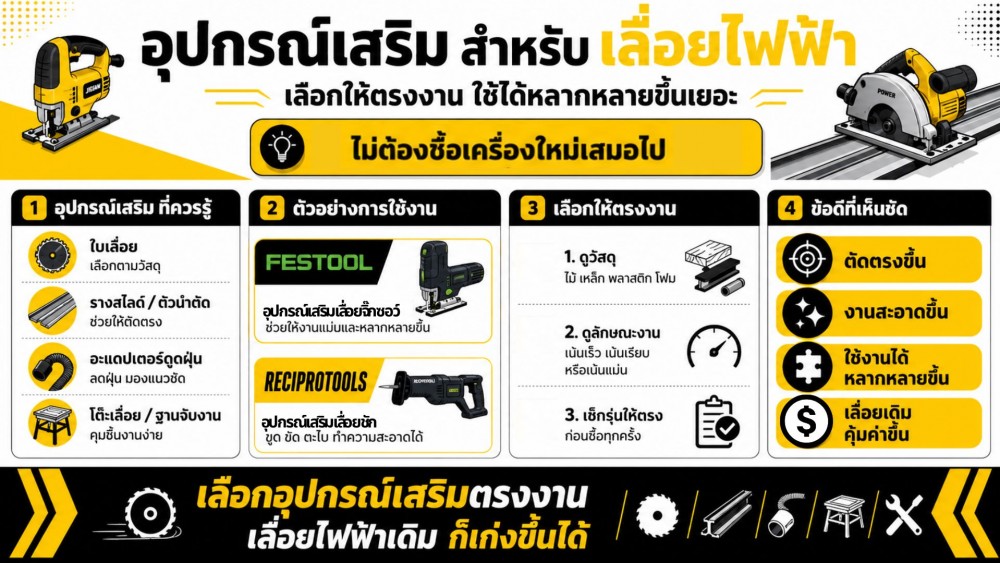
Summary: Choose the Right Accessories, and Your Existing Electric Saw Can Do Even More
Electric saw accessories are essential aids that make a single tool more versatile, more precise, and better suited to the job. Whether it's cutting guides, dust extraction adapters, saw tables, base plates, or various clamping devices, choosing the right ones for your material and type of work helps reduce crooked cuts, splintered edges, airborne dust, and ruined workpieces. For example, a jigsaw cutting guide is ideal for those looking to increase cutting accuracy, while a jigsaw table is suitable for DIY projects, small woodworking tasks, and jobs requiring finer workpiece control.
For those who have Jigsaw and Shear already, don't overlook accessories just yet. Sometimes adding the right small accessory for the job can noticeably improve the performance of your existing tool.