


 EN
 ไทย


Customers Also Purchased


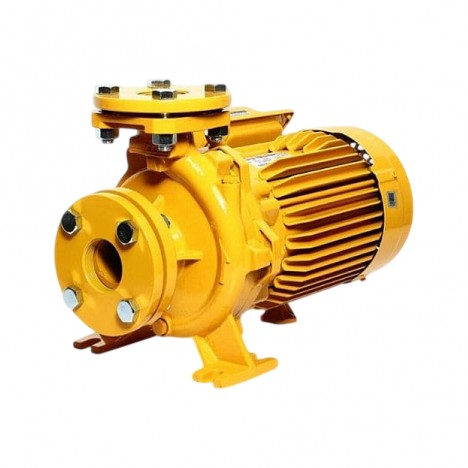


A centrifugal pump is a commonly found water pump with versatile applications, ranging from residential households and agriculture to industrial plants. Key highlights include delivering a high flow rate, running well continuously, and being available in various sizes.
However, when it comes to purchasing, the question many get stuck on is: should you choose a single-impeller or twin-impeller centrifugal pump? Both use the same operating principle, but they differ in terms of pressure, flow rate, suitable applications, price, and maintenance.
In this article, we will compare both types in an easy-to-understand way to help you choose the right centrifugal pump for the job, avoiding issues like weak water flow, water not reaching its destination, or the pump working harder than necessary after installation.
What is a centrifugal pump? Why is it so popular?
Electric Centrifugal Pumps (Centrifugal Pump) works by using an impeller rotating at high speed to create centrifugal force that moves water from the impeller center to the outer edge, then discharges it through the pipe via a volute casing resembling a snail shell. That is the origin of its Thai name, "spiral-shell pump" (Centrifugal Pump).
The advantages of this type of centrifugal pump are delivering large water volumes, having a simple structure, easy-to-find spare parts, and wide versatility in households, buildings, farms, factories, and general water circulation systems.
However, each centrifugal pump model has distinct strengths: some are suitable for applications requiring high flow rates, while others are suited for tasks needing high pressure or lifting water to high elevations. Therefore, choosing a pump shouldn't depend solely on size or horsepower, but on internal construction—especially the number of impellers, which defines the different operational characteristics between single-impeller and twin-impeller pumps.
Why is the impeller of a centrifugal pump important?
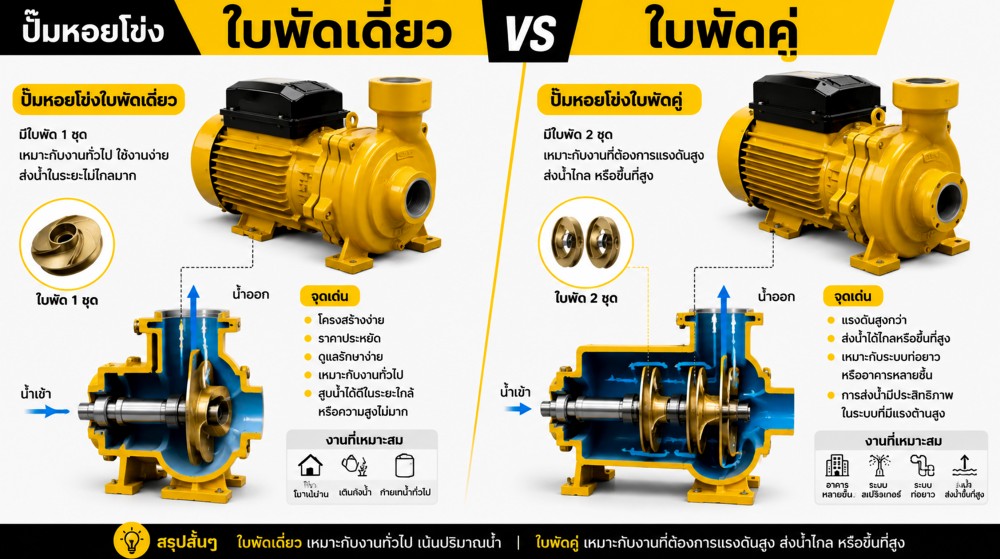
The impeller is the heart of a centrifugal pump. It converts energy from the motor into centrifugal force to push water out. It affects not only the water volume, but also pressure, power consumption, and suitability for the piping system.
Single-Impeller Centrifugal Pump
This is a pump with a single impeller. It features a simple structure, low cost, and easy maintenance. It is suitable for general water delivery tasks that do not require high pressure, such as watering plants, pumping water between tanks, or general water circulation systems over short distances. Simply put, it excels at "moving high volumes of water smoothly" rather than "pushing water to high elevations," and when issues arise, it is easier to repair due to having fewer parts.Twin-Impeller Centrifugal Pump
This is a pump with two impellers. Water undergoes two stages of pressure boost, thereby generating higher pressure. It is suitable for tasks requiring water delivery to multi-story buildings, delivery through long pipelines, or systems that require relatively stable and consistent pressure.
A common misconception is that a twin impeller always means more water output. Its true advantage lies in pressure and delivery head, not flow rate. For certain tasks requiring high water volume without high pressure, a single-impeller pump may even be more suitable.

Key Factors to Consider Before Buying a Centrifugal Pump
- Where is the water being delivered? Short distances or low elevation → A single impeller is sufficient. Delivering to high floors, long distances, or complex piping → A twin impeller is more suitable.
- How much water do you need? For tasks requiring high water volume, such as filling ponds or pumping into orchards, look primarily at the Flow Rate. For tasks requiring lifting water to high elevations or supplying pressure-dependent nozzles, consider the Head value as well.
- How is the piping system? Pipes that are too small cause the pump to work harder and restrict water flow. Unnecessary elbows should be minimized and air leaks into the suction pipe prevented, as centrifugal pumps cannot tolerate air in the suction line, which may prevent water from lifting or cause the pump to malfunction.
- How clean is the water? Centrifugal pumps are suitable for clean water. If the water contains sand, sediment, or debris, a strainer or filtration system should be installed before the pump intake to prevent premature impeller wear and seal damage.
What problems can occur if the wrong type of centrifugal pump is used?
If a single-impeller centrifugal pump is chosen for an application requiring much higher pressure than the pump's capability, potential issues include weak flow at the destination, failure to deliver water to the desired height, pressure drops when multiple outlets are used simultaneously, or the pump running under continuous heavy load, shortening its lifespan.
Conversely, choosing a dual-impeller centrifugal pump for light-duty applications that do not require high pressure can result in unnecessary costs, as the pump is typically more expensive, more complex to maintain, and its full capacity remains underutilized. In some cases, if the piping system is unsuitable, excessive pressure may also place added stress on system components.
Additionally, whether single-impeller or dual-impeller, improper installation can cause similar problems, such as failure to pump due to lack of priming, suction pipe leaks, a faulty foot valve, an undersized suction pipe, water levels below the pump's suction limit, or air entrapment inside the pump casing. Therefore, proper installation and system layout are just as crucial as selecting the right pump model.
Frequently Asked Questions
Is a dual-impeller pump more powerful than a single-impeller one?
Generally, dual impellers generate higher pressure, making them suitable for high-elevation lifting or long-distance water transfer. However, this does not mean water discharge is doubled, nor is it superior for every application.
Is a single-impeller pump suitable for agricultural use?
It is well-suited for general water pumping, garden watering, or filling ponds over short distances. However, if the piping is very long or the discharge nozzles require high pressure, a dual-impeller pump should be considered instead.
Does a dual-impeller pump consume more electricity?
This cannot be determined by the number of impellers alone. Power consumption mainly depends on motor rating and operating load. If the pump is properly matched to the system, it will operate efficiently without consuming unnecessary electricity.
Select Electric Centrifugal Pumps here