


 EN
 ไทย


Customers Also Purchased
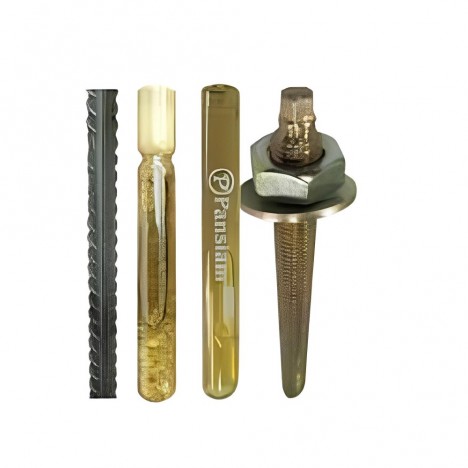
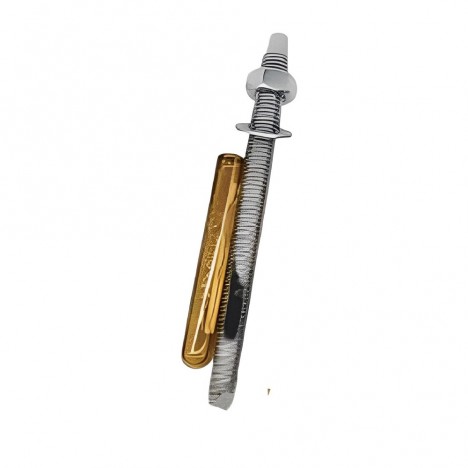
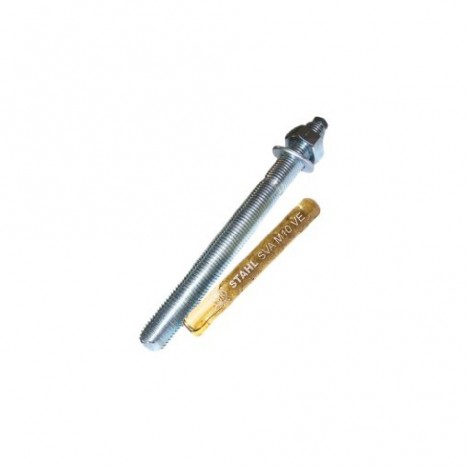
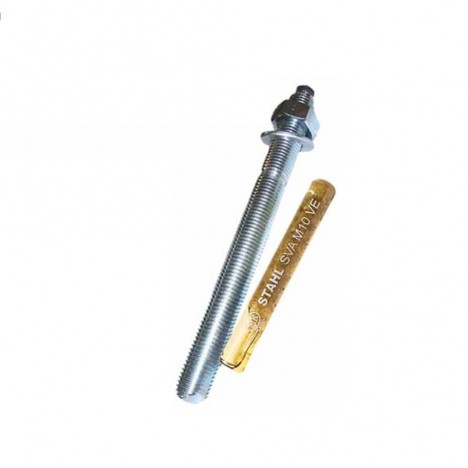
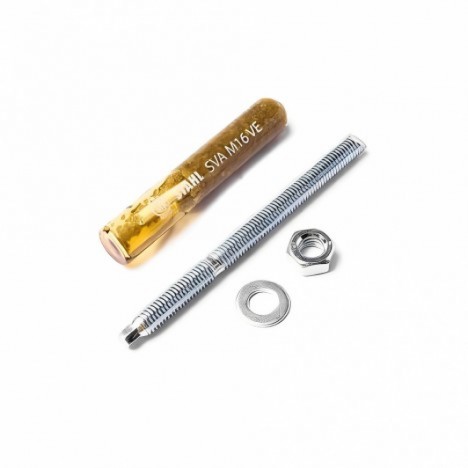
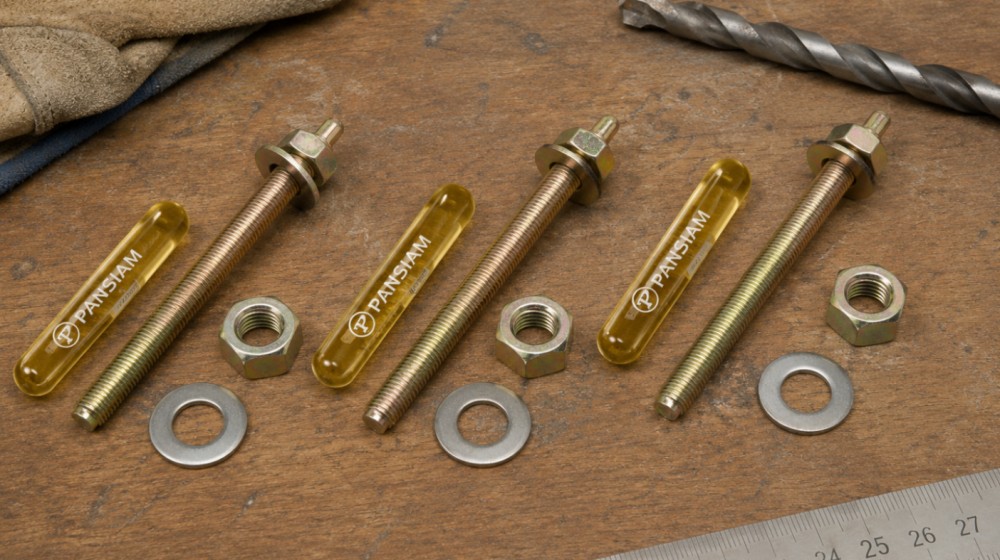
When anchoring heavy loads to concrete walls or floors, many people immediately think of chemical anchors because they feel more secure and reliable than conventional expansion anchors. This is especially true for steel frameworks, base plates, awnings, or railings, where failure means not only property damage but also potential safety hazards. However, when it's time to actually buy, a common question arises: What size should I use? Is M8 sufficient, or should I step up to M10 or M12? Some people opt for a larger size right away, assuming bigger is inherently stronger. While that sounds logical, it isn't always so straightforward in real-world applications.
Chemical anchor It's not just about the size or weight of the workpiece. Other factors you must consider together include the base material to be drilled, hole depth, number of anchoring points, edge distance from the concrete, and installation method. Even with an M12 anchor, if it is drilled incorrectly, dust isn't blown out cleanly, or a load is applied before the resin cures, the anchor point may not hold as strongly as expected.
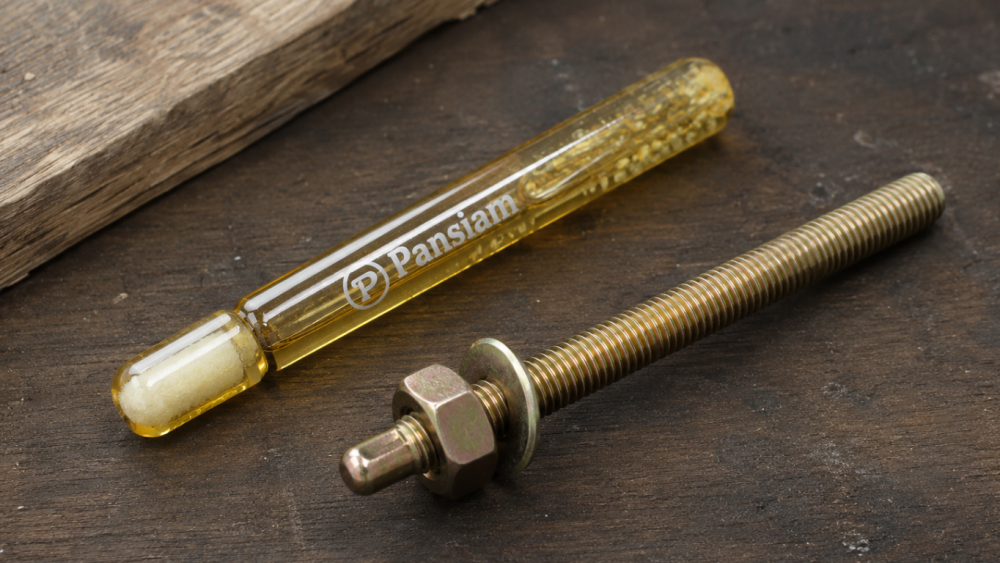
Before choosing a size, you need to understand what M8, M10, and M12 mean.
The "M" preceding the number denotes the metric thread diameter of the threaded rod, not the drill hole size directly. M8 refers to a threaded rod of approximately 8 mm, M10 is about 10 mm, and M12 is about 12 mm. However, when using chemical anchors, the drilled hole is usually slightly larger than the threaded rod to provide space for the chemical resin to flow and surround the rod.
A common example is that M8 might require a hole of about 10 mm, M10 about 12 mm, and M12 about 14 mm. However, these numbers should not be taken as a hard-and-fast rule, as different brands and models may specify different hole sizes and depths. Always consult the user manual or product specifications for your specific application. This point is critical because many people mistakenly believe that using an M10 threaded rod means you can simply drill a 10 mm hole. Consequently, there isn't enough resin, the threaded rod becomes too tight to insert, and the anchoring strength is compromised.
So, what kind of applications should use M8?
M8 is suitable for light to medium-duty applications, such as securing small mounting brackets, certain types of shelving, small base plates, or general installations that do not carry heavy loads and are not subject to frequent shock loads. The advantages are a smaller drill hole, less resin consumption, easy installation, and a more secure hold than standard plastic anchors. However, for high-load applications like large awning frameworks, steel column bases, or safety guardrails, you should not choose M8 based merely on the assumption that it "should be enough." These applications require evaluating the number of anchoring points, actual weight, concrete strength, and the dynamic forces generated during use.
M10 is a commonly used medium size due to its good balance.
If the job is not very light, yet not quite heavy-duty, M10 is often the go-to size for many because it strikes a perfect middle ground—stronger than M8, but not as bulky as M12. Typical applications using M10 include sign brackets, medium steel structures, base plates, or certain types of steel railings. However, M10 is not a universal one-size-fits-all solution for all medium-duty jobs. If the wall is not structurally sound, the drilled hole is not properly cleaned, or the embedment depth is insufficient, it may still fail to achieve its full load capacity despite the appropriate size. Actual site conditions must always be taken into account.
M12 is suitable for applications requiring higher holding power.
M12 is often chosen for more demanding applications, such as base plates, steel frames, awning structures, certain guardrails, or workpieces that bear more weight and dynamic loads than typical applications. A larger threaded rod provides greater stability in many cases, but the trade-offs are drilling larger holes, using more chemical adhesive, and ensuring the base material has enough mass to support the load.
This is where many people make a mistake by assuming that choosing M12 first is inherently safer. However, if the drilled hole is too close to the concrete edge or adjacent holes, using a larger size can cause the surrounding concrete to crack. Especially for awnings, railings, or applications where failure poses safety risks, having a qualified technician or engineer review the specifications is much safer.
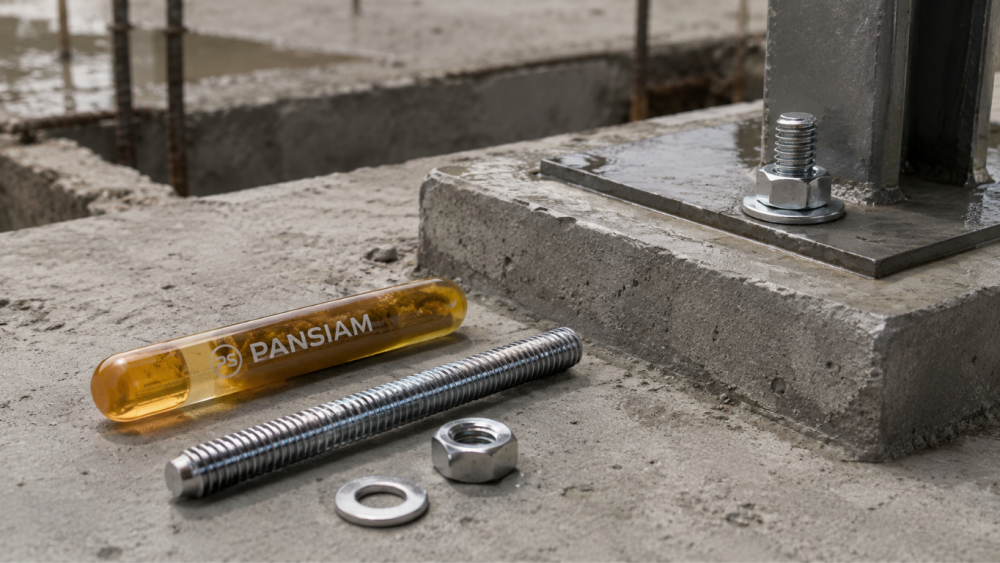
Don't just ask “how many kilos can it hold?” because the answer isn't that simple.
A popular question is how many kilograms an M8 or M12 chemical anchor can support. In reality, it is very difficult to give a single figure because holding power depends on many factors simultaneously: the substrate being drilled (solid concrete, solid brick, hollow block, or autoclaved aerated concrete), hole depth, hole cleanliness, amount of resin injected, edge distance, spacing between anchors, and the type of forces involved (tension, shear, bending, or vibration).
Two applications both using M10 can have completely different load capacities if one is drilled into dense concrete while the other is in a wall that isn't strong enough. For general light-duty jobs, you can estimate based on on-site conditions and product manuals, but for safety-critical applications, guesswork should never be the basis.
Concrete walls, concrete blocks, and lightweight concrete cannot be approached the same way.
Chemical anchors perform exceptionally well in solid concrete because the resin bonds tightly with the borehole wall, providing firm holding power. However, with hollow concrete blocks, perforated bricks, or hollow walls, greater care is needed because the resin may flow into internal voids instead of bonding around the threaded rod as intended. These types of applications sometimes require the use of mesh sleeves.
As for autoclaved aerated concrete (AAC), even closer attention is required because the material is porous and has a lower load-bearing capacity than concrete. You should not assume that simply using a larger threaded rod will solve the problem. If using chemical anchors with AAC, choose resins or anchor systems explicitly rated for this material, and do not use them for heavy loads without checking the specifications. Sometimes, a properly installed M10 in good-quality concrete is far more reliable than an M12 installed in an unsuitable wall.
Is choosing the larger size always better?
Not necessarily. A larger size requires drilling a larger hole, using more resin, and demands more space within the concrete. If the installation point is close to an edge, a corner, an existing hole, or where concrete space is limited, selecting an overly large size can create more complications on the job site.
The ideal size is not the largest one, but the one that best fits the application. For small jobs, an appropriately sized anchor is sufficient; for medium jobs, M10 often offers great value and balanced performance; for heavier loads, consider M12 or larger based on engineering specifications.
Poor installation cannot be compensated for by any size.
Chemical anchors perform at their best only when the borehole is clean, the hole diameter is correct, and the resin is allowed to cure for the full specified time. After drilling, concrete dust remains inside the hole; injecting resin directly without blowing out dust or brushing the hole can cause the adhesive to bond to the dust rather than the borehole walls, significantly reducing holding strength.
The correct procedure is to drill the hole to the diameter and depth specified in the manual, blow out the dust, brush the hole clean, blow it out again, then inject the resin, insert the threaded rod with a slight twisting motion, and allow the adhesive to cure for the manufacturer's specified time before tightening the nut or applying any actual load. Often, chemical anchor failures do not occur simply because the size was too small, but because of incorrect hole sizing, unclean holes, insufficient resin, or loading the anchor before it has fully cured.
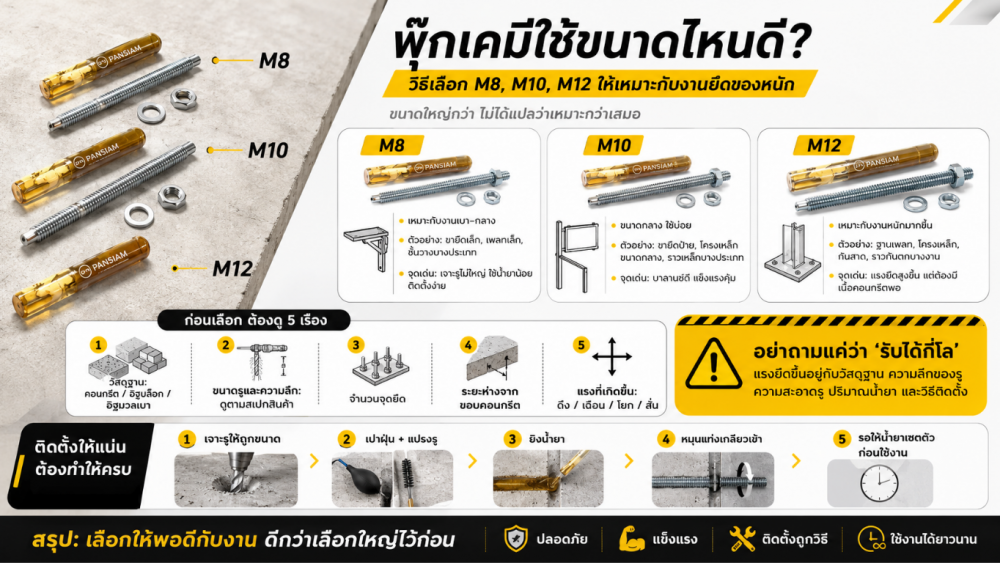
Selecting the right size chemical anchor ensures a cleaner, safer outcome.
Chemical anchor They are fantastic solutions for heavy-duty anchoring, but that does not mean you should always pick the largest size. For light-to-medium tasks, M8 may be plenty; for medium jobs requiring higher stability, M10 is broadly versatile; and for heavier-load applications, M12 may be more suitable.
Regardless of the size chosen, it is equally crucial to match it to the base material, drill the correct hole size, clean the borehole thoroughly, inject sufficient resin, and allow it to cure fully before putting it into service. A strong chemical anchor connection does not come from size alone, but from proper sizing and correct installation from the start.