EN
 ไทย


Customers Also Purchased



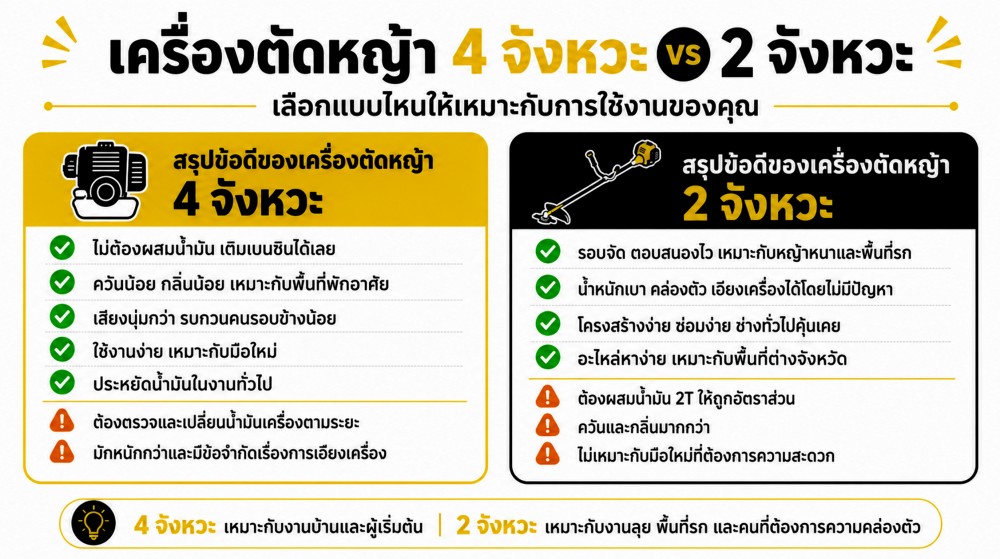
This question sounds simple, but the answer depends on each person's usage. Many people tend to think that 4-stroke brush cutters must always be better because they are more fuel-efficient, quieter, and produce less smoke. However, many who actually work in large areas or do heavy-duty tasks still choose 2-stroke brush cutters. The truth is, neither type is definitively better; each has its own distinct strengths.
- 4-stroke brush cutters are easy to use, require no fuel mixing, run quietly with low smoke, and are ideal for general homes and gardens.
- 2-stroke brush cutters feature high RPM, agility, lightweight design, and easy repair, making them suitable for heavy-duty work or overgrown areas.
Therefore, before making a purchase, Lawn mower you should first consider how you will use it, your budget, and how much maintenance you are prepared to handle.
What are 2-stroke and 4-stroke brush cutters?
Before comparing which brush cutter model is better, we must first understand that the terms "2-stroke" and "4-stroke" refer to how the engine operates; it doesn't mean that one is necessarily old technology and the other is new.
2-stroke and 4-stroke engines generate power differently, directly affecting the characteristics of the brush cutter—including RPM power, noise, smoke, fuel consumption, maintenance, weight, maneuverability, and suitability for various tasks.
For the average person, there is no need to know deep technical details, but understanding the basics will help you choose the right machine and avoid falling for advertising claims that one type is "the best" without considering your actual application.

What is a 2-stroke brush cutter?
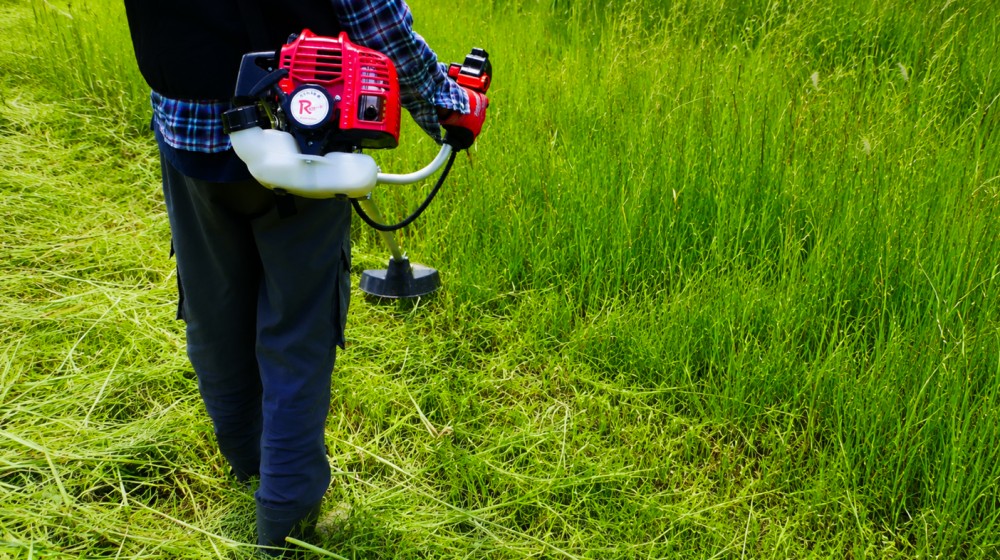
- Key strengths: High RPM, responsive throttle, lightweight, and agile. Ideal for overgrown, uneven terrain, or tasks requiring frequent lifting of the cutting head.
- Points of caution: Fuel must be mixed in the correct ratio; incorrect mixing can affect starting and engine lifespan. It also produces more smoke and odor.
What is a 4-stroke brush cutter?
An engine with a separate engine oil system, similar to a standard motorcycle engine. You only fill it with pure gasoline—no need to mix anything in.
- Highlights: Easy to use, smoother sound, low smoke, ideal for homes, gardens, resorts, or noise-sensitive areas.
- Cautions: Engine oil must be checked and changed at scheduled intervals, and tilting the machine excessively during operation should be avoided as it may affect the engine lubrication system.
Where is a 4-stroke brush cutter better than a 2-stroke?
For the general user who doesn't perform heavy daily work, a 4-stroke brush cutter offers several advantages, but it is not suitable for every situation.
- No fuel mixing required: Simply add gasoline without guessing the 2T ratio. This helps reduce errors and is ideal for users who only operate it a few times a month or want to grab and go immediately.
- Less smoke and odor: Because it does not burn engine oil with the fuel, exhaust emissions are cleaner. It is suitable for homes, resorts, or areas with people nearby.
- Smoother sound: Less high-pitched compared to 2-stroke engines, allowing longer use with less fatigue and disturbing those around you less.
- Better fuel economy for general tasks: The combustion system is more orderly, maximizing fuel efficiency during regular mowing. However, actual savings still depend on grass conditions, blade sharpness, and maintenance.
Is a 2-stroke brush cutter still worth using?
It is definitely still worth using, especially for serious gardeners, frequent outdoor users, or those needing to cut overgrown grass on uneven terrain. A 2-stroke machine remains well-suited for many situations.
- High RPM, quick response: The trimmer head responds instantly upon throttling. Ideal for thick grass, overgrown weeds, or vegetation requiring high RPM. In areas with uneven grass thickness, a 2-stroke machine provides a more agile and controlled feel.
- Simpler construction, hassle-free maintenance: General technicians are more familiar with 2-stroke engines. Spare parts are easy to find and repairs are straightforward. Especially for those in provincial or remote areas, this is an important factor to consider for when problems arise, not just on purchase day.
- More agile when tilted: For work along fence lines, ditch banks, mounds, or sloped surfaces, 2-stroke engines have an advantage because their lubrication system has no tilt-angle limitations like 4-stroke engines.