EN
 ไทย


Customers Also Purchased


When it comes to woodworking, one of the most interesting questions is: "If I just want to cut wood straight, do I need multiple Jigsaw and Shear saws?" Because when you actually search for power saws, you will find a great variety of tools, including circular saws, jigsaws, miter saws, table saws, track saws, or multi-tools certain models that can fit wood-cutting blades
Seeing so many options makes it uncertain whether everyday DIY home woodworking, or just cutting framing timber to build small shelves, truly requires owning every type of power saw—or if starting with just one is enough. The phrase "cutting straight" in woodworking does not always mean the same thing, and each task may require different tools. This is precisely why many people feel overwhelmed by the variety of power saws available.
Cutting straight does not depend on the power saw alone
Besides the question of What types of power saws are there for woodworking? Does an all-in-one saw truly exist? We should also understand that a straight cut in woodworking comes from a combination of several factors. The tool—such as a power saw—certainly plays a role, but the saw blade, blade condition, sharpness, workholding method, marking accuracy, clearance allowance, user steadiness, and cutting support surface are just as important. Even with a top-notch saw, if the wood shifts during cutting or the line was marked crookedly to begin with, the final cut will still end up skewed.
Therefore, before considering buying another power saw, ask yourself whether the issue comes from "the tool not being suited for the task" or from "lacking cutting accessories," such as:
- Lacking a guide rail
- Lacking clamps to secure the wood
- Lacking a stable support table
- Using a saw blade unsuitable for the wood type
Sometimes investing in small accessories can help achieve straighter cuts more effectively than buying an entirely new power saw.
On a limited budget, which power saw should you start with?
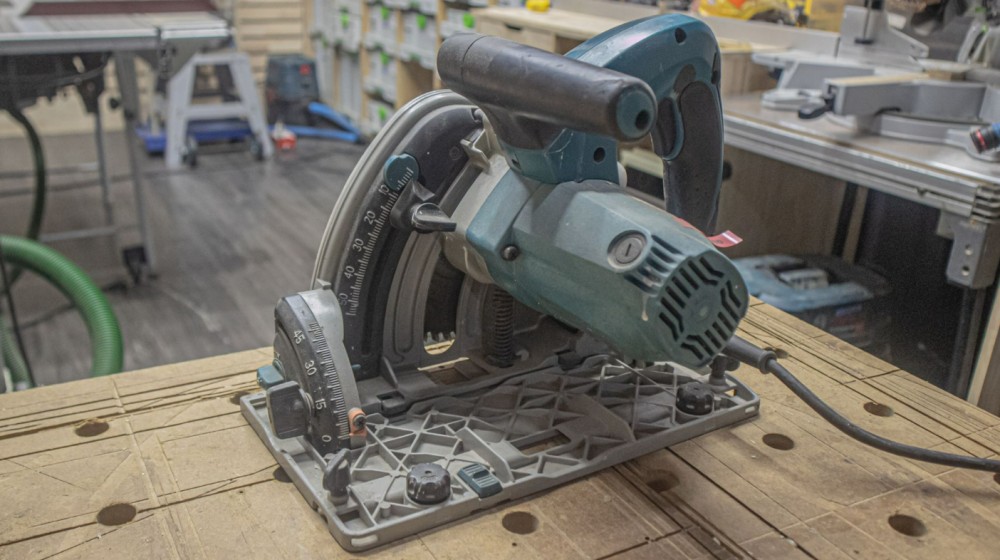
If you have to choose a first power saw for general straight wood cutting, a circular saw is the most versatile choice because it can cut sheet goods, plywood, framing lumber, solid wood, or pallets, depending on the tool size and selected blade.
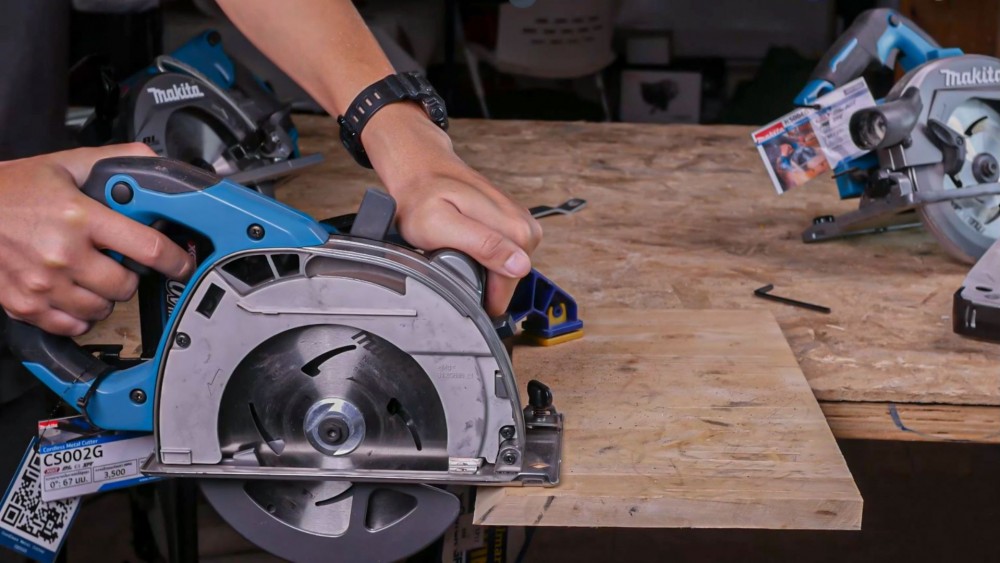
The strengths of a circular saw are fast operation, great straight-line cutting when guided, and a wide range of entry price points—from DIY models to professional-grade tools.
A circular saw might not offer the same precision as a table saw or track saw, but for those focusing solely on straight wood cuts without complex work, a single electric circular saw paired with a simple cutting guide rail is well-suited for many tasks. Cutting plywood sheets for shelving, trimming boards shorter, cutting wood for small table frames, or cutting lumber for home repairs can all be done without issues. The key is selecting a blade size suitable for the wood thickness and choosing a blade that matches your desired cut finish quality.
Is a track saw necessary if you want straight wood cuts?
If the question is whether cutting wood straight alone warrants buying a higher-tier power saw like a track saw, the answer is: not necessarily for everyone. If you cut wood occasionally, do general tasks, or don't require an ultra-smooth cut finish yet, a circular saw with a guide rail or a clamped straightedge works just fine.
A track saw is the answer for precision straightness, but may not fit every budget
The advantage of a track saw is convenience and confidence in straight cuts, but its limitation is a higher price point than general power saws and the requirement of guide tracks suited to your workpiece length. If you need to cut large sheets of varying sizes, you may need multiple track lengths or rail connectors, increasing the overall cost.
Therefore, for beginners, buying a track saw as your first power saw may not be necessary if it's not yet clear how often you will use it. However, if you know for certain that your main work involves long, straight sheet cuts and requires a very neat finish, such as:
- Making furniture for sale
- Taking on interior decoration jobs
- Cutting expensive board materials where mistakes mean high costs
A track saw is a worthwhile power saw investment because it boosts working confidence, reduces rework, and delivers a much more professional finish.
What kind of straight-cutting work is a table saw suitable for?
Get to know: What is a table saw? How is it different from a circular saw? What must be distinguished is that "cutting straight" and "making repeated identical cuts" are not the same thing. A circular saw or track saw helps you make great straight cuts, but if you need to cut 20 pcs of wood to the exact same width, a table saw is the superior power saw because you set the rip fence once and make continuous repeated cuts. This is why many woodworkers often own both a track saw and a table saw—one excels at breaking down large sheets, while the other excels at repetitive ripping and batch production.
For beginners, if you are not yet in mass production, there is no rush to buy a table saw. Start with a handheld power saw that offers good guide control, then observe your own usage patterns. If you frequently need to rip wood repeatedly, handle larger batch quantities, or want to avoid spending excessive time remeasuring, upgrading to a table saw later is never too late.
Is a miter saw necessary if the focus is on cutting wood straight?
A miter saw is a power saw ideal for cutting lumber strips, structural timber, baseboards, picture frames, or jobs requiring precise cutting angles. Its highlight is making convenient 90-degree square cuts and adjusting cutting angles, such as from 90 to 45 degrees. Compared to circular saws, a miter saw might not be suitable for cutting large wood sheets, but it is great for cutting lumber strips to precise angles with quick repeatability.
Therefore, if our definition of "straight cut" means squaring up the ends of framing timber, cutting table legs to identical lengths, or cutting large volumes of lumber strips, a miter saw can be a power saw that helps tremendously. However, if the focus is on cutting plywood panels, boards, or ripping sheet goods, a miter saw is not the primary choice because its cutting capacity is limited by blade size and the tool's sliding range.
Can a scroll saw or jigsaw make straight cuts?
A jigsaw is an easy-to-use, lightweight power saw that excels at curved cuts. If you ask whether it's well-suited for cutting wood straight, the answer is: It works, but it's not its specialty A jigsaw is best suited for cutting curves, cutouts, openings, or working in tight spots where a circular saw cannot reach, making it an excellent "support-tier" power saw.
However, the problem with jigsaws for straight cuts is that the blade is thin and moves up and down, making it prone to deflecting along the wood grain—especially with thick or hardwood stock. The cut may look straight on top, but it can be beveled or angled underneath.
It's acceptable for rough cuts or short straight lines, but if you need a truly straight, precise line, a jigsaw is not suitable as a primary power saw.
Jigsaws are better as a supplementary tool than a primary one
If you already have a circular saw, a jigsaw will complement what the circular saw cannot do, such as curved cuts, internal cutouts in panels, or fine detail work. But if you don't own any saw yet and your main goal is cutting wood straight, starting with a jigsaw is not recommended unless your primary work involves curves or cutouts.
How many power saws are enough?
The most appropriate answer depends on your "actual type of work," not the number of tools others own.
For general DIY tasks and occasional wood cutting, a single circular saw with an appropriate blade and a cutting guide might be plenty.
- If you frequently cut large wood panels, a track saw will make things more convenient.
- If you repeatedly cut lumber strips and specific angles, a miter saw will save you time.
- If you rip large quantities of wood, a table saw is more suitable.
- If your work involves curved cuts or internal openings, a jigsaw is a very useful supplementary tool.
You don't need multiple power saws when starting out. But as your workflow becomes clearer, a second or third tool can help reduce working time, minimize errors, and make results more consistent.
Start with the tasks you do most frequently
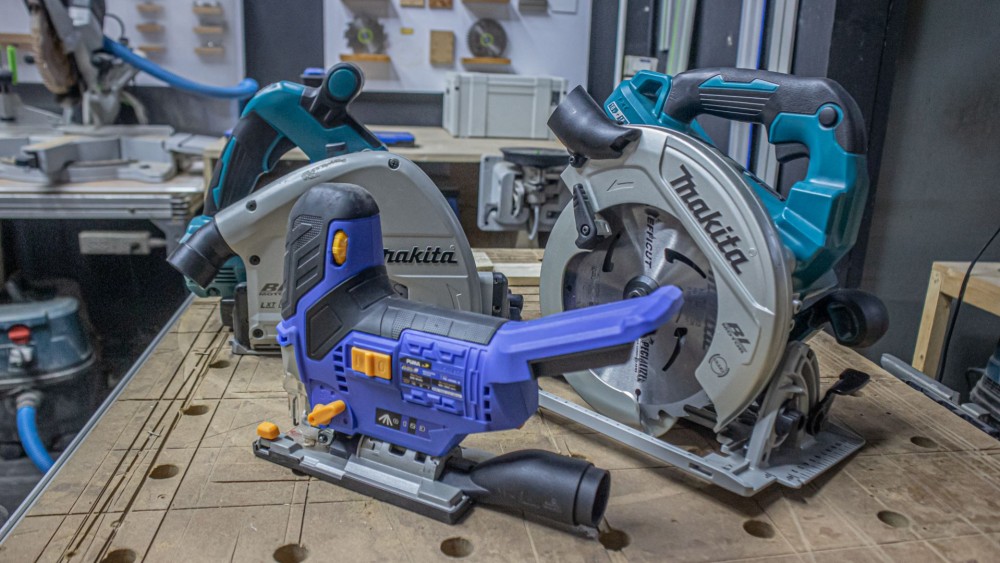
The easiest way to choose is to look at what work you think you will do most often. If you mainly cut sheet goods, start with a circular saw or a track saw. If you mainly cut dimensional lumber, look at a miter saw. If you do a lot of rip cuts, look at a table saw. If you cut curves or cutouts, look at a jigsaw. But if you are still not sure, your work is varied, and you want a versatile first power saw, a circular saw remains the most sensible starting point for many people.
Additional Things to Consider Before Buying a New Power Saw
Before deciding to buy another power saw, take a look at the equipment around you first. Many times, the problem of not cutting straight simply comes from lacking basic aids, such as:
- Not having enough clamps
- An unstable workbench
- Not having a reliable square
- Using the wrong type of saw blade
- Not having a guide rail
These factors have a significant impact on work quality and usually cost less than buying a new tool.
To give a simple example: with the same power saw, if you change the blade to suit the wood and the type of cut, the results can be noticeably different. A fast-cutting blade may leave a rougher finish, while a high-tooth blade may give a cleaner finish but cut slower. If cutting plywood or laminated sheets, choosing the wrong blade can easily cause chipping along the edges.
Therefore, choosing the right saw blade can sometimes elevate your work more than replacing the tool itself.
Small accessory tools can truly make cuts straighter
Cutting wood straight requires a proper system rather than skill or luck. If you measure well, clamp well, align properly, and choose the right blade, you can achieve clean results even with a single power saw. Conversely, even with multiple tools, without a good foundation in measuring and work-holding, the results will still deviate.
For both beginners and professionals, investing in basic accessories and organizing your work systematically will help you get much more value out of your power saw.
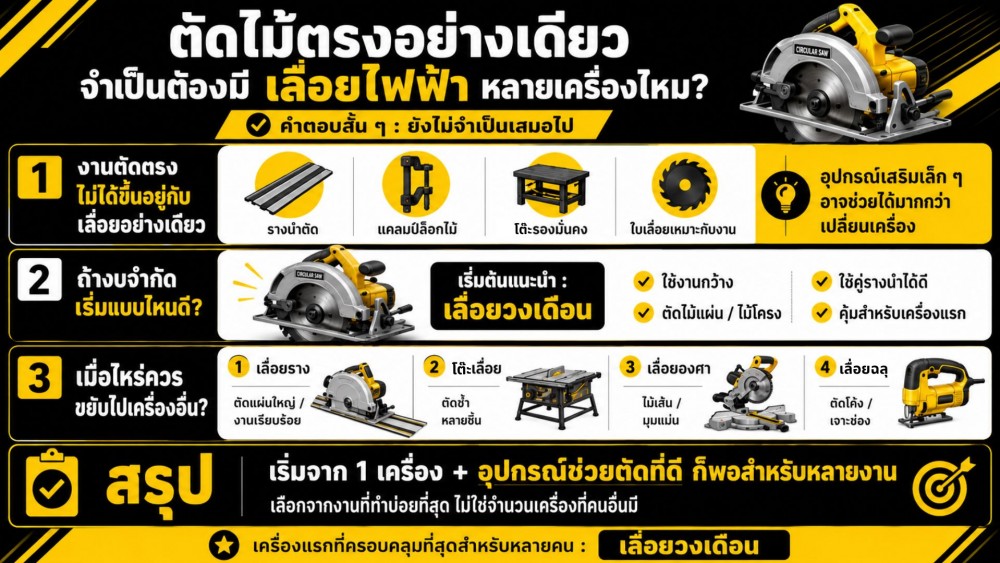
Conclusion: If you only cut wood straight, there is no need to rush into getting multiple types of power saws
If your goal is simply to cut wood straight, there is no need to own multiple power saws right from the start. A single tool chosen correctly for your work, paired with good cutting guides, is enough for most tasks. Especially for DIY or small-to-medium woodworking, rushing to buy multiple power saws can be a waste of budget, result in underutilization, and still fail to solve the core problem if the real issue lies in measuring, clamping, or blade selection.
The best approach is to start with your actual work first:
- If you need a versatile first power saw, a circular saw is a great choice.
- If you frequently cut large sheets and need higher precision, then consider a track saw.
- If you make repetitive cuts and angles on dimensional lumber, then add a miter saw.
- If you need to rip a large amount of lumber, then consider moving up to a table saw.
- If you need to make curved cuts or cutout openings, then add a jigsaw as a complementary power saw.
Choosing Jigsaw and Shear Starting with just one unit is simpler, more cost-effective, and better meets real-world job needs than buying multiple machines just out of fear that one won't be enough.