EN
 ไทย


Customers Also Purchased


When you see Drill various types available in stores or on websites, such as on our iToolmart website. Some people might wonder, "Why are many models priced at just a few thousand, while others can reach ten thousand, twenty thousand, or even more?" What makes such a huge price difference? Is it the brand, the motor, the battery, or the gear system and unseen technology?
The answer is that high-end drills aren't expensive because of just a single part, but typically because of the tool's "integrated system"—internal materials resistant to heat and impact, as well as safety systems and long-term operating precision. Simply put, premium drills don't just sell raw power; they offer stability, durability, precision, safety, and confidence in real-world use.
So, let's take a look at what actually drives up the price of a drill. How much does the motor matter? Why is the battery crucial? Why is the gear system a key highlight in certain models? We'll use case studies to illustrate that higher-priced models differ by far more than just the number on the price tag.
Why Are Drills Expensive?
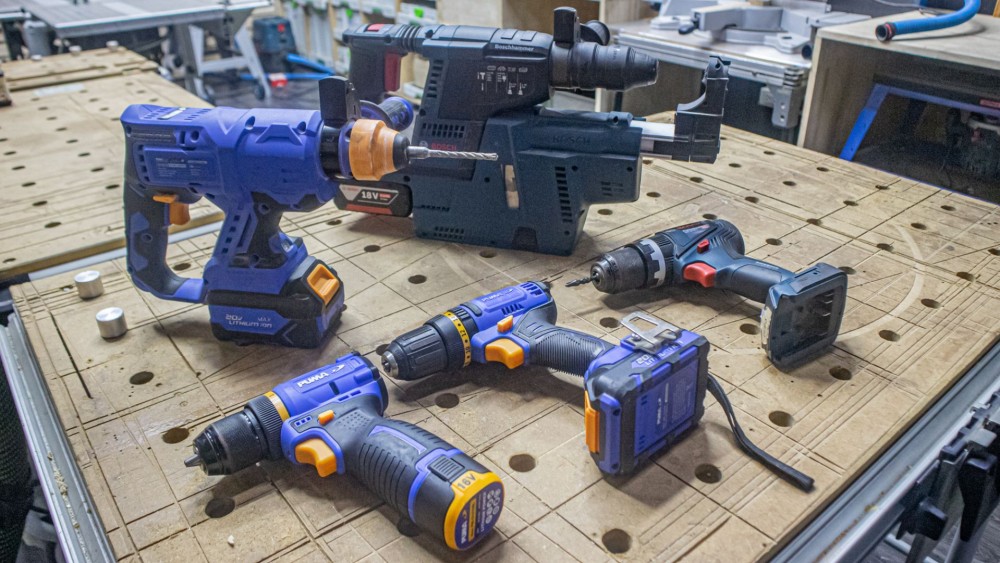
When it comes to modern drills—whether cordless or rotary hammers—the primary factor that drives the price up is typically the "motor." Many entry-level models may use brushed motors, which are functional, affordable, and sometimes easy to repair, but come with limitations regarding heat, wear and tear, energy efficiency, and maintaining power under continuous heavy loads.
High-end drills usually feature brushless motors. In actual use, you will notice that the tool responds faster, maintains RPM better, and doesn't bog down easily under heavy loads compared to smaller or budget models. Why Choose a Brushless Drill? Why Does It Matter and How Does It Differ? However, you need to understand that a brushless motor is just one part of the system. If the battery cannot supply enough power or the control circuitry is poorly designed, the tool still won't be able to unleash its full potential.
Therefore, the term "good motor" that drives up the price of a drill must be considered alongside the entire electrical system, cooling system, and powertrain.
A Good Motor Isn't Just Powerful—It Must Be Controllable
A great tool isn't measured solely by its maximum power; it's also measured by power control. Different tasks require different amounts of force. If a tool only has raw power but is hard to control, it might over-drill, strip screw heads when driving screws, or damage delicate materials.
High-end drills therefore offer finer power control, such as precise clutch adjustments, smooth trigger response, or more consistent RPM maintenance as the load changes. These may sound like minor details, but for those who use them every day, the difference is night and day—an easy-to-control tool makes work faster, reduces fatigue, and better minimizes workpiece damage.
Why Does the Battery Make a Drill More Expensive?
Some drill models may already seem pricey as tool only (no battery), but once you include the cost of batteries and a charger, the price rises even further. That is because high-quality batteries represent a significant portion of the manufacturing cost for cordless tools.
A Good Battery Prevents Sudden Power Drops
What sets high-end drills apart from standard models is that under heavy use, power and speed drop much more slowly. For example, when drilling wood with large bits or using hole saws, if the battery cannot supply enough current, the motor won't perform at its peak. But if the battery is high-quality and works seamlessly with the control system, the tool maintains consistent power throughout.
This is why some high-end drills don't just feel absurdly more powerful, but rather feel "smoother and more stable." They don't just deliver power when you first pull the trigger; they provide sustained power. And sustained performance is precisely what drives the cost of professional-grade cordless tools.
The Gear System: An Overlooked Factor That Makes a Huge Difference
Standard drills often have only a single gear speed, or at most 2 speeds, which is sufficient for general household tasks or light DIY work. However, when tackling a wider variety of jobs, having fewer gears can leave the tool lacking flexibility.
The gear system in a drill serves to balance torque and rotational speed, allowing you to select the optimal power range for the job, preventing the motor from straining, and helping reduce heat buildup.
High-end drills therefore often feature a more refined gear system, enabling the tool to cover everything from delicate fastening to general drilling and heavy-duty drilling. This is neither a toy nor an optional gimmick, but rather a factor that determines how versatile a tool is and how well it performs across different applications.
Good gears prevent the drill from straining excessively
Using the wrong gear for the task causes the drill to work unnecessarily hard. For example, using high speed on jobs that require high torque will make the machine heat up quickly, become noisy, experience heavy loads, and potentially shorten its lifespan. Conversely, using a low gear for tasks that require speed can result in slow work and a less-than-ideal surface finish.
High-end drills with quality gear systems let you select more suitable modes. Especially when facing various tasks in a single day—such as drilling wood in the morning, drilling steel in the afternoon, installing fixtures in the evening, or constantly switching between drilling and screwdriving—a refined gear system makes work much smoother, which is one reason why certain models cost more than standard tools.
Is the chuck and chuck-change system also part of the high price?
Another factor that drives up the price of a drill is the chuck and attachment-changing system. Standard drills may come with only a single keyless chuck, which is sufficient for basic tasks. However, some models are designed with interchangeable chucks to allow a single tool to handle multiple tasks—such as having a standard drill chuck, a quick-release hex chuck, an angle chuck, or specialized attachments for installation work.
The advantages of an interchangeable chuck system include:
- Helps reduce on-site working time
- Allows a single tool to adapt better to various situations, such as furniture work where you need to drill a pilot hole first and then immediately switch to driving screws.
- If the chuck is easy to change and locks securely, work becomes much faster.
- In tight spaces, specialized chuck attachments allow access to angles that standard drills cannot reach.
- High-quality chucks also impact accuracy
Safety systems are a hidden cost in high-end drills
The more powerful a drill is, the better its control and safety systems need to be—especially when a drill bit binds in material or experiences sudden kickback. This can twist your wrist or cause you to lose control of the tool. High-end drills therefore incorporate kickback protection or anti-kickback systems to help reduce risks during use.
These safety systems are features that people may not realize they need; however, in real-world use—especially when drilling large holes, drilling tough materials, using long bits, or working in awkward positions where tool control is difficult—a drill with an auto-cutoff or kickback control system provides safer, more confident operation.
Example: FESTOOL TPC 18/4 Drill
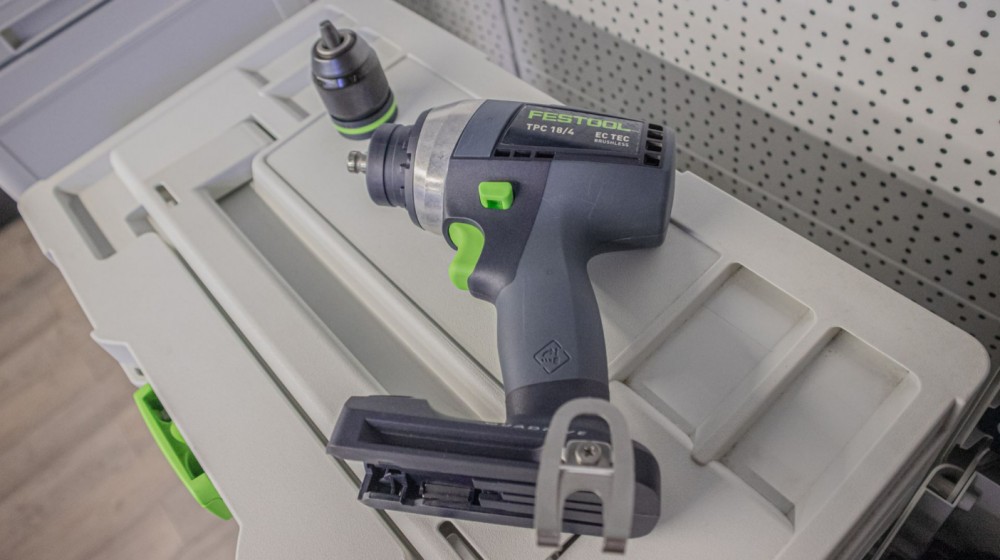
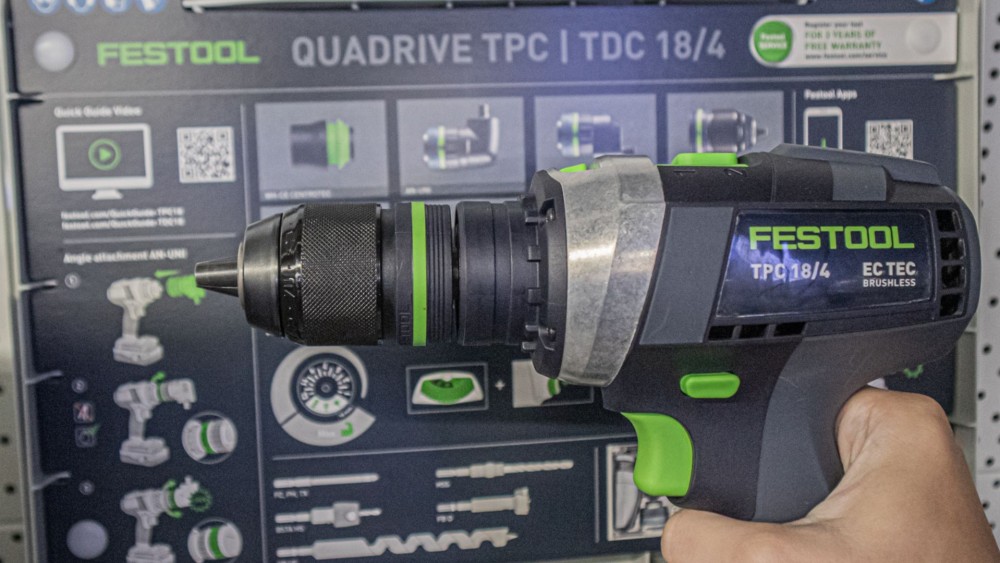
Let's take a look! What can Festool's top-tier drill do? Is it right for you? To illustrate what makes a drill expensive, let's take a look at FESTOOL model 575604 TPC 18/4 I-BASIC 18V, whose tool only (no battery) price is 2-3 times more expensive than standard tools which is an 18V Cordless Percussion Drill packed with a brushless motor, a 4-speed operating system, axial impact, and a KickbackStop system to help prevent kickback that could twist your wrist.
This clearly reflects the concept of high-end drills: it's not just about "being able to drill," but about being versatile, highly controllable, and safer during heavy-duty applications.
4-speed gearbox: the feature that sets the TPC 18/4 apart
One of the highlights of the FESTOOL TPC 18/4 is its 4-speed gearbox, unlike standard drills that usually have up to 2 gears. Having more gears allows for much finer power control, ideal for tasks requiring both torque and speed in a single tool, such as:
- Screwdriving jobs requiring torque control
- Wood drilling requiring the appropriate speed
- Steel drilling where speed shouldn't be too high
- Applications demanding extra power in hard materials
This model's specifications state a maximum torque in wood and steel of 50/75 Nm and a chuck capacity of 1.5-13 mm, which accommodates a sufficiently wide range of common drill bits. It also supports drilling up to 70 mm in wood, 13 mm in steel, and 10 mm in brick, showing that the tool isn't just designed for light work, but also handles a variety of serious jobs.
FastFix and CENTROTEC help speed up transitions between tasks
Speaking of changing chucks, another feature that distinguishes high-end drills is the chuck and accessory system. This model comes with a CENTROTEC tool chuck and a 13 mm FastFix keyless chuck, making swapping heads or changing applications much more convenient.
For professionals doing real installation work, switching from drilling to screwdriving or changing the chuck to match the bit being used happens very frequently. If the chuck system is fast, secure, and precise, it significantly reduces working time.
What to ask yourself before buying an expensive drill?
Before deciding to buy an expensive drill, don't just ask, "Is this model powerful?" You should also ask, "What does my work really require?" Check aspects like:
- What type of motor it has, and how many gears the gearbox offers
- Whether the torque is sufficient for the job, and if the battery is compatible with other tools
- Whether the chuck is easy to change
- What safety systems are included
- Whether the weight is suitable for prolonged use
And importantly, is there after-sales service and spare parts availability?
Because a drill, especially an expensive one, should be a long-term investment, not just purchased for good-looking specs.
Summary: What makes a high-priced drill expensive?
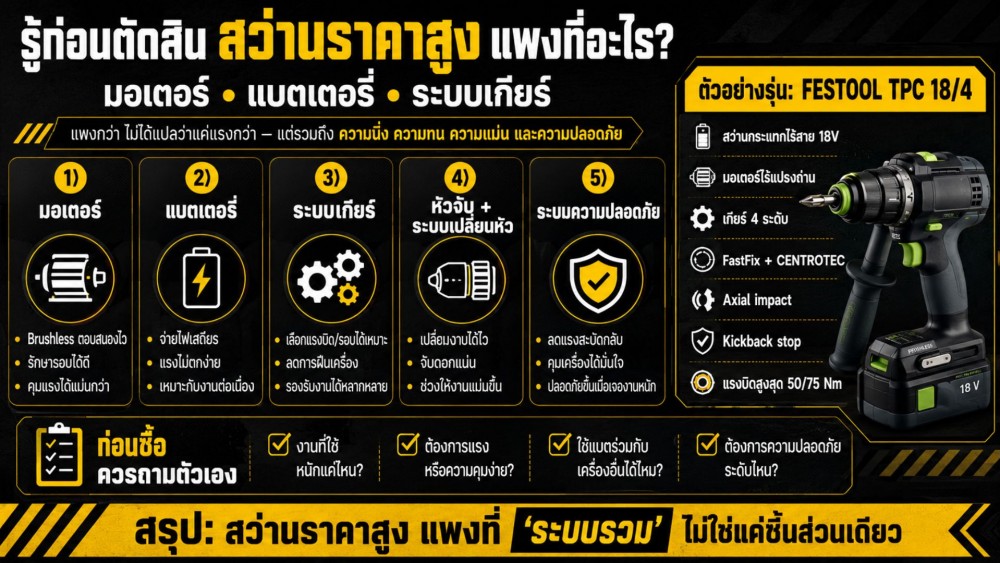
High-priced drills aren't expensive just because of the motor, battery, or gear system alone. Instead, the cost lies in bringing everything together to work seamlessly as one. For example, a motor that is powerful yet controllable, a battery that provides stable power delivery, a gear system that can handle the load with properly matched power bands, a precise chuck, safety systems that reduce risks, and a body designed for long-term real-world use.
Therefore, when choosing a drill, don't just look at whether it's cheap or expensive—look at what level of tool your work requires. For general use, a mid-range or budget-friendly drill might offer great value.
If you need a tool that can handle heavy-duty work, is easy to control, accurate, safe, and supports a wide variety of tasks over the long term, Drill A high price tag may not be too expensive, but rather an investment in a tool that helps you work better, faster, and with confidence from the very first time you pick it up.