


 EN
 ไทย


Customers Also Purchased


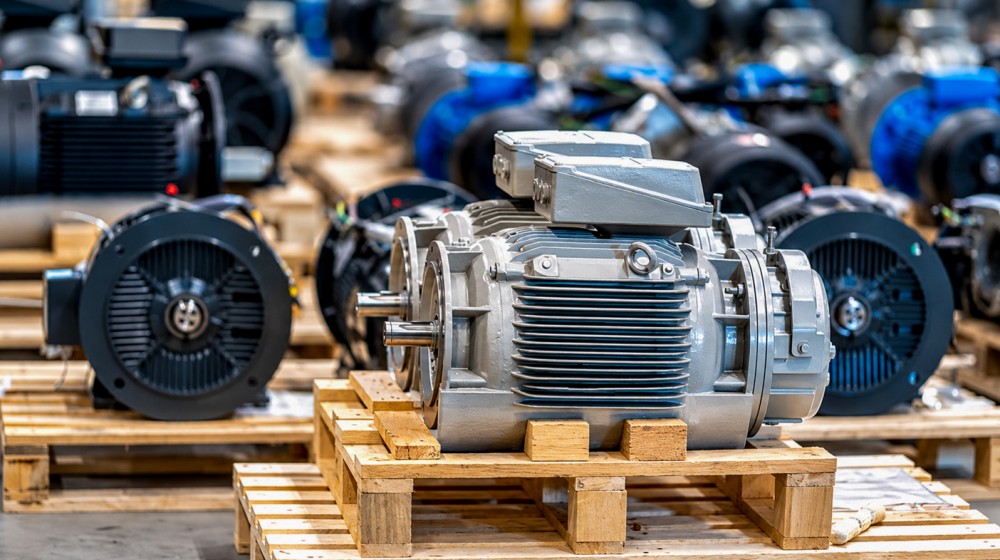
When buying an electric motor, many people usually start with basic questions like: How many horsepower? How many phases? What RPM? But upon looking at the actual specs, you'll encounter unfamiliar codes such as IE1, IE2, IE3, IE4—known as Motor Efficiency Classes. So what are these IE ratings? Do they relate to how powerful the electric motor is? And do you really need to know about them? Especially if the motor is used frequently or continuously, such as in water pumps, industrial fans, machinery, or conveyor belts in factories. That's because the IE rating doesn't mean the motor is more powerful; it indicates how efficiently the electric motor converts electrical energy into mechanical energy. Simply put, it tells you how much of the supplied electrical power is converted into rotational force, and how much is lost as heat.
The IE code indicates the energy efficiency class, with IE1 being the lower class and IE5 being the highest class in the current European system. European regulations mandate that certain categories of motors must meet IE2, IE3, or IE4 standards depending on their size and operating characteristics.
What Is Electric Motor Efficiency?
When Electric motor operates: we supply electrical power, and the motor converts it into rotational force at the shaft. In the real world, however, energy is not entirely converted into rotation. Some of it is lost as heat, noise, and friction in the windings, iron core, bearings, and various components.
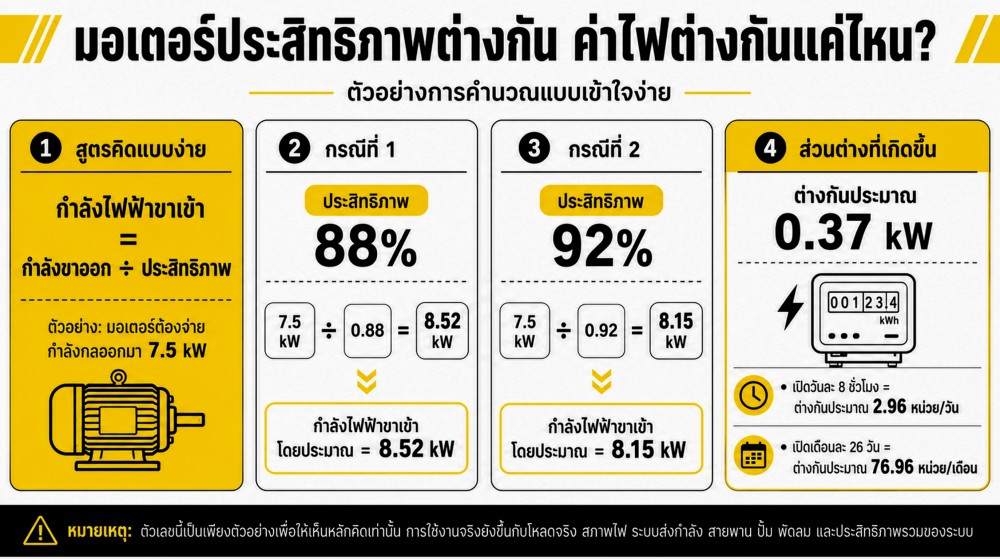
For example, a motor requiring a mechanical output of 1 kW at 80% efficiency would need an electrical input of about 1.25 kW, with the 0.25 kW difference becoming energy loss. But with 90% efficiency, it requires less input power to achieve the same mechanical output. This is why higher-IE electric motors are not just better for energy savings, but are also directly tied to heat generation, service life, and long-term cost-effectiveness. Lost electricity typically turns into heat accumulation inside the motor; if the motor runs too hot and ventilation is poor, the lifespan of the insulation, windings, and bearings will inevitably be shortened.
Electric Motor Examples
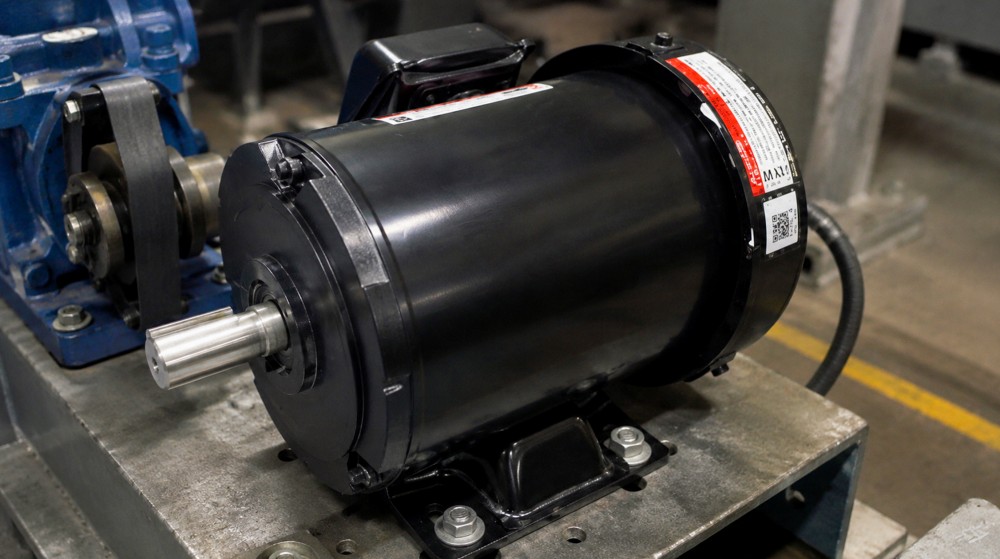
MITSUBISHI Electric Motor 1/2 HP Model SF-QR 1/2 HP 4P 220/380 V.
- Type: High-quality 3-phase induction electric motor conforming to JIS (Japanese Industrial Standards) and IEC (International Electrotechnical Commission) standards. A 3-phase induction motor equipped with a cooling fan at the rear of the
- electric motor, along with cooling fins on the housing (for certain models), helps reduce internal material deterioration caused by the effects of
- heat generated during operation. This ensures a long motor service life and a durable structure. All Mitsubishi motor models offer high operating efficiency, high torque, and full rated output.
- Extremely low operating noise resulting from well-balanced design. The enclosed structure effectively prevents foreign objects from entering the motor. Ideal for ventilation applications, conveyor belt systems, compressor unit pairings, general industrial use, and factory production lines.
What is IE on an Electric Motor?
IE stands for International Efficiency, which represents the energy efficiency rating of an electric motor. It is a classification code indicating a motor model's energy efficiency level relative to standardized benchmarks.
The relevant standard is IEC 60034-30-1, which covers line-operated AC motors rated from 0.12–1,000 kW, voltages from 50–1,000 V, and 2, 4, 6, or 8 poles. Simply put, IE is the "energy-saving grade" of an electric motor, determined by its efficiency rating relative to its power capacity, speed, and pole count.
Commonly Referenced IE Efficiency Classes
- IE1 = Standard Efficiency
- IE2 = High Efficiency
- IE3 = Premium Efficiency
- IE4 = Super Premium Efficiency
The higher the IE number, the less energy the motor loses as heat; however, it does not mean increased horsepower. For example, a 3 HP IE1 motor and a 3 HP IE3 motor provide the same power output, but the IE3 motor utilizes electricity more cost-effectively due to lower energy losses.
What is an IE1 Electric Motor?
IE1 is the Standard Efficiency rating—the most basic efficiency level in the IE1–IE4 spectrum. Historically widespread due to its low initial cost, its use is now being phased down in many countries, especially for industrial applications.
The advantage is low purchase cost, but with daily operation, long-term electricity costs can be higher. IE1 is therefore best suited for intermittent, non-continuous applications. If running daily, upgrading to IE2 or IE3 is generally more cost-effective overall.
What is an IE2 Electric Motor?
IE2 represents High Efficiency, offering lower energy losses than IE1 through improved materials, winding quality, rotor design, and cooling systems.
IE2 strikes a balanced sweet spot between purchase cost and energy savings. It suits regular, ongoing duty that is not demanding enough to mandate a premium motor. However, for factory or regulated applications, always verify local compliance requirements, as some standards require IE3 or higher.
What is an IE3 electric motor?
IE3 stands for Premium Efficiency, a level that many factories and industrial applications increasingly prioritize because long-term electricity costs accumulate to far more than the initial purchase price of the motor.
IE3 is suitable for applications where the motor must run continuously, such as building or factory water pumps, industrial fans, blowers, production lines, or systems with multiple motors. Although the initial purchase price is higher, if used frequently, that difference is typically paid back in the form of lower electricity bills.
What is an IE4 electric motor?
IE4 stands for Super Premium Efficiency, ideal for applications requiring exceptional energy loss reduction or systems where long-term energy costs are strictly managed.
IE4 electric motors are typically more expensive than IE3 and require additional considerations, such as compatibility with existing systems and speed control. For household or light-duty tasks, it might not be necessary. However, for serious industrial operations running long hours with high power costs and a goal of long-term cost reduction, IE4 is an option worth calculating—you shouldn't just look at the purchase price on the quotation.
Does higher IE mean more power?
No. A higher IE means "more energy-efficient," not "more powerful." Suppose two motors are both 5 HP and identical in every other way, but one is IE1 and the other is IE3; their output power is still the same. The IE3 motor just uses electricity more efficiently with less energy loss—like two cars with similar power, but one consumes less fuel. Therefore, if a job requires 3 HP and you substitute it with a 2 HP IE4 motor, it still won't handle the load. A higher IE does not compensate for an undersized motor.
Why do higher IE motors save more electricity?
Because they have lower internal energy losses, whether from heat in the windings, the iron core, or mechanical friction. As a result, more of the input electrical energy is converted into rotational force.
An easy observation is that higher IE motors typically run cooler during normal operation. However, under excessive load, voltage drops, or poor ventilation, an IE4 motor can still be damaged. In conclusion, IE indicates energy cost-effectiveness, but you must still choose the right size, horsepower, and RPM for the application first.
Does IE apply to all types of electric motors?
Not in all cases. This is very important because some people see the term IE and assume every type of motor has an IE rating.
The IEC 60034-30-1 standard applies to specific groups of electric motors, especially single-speed AC motors operating on alternating current within the standard's scope. It does not mean all motors on the market use the same classification method. For instance, small DC motors, servo motors, specialized motors, motors integrated into certain machines, or motors designed exclusively for inverter-driven operation may have different standards or evaluation methods.
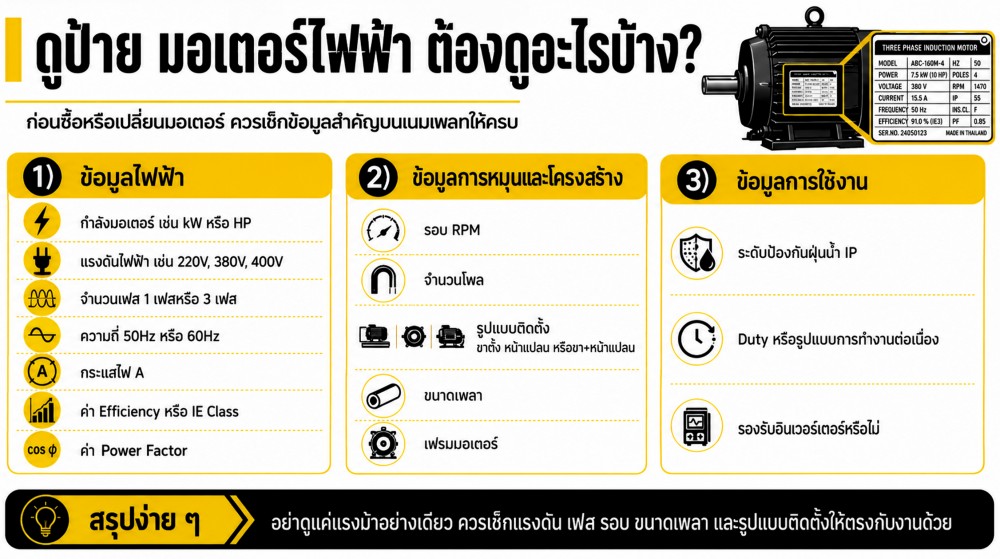
Therefore, when choosing a motor, primarily check the nameplate, catalog, and manufacturer specifications. If you're unsure, ask the seller: What IE class is this motor? What power supply does it use? Is it inverter-compatible? And what type of load is it suitable for?
Conclusion
IE1–IE4 are energy efficiency classes for electric motors: the higher the number, the greater the energy savings, especially for continuous or daily use. However, IE does not indicate motor power and is not the only specification to consider. You must also evaluate horsepower, RPM, phase, voltage, frame size, and load characteristics. Choosing a high IE rating but the wrong size will still cause issues.
Select Electric motor to suit the application