


 EN
 ไทย



Customers Also Purchased
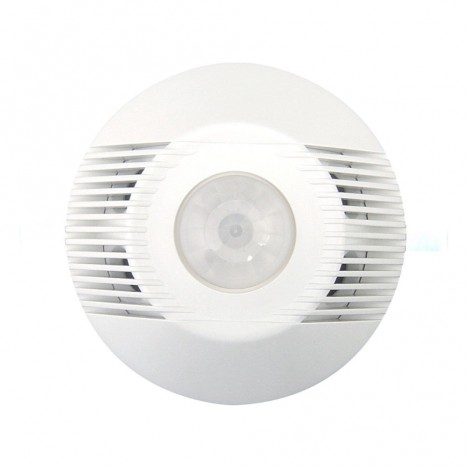
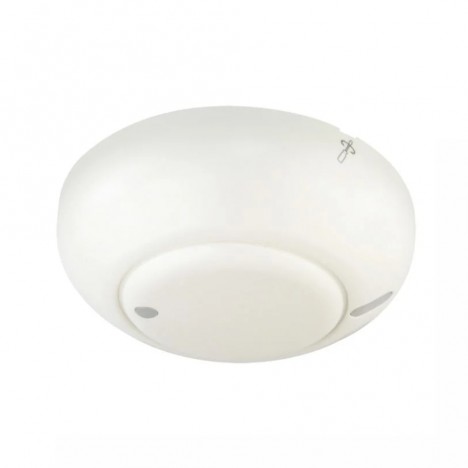
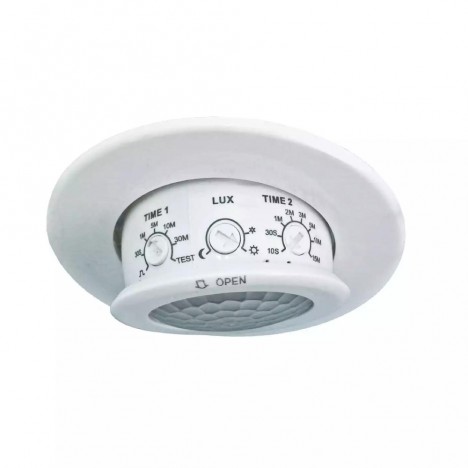
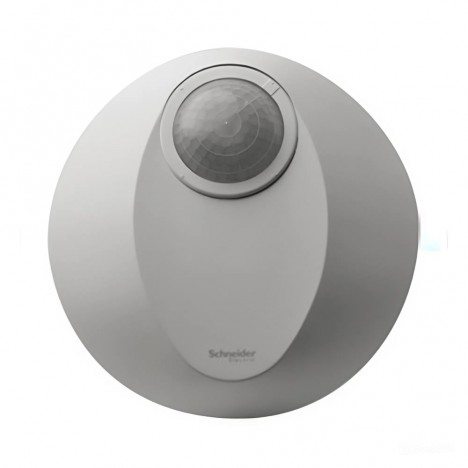
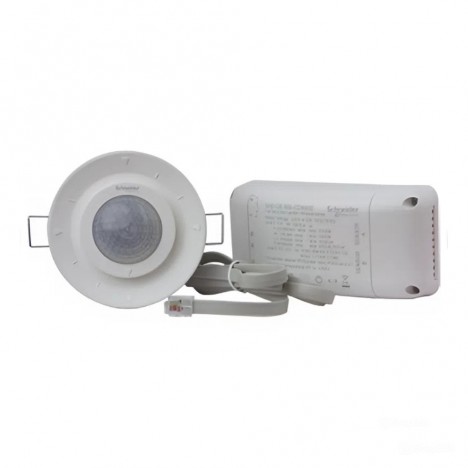
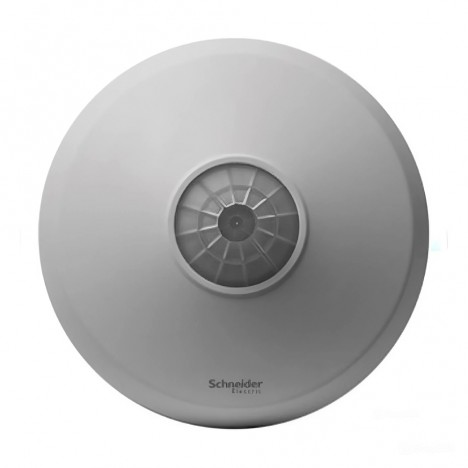
Motion Sensors These are common devices in automatic lighting systems, whether for front porches, hallways, stairwells, restrooms, parking lots, or security systems. The operating principle seems simple: when someone walks by, the sensor detects the movement and automatically commands the lights or connected equipment to operate.
In reality, motion sensors are not all the same, and each type works differently. Choosing the wrong type or installing it in an unsuitable area can cause the lights to trigger frequently on their own, fail to turn off as expected, or sometimes not turn on at all when someone walks by.
Common sensors used in automatic lighting systems include: PIR Sensors and Microwave Sensor Both are used to detect motion, but they differ in detection method, sensitivity, coverage range, and suitable application areas.
This article will walk you through PIR Sensor and Microwave Sensor how they differ, which type suits which space, and how to choose the right motion sensor for practical use.
What is a motion sensor?
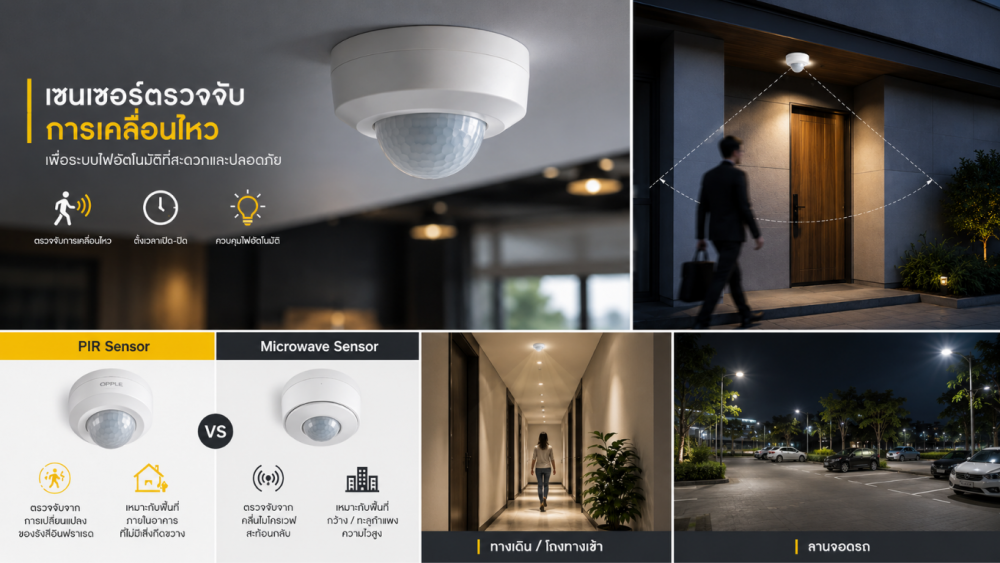
A motion sensor is a device used to detect whether people, animals, or objects are moving within a designated area. When motion is detected, it sends a signal to activate other equipment, such as light bulbs, light fixtures, alarm systems, CCTV cameras, or automatic control systems.
Common examples include hallway lights that turn on when someone walks by, porch lights that turn on when detecting an approaching person, office restroom lights that turn on automatically, or parking lot lights that activate when cars or pedestrians enter.
The advantages of motion sensors include increased convenience, reduced switch touching, eliminating the problem of forgetting to turn off lights, and enhancing security in certain areas. However, the key is choosing the right type for the specific site conditions; an improper choice can lead to false triggers, causing more annoyance than convenience.
What is a PIR Sensor?
PIR Sensor or Passive Infrared Sensor It is a motion sensor that operates by detecting changes in infrared radiation within its detection area.
In simpler terms, people, animals, or warm objects constantly emit infrared radiation. When someone walks past the sensor, the level of radiation received by the sensor changes, allowing it to recognize that motion has occurred.
The term Passive This means the sensor itself does not emit waves or energy, but merely receives changes occurring in the area. For this reason, PIR sensors are widely used in automatic lighting for homes, office buildings, restrooms, hallways, stairways, and areas where general pedestrian traffic needs to be detected.
Key Highlights of PIR Sensors
The highlights of a PIR sensor are its ease of use, affordable price, and suitability for clearly defined spaces such as rooms, hallways, doorways, stairs, or areas where you only want lights to turn on when someone actually walks through.
Since PIR sensors detect changes in infrared within their line of sight, controlling the detection zone is easier for general household applications. When installed in an appropriate position, it reduces the chances of false triggers from movement outside the targeted area. Another advantage is that PIR sensors do not emit waves, making them ideal for spaces requiring moderate, non-hypersensitive detection, such as restrooms, storage rooms, doorways, indoor hallways, or stairwells.
For residential homes and small buildings, PIR sensors are a cost-effective choice because they are sufficient for general use without being overly complex.
Precautions for PIR Sensors
Although PIR sensors are easy to use, there are limitations to be aware of before installation. Because this type of sensor relies on infrared radiation changes, thermal disturbances or air currents can cause false triggers or malfunctions.
Locations requiring special caution include areas near air conditioners, air vents, or fans; near windows with strong sunlight; near heat-emitting appliances; spots where pets frequently pass; and areas where furniture or shelves obstruct the detection angle.
Another important point to know is that a PIR Sensor relies directly on the sensor's line of sight. If there are obstacles such as walls, doors, furniture, or partitions, it may not cover the entire area—causing lights to fail to turn on when someone walks past, or only detecting movement at certain angles.
In addition, PIR Sensors are not suitable for detecting people who stay still for long periods, such as when working, meeting, or reading. This is because the sensor focuses on detecting changes rather than continuously sensing presence. If there isn't enough movement, the light may turn off even though someone is still in the room.
What is a Microwave Sensor?
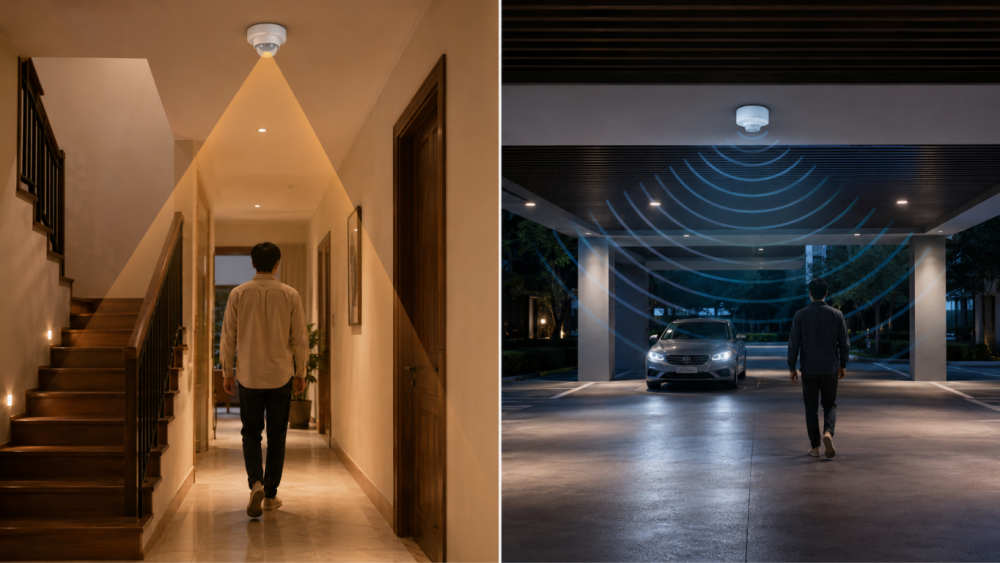
Microwave Sensor It is a motion detection sensor that works by emitting microwave signals and detecting the reflected waves. When an object moves within the area, the reflected waves change, allowing the sensor to recognize that motion has occurred.
This principle differs from PIR Sensor in that Microwave Sensor it does not rely on changes in infrared radiation, but rather on changes in reflected waves when an object moves into the detection zone.
For this reason, Microwave Sensors offer higher detection sensitivity in many cases and can detect minor movements or cover wide areas effectively, depending on the model, detection range, detection angle, and device settings.
Strengths of Microwave Sensors
The highlight of a Microwave Sensor is its high sensitivity, making it suitable for areas requiring a broad detection range or spaces where the sensor needs to respond quickly to movement.
Examples of areas commonly considered for Microwave Sensors include long corridors in buildings, parking lots, warehouses, storage facilities, semi-open spaces, or areas with intermittent pedestrian and vehicular traffic. Another advantage is that Microwave Sensors do not rely on heat changes like PIR sensors, allowing them to perform better in certain environments where PIR coverage falls short—such as large spaces or areas where you need to detect moving objects, not just people.
However, the sensitivity of a Microwave Sensor is both an advantage and a caution, because installing it in an unsuitable area may cause lights to trigger more frequently than desired.
Precautions for Microwave Sensors
Some Microwave Sensor models can detect movement through certain materials, such as glass, thin ceilings, or thin walls, depending on the model, transmission power, frequency, materials, and on-site conditions.
This feature makes Microwave Sensors ideal for applications requiring comprehensive coverage, but it can also cause false triggers—such as when installed in a room adjacent to a road and detecting passing cars outside, or installed near glass and sensing pedestrians walking on the other side.
Additionally, if the area has constant motion—such as a fan fluttering curtains, moving doors, swaying trees, or frequent movement nearby throughout the day—the sensor may trigger the lights repeatedly, making it seem like the lights never turn off.
Therefore, when choosing a Microwave Sensor, you should check whether the sensitivity, detection range, and time delay are adjustable, as proper configuration significantly affects real-world performance.
What is the difference between a PIR Sensor and a Microwave Sensor?
To explain it simply, PIR Sensor and Microwave Sensor Differ in Detection Principles
PIR Sensor Detects changes in infrared radiation within the area. Suitable for detecting people walking through clearly defined areas such as bathrooms, corridors, stairs, or doorways. Meanwhile, Microwave Sensor Detects changes in reflected waves when an object moves. Suitable for areas requiring high sensitivity, wide detection range, or traffic moving in and out across broad spaces, such as parking lots, long corridors, or warehouses.
In general, PIR Sensors are suitable for homes or general-purpose spaces because it is easier to control the detection zone. Microwave Sensors are suited for areas requiring fast response and wider coverage, but care must be taken regarding detection beyond the intended area.
To sum up clearly: PIR Sensors are ideal for applications requiring a well-defined, just-right zone, while Microwave Sensors are best for jobs needing high sensitivity and extended coverage—though they require more careful selection and configuration to suit the space.
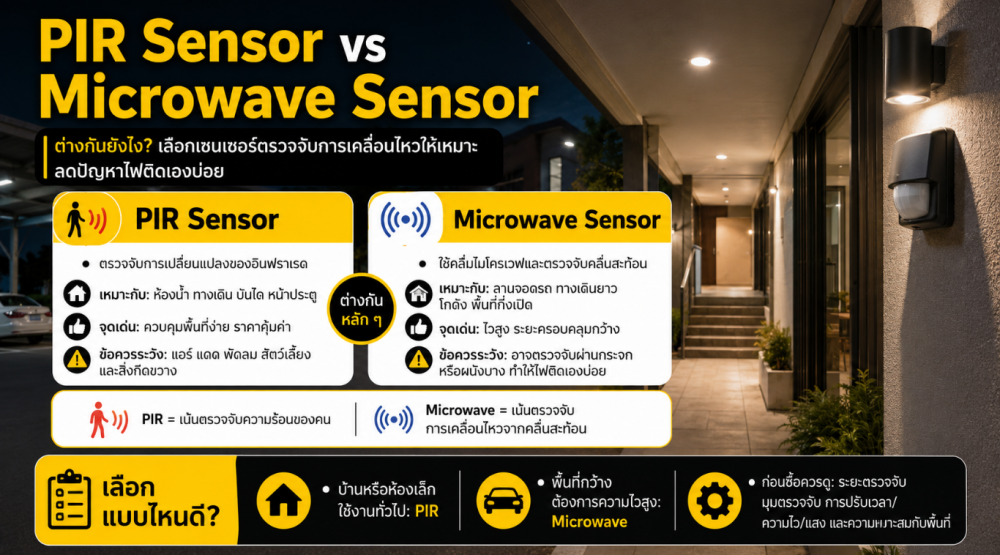
Why Choosing the Wrong Sensor Causes Lights to Turn On Frequently by Themselves
Issues such as lights turning on by themselves, lights not turning off, or flickering on and off are not always caused by a faulty sensor. Many times, they stem from selecting the wrong sensor type for the space or installing it in a location with interference. For instance, using a Microwave Sensor in too small an area or near movement outside the targeted zone can cause it to detect that movement and trigger the lights far more often than intended.
Conversely, if a PIR Sensor is used in spots with strong direct sunlight, hot air currents, AC airflow, or frequently passing pets, it may also lead to false triggering. Another common cause is improper configuration, such as setting the delay time too long, setting the sensitivity too high, or adjusting ambient light thresholds inappropriately for the area. This leads many people to mistakenly believe the light won't turn off, when in fact the sensor keeps re-detecting and resetting its countdown timer continuously.
Therefore, the problem of lights turning on all day does not necessarily mean the sensor is defective; you should check the sensor type, installation location, surrounding interference, and device settings together.
What Types of Spaces Are Suitable for a PIR Sensor?
PIR Sensors are suitable for areas requiring clear detection of passing people without excessive thermal interference, such as home hallways, stairs, bathrooms, storage rooms, doorways, laundry rooms, or spaces used intermittently.
These areas do not require a long detection range, but need the light to turn on when someone actually enters and shut off when there is no movement within a specified period. For residential homes, guest rooms, small office buildings, or retail shops needing localized lighting, a PIR Sensor is an appropriate choice because it is easy to use and not unnecessarily oversensitive.
If you want to choose a PIR motion sensor for general automated lighting, you may consider models tailored to specific mounting methods, such as: SCHNEIDER SAE-UE-MS-CDBWE Wall-mounted PIR type with a 7-meter radius, ideal for front-facing detection or corridor areas. For spaces where ceiling mounting is preferred, you can choose a SCHNEIDER SAE-UE-MS-CSAWE Ceiling-mounted PIR type with a 7-meter radius, providing neat top-down motion detection that blends seamlessly into the space.
For applications that require controlling devices from more than 1 point, you may consider SCHNEIDER SAE-UE-MS-CDAWE Ceiling-mounted PIR type with a 7-meter radius and 2-channel output, suitable for jobs needing separate control or integration with more complex lighting systems. Always verify electrical load, installation method, and actual site conditions before selecting.
Additionally, avoid installing directly facing air conditioners, fans, ventilation vents, windows with strong sunlight, or paths where pets frequently pass, in order to minimize false detections.
What Kind of Spaces Are Suitable for Microwave Sensors
Microwave sensors are suitable for areas requiring a wide detection range or fast motion response, such as long building corridors, parking lots, warehouses, semi-open spaces, or areas with intermittent foot and vehicle traffic. In these areas, using a sensor with higher sensitivity and wider coverage helps automated lighting systems perform better, especially in spots that PIR sensors cannot thoroughly cover.
However, using a microwave sensor in small rooms, compact bathrooms, bedrooms, or areas adjacent to streets, glass, or thin walls requires extra caution, as the sensor may detect unwanted movement from outside the intended area. If installation in such spaces is necessary, choose a device that allows adjustment of sensitivity, detection range, and time delay to suit the actual environment.

What to Consider Before Buying a Motion Sensor
Before purchasing a motion sensor, you shouldn't only look at whether it's a PIR sensor or a microwave sensor, but also consider other specifications, as these directly affect actual performance.
Key factors to consider include:
- Detection range and detection angle
- Suitable installation height
- Electrical load capacity or supported wattage
- Adjustability of time delay, sensitivity, and light level (lux)
- Suitability for indoor or outdoor use
For example, if you want to install it in a room, corridor, or well-defined area, a PIR model with a radius of around 7 meters may be sufficient for general applications, available in both wall-mount and ceiling-mount options depending on the space layout. However, if you need the sensor to operate in response to ambient light levels, you might consider a model featuring Lux Sensor functions as well, such as SCHNEIDER CCT570003 Type PIR + Lux Sensor with a 3.5-meter radius, which is suitable for applications where lights should turn on only when motion is detected and ambient light meets preset conditions.
For spaces requiring higher precision, such as meeting rooms, offices, or areas where people may sit still for periods of time, consider hybrid-technology sensors, such as SCHNEIDER CCT551011 Type PIR + Ultrasonic with an 8-meter radius, which helps overcome the limitations of using PIR alone in certain cases. Nevertheless, you should choose based on actual usage patterns rather than detection range alone.
Another crucial factor is installation orientation. Even with a high-quality sensor, incorrect angles, wrong orientation, or mounting too close to interference sources can cause false triggers, failure to trigger, or unintended operation.
PIR Sensor vs. Microwave Sensor: Which One Is Better?
In reality, there is no definitive answer as to which one is better, because both are Motion Sensors with distinct strengths and limitations.
For general household applications, such as hallway lights, restroom entrance lights, stair lights, front door lights, or storage rooms, PIR sensors are usually sufficient and easier to use because the space is clearly defined and does not require overly high sensitivity. However, for large areas, long hallways, parking lots, warehouses, or areas requiring quick response times, Microwave Sensors are more suitable, especially when choosing devices with adjustable settings and installing them in appropriate positions.
The key is not to choose the one that looks the best, but to choose one that matches the actual application space—considering the required detection range, surrounding interferences, whether it is a small room or a wide area, and how quickly you need the light to respond.
Choosing the right type of sensor for the job from the start reduces issues like false triggering, lights failing to turn off, or lights failing to turn on when someone walks by, making the automatic lighting system more convenient to use in the long run.