


 EN
 ไทย


Customers Also Purchased




Many people buy a centrifugal pump only to encounter the same issue: upon turning on the switch, the motor spins and sounds normal, but no water comes out, or only a little water comes out before stopping completely. Sometimes, the centrifugal pump sounds like it is spinning dry, and after running for a while, the pump body heats up—even though it was just newly installed or had been working well previously.
The most common cause is "trapped air in the system." A centrifugal pump must have water inside the pump casing and suction pipe before starting operation. If there is only air or not enough water, the pump will spin but fail to draw water. This condition is simply known as "pump not drawing water." The fundamental solution is "air purging," technically known as priming. It sounds like a specialized job, but in reality, anyone can do it once the principle is understood—especially for household, gardening, agricultural, or general pumping tasks.
In this article, we will introduce what priming is, why Electric Centrifugal Pumps priming is necessary before use, the correct method to do it, and what to check next if the water still doesn't come up after priming.
What Is a Centrifugal Pump? Why Does It Need Water Before Starting?
Before discussing how to prime, you need to understand the nature of a centrifugal pump. A centrifugal pump uses an impeller rotating inside the pump casing to fling water outward through the discharge pipe. As the impeller spins at high speed, water is thrown out, creating suction from the suction pipe side to replace it. Simply put, a centrifugal pump does not "suck water directly" like a drinking straw; instead, it uses the rotation of the impeller to generate water flow. Only when there is enough water in the pump body and suction pipe can the system begin to draw and deliver water.
The problem is that air is much lighter than water. If the pump casing or suction pipe is full of air, the impeller will spin in air instead of water, causing it to fail to draw water or flow continuously. This issue is commonly encountered after a new installation, after disconnecting pipes, after a well runs dry, when the suction pipe leaks, or after the pump has been idle for a long time. This is why a centrifugal pump must have its system completely filled with water, or primed, before actual operation.
What Is Priming?
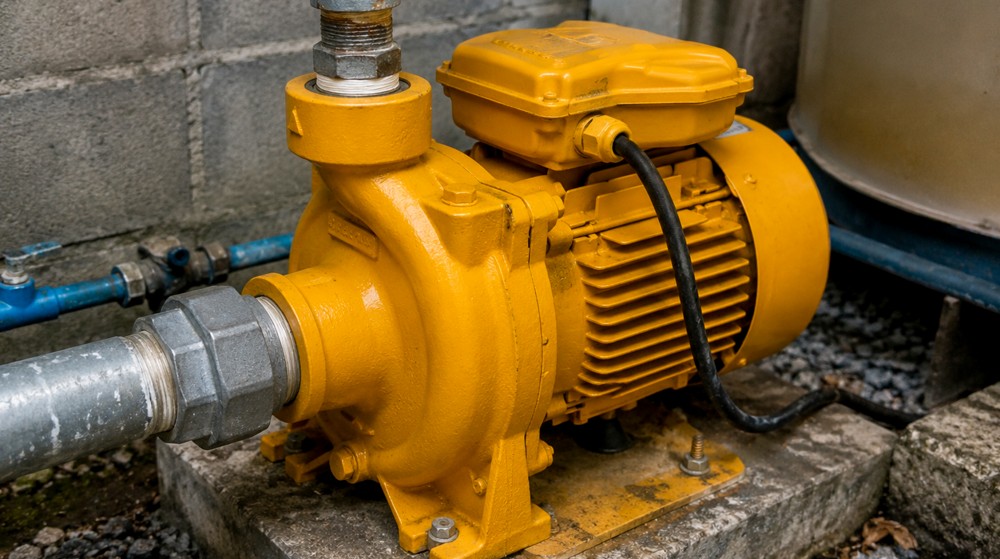
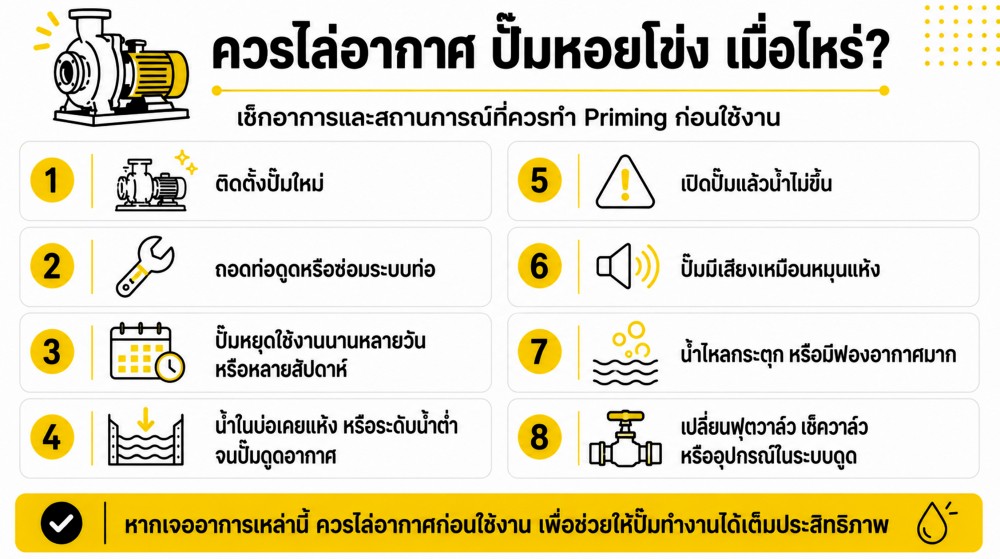
It is the process of filling water into the pump body and suction pipe to purge the air before starting the machine. In simple terms, it ensures that the pump is full of water so it does not run dry in the air. When water is added, it displaces the air in various cavities within the pump and suction pipe. If the system has a well-functioning foot valve or check valve, the water will remain in the pipe without flowing backward. When the pump is turned on, the impeller immediately spins in water, making drawing water much easier. If priming is not performed or done incompletely, the following symptoms may occur:
- Motor runs, but no water flows out
- Water discharges intermittently, not continuously
- The pump makes abnormal noise
- The pump body heats up quickly
- Pipes vibrate or there is the sound of air in the system
- Running for a long time without water coming out, risking damage to the seal or impeller
The important thing is that priming isn't just pouring in a little water and being done; you must fill it completely and ensure there are no leaks in the suction pipe. Otherwise, air will re-enter, and no matter how many times you prime it, the pump still won't draw water.
Why does a centrifugal pump fail to draw water even though the motor is spinning?
This is a very common question, as many users tend to think that if the motor is spinning, the pump should be working. However, for a centrifugal pump, the motor spinning does not necessarily mean water will be pumped.
A centrifugal pump requires several conditions to be met at the same time: water in the pump casing, water in the suction pipe, no leaks in the suction pipe, a fully closed foot valve, a suction lift within the pump's capacity, and no blockages in the water path. If any of these are missing, the pump may spin, but it will not be able to deliver water.
- Air trapped in the pump body or suction pipe: The main reason priming is necessary. When there is too much air in the pump casing or suction pipe, the impeller spins against air instead of water, preventing the pump from generating suction.
- Leaking or clogged foot valve: The foot valve prevents water from flowing back down into the water source. If it leaks, the water filled into the suction pipe will drain back out; when you turn the pump on again, the pipe fills with air once more, requiring frequent re-priming.
- Small leaks in the suction pipe: Suction-side leaks sometimes show no visible water leaking out because the pump is pulling water inward. Instead, air gets sucked in through the leak, introducing air bubbles into the system and causing the water flow to be interrupted.
- Suction lift is too deep: General centrifugal pumps have limitations on suction lift. If the water source is too far below the pump, it may fail to draw water even after proper priming. You need to check both the pump specifications and the actual site conditions.
- Blockages in the pipe or suction inlet: Leaves, mud, sand, or debris trapped around the foot valve or the tip of the suction pipe prevent sufficient water from entering the pump. Symptoms are similar to having air in the system—the motor spins, but water flow is weak or nonexistent.
What do you need to prepare before starting to prime?
Although it is a basic task, it involves water, electricity, and rotating machinery. Rushing or not properly shutting down the system can be dangerous. Things you should prepare:
- Clean water for filling the pump body
- A bucket or water hose to help fill water
- A wrench or tools to open the priming plug according to the pump model
- A cloth to wipe around the pump area
- Flashlight for inspecting leaks or pipe joints
- Thread seal tape in case minor leaks are found
- Work gloves
Precautions
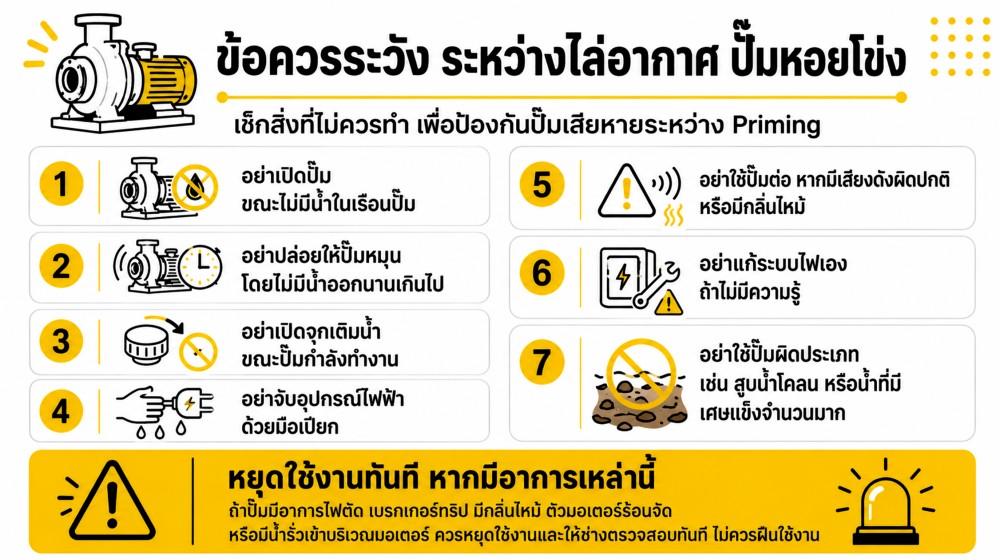
Always switch off and disconnect power first. Never open the priming plug or disconnect fittings while the pump is running. If there is standing water around the pump or the wiring looks compromised, stop using it and have a technician inspect it first.
How to Properly Prime a Centrifugal Pump
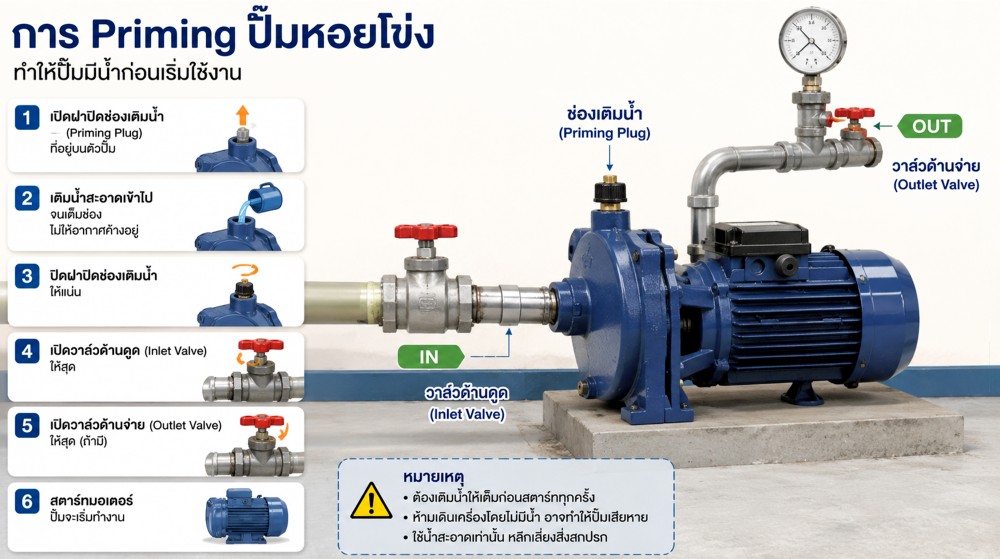
- Step 1: Always shut off the pump and disconnect the power first. Always switch off power at the circuit breaker, not just at the pump switch—especially for systems connected to a float switch or pressure switch, as the pump might start automatically.
- Step 2: Check the water level in the water source. See if the well or tank has enough water. If the water level is below the suction pipe inlet or the foot valve is exposed above water, no amount of priming will succeed.
- Step 3: Inspect the foot valve and suction pipe end. The foot valve prevents water from flowing backward. If it leaks or clogs, the primed water will continuously drain back into the well. Check that it is free of leaf debris, not clogged, and the valve flapper moves normally.
- Step 4: Open the priming plug on the pump body. Carefully open the priming plug at the top of the pump casing. Use a tool that properly fits the bolt head or threaded cap. Avoid forcing it with pliers and damaging the head, which could prevent a tight seal later and cause air leaks.
- Step 5: Fill the pump casing completely with water. Slowly pour clean water into the casing so it displaces the trapped air effectively. You will see air bubbles rising during the fill. Keep filling continuously until water reaches the rim of the port. If the water level keeps dropping continuously, suspect a leaking foot valve or an issue with the suction line.
- Step 6: Wait a moment and top it off again. Wait for water to settle and displace air throughout the various parts of the system. The water level in the priming port may drop slightly. Then top it off until full again, especially for systems with long suction pipes or newly installed systems.
- Step 7: Tighten the priming plug snugly. Tighten the priming plug appropriately—not so loose that it draws in air, and not so tight that it damages the threads. Also inspect the gasket or O-ring around the plug to ensure it is intact and not torn, as this is another common point for air leaks.
- Step 8: Slightly open the discharge valve. Slightly open the valve on the discharge side to give remaining air in the system an outlet and reduce resistance at startup. If there is a downstream faucet, open it slightly to check when water begins to flow.
- Step 9: Run a short test cycle on the pump. Turn on the power and run a test. If primed properly, the pump should draw water shortly, its sound will smooth out, and water will flow steadily. Initially, there may be some air bubbles or sputtering, which is normal. However, if no water comes out after running for a while, shut off the machine immediately and recheck.
- Step 10: Check for leaks and abnormalities after water flows. Once water is flowing, walk around and inspect pipe joints, fittings, threads, the suction pipe, and the priming plug for water leaks or air hissing sounds. If the water has lots of bubbles, flows unstably, or requires frequent re-priming, suspect the suction line and foot valve first.
Common Mistakes People Make When Priming Centrifugal Pumps
- Not filling the water completely: Some people pour in just a little water, see it well up, and immediately seal it and turn on the pump, even though a lot of air may still remain in the suction line. You should fill it until full, wait for the water level to stabilize, and then top it off again.
- Letting the pump run dry for too long: When the pump is turned on and water doesn't flow, many people let the unit keep running hoping water will eventually come up on its own. However, running a pump dry without water lubrication can cause seals to overheat, damage the impeller, or accelerate wear on internal parts. If water doesn't flow, shut it off and recheck the system.
- Neglecting to check the foot valve: The foot valve is a major cause of losing prime, but many people overlook it because it sits submerged at the end of the pipe out of sight. If you have to re-prime every time before turning on the pump, there is a high chance the foot valve is leaking and water is draining back into the well.
- Using an undersized suction pipe or having leaks at fittings: A suction pipe that is too small, too long, or has too many elbows makes drawing water harder. Furthermore, if there are leaks along threads or fittings, air will easily enter the system, preventing the pump from operating at full capacity.
- Placing the pump too far above the water source: Centrifugal pumps have suction lift limits. If placed too high above the water surface, no matter how many times you prime it, it won't draw water. The correct solution isn't repeated priming, but adjusting the pump position or choosing a pump better suited for the job site.
Do Self-Priming Centrifugal Pumps need to be primed?
Many people may have seen the term 'Self-Priming Pump' and thought that priming can be completely ignored. In reality, a distinction must be made: Self-Priming pumps are designed to handle air in the system better than standard centrifugal pumps, but fundamentally, on initial startup, water must still be present in the pump casing as specified by the manual.
The advantage of this type of centrifugal pump is that once there is initial priming water in the casing, the pump can purge some air and draw water more easily in certain situations. However, this does not mean the pump can be run dry indefinitely, nor does it replace proper suction piping installation.
Therefore, even when using a Self-Priming pump, you should always consult the specific model's manual and ensure there is water in the pump casing before operation, especially after a new installation or system repairs.
Frequently Asked Questions about Centrifugal Pumps
After priming, do I need to refill water every time?
If the system is intact, it is not necessary. The foot valve should help hold water in the suction pipe. But if you have to refill water every time, it means there may be backflow, a leak in the suction pipe, or the foot valve is not sealing completely.
What causes the water to keep disappearing after refilling?
If the water level drops initially, it might be because water is displacing air in the pipe. But if you can never fill it full or the water level drops very quickly after filling, suspect a leaking foot valve, a leaking suction pipe, or a point where water is escaping the system.
The pump is running but no water comes out. Can I leave it running for a long time?
You shouldn't. Letting the pump run without water lubrication can damage the mechanical seal and internal components. If water doesn't come up, shut off the machine and recheck the system.
Select Electric Centrifugal Pumps here