


 EN
 ไทย


Customers Also Purchased
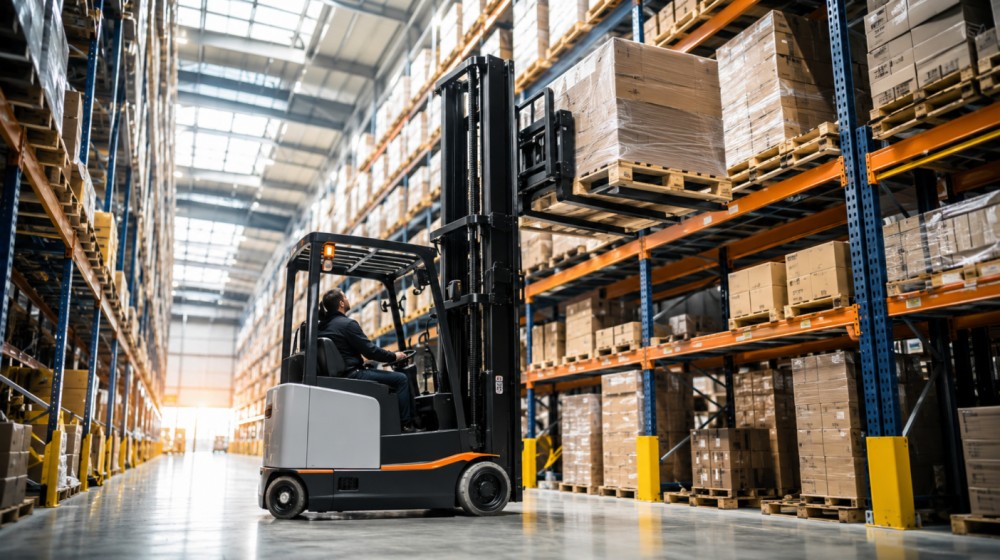
In the world of warehouses, industrial factories, or businesses that need to lift and move heavy goods every day, there is one piece of equipment that is virtually indispensable: that is "The Forklift"
Just having a forklift in the workspace allows tasks that once required multiple people working together to be completed faster, more safely, and with genuinely less physical burden. But what many might not yet realize is that forklifts don't just come in the typical style seen in movies or news reports. In reality, there are many more types: electric forklifts, diesel forklifts, LPG gas forklifts, reach trucks, stackers, pallet trucks, and even models specifically designed for rough terrain. Each type is suited to different operational needs.
This means choosing a forklift based solely on price or following what others use might not always be the best approach. Selecting the wrong type doesn't just result in poor cost-efficiency; it can also slow down work, cause the vehicle to wear out faster than it should, or pose safety risks to both personnel and goods in the area.
This article aims to introduce you to forklifts from the ground up: what they are, how many types exist, which tasks each type is suited for, and what to consider before buying or renting. This will help you make the right choice for your actual worksite without wasting time on trial and error.
What is a Forklift?
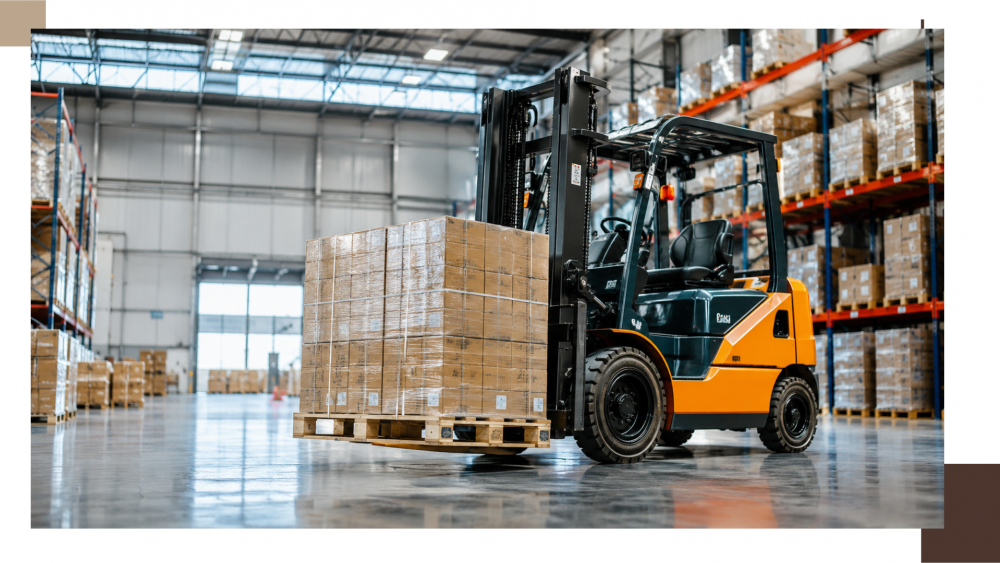
A forklift, universally known as such, is an industrial lift truck designed to lift and move heavy goods or materials. The key feature that distinguishes it from general handling equipment is the lifting mechanism at the front, known as the "forks." These are inserted underneath a pallet or cargo base to lift, transport, and place the load in the desired location in a single operation.
What makes forklifts the heart of warehouse and factory operations is their ability to "lift" and "transport" simultaneously in one machine. This differs from hand trucks or hand pallet jacks, which are better suited for short-distance horizontal movement. This is especially true for tasks requiring repeated lifting throughout the day, or for goods too heavy for manual labor to handle safely—whether they be palletized goods, crates, sacks, chemical drums, steel, timber, construction materials, or even certain types of machinery.
Simply put, if a warehouse or factory is the body, the forklift is the muscle that keeps the entire system moving efficiently.
What Can a Forklift Be Used For?
If you ask what a forklift can do, the short answer is "almost anything involving lifting and transporting heavy loads." For a clearer picture, imagine daily activities in a warehouse or factory: moving pallets in and out, loading goods onto trucks, stacking inventory onto high racks, transferring raw materials into production lines, or transporting heavy construction materials like steel, timber, or bulky equipment that could never be moved manually. These are all tasks a forklift can handle—and handle better than alternative methods in almost every dimension.
In large warehouses, forklifts enable workers to move significant volumes of goods in noticeably less time. In manufacturing plants, they are often used to receive raw materials from unloading bays, deliver them to production lines, and then move finished goods to storage or shipping areas—repeating this cycle all day without disrupting the workflow.
In summary, for any business that regularly deals with heavy lifting, pallet handling, loading goods, or moving large quantities of materials, a forklift is not just an optional accessory; it is the vital component that drives the entire operation forward.
Essential Components of a Forklift You Should Know
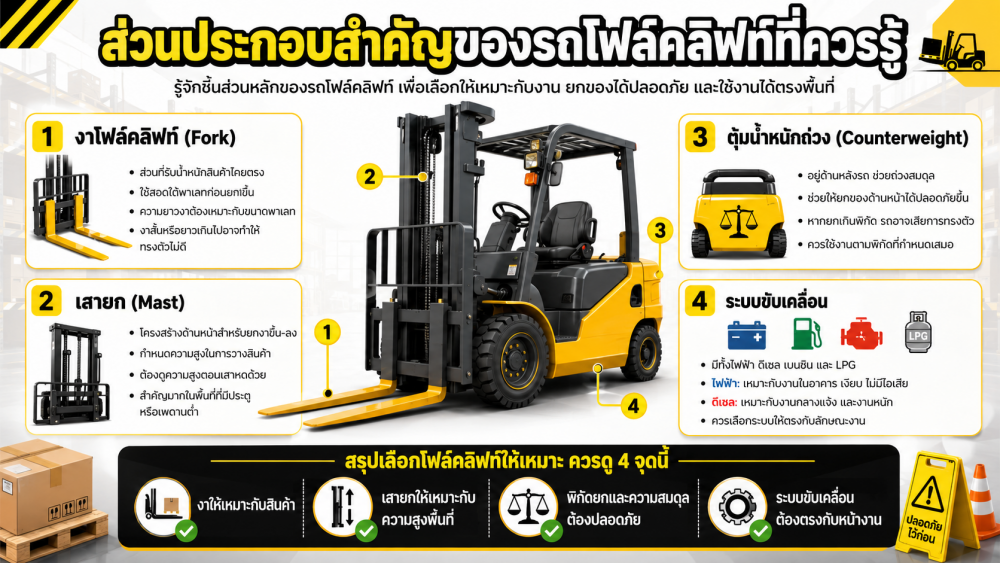
Before choosing the right forklift for the job, there is one fundamental thing you should understand: "What are the components of this machine?" Each part does not merely enable the truck to operate; it directly impacts lifting capacity, worksite safety, and suitability for the actual operating environment.
Forks
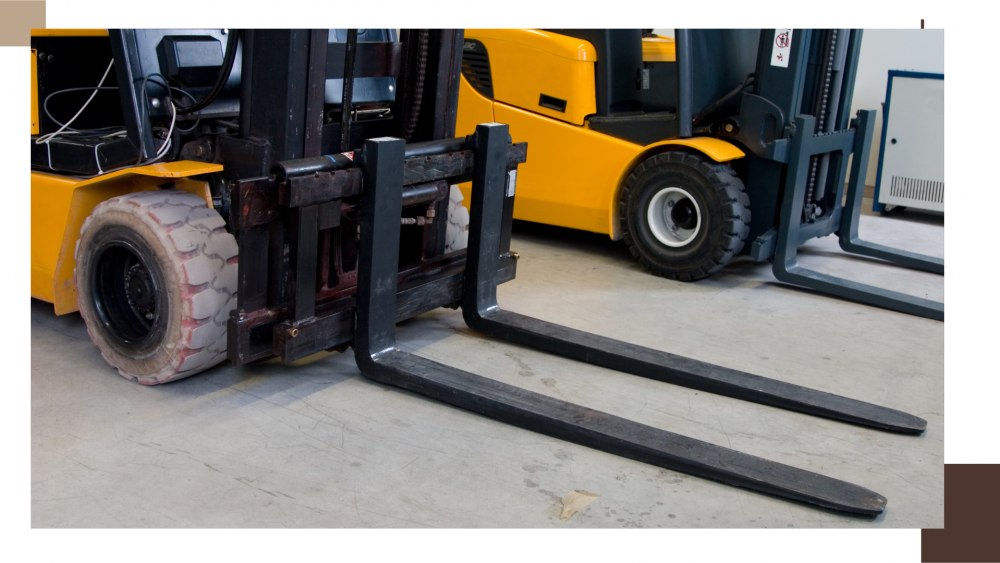
The forks directly support the weight of the load. They consist of two steel prongs extending forward from the front, designed to slide under pallets or cargo bases before lifting. While it sounds simple, fork length and strength are crucial. If the forks are too short, the load may be unbalanced; if they are too long, maneuvering the truck in tight spaces becomes difficult. Choosing forks should always be considered alongside the actual pallet size and cargo weight used.
Mast
The mast is the vertical front assembly that raises and lowers the forks. Mast height directly determines how high the forklift can place goods on shelving. However, another aspect often overlooked is the collapsed height of the truck. If your facility has low doorways, low ceilings, or restricted warehouse entrances, a forklift with a mast that is too tall may not be able to enter the workspace at all.
Counterweight
Located at the rear of the forklift, this is the reason the vehicle's back end is heavier than expected. Its function is to counterbalance heavy loads lifted at the front. If overloaded, operated improperly, or carrying an unbalanced load, the forklift can lose stability more easily than you might think. This is why strictly adhering to the rated capacity is so important.
Drive System
Forklifts offer various drive systems, including electric, diesel, gasoline, and LPG. Each has distinct advantages: electric is ideal for indoor use because it produces no exhaust fumes, operates quietly, and is easy to maintain; diesel is suited for outdoor, heavy-duty applications that demand high power and continuous long hours. Matching the drive system to your operational requirements is always one of the very first decisions to make.
How many types of forklifts are there?
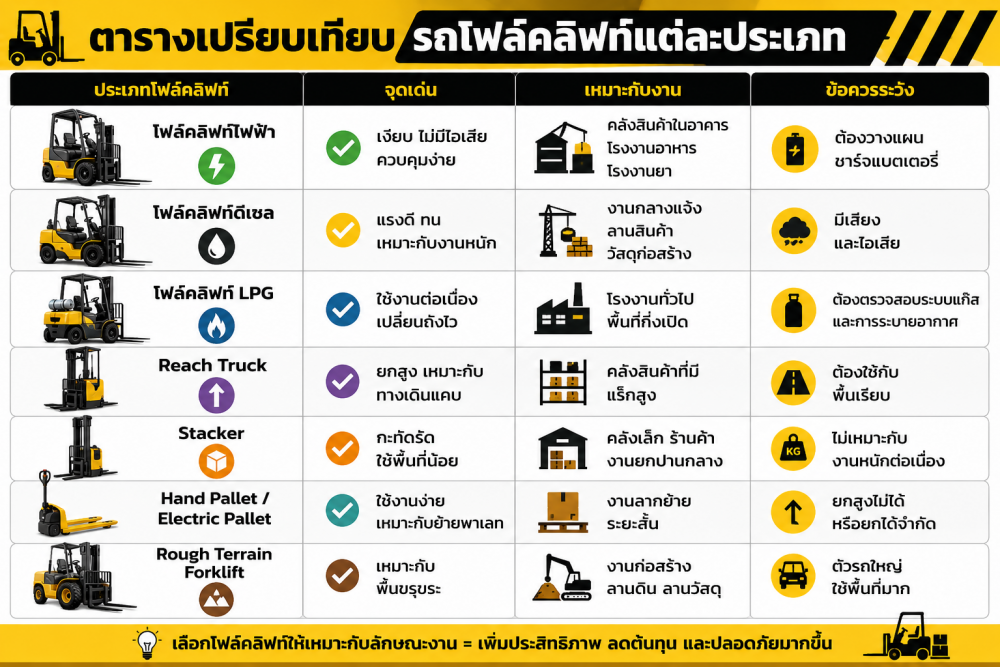
Forklifts are not one-size-fits-all, and they can be categorized in various ways—by power source, operational characteristics, or working environment. For those looking to buy or rent, the simplest approach is to look at the types actually used on-site, which fall into 8 main categories:
1. Electric Forklift
Powered by batteries, it operates quietly with zero emissions, making it especially suitable for indoor use—whether in warehouses, food processing facilities, pharmaceutical plants, or any area requiring cleanliness and good air quality. Energy costs per duty cycle are also lower than combustion engines. A critical consideration is battery charging: if operations run continuously all day, having spare batteries may be necessary to prevent downtime.
2. Diesel Forklift
A powerhouse built specifically for heavy-duty and outdoor applications—such as freight yards, construction sites, building material stores, or areas handling heavy loads like cement, steel, and machinery. Just refuel and resume work immediately without waiting to charge. However, due to engine noise and exhaust fumes, it is not suitable for enclosed or poorly ventilated spaces.
3. LPG / Gas Forklift
The middle ground between electric and diesel. It produces fewer emissions than diesel, supports continuous operation well, and lets you swap tanks to get back to work immediately. Ideal for general factories or well-ventilated warehouses. Special attention must be paid to gas cylinder safety, leak inspections, and operating exclusively in well-ventilated areas.
4. Gasoline Forklift
Less common than the first three types, but still found on some jobsites. Key advantages are responsive engine power and easy starting, though fuel costs are higher and it still produces exhaust fumes. Today, fewer businesses choose gasoline models, opting instead for electric, diesel, or LPG.
5. Reach Truck
Specially designed for warehouses with high shelving and narrow aisles. It lifts loads higher and maneuvers better in confined spaces than standard forklifts. Ideal for distribution centers, e-commerce warehouses, or facilities looking to maximize vertical building space. However, it requires flat, smooth indoor floors and is not suitable for rough terrain or outdoor work.
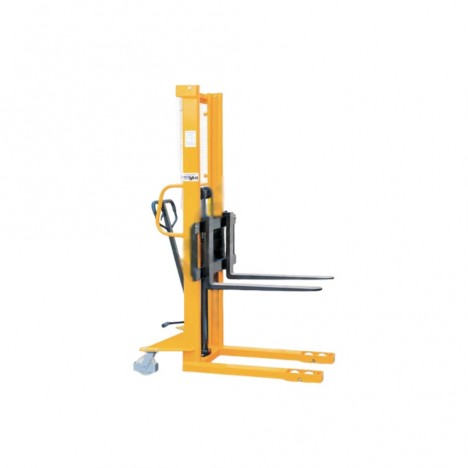
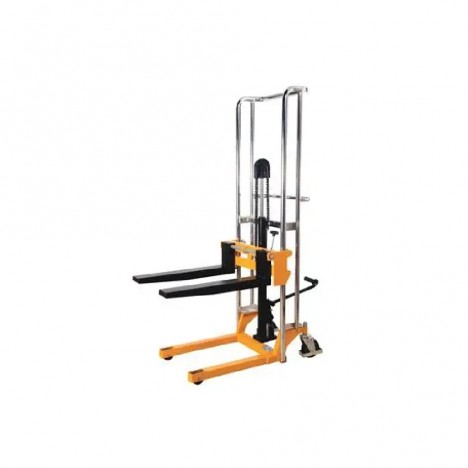
6. Stacker
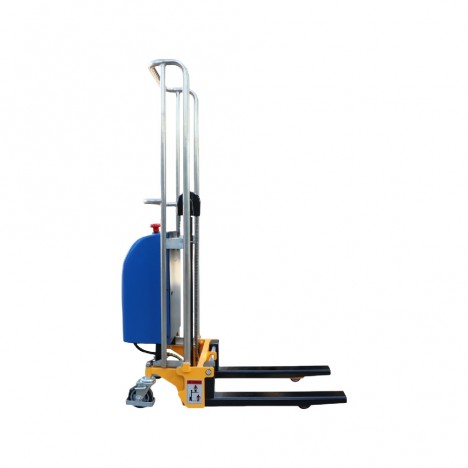
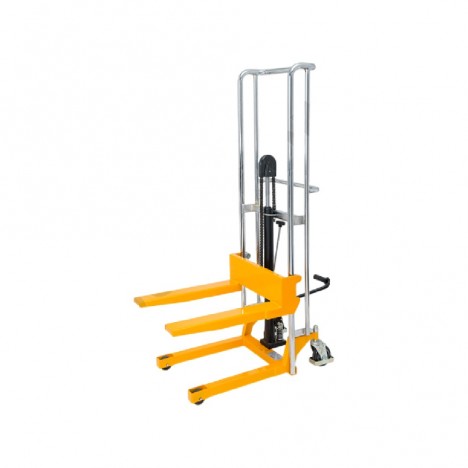
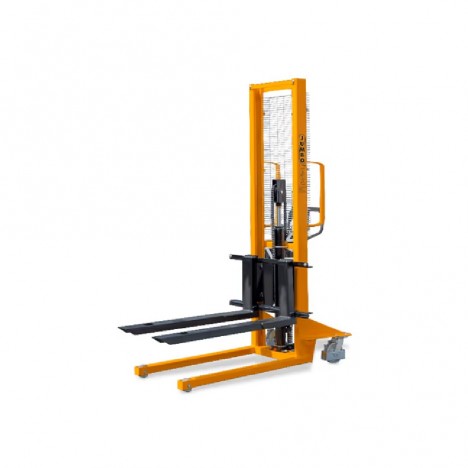
More compact than conventional forklifts, making it suitable for moderate lift heights and smaller spaces—such as small warehouses, shops, or compact workshops. Available in manual hydraulic, semi-electric, and fully electric versions at a more accessible price point. However, for heavy loads, continuous operation, or long-distance travel throughout the day, a forklift is still the superior choice.
7. Hand Pallet and Electric Pallet Trucks
While perhaps not a full-fledged forklift, it is an essential piece of equipment that has always worked alongside warehouses. A Hand Pallet truck is suitable for moving pallets over short distances on smooth floors, while an Electric Pallet Truck uses electric power to assist propulsion, further reducing physical effort and making it ideal for frequent pallet handling. If your job does not require lifting goods onto high racks and only involves moving pallets from point A to point B, a pallet truck might be much more cost-effective than investing in a large forklift.
8. Rough Terrain Forklift
A forklift specifically designed for rough terrain, featuring large tires and a robust suspension system. It performs well on dirt, stone, gravel, or construction sites, making it ideal for outdoor work, agriculture, or areas where smooth-surface forklifts struggle to operate. However, due to its large size and wide turning radius, it is not suitable for narrow indoor spaces.
Comparison Table of Forklift Types
How to Choose the Right Forklift for Your Application?
Many people choose a forklift based primarily on price, but in reality, the most expensive or the cheapest truck is not necessarily the best fit for your job. What you should ask before deciding is, "How well does this truck match my actual operating conditions?" Here are the key factors to consider before choosing:
1. Load Weight to be Lifted
Start with the clearest figure: how heavy are the goods that need to be lifted? Never choose a forklift with a rated capacity that precisely matches your product's weight, because in real-world operations, you must factor in the weight of pallets, packaging, and the load's weight distribution. Another aspect often overlooked is the Load Center (center of gravity of the load), as long goods or unevenly distributed weight can affect lifting capacity more than you might think.
2. Lifting Height Required
If you only need to lift goods onto trucks or stack at low heights, lift height might not be the primary concern. But if you need to place goods on high racking systems, you must select a forklift with an adequate mast height. A crucial factor to check alongside this is the collapsed mast height (overall lowered height), as the truck needs to pass through doorways, warehouse entrances, or areas with low ceilings. Choosing a mast that is too tall without considering spatial constraints can render it completely unusable in your actual facility.
3. Operating Environment
For indoor operations on smooth floors where noise and exhaust emissions must be minimized, electric forklifts are usually the best solution. For outdoor tasks or stockyards requiring high power, diesel forklifts are more suitable. Meanwhile, for semi-open areas such as well-ventilated factories or covered loading docks, LPG forklifts are an equally attractive option.
4. Floor / Surface Conditions
This matters more than many think. Smooth concrete floors in warehouses are ideal for electric forklifts, reach trucks, or stackers. But if the ground is rough, pitted, or unpaved dirt, you must choose a truck specifically engineered for that surface type. Using the wrong type of forklift on poor ground conditions not only accelerates tire wear, but also risks tipping over or losing control while lifting loads.
5. Aisle Width and Turning Radius
Warehouses with narrow aisles may not be suitable for conventional forklifts, as they require ample space for turning and maneuvering. Be sure to clearly measure aisle widths, doorways, turning points, and racking clearances before making a decision. Even if the forklift has sufficient lifting capacity, if it cannot turn or enter the operating area, it will be unusable.
6. Usage Frequency
Heavy daily use demands a durable forklift with readily available spare parts and reliable after-sales service. However, if usage is infrequent—such as lifting items only a few times a day or solely during receiving shipments—investing in a large forklift may not be cost-effective. A stacker, electric pallet truck, or even renting a forklift occasionally could be a much smarter choice.
7. Budget and Long-Term Operating Costs
The purchase price is only one part of the total cost of ownership. You must also consider fuel or electricity costs, battery replacements, tire wear, maintenance and repairs, and operator training expenses. Sometimes a machine that is cheaper on day one ends up with higher long-term costs and proves ill-suited to the job, leading to lost time. Looking at the full picture—combining upfront cost, running expenses, and long-term value—provides a much more accurate answer than merely looking at the sticker price.
Forklift Safety Precautions
Forklifts certainly help speed up work, but they are also equipment that requires equal caution during operation, especially when dealing with heavy loads, tight spaces, or areas shared with pedestrians. Most accidents on-site stem from overlooking simple safety procedures that should be done out of habit.
Before every use, conduct a complete pre-operation inspection: brakes, tires, forks, mast, electrical systems, warning signals, and fuel or battery levels, as well as checking for leaks, cracks, or any abnormalities. This step takes little time, but greatly prevents issues from occurring midway through work.
There are several things to avoid during operation, including overloading, driving with the forks raised high, making sharp turns, speeding, or allowing untrained individuals to operate the machine. Each of these increases the risk to the cargo, the forklift, and people in the area.
For areas shared by both forklifts and pedestrians, clearly designate forklift traffic lanes, install warning signs, place convex traffic mirrors at blind spots, and use warning lights or audible alarms to ensure everyone in the area is aware and can steer clear in time.
Choose the right forklift: work gets faster, safer, and more cost-effective
To put it briefly, Forkliftis equipment that truly transforms operations in terms of speed, safety, and organization. However, all of that can only happen when you choose the right forklift for the job from the start.
Each type of forklift has different strengths: electric is suitable for indoor use, diesel is ideal for outdoor and heavy-duty work, LPG is suitable for semi-open areas, Reach Trucks are designed for high-bay warehouses, while Stackers and Hand Pallet Trucks are suited for lifting or moving pallets that do not require heavy lifting capacity. Recognizing these differences is the starting point for making the right choice.
And before deciding to buy or rent, don't forget to thoroughly consider load weight, required lifting height, working area, floor conditions, aisle width, usage frequency, and long-term costs. Choosing properly from the beginning not only makes operations smoother, but also reduces hidden costs, minimizes on-site problems, and enhances safety for the cargo, driver, and everyone in the area.
smoother, reduces on-site problems, lowers hidden costs, and provides greater safety for the cargo, driver, and nearby workers.