


 EN
 ไทย



Customers Also Purchased
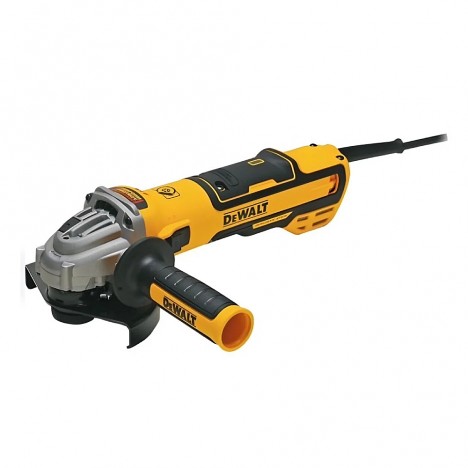
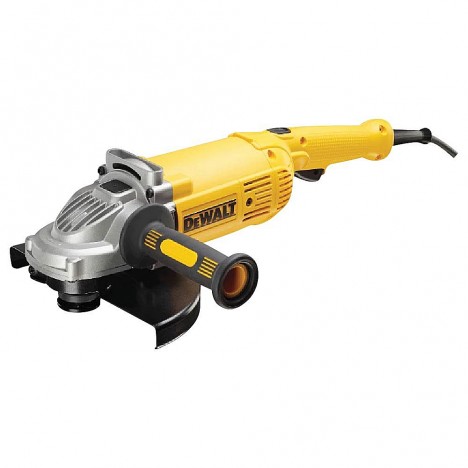

I think many people might still hold onto this perception that Grinder if you really want power, it has to be corded, while cordless is only suitable for light jobs where there's no outlet. But nowadays, mindsets may be changing. We're starting to see tradesmen use cordless angle grinders as their primary tool. The question follows: are they really powerful or good enough to replace corded models? Or is it just because they were expensive to buy, so they have to make the most of them?
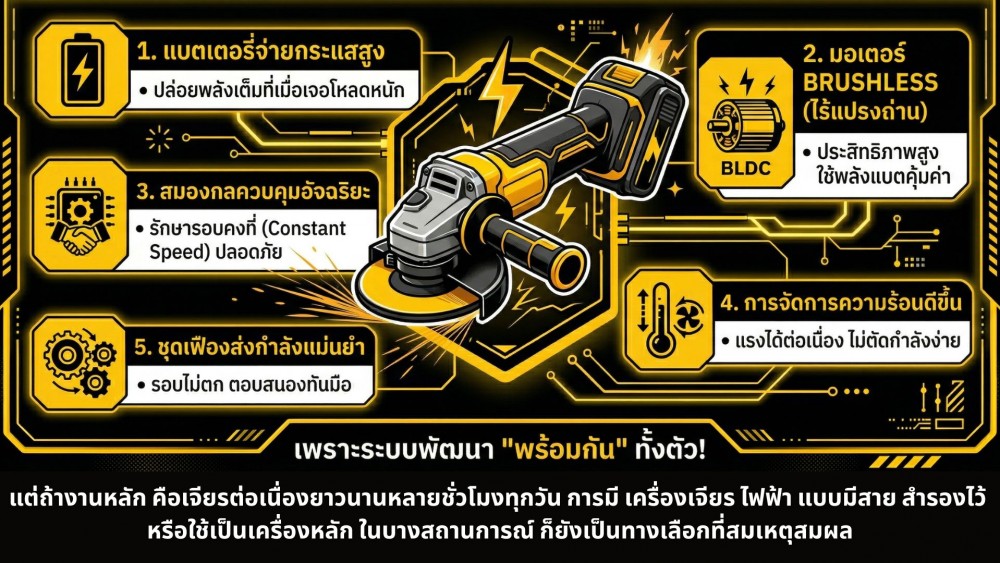
The truth is, newer cordless angle grinders have genuinely become more powerful, and it's not due to any single technology alone. There have been simultaneous advancements across multiple systems—batteries, control circuitry, motors, thermal management, gear sets, and internal systems that more precisely regulate torque, speed, and safety.
So, let's take a look at why newer cordless angle grinders are more powerful, what hidden technologies many people still don't know about beyond high-RPM motors or longer-lasting batteries, and what to look for beyond just "high voltage" or "powerful motor" when buying to get a tool truly suited to your work.
Perception of Cordless Angle Grinders: Why Did They Feel Underpowered?
To put it bluntly, earlier cordless angle grinders had limitations on many fronts: batteries couldn't deliver full current, control circuits weren't smart enough, and brushed motors suffered heavy energy loss. Under heavy loads or continuous use, RPM would easily drop, leaving many feeling that while initial power was decent, it fell short in real-world use.
Back then, a heavy balance had to be struck between "power" and "runtime." If tuned too aggressively, the battery drained quickly and the tool overheated fast. Many models were thus calibrated moderately—fine for general use, but not yet ready to fully replace corded models. As a result, the lasting impression for many was that cordless angle grinders are convenient, but their power still lags behind.
Because this perception has persisted for so long, when a new grinder model comes out, many people still might not believe it is actually more powerful, assuming it's just a new design or longer-lasting battery. In reality, the internal technology has advanced far beyond what meets the eye.
Batteries have evolved in both capacity and current delivery.
Modern power tool batteries across many systems, including grinders, have undergone improvements at the cell chemistry level. Newer cells can deliver higher current, have lower internal resistance, and withstand heat better than ever before.
That means when the tool needs instant power upon startup or during heavy grinding, the battery can deliver fuller energy than before, making users feel that the tool responds quickly, feels responsive in hand, and sustains heavy workloads more continuously.
Some platforms have even advanced battery pack construction, such as:
- Cell layouts that reduce heat buildup, like Bosch's ProCore
- The use of more efficient conductive busbars
- More detailed communication between the battery and the tool, such as Milwaukee FUEL
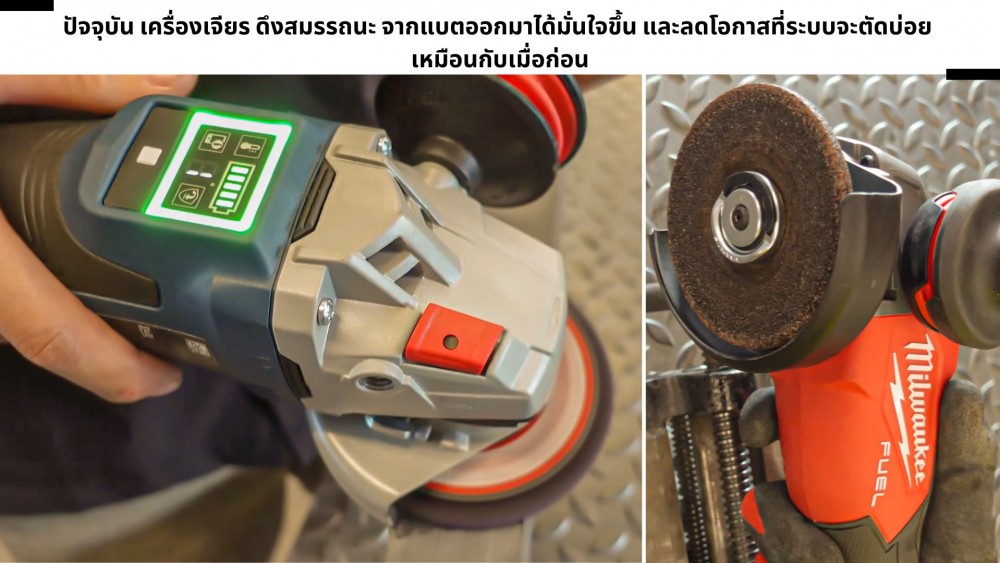
Brushless motors allow cordless grinders to overcome past limitations.
If I had to choose one technology that has most clearly elevated cordless grinders, I would give it to brushless motors. They reduce wear and tear while helping the tool utilize energy with full efficiency. Brushed motors suffer from friction loss, accumulate significant heat, and easily lose performance under continuous heavy use; however, brushless motors have greatly minimized these limitations.
A major advantage of brushless motors for grinders is precise power control and fast response. The electronic circuitry can deliver power based on the actual load instantly, channeling energy to the workpiece more efficiently. The result is a tool that feels more solid and powerful while maintaining power better than before.
Another key point is that with higher motor efficiency, heat is correspondingly reduced. Manufacturers can thus confidently tune grinders to handle heavy workloads longer without prematurely tripping protection cut-offs. This is why many new models are both more powerful and run smoother at the same time. Is the latest PUMA cordless grinder set—compact and high-speed—worth buying?
Brushless doesn't magically create more power, but makes energy usage "more efficient."
The term "brushless" doesn't mean it creates extra power on its own; rather, it helps the grinder utilize energy from the battery more efficiently, reducing losses, controlling timing more precisely, and sustaining performance in real-world use. All of these factors make the tool feel noticeably more powerful.
Electronic circuitry and internal microcontrollers that people overlook
In fact, newer cordless grinders feature much smarter control systems. Internally, circuits continuously monitor load, temperature, and battery voltage to calculate the optimal power delivery for each phase of work.
Grinding itself doesn't involve a constant load: one moment you are touching the workpiece lightly, and the next you are pressing down hard or encountering sudden resistance. When using an angle grinder, why shouldn't you press too hard? What does it affect? If a tool isn't well controlled, it will experience RPM drops, jerking, or frequent cut-outs. However, newer models respond better to constantly changing loads, allowing the grinder to maintain RPMs more consistently. Functions that help the tool operate more smoothly include:
- Soft Start Helps the tool start up more smoothly
- Anti-Kickback Reduces kickback when the disc binds
- Overload Protection Prevents the tool from overloading
- Constant Speed Control Helps maintain a constant speed
Therefore, a good angle grinder should not only spin fast, but also maintain excellent speed control without bogging down easily during actual work.
Thermal management keeps the "power output" high for longer
When talking about angle grinder power, many people only look at the initial burst. In reality, what matters is how long it can sustain that power. Some models feel powerful at first, but after a short period of continuous use, they start to weaken as heat builds up or protection systems kick in.
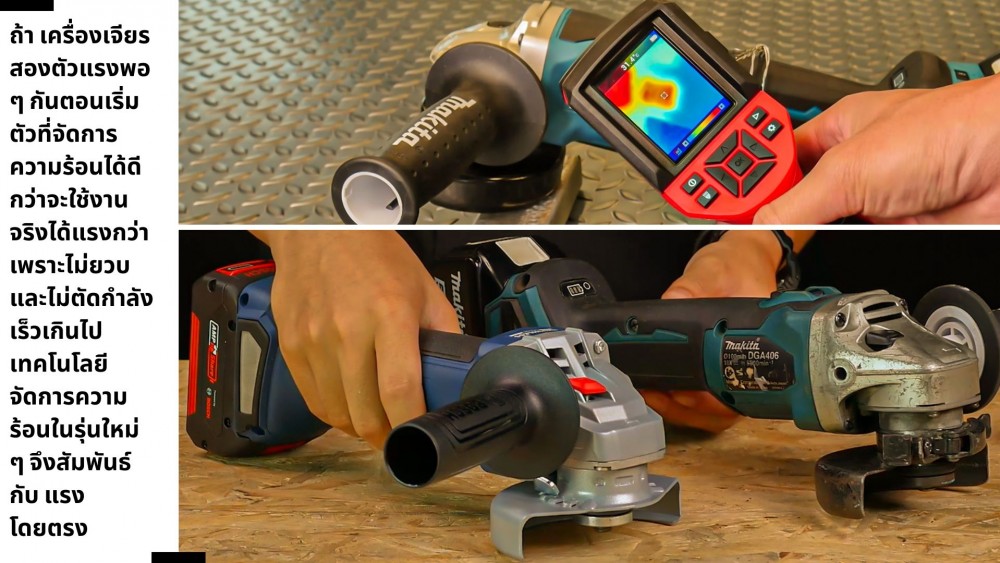
Why do some tools feel sluggish after being used for a while?
The main culprit is usually heat. When the temperature exceeds the system's threshold, the tool reduces power to protect the motor, battery, and circuit boards, making the angle grinder feel more sluggish than when it started.
Newer angle grinder models feature continuous improvements in heat dissipation across air vents, motors, circuits, and battery structures to better sustain performance during continuous operation.
The drive system also affects how powerful the tool feels
Many people overlook this part. When seeing a more powerful angle grinder, they tend to think primarily of the motor and battery. In reality, the gear set is what directly transfers power from the motor to the disc. If gear ratio design, gear materials, assembly precision, and gearbox durability are improved, the tool transmits power much more efficiently as well.
Many newer models have significantly reduced transmission loss by minimizing friction and play, while synchronizing the motor's timing more closely with the gear set. As a result, the angle grinder feels more solid in hand, resists bogging down under heavy loads, and wastes less energy during no-load spinning.
Especially in grinding tasks where the load changes rapidly, a tight and precise drive system allows the tool to respond instantly to the user's touch.
Battery-to-tool communication enables smarter power management
The word "software" might sound distant from angle grinders, but in modern cordless tools, it plays an increasingly vital role. In some systems, batteries aren't just power packs; they send real-time status data—such as temperature, voltage levels, current discharge, and overall operating conditions—to the tool's circuitry to regulate performance on the fly.
The advantage of this system is that the angle grinder doesn't deliver power blindly; it adjusts based on real-time conditions. For example, if the battery is cool and ready, the tool can draw maximum power. But if the temperature starts to climb, the system balances power delivery to maintain optimal performance for as long as possible.
Many modern angle grinders don't just offer raw power—they deliver smart, refined power designed for longer runtimes and enhanced safety.
Can newer cordless angle grinders replace corded models yet?
The answer is “Yes, for far more applications than before” —though not 100% of all jobs just yet. For general cutting, grinding, deburring, surface finishing, installation, repair, structural fabrication, or jobs requiring frequent movement and areas without easy power access, modern cordless angle grinders excel. Many users now rely on them as primary tools because the combination of power, mobility, and grab-and-go convenience makes them exceptionally worthwhile.
However, for long, continuous, heavy-duty industrial tasks—such as all-day grinding, continuous thick cutting, or applications requiring full power without worrying about battery life or tool rest periods—corded models still have their place. The key question isn't which type is better, but rather, "What does our work involve?"
Signs that a cordless grinder is right for your job
Using a cordless grinder is well worth it if your work involves conditions such as:
- Frequently moving work locations
- On-site installation work or working at heights
- Needing quick deployment without dragging extension cords
- Intermittent use with a demand for high responsiveness
- Valuing maneuverability just as much as power
With the technologies found in the latest models from Makita, Bosch, DeWalt, Milwaukee, and other brands
Conclusion
Newer cordless grinders are more powerful because the entire system has evolved simultaneously. It's not just about bigger batteries or stronger motors; it also includes batteries that deliver higher current, more efficient brushless motors, smarter control circuitry, better thermal management, and precision-engineered gearboxes.
Many people might only see that new grinders are more powerful, but the reality behind it is simultaneous multi-point engineering advancements. This makes modern cordless tools stand out not just for convenience, but also for tackling serious, heavy-duty jobs.
For anyone who still considers Grinder cordless tools as second-tier options, now might be the time to reconsider. The technology inside has evolved far more than many realize.