


 EN
 ไทย


Customers Also Purchased


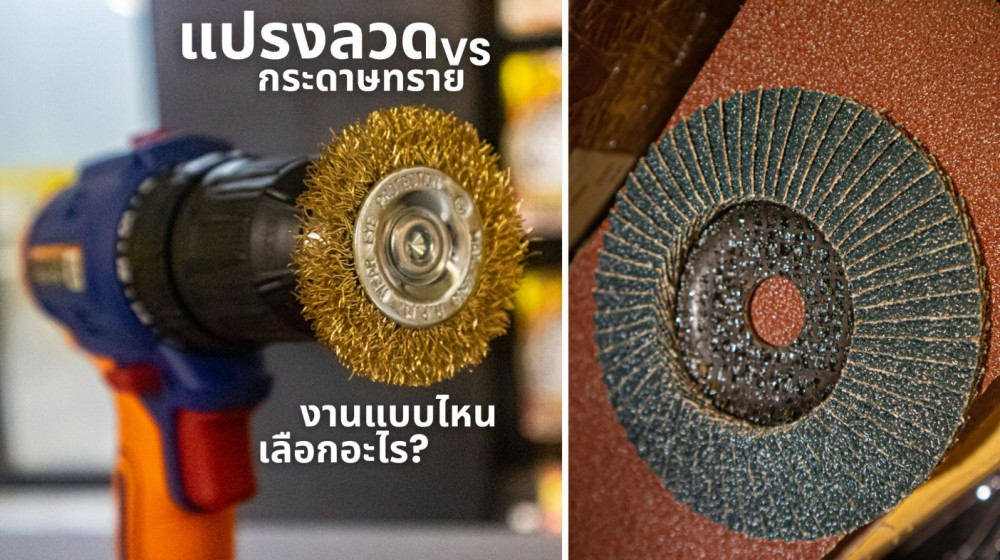
Have you ever wondered? When facing real job-site challenges like thick, flaky rust, black welding slag, peeling old paint, or mill scale that seems fused to the steel, using sandpaper feels noticeably slow and clogs easily. Shortly after sanding, the paper's surface clogs up, progress stalls, and it feels just like you're wasting time sanding something that will never come off.
And what if you grab Wire Brush to use instead—would that be better? Will it help clear the surface faster, or will it leave even worse scratches? Some say a wire brush "clears everything in one swipe," but others warn that "one slip leaves marks, and the paint finish will never be smooth." Hearing this, I'm sure many people start to hesitate: will it help the job, or ruin it?
Or is it really a matter of which job suits which tool, and how to match it with the material and surface condition instead?
Therefore, in this article, we will unpack the question clearly without holding back: what is the difference between a wire brush and sandpaper, why so many people compare the two, and which one to use for what kind of job in terms of time, effort, and surface quality?
Why Do We Compare a "Wire Brush" with Sandpaper?
To put it most accurately, wire brushes and sandpaper aren't always a 1:1 direct rivalry, as their job purposes differ from the start. Sandpaper excels at "smoothing surfaces and controlling grit fineness," while wire brushes excel at "sweeping, scraping, and brushing off" surface contaminants like rust, old paint, soot, welding spatter, or grinding scale.
However, people often compare them because on the actual job site, we frequently encounter situations like these:
- Need to remove rust before painting, but don't know where to start
- Stripping old paint and wanting to prep the surface so the new coat adheres durably
- Need to clean weld seams to prepare for primer spray
- Wanting to scuff the surface to a "matte" finish for better paint or adhesive bonding
When facing these situations, the questions arise: "Which one will be faster?" and "Which one won't ruin the workpiece?" This is precisely where a wire brush comes in as an alternative option that could easily replace sandpaper.
How Does a Wire Brush Work to Remove Stains and Buildup Quickly?
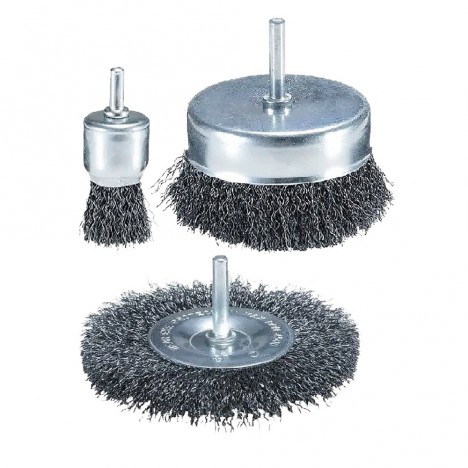
Types of Wire Brushes and Proper Selection A wire brush is a tool designed for heavy sanding all the way up to stripping. They are available in hand, cup, and end brush styles, made from materials such as steel, brass, or nylon.
Its highlight is using numerous wire strands that act like tiny "teeth" to brush and scrape away dirt, stains, rust, and paint, peeling them off the workpiece surface. Its principle is not "smoothing" like sandpaper, but "combing or sweeping" the surface clean, especially for layered or stubbornly adhering buildup.
How does sandpaper work differently from a wire brush?
Sandpaper uses abrasive grains to abrade and "cut into the surface" to make it smoother or create a roughness that can be controlled by grit numbers. Its strength lies in controllable and predictable results: applying similar force and direction yields similar results. Therefore, tasks requiring a uniform surface—such as paint prep, smoothing putty, leveling wood surfaces, or creating a matte finish—usually "must finish with sandpaper," even if prepped with a wire brush first.
Sandpaper Grit: The Job Defining Factor That Wire Brushes Lack
Choosing sandpaper is like selecting the desired "roughness level" of the surface: lower numbers mean coarser, higher numbers mean finer. This lets us plan what the finished surface should look like and progress through grits step-by-step. For instance, if the workpiece has heavy marks, you start coarse to level it out first, then move to finer grits to gradually fade the scratches until visibly and tactually smooth. In contrast, while a wire brush excels at "brushing away buildup" and "raking out crevices," it lacks such a clear grit grading system. Instead, it is controlled by the wire type, wire thickness, stiffness, twist style, and the user's applied pressure—which beginners often find harder to control.
To put it simply: if you need a surface ready to show off or ready for a flawless paint finish, use a wire brush to pave the way by clearing out rust, old paint, and black marks first. Then let sandpaper "even out the roughness across the entire piece" for a uniform, controlled finish. This approach delivers fast work and beautiful results.
Wire Brush vs. Sandpaper: Which One Is Better?
The straightforward answer is that in actual use, neither is inherently better than the other, because it entirely depends on what you want to remove from the workpiece surface.
Differences in Applications
If you need to "smooth the surface, control fine detail, and prep for aesthetics"—such as preparing a smooth finish for painting wood or furniture—sandpaper is more suitable because its grits offer far better control over roughness and fineness than a wire brush, providing a much more consistent surface. Especially for jobs that need to look and feel completely smooth, using only a wire brush can easily leave scratch patterns or wire marks that show through after painting.
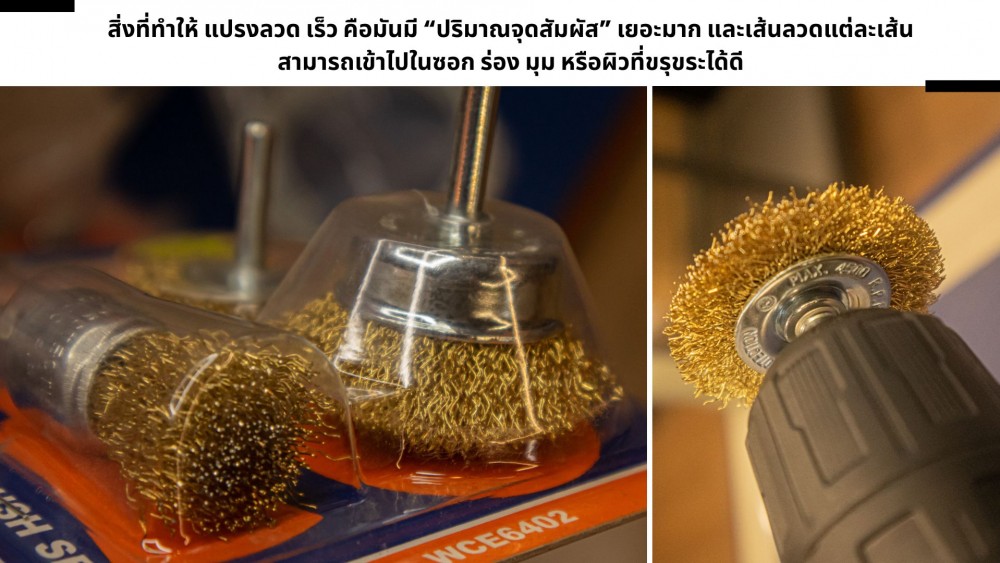
On the other hand, if you want to remove "buildup sticking to the surface" such as rust, old paint, black scale, or weld slag, a wire brush acts like a "broom" that sweeps away layers of debris without repeated rubbing. It also gets into crevices, grooves, and uneven surfaces much better, especially on porous or textured materials. If the goal is simply to make the surface "clean enough" for the next step, a wire brush delivers visible results very quickly.
Wire brushes excel at "mechanical cleaning"—removing surface buildup fast—while sandpaper excels at "surface conditioning for a finished quality"—delivering a controlled, smooth, and refined finish. In practical work, what works best is usually using them in the right sequence rather than choosing one over the other.
What types of jobs call for a wire brush, and why does it work?
Drill-Mounted Wire Brush Attachments: What can they clean? How to use them effectively and safely? At this point, we need to reiterate that a wire brush does not make the surface instantly smooth; it makes the surface clean enough for the next step. So let's run through a checklist to see which jobs warrant grabbing a wire brush so you can work faster without leaving unsightly gouges or ruining the piece beyond use.
1. Stripping rust from steel before painting
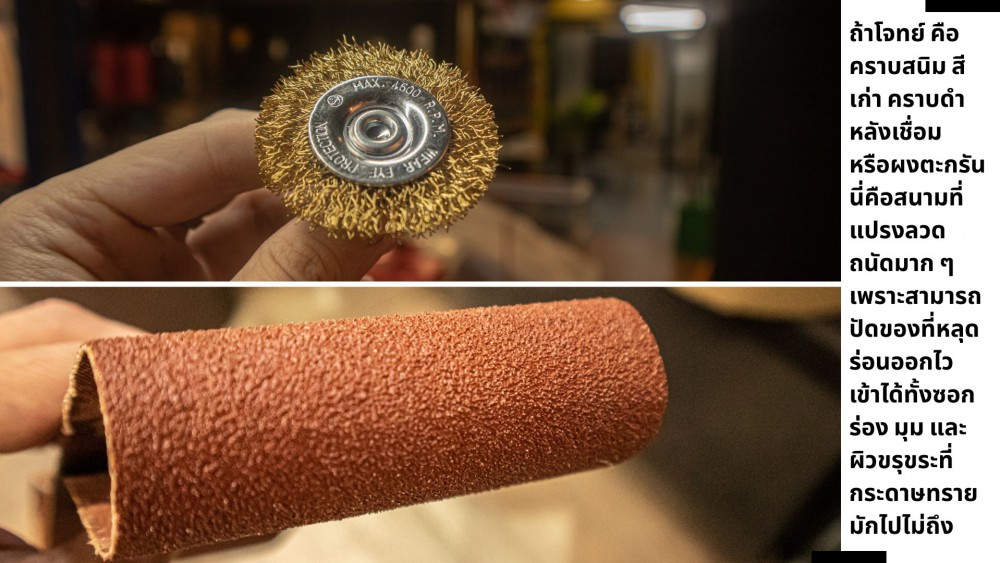
Rust is not always a fine powder; sometimes it forms tough, scale-like layers. If you use only sandpaper, it can easily clog, requiring frequent sheet changes. Moreover, sanding can sometimes just polish down the rust flat without actually exposing the bare steel underneath.
A wire brush excels because it quickly flicks away flaking rust and penetrates porous pits well, especially when using a cup brush on an angle grinder. However, you must control the pressure and angle carefully, just like using a grinding disc or flap disc.
2. Cleaning weld spatter / black discoloration after welding
Most metal surfaces after welding have black slag or hard scale adhering to them. If you paint directly over this surface, the paint tends to peel off easily. A wire brush helps clean the surface after welding much faster and noticeably reduces surface preparation time.
3. Cleaning rough surfaces / cast surfaces / checkered plates / mesh gratings
On these types of surfaces, sandpaper only touches the "peaks" of the texture. However, a wire brush can reach down into the grooves, removing residues effectively. It is ideal for cleaning steel gratings, iron fences, angle irons with multiple corners, or porous cast surfaces.
4. Corners, crevices, threads, and folded edges
For threads, bolts, folds, or bent edges, sandpaper struggles to reach because it is flat and tends to catch on edges, only sanding the outer surface. Moreover, trying to force it into grooves often causes it to tear easily—especially in narrow grooves or areas with sharp burrs that can slice right through sandpaper.
Here, a manual hand wire brush or an end wire brush is much more effective because the wire bristles can actually dig into grooves and crevices, quickly brushing away rust, dust, and paint trapped in threads while offering great control when doing spot work.
Best Approach: "Use in Combination with Sandpaper", Not Choosing One Over the Other
Honestly, if you ask what gets used most often in real-world jobs, the answer is likely both equally: use a wire brush to start the job, then finish up with sandpaper.
The workflow looks roughly like this:
- Step 1: Use a wire brush to remove as much surface buildup as possible (rust, peeling paint, black slag).
- Step 2: Use a moderately coarse sandpaper (e.g., 80–120 grit) to smooth out marks and create uniformity.
- Step 3: Step up to finer grits (e.g., 180–240 or higher depending on the application) to finish the surface.
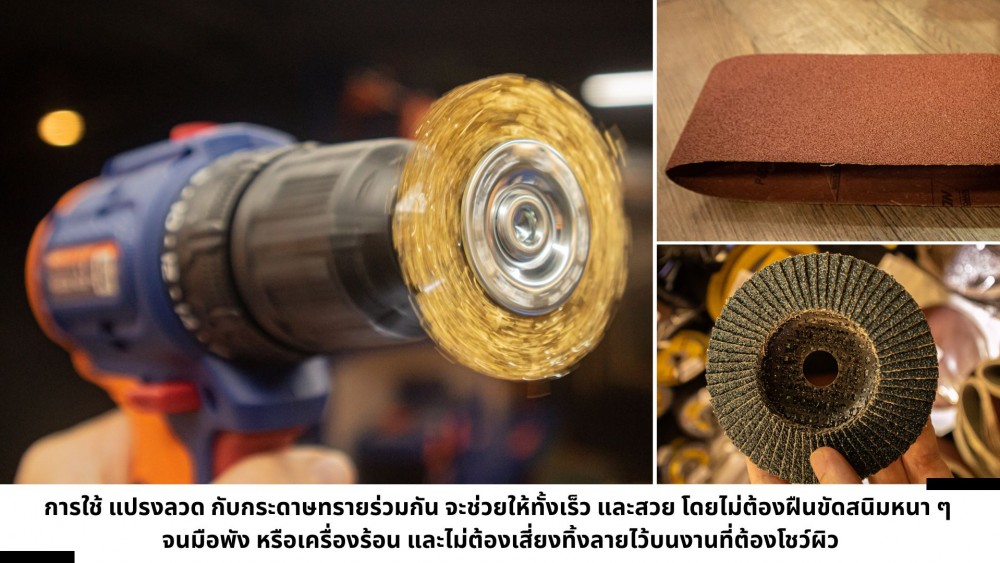
Conclusion: Neither is better—it all depends on selecting the right tool for the job
Based on common scenarios: choose a wire brush when you need to quickly remove rust, buildup, or flaking paint, or for workpieces with lots of crevices, corners, and grooves, post-welding slag, or heavy steel jobs that don't require a high-end show finish.
Choose sandpaper if you need a smooth surface, controlled finish, and consistent prep for a smooth paint job—such as woodworking, furniture, exposed-surface finishing, and smoothing out putty or primer. However, the best approach is to start with a wire brush for thorough cleaning, followed by sandpaper to refine the surface. The job will be faster and achieve a much cleaner finish.
A final question to think about before finishing: Are you stripping off buildup, or creating a fine finish? Because if you are clearing away stains, rust, old paint, or dark grime, wire brushes are born for this. But if you are finishing a surface to look smooth and ready for paint, sandpaper still controls the outcome best. And if you want both "speed" and "beauty", I emphasize once again: do not limit yourself to just one. Use a wire brush to pave the way, and let sandpaper carry you to the finish line—without ruining your work, wasting materials, or losing time.
The term Wire Brush Many people see them as rough, basic tools, but when used for the right job, in the right type, and with controlled pressure, they make surface preparation noticeably easier—truly.