EN
 ไทย


Customers Also Purchased

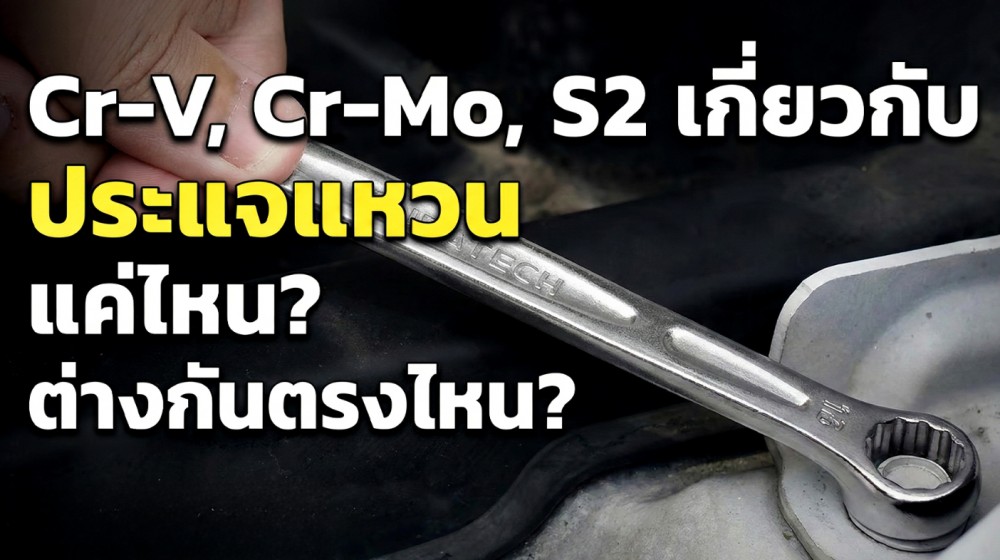
Has this ever happened to you? Standing bewildered in the hardware aisle, your eyes catch English abbreviations stamped on ring spanners like Cr-V, Cr-Mo, or S2... The first questions popping into your head are inevitably "What are they? How do they differ? Why does the price jump so much? Which one gives the best value?
Because in real life, we don't buy Ring Spanner to put in a display cabinet. We buy them to tackle real work: facing rounded nuts, thick rust, tight spaces, and sometimes greasy, sweaty hands while needing to finish the job quickly. Today, we're going to break down how each material affects the ring spanner in your hand, and which one is the true soulmate for your toolbox.
First of all, these letters represent the metal alloys in ring spanners:
- Cr = Chromium
- V = Vanadium
- Mo = Molybdenum
- S2 = Name of a tool steel grade that is commonly used to make "screwdriver bits" rather than spanners.
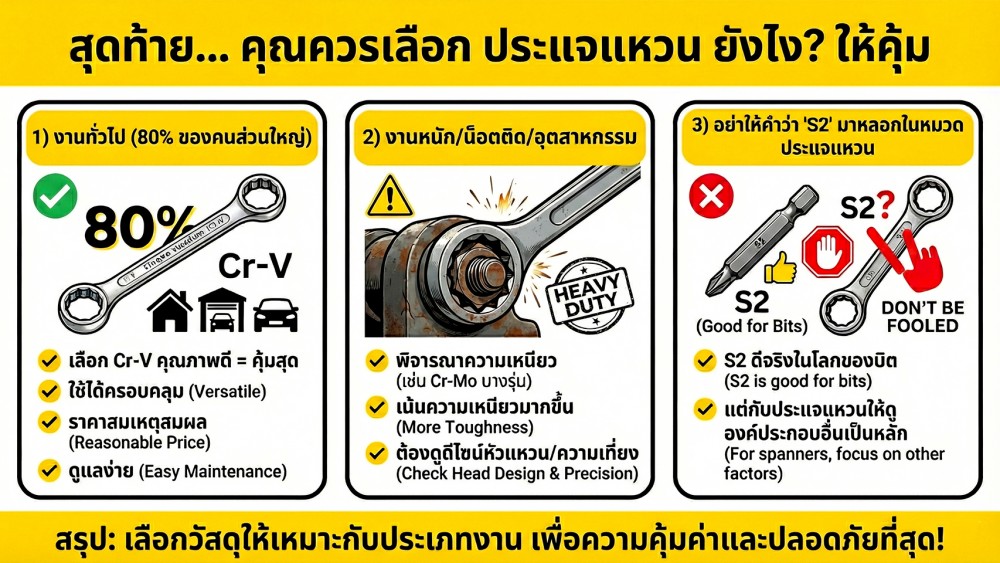
- Cr‑V is the popular standard for general ring spanners.
- Cr‑Mo is more often found in "tools that withstand high impact/heavy torque," but some brands also use it for heavy-duty ring spanners.
- S2, when talking about ring spanners... is mostly "a misconception," because S2 is commonly found in bits/screwdriver bits, not spanners.
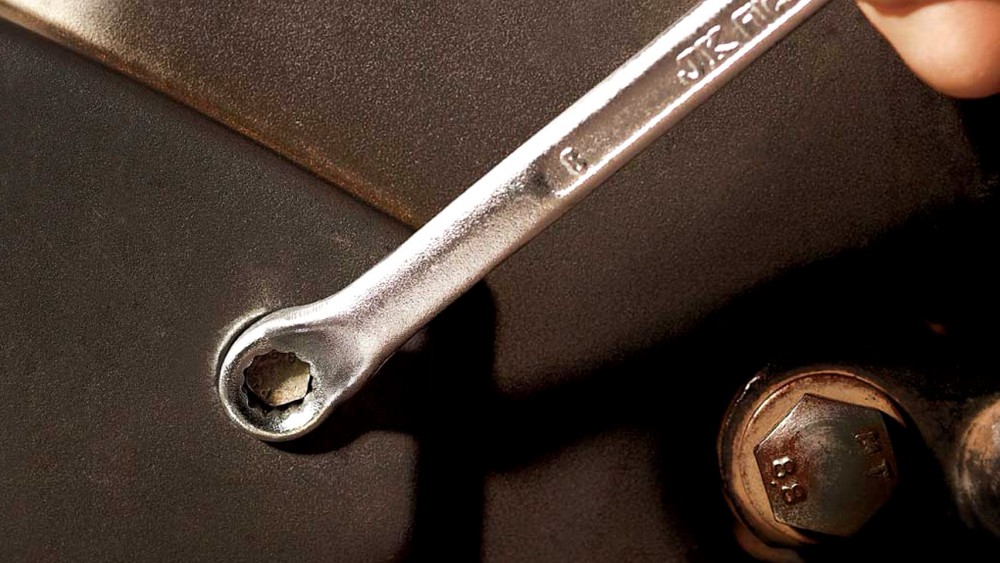
Where do ring spanners fail? Understanding the failure points will help you understand the materials better
Let's share from what we frequently encounter in real-world work. Most ring spanners don't just snap in half easily—unless they are very low-grade or severely misused. Instead, warning signs gradually appear before escalating into major problems right when you're in a rush. Here are the common symptoms you'll encounter:
- Slipping ring end: The inner teeth start to chip or deform. Once that happens, it no longer makes "full contact" with the bolt head, feeling like it is constantly slipping off the corners whenever you turn it.
- Flared or stretched ring end: Inconsistent dimensions, inferior steel, or improper heat treatment can cause the opening to stretch under heavy torque, making it feel noticeably looser than when it was new.
- Bending wrench body: When tackling extremely stuck fasteners, the wrench body yields. Sometimes the bend isn't obvious, but you can feel that it no longer handles torque with the same rigidity.
- Stripping the bolt head before the spanner fails: This is actually far worse. While the spanner looks undamaged, the deformed bolt head makes finishing the job much harder, forcing you to find on-site workarounds.
So, the question is: where does the steel material come into play? It all comes down to balancing hardness and toughness.
- High hardness: Excellent wear resistance and keeps a sharp bite for a long time, but it risks "chipping or cracking" under sudden shock or impact loads.
- High toughness: Great shock resistance and rarely chips, but the surface may wear faster and it can bend under sustained heavy torque.
That is why truly great ring spanners don't compete on being the "hardest," but rather on having the "right balance"—and most importantly, proper heat treatment and consistent quality control.
Cr‑V (Chrome Vanadium): The most common standard found in ring spanners
If you buy a set of ring spanners, chances are very high you'll see the mark "Cr‑V." It serves as a "versatile general-purpose standard" that easily handles everyday fastening tasks, especially for applications like:
- General maintenance around the home or factory
- Light to medium automotive work (tasks that don't involve constant hammering or impact)
- Machinery assembly and installation work
- General workshop tasks that require frequent use
So, what makes Cr‑V so good?
- "Just right" wear and corrosion resistance for daily tasks: Chromium helps with overall corrosion and wear resistance, while vanadium refines the steel's grain structure. Under repetitive torque, the ring end is able to stay "sharp" longer than ordinary steel grades.
- A well-balanced combination of hardness and toughness: For practical ring spanners, we need two things at once: "a ring end that doesn't slip easily" and "a wrench body that doesn't bend or flex easily." Cr‑V hits this sweet spot—hard enough to grip bolts firmly, yet tough enough to take working loads, all without driving up the cost excessively.
- Attractive surface finish and easy maintenance (with known limits): Most Cr‑V spanners have a polished chrome finish that makes wiping off oil easy, looks clean, and provides a degree of rust resistance... However, leaving them damp, exposed to salt water, or coated with chemical residues for long periods can still cause rust (chrome merely "delays" it; it doesn't make it invincible).
Speaking from a real user's perspective: a "good" Cr‑V can be felt by how snugly it fits onto the bolt head. It's a precise fit—not wobbly, not loose, and without needing heavy pressure to engage properly. This is truly what makes high-grade Cr‑V feel vastly different from just the words "Cr‑V" printed on a box.
Cr‑Mo (Chrome Molybdenum) Ring Spanners
If Cr‑V is your everyday companion, Cr‑Mo is more like the heavy-duty workhorse. However, it should be clarified that Cr‑Mo is most commonly discussed in the realm of impact sockets and tools subjected to high shock/sudden torque. This is because molybdenum improves resistance to impact and heat, giving the steel greater toughness.
Ring spanners are not typically designed to take "impacts" like impact sockets. But in real-life work, we sometimes inadvertently do it—such as tapping the wrench handle lightly with a hammer to break a bolt loose, or applying sudden, jerking force.
In such cases, a tougher material is much more likely to survive without chipping or cracking, which is one reason why many consider Cr‑Mo ideal for heavy-duty work.
Practical Benefits You Can Actually Feel
- Toughness and resistance to sudden loads: When a bolt is genuinely seized and you need to apply a sudden jerk or withstand shock loads, tougher steel is far less likely to chip.
- Used in specialized tools: Some brands manufacture ring spanners geared towards heavy industrial use or wrenches engineered for high-torque applications, utilizing Cr‑Mo for structural durability.
Points to Consider Before Following the Hype
- Cr‑Mo does not automatically prevent "rounding off bolt heads." Stripping or rounding bolt heads depends on the contact profile geometry and dimensional precision just as much as the material. If the ring head design is poor, it can still round off bolts even if made of Cr‑Mo.
- The price may be unnecessarily high for general tasks. If you're tightening ordinary bolts for household DIY or standard vehicle repairs without frequent shock loads, good quality Cr‑V will likely be a much better value.
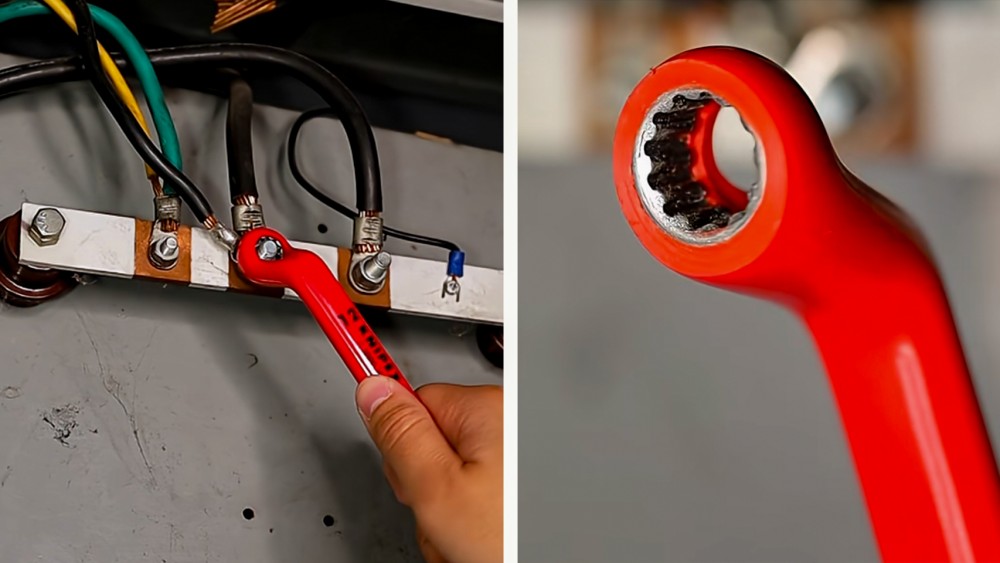
Why Do People Talk About S2 in Relation to Ring Spanners?
We encounter this quite often: some customers ask whether an S2 ring spanner is better. This mostly stems from familiarity with the term S2 in the context of screwdriver bits, as S2 is a tool steel commonly used for bits due to its high hardness and excellent torsional resistance.
Is S2 Actually Used to Make Ring Spanners?
In the general market, most ring spanners are not made from S2. S2 is primarily suited for small parts like bits that endure localized torque and require extremely high hardness and wear resistance. A ring spanner is a larger piece requiring a balanced toughness along with manufacturing and heat-treatment processes tailored to its geometry. If you see the label "S2" on a wrench-related product, double-check whether:
- It refers to the "bits" included in the set,
- Or if it is a type of "hex wrench / Allen key" that might legitimately use S2.
However, if it is an actual ring spanner prominently labeled with S2, I recommend checking the specifications carefully, as this is not a standard material typically found in ring spanners.
Real-World Experience Perspective
If you are choosing a "ring spanner," don't get misled by the S2 buzzword. Instead, focus on:
- The ring profile geometry (gripping bolt heads in a way that minimizes rounding)
- Dimensional accuracy
- Thickness/profile for tight access
- Surface coating/rust prevention
S2 offers far more value when you are choosing "screwdriver bits"