


 EN
 ไทย


Customers Also Purchased




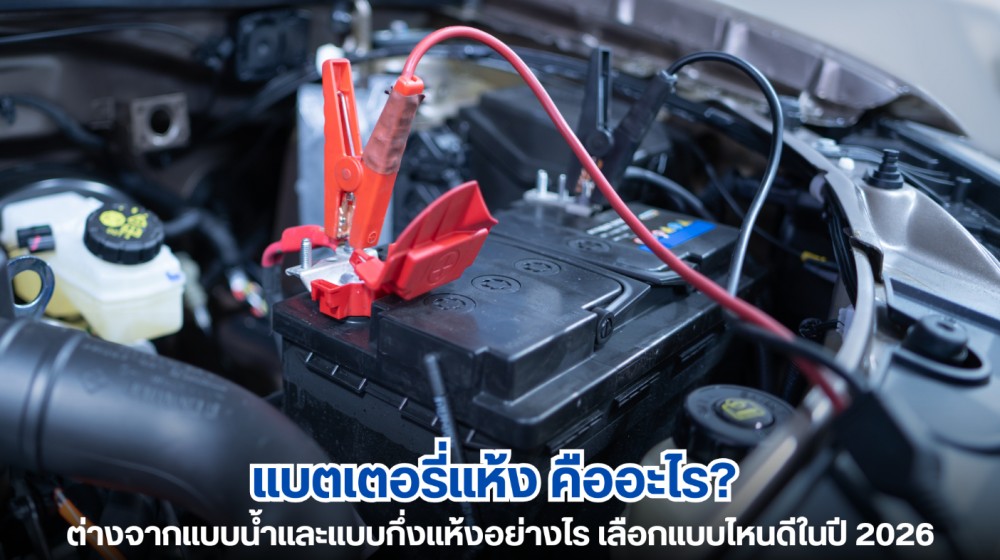
Has this ever happened to you? Starting your car in the morning, only for the engine not to turn over, the headlights dim, and a repetitive clicking sound—before you realize "the battery is dead"?
Sudden battery failure is one of the most common causes of unexpected breakdowns on the road, and that's why the term Dry Cell Batteries has become a popular search keyword for people looking to replace their car battery. Meanwhile, more than 80% of new car models come with dry-cell batteries as factory standard because they offer more stable voltage, require less maintenance, and suit today's increasingly complex electrical systems.
But the question is...
Are dry-cell batteries really better than wet-cell batteries? And what is a semi-dry battery? Which one offers the best long-term value?
This article will take you through an in-depth dive—from internal construction and operating principles to technical differences and professional cost-effectiveness analysis—so you can choose your battery with confidence and never risk getting stranded on the road again.
What is a dry-cell battery? Understand the operating principle before making a decision
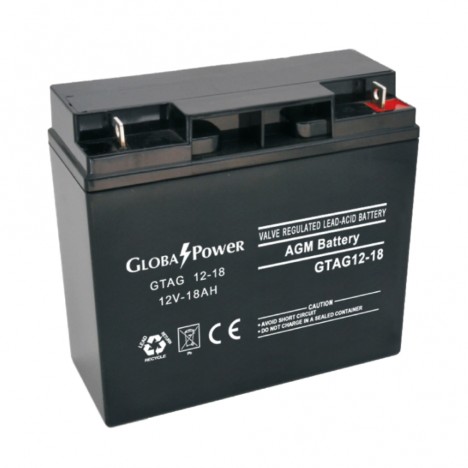
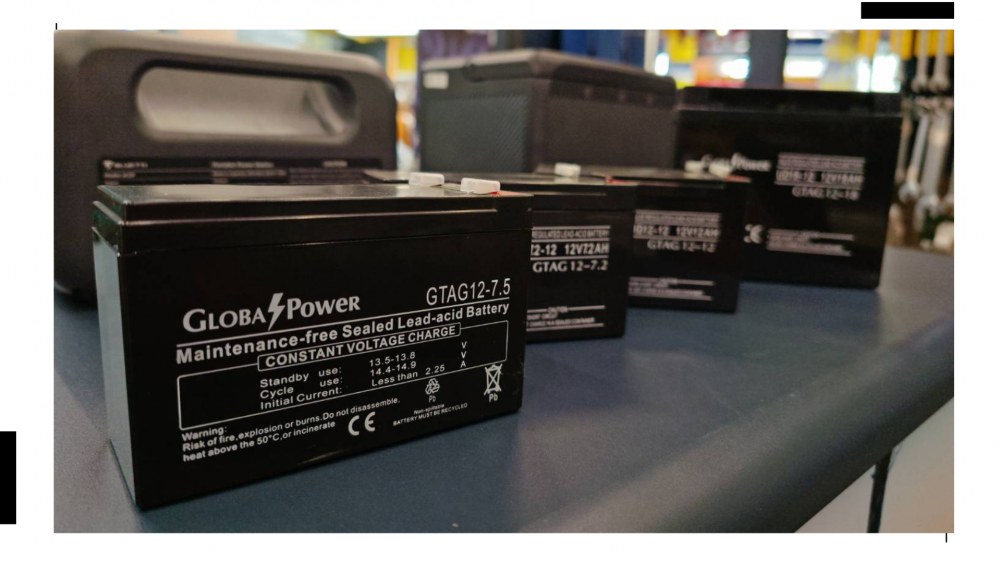
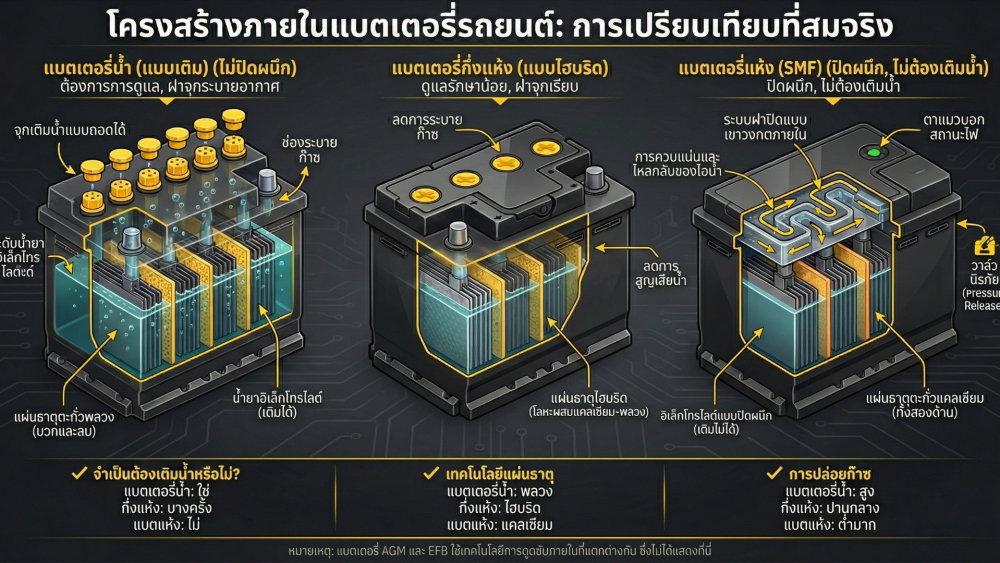
Dry-cell battery (Maintenance Free Battery – MF) is a lead-acid battery designed to require no distilled water refilling throughout its service life. It uses technology to control electrolyte evaporation, along with a specialized plate structure that reduces internal gas generation.
Although it is called "dry," there is still liquid electrolyte inside; it is simply sealed and engineered with a more stable internal system compared to wet-cell batteries.
Internal construction of a dry-cell battery
Dry-cell batteries are still a system of Lead-Acid Battery Includes
- Positive Plate
- Negative Plate
- Electrolyte (Sulfuric Acid)
- Separator
- Sealed Cover System
The key difference lies in the use of Calcium Alloy instead of traditional antimony, which helps:
- Reduce water loss
- Reduce acid mist emission
- Reduce corrosion
- Improve voltage stability
Why do dry cell (maintenance-free) batteries not require adding water?
In wet cell (flooded) batteries, charging causes electrolysis of the water inside, turning it into hydrogen and oxygen gases. These gases escape through the battery caps, gradually reducing the water level and requiring periodic refills with distilled water.
However, Dry cell batteries are designed to minimize water loss from the start by using calcium-alloy plates, which minimize gas generation during charging and significantly reduce water evaporation. In addition, an internal pressure control system reduces gas venting to the outside, practically eliminating water level drops and the need for refills.
The result is:
- No need to open caps to refill distilled water
- Reduces the risk of battery deterioration caused by neglected maintenance
- More convenient to use for general users
Simply put:
- Wet cell (flooded) battery “continually evaporates”
- However, dry cell batteries are “designed for minimal evaporation from the start”
What types of vehicles are dry cell batteries suitable for?
- Sedans
- SUVs
- General-use pickup trucks
- Vehicles with multiple electrical systems
- Vehicles used primarily in the city
Currently, most newer car models use dry cell batteries as factory standard because they meet convenience and safety needs.
What is a flooded battery? Is it still worth using today?
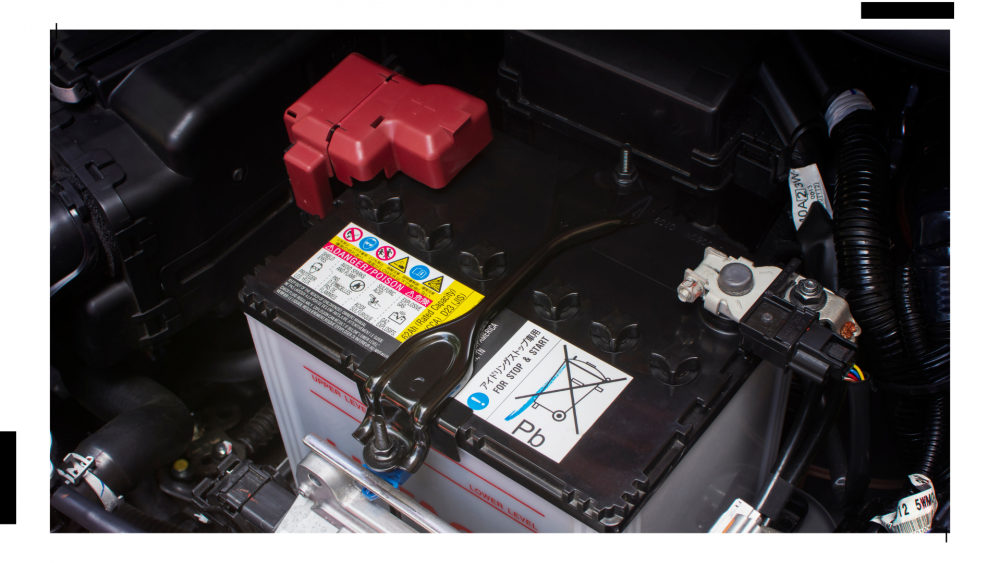
Flooded Battery is a traditional lead-acid battery that requires periodic topping up with distilled water, as the electrolyte inside evaporates during charging.
The basic structure is similar to a dry cell battery, but the difference lies in:
- No advanced water-loss reduction system
- Features removable caps for refilling water
- Vents more gas to the outside
Key Advantages of Flooded Batteries
Although dry cell batteries are more popular today, flooded batteries still have several advantages, including:
- Lower price Suitable for those looking to save budget
- Withstands heavy use well Such as commercial pickup trucks and lorries
- Simple structure, maintainable
For those who regularly service their own car, refilling distilled water every 1–2 months might not be an issue
Limitations to consider
However, flooded batteries have points to watch out for
- If you forget to refill water and the level drops below the plates → battery deteriorates quickly
- Risk of acid corrosion on battery terminals
- Requires opening the bonnet for regular checks
In newer cars with complex electrical systems, flooded batteries may not provide voltage as stable as dry cell (maintenance-free) batteries
So in 2026, should you still choose a flooded battery?
The answer is "It depends on the usage" Which dry cell batteries Suitable for
- Heavy-duty vehicles
- Those who want a low initial cost
- People who can regularly maintain their car themselves
However, for typical urban drivers seeking convenience, dry cell batteries are often a more suitable choice
What is a semi-dry (low maintenance) battery? A middle-ground choice between convenience and price
Semi-sealed battery (Hybrid Battery or Low Maintenance Battery) This is a battery developed from the wet type by reducing water loss, yet it can still be topped up with distilled water when necessary. Simply put, it is the "middle ground" between wet-cell and dry-cell (maintenance-free) batteries.
How is it different from the first two types?
- Evaporates water slower than wet-cell batteries
- Still has caps that can be opened to refill water
- Does not require maintenance as frequently as wet-cell batteries
- Slightly cheaper than dry-cell batteries
The internal structure often uses alloys that help reduce gas generation, causing water levels to drop more slowly, so it does not need to be refilled as frequently as traditional batteries.
Who is the semi-sealed battery suitable for?
- Those who want to save more budget compared to dry-cell batteries
- General vehicle usage without heavy electrical accessories
- Willing to do some maintenance checks, but not as often as with wet-cell batteries
Is it worth it?
In the past, semi-sealed batteries were considered a popular choice because they offered a good balance between price and maintenance. Nowadays, since the price difference with dry-cell batteries is no longer as significant as before, many users have shifted to dry-cell batteries instead for long-term convenience.
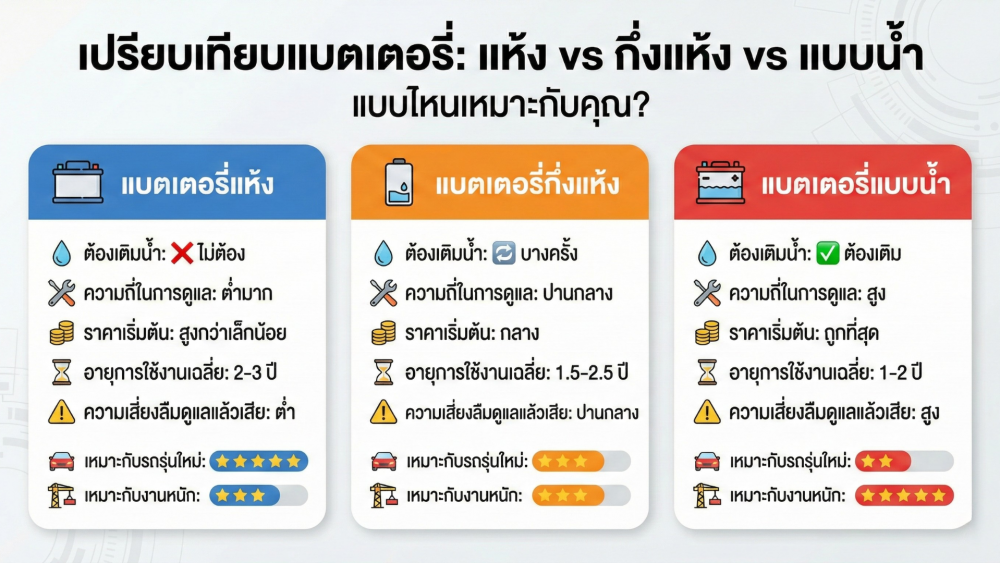
Comparison Table: Dry vs. Semi-Sealed vs. Wet Battery – Which one is right for you?
Easy-to-understand analysis
- If you want: Convenience: No need to frequently open the hood to check → Dry-cell battery is the best choice
- If you want: Moderate cost-effectiveness with some manageable maintenance → Semi-sealed battery is a viable option
- If you want: Most economical and perform regular vehicle maintenance yourself → Wet-cell batteries still meet your needs
An angle many overlook
Although wet-cell batteries are cheaper, when you factor in:
- Maintenance time
- Risk of sudden battery failure
- Emergency roadside assistance costs
Sometimes dry-cell batteries may be "more worthwhile overall" for general users
How many years is the lifespan of a dry-cell battery?
On average 1.5–3 years, depending on various factors
- Frequent short-distance driving
- Leaving the car parked for long periods
- Additional electrical accessories
- Hot weather conditions
- Brand quality
Cars equipped with 24-hour dash cams or heavy audio systems put extra strain on the battery
Warning signs that the battery is nearing the end of its life
- Hard starting in the morning
- Dim headlights
- Clicking sound, but the engine won't start
- Over 2 years old
- Malfunctioning electrical system
Should be checked before breaking down on the road
How to Choose the Right Maintenance-Free Battery for Your Car
Choosing the right maintenance-free battery shouldn't be based solely on price, but should reference vehicle specifications and actual usage conditions. Choosing the wrong size may cause rapid battery degradation or subsequent electrical system issues.
Main factors to consider include:
- Capacity (Ah) Should meet factory specifications, not lower than the original spec
- CCA Rating Crucial for large-engine or diesel vehicles, as it affects cranking power
- Date of Manufacture Choose fresh batteries that haven't been stored in stock for too long
- Warranty At least 12 months, with pre-installation electrical system testing service
Choosing the exact model matching your usage will help extend battery life and reduce the risk of unexpected breakdowns in the future.
Next-Gen Battery Trends: EFB and AGM
In addition to maintenance-free, conventional wet, and semi-sealed batteries, some newer car models today—especially vehicles equipped with Start-Stop will use specialized batteries, such as EFB and AGM Both types of batteries are engineered to handle frequent engine starts and deeper cycling than usual, making them ideal for vehicles with complex electrical systems or numerous electronic accessories.
- EFB (Enhanced Flooded Battery) An upgraded version of conventional batteries designed for heavier-duty use
- AGM (Absorbent Glass Mat) It features higher technology, supports high electrical loads, and delivers more stable voltage.
However, if your car does not have a Start-Stop system and is used for general daily driving, a dry cell battery is still considered sufficient and the most worthwhile choice.
Conclusion
When comparing them all, a dry cell battery is considered the most balanced choice for most car owners today because it offers convenience, requires minimal maintenance, and is well-suited for modern automotive electrical systems. Wet cell batteries remain suitable for those on a budget who can maintain them regularly, while semi-dry cell batteries offer a middle-ground alternative providing a good level of value.
The most important thing is to choose a battery that matches your car's specifications and actual usage conditions. Selecting the right type from the start will help extend its service life, reduce the risk of breakdowns on the road, and give you more driving confidence in the long run.