


 EN
 ไทย


Customers Also Purchased




Imagine you are using a Jigsaw and Shear to cut a board of wood. The blur of the fast-spinning blade and the steady hum of the motor make you feel in complete control. Your grip is firm, but at the exact moment you feel "confident" or "a little rushed," the tool binds, and the saw violently jerks back at you without warning. That is "Kickback"—a short word that has left many electric saw users with stories to tell.
Even experienced electric saw users can slip up because it's purely a matter of physics, hiding in the minor details we routinely overlook—such as the blade's angle of approach, hand pressure, grain direction, material tension, dulling blade sharpness, and ultimately the "type of electric saw" you choose, some of which carry risk factors where a single millimeter off can trigger an immediate kickback.
Therefore, we'll dive into what kickback in electric saws really is, how the force is redirected, why it turns dangerous in a fraction of a second, and most importantly, which types of electric saws carry the highest risk of kickback. Is it because of a larger danger zone? Or because the usage pattern causes the blade to bind frequently? As well as why certain models and types of power saws "have a higher chance of jerking back" than you might think.
What is Kickback "in the context" of power saws?
Kickback is a phenomenon where, while a power saw is operating normally, the blade or cutting component gets stuck or pinched, causing the motor's rotational force to be transferred back. This force violently thrusts or flings the saw back toward the user. Kickback can happen with almost any type of power tool, and with power saws, it often stems from very ordinary occurrences, such as…
- The wood is slightly warped; halfway through the cut, the kerf "pinches" the saw blade.
- The workpiece isn't properly supported; once the cut-off piece falls away, its weight pinches the cut shut.
- A dull blade forces you to push harder; once it snags, the accumulated force snaps right back.
- Cutting at the wrong angle, especially using the "blade tip" to bite into the material.
The terrifying part is that kickback usually happens in a fraction of a second. Before your brain can even tell your hands to stop, the rotational force has already taken over. Therefore, "understanding the causes" and "choosing the right saw" are just as crucial before deciding to buy a power saw as How thick can each type of electric saw cut? or Power Saws for Tradespeople: How to Choose the Right One for Your Work?
Why Kickback Is Directly Related to the Type of Power Saw
The next question is: why do some people use circular saws for years and rarely experience kickback, while others pick up a chainsaw for the first time and it almost flies out of their hands? The answer lies in these key factors:
Cutting action of the saw teeth
The teeth of different power saws and blades "bite" differently. Some blades offer a smoother cut and are easier to control, while others bite aggressively and cut fast. Although the job gets done quickly, they are much more prone to binding. When hitting wood knots, reverse grain, or applying just a bit too much pressure, the teeth are more likely to "snag" the material and kick back. Simply put: fast-cutting blades require a steady hand and an equally steady workpiece.
Tool construction and safety systems
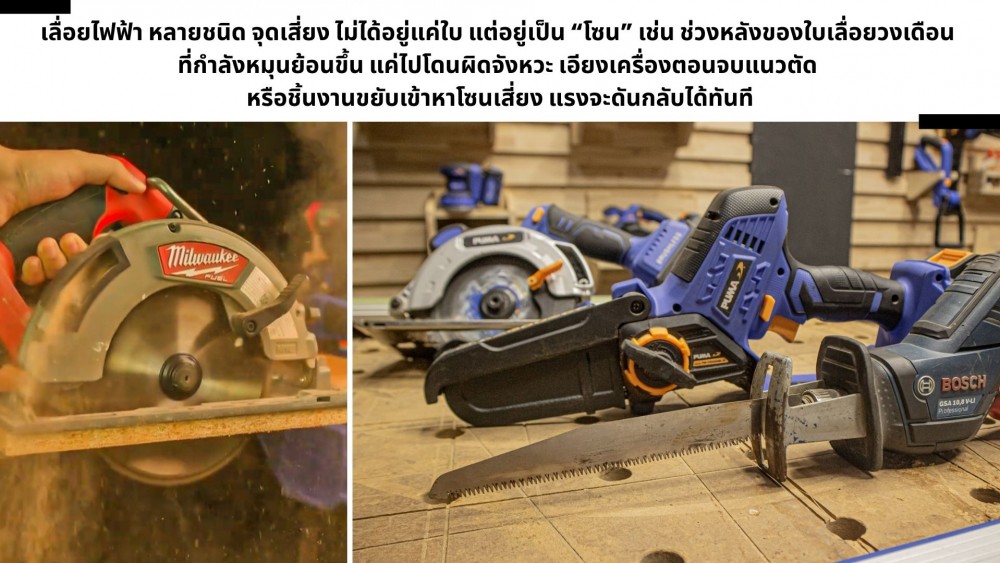
Many pro-grade power saws feature protective systems such as blade brakes, clutches, blade guards, or anti-kickback shut-off systems (Kickback Control), which help reduce severity and give you more time to react.
The tool's construction also plays a role: a rigid base reduces twisting, dual handles help control jerks, and soft start reduces startup recoil. These don't eliminate kickback entirely, but they help prevent a "small mishap" from turning into a "major incident."
Which type of power saw carries the highest kickback risk?
Ask off the cuff, and most people would say "chainsaws." Yes, it is indeed one of the highest-risk tools. But the truth is, "risk" doesn't come in just one form—and certain types of power saws that people assume are safe can deliver kickback that hits just as hard.
Therefore, let's break it down to clearly see how the kickback risk differs among each type of electric saw.
1. Chainsaw: The top electric saw when it comes to kickback
When it comes to jerking upward and clearly flying back toward the user, the chainsaw is the undisputed champion. This is especially true for the force generated at the "upper tip of the guide bar," which is the highest-risk zone. When the chain strikes wood at that corner, the force immediately kicks the bar up. Because the chain has teeth cutting continuously in a loop, if it pinches, it doesn't just "slow down gradually," but releases the accumulated energy from the entire rotating chain system.
Factors that make this type of electric saw even riskier include:
- Accidentally touching the wood with the tip of the guide bar
- A dull chain or uneven teeth, causing uneven cutting and frequent snagging
- Incorrect chain tension (too loose increases the chance of whipping/kicking back)
- Cutting wood with many knots or against cross grains
Many chainsaw models come with a Chain Brake that stops the chain when sudden jerk forces occur, as well as low-kickback chain tooth designs. However, even with these systems, remember that the "baseline risk" of this type of electric saw remains high.
2. Circular Saw: An electric saw with a silent risk, but real pain
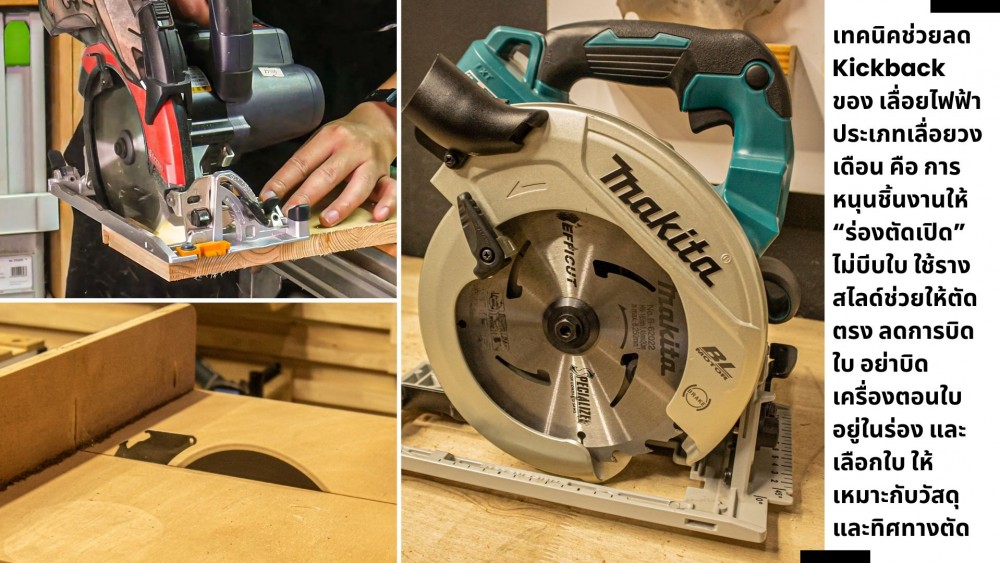
Many people think a circular saw is an easy-to-control electric saw because it has a base plate, a blade guard, and looks like a typical DIY tool. But circular saw kickback happens more often than you think, especially when cutting large panels, making rip cuts, or sawing into wood under tension.
The main cause is "blade pinching." When the kerf closes and pinches the blade, the top part of the upward-spinning blade can propel the saw straight back toward the user. Especially if you are pushing the saw forward, the combined force becomes even more severe. Common mistakes include:
- Improper workpiece support: cutting causes the workpiece to sag, closing the kerf
- Using the wrong blade: teeth that are too coarse for wood requiring fine cutting, leading to snagging
- A dull blade paired with heavy downward pressure: once the blade snags, the force recoils at full blast
- Cutting "wood with internal tension," such as twisted wood, compressed wood, or wood clamped in the wrong positions
3. Table Saw: The electric saw where kickback "launches the workpiece"
When talking about an electric saw that gives serious woodworkers "a rational fear," the table saw is certainly one of them. That's because the kickback force doesn't just throw the tool, but instead "launches the workpiece backwards" like a bullet. This is extremely dangerous because it can easily hit your torso, hands, or face.
The workpiece is fed past the saw blade. If it twists even slightly or pinches against the fence, the blade will catch the workpiece and throw it back instantly. The longer the wood, the greater the force. Factors that "increase the risk" on this type of saw include:
- Not using a riving knife or splitter
- Using a fence that is not parallel to the blade
- Feeding the workpiece by hand too close to the blade, leading to loss of control
- Cutting twisted wood or wood with internal tension
4. Miter Saw: Lower risk, but not zero
A miter saw is a power saw that many people feel is safe because the workpiece remains stationary, the blade comes down from above, and it has a supporting fence. However, kickback can still occur in the form of "flying workpieces" or the "blade pulling the workpiece in," especially with small pieces or wood that is not clamped tightly. Risk points include:
- Cutting very short pieces without clamping them
- A dull blade that cuts unevenly, causing the workpiece to vibrate
- Raising the blade too quickly before it stops spinning, causing wood debris to catch on the teeth and fling back
Overall, miter saws are considered to have a lower risk of kickback than top-tier power saws like chainsaws, table saws, and circular saws. However, you still need to follow the principle: "Hold firmly, clamp tightly, wait for it to stop before lifting."
5. Reciprocating Saw and Jigsaw: Power saws that "buck" more than they "kick back"
Reciprocating saws and jigsaws are power saws where kickback does not occur as a direct, aggressive thrust backward. Instead, it appears as "machine bucking," "whipping," or "jumping out of the cut line." Because their blades are thin and long, they tend to vibrate and twist easily when encountering resistance or getting stuck. Risk points include:
- Selecting a saw blade unsuitable for the material (such as a blade with teeth that are too coarse for fine work)
- Not gripping the tool firmly, allowing the shoe base to lift off the workpiece
- Cutting curves that are tighter than the blade's capability
The advantage is that the "kickback" force of these two types of power saws is generally less than that of circular saws or chainsaws that require strict manual control. However, they can still cause injuries from straying off line into hands or from flying debris.
6. Band Saw and Scroll Saw: Low-risk power saws, but still require caution
If you are looking for a power saw with a very low chance of "direct thrust kickback," consider these two. The cutting direction of a band saw is mostly downward or toward the table, which rarely causes the tool to thrust backward like a circular saw or table saw. As for a scroll saw, it has a short blade that cuts up and down with gentler cutting power, practically eliminating aggressive, terrifying kickback forces.
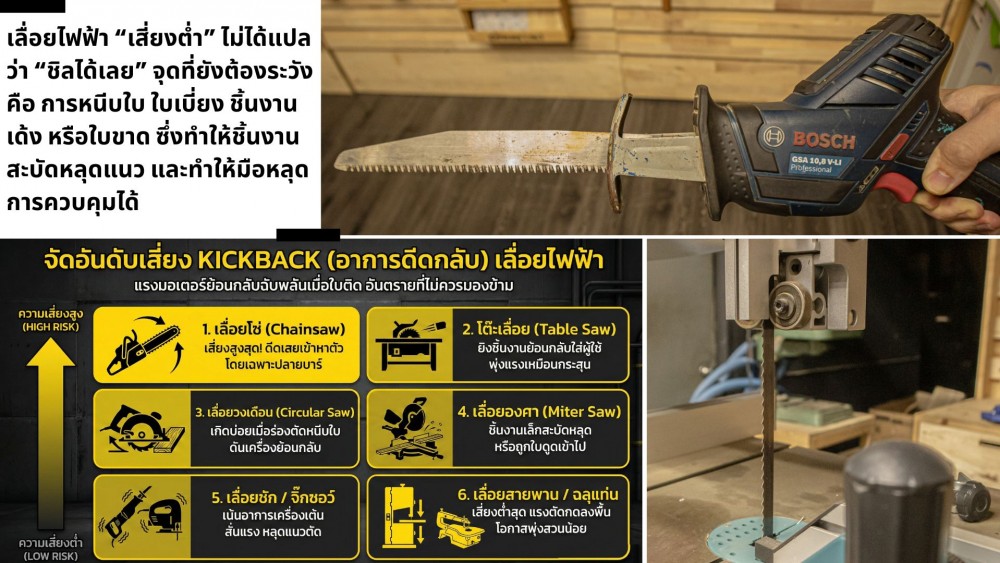
Conclusion: Power saws and kickback—which type carries the "highest risk"?
Kickback is a phenomenon where a power saw's blade, chain, or cutting component becomes "jammed, pinched, or caught," causing rotational force to reverse, which makes the tool thrust backward or the workpiece shoot backward Suddenly. Simply put, it's the moment when the cut stalls, but the motor's power keeps pushing, instantly generating a violent kickback force. This is precisely why certain types of power saws are categorized under higher risk groups.
Wherever there are moving cutting parts and workpieces that can twist, pinch, or vibrate, a reactive force can always occur. However, some types carry such a low risk that it is rarely encountered. If ranked based on the "likelihood of kickback occurring and the severity when it happens," here is the general overview to use as a guide before purchasing.
- Chainsaw: Highest risk, kicks up rapidly and violently, especially at the tip of the guide bar.
- Table Saw: Can shoot the workpiece backward, posing extreme danger to the operator standing in front of the machine.
- Circular Saw: Caused by blade pinching; happens frequently if the workpiece is not properly supported.
- Miter Saw: Risk stems from workpieces slipping or getting pulled into the blade.
- Reciprocating Saw / Fret Saw / Jigsaw: Low risk; usually manifests as vibration, chattering, or jumping off the cut line instead.
- Band Saw / Scroll Saw: Very low risk of projectile or backward kickback, but you still need to beware of blade pinching, blade deflection, workpiece chatter, and blade breakage.
If you are choosing, Jigsaw and Shear The first one Start by asking yourself first: "What kind of work do I mostly do?" rather than starting with "the most powerful" or "the fastest cutting," because higher speed comes hand in hand with harder control.