


 EN
 ไทย


Customers Also Purchased


When choosing to buy an Electric Wire hoist electric hoist, most people focus on only one number: the "rated lifting capacity," such as 1 ton, 3 tons, or 5 tons, assuming that if the hoist can lift the weight, it's fit for the job. In reality, according to engineering principles, what determines whether a hoist will be durable or fail easily isn't just how much it can lift, but rather how long it can operate continuously. This technical parameter is called Duty Cycle, often indicated on the nameplate as %(ED)—a metric that is frequently overlooked and the primary reason electric hoist motors burn out even shortly after being put into service.
In this article, we will help you understand the true meaning of Duty Cycle, how to calculate and select the right specs for your production line, and the ISO/FEM standards you need to know for the most worthwhile long-term investment.
What is Duty Cycle %(ED) in Engineering?
Duty Cycle is a standard rating indicating the "continuous operation capability" of electrical equipment, calculated from the ratio between the "Operation Time" relative to the "Rest Time" to allow the motor sufficient time to dissipate heat. According to international electric hoist standards, a 10-minute time base is always used for calculation.
In short: Electric hoists are not designed to run 24 hours continuously like a fan motor. Instead, they are designed to operate in "cycles," requiring rest intervals to dissipate heat accumulated from lifting loads.
Reading the %(ED) Value: What Do These Numbers Tell Us?
When examining an electric hoist's nameplate, you will find different %(ED) ratings, which can be categorized by application as follows:
Light Duty Group (25%)
- Meaning: Within a 10-minute period, the hoist can operate for 2.5 minutes and must rest for 7.5 minutes.
- Applications: Suitable for maintenance work, auto repair shops, or simple, infrequent lifting. Not suitable for installation on production lines.
Medium Duty Group (40%)
- Meaning: Within a 10-minute period, the hoist can operate for 4 minutes and must rest for 6 minutes.
- Applications: Suitable for general industry, warehouses, and assembly work with cycles alternating between operation and rest.
Heavy Duty Group (60% or higher)
- Meaning: Within a 10-minute period, the hoist can operate for 6 minutes or more, with less than 4 minutes of rest time.
- Applications: Suitable for heavy-duty applications requiring high continuity, such as steel mills, automotive manufacturing plants, or shipping ports with continuous lifting operations.
Hidden Factors that Overload Electric Hoists (Derating Factors)
Even if the specification states a 40% capacity, actual on-site factors can reduce performance, which engineers must take into account:
- Rapid button pressing (Inching / Jogging): The habit of repeatedly "tapping" the button to align a workpiece generates an inrush current (Starting Current) 3-5 times higher than normal operating current. Heat accumulates in the motor windings faster than continuous pressing, resulting in a reduced actual Duty Cycle.
- Ambient Temperature: The %(ED) rating is typically tested at room temperature (20-40°C). If used in smelters or under hot roofs, the motor's cooling system will be less effective.
- Average Load Weight (Load Spectrum): If most lifting operations are performed at full capacity (Full Load) at all times, the motor bears a significantly heavier burden than lifting lighter loads.
International Standards Comparison: ISO and FEM Class
For precise communication with suppliers, always verify the durability class (Durability Class) alongside the %(ED) rating.
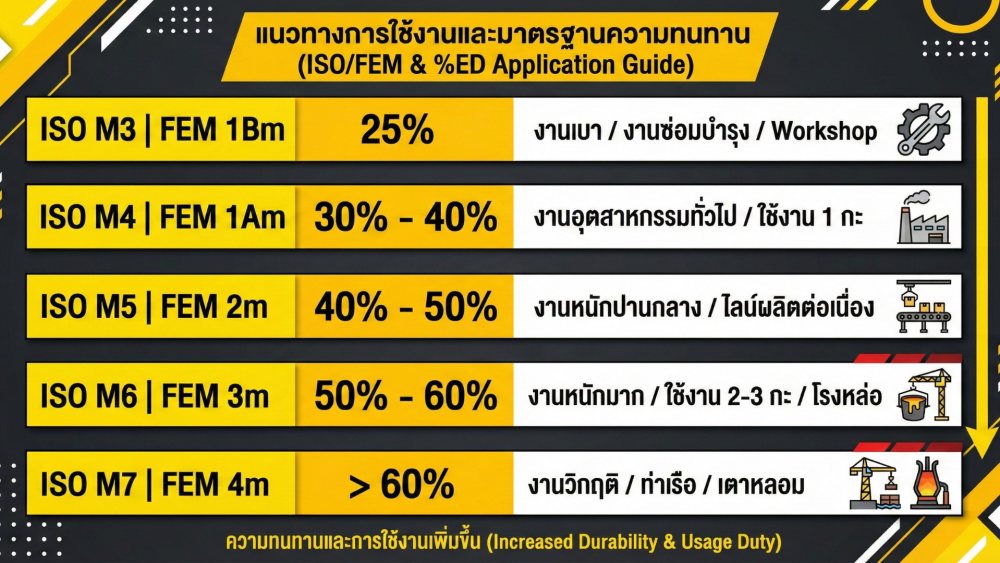
Recommendation: For facilities with continuous production, choose a minimum specification of FEM 2m (M5) for optimal cost-effectiveness and to minimize downtime.
Damage caused by choosing the wrong Duty Cycle
Using an electric hoist with a low Duty Cycle in conditions that exceed its limits can physically impact the machine as follows:
- Thermal Overload: Heat accumulation in the iron core and copper windings exceeds what the insulation can withstand.
- Insulation Failure: The insulating varnish coating the windings deteriorates, melts, or becomes brittle, leading to short turns between coils.
- Brake Slippage: Heat from the motor can transfer to the brake assembly, degrading the brake pads and leading to brake slippage or loads dropping during lifting, which poses a severe hazard.
How to calculate and select the correct specification (Practical Calculation)
To select the right electric hoist for your application, try using this basic calculation formula:
Example Scenario:
- Required lifting height: 6 meters
- Hoist speed: 4 meters/minute (takes 3 minutes per lifting/lowering cycle)
- Required frequency: 10 cycles per hour
Calculation:
- Actual operating time per cycle: 3 minutes
- Total operating time per hour: 10 cycles x 3 minutes = 30 minutes
- Duty Cycle Percentage: (30 minutes / 60 minutes) x 100 = 50%
Purchase Recommendation: From the calculation, the actual duty cycle is 50%. Therefore, you should not choose a standard hoist model (40%), but instead upgrade to a Heavy Duty model (60%) or FEM 2m/3m grade to provide an adequate Safety Factor for actual operation.
A worthwhile investment begins with the right "specifications"
Purchasing Electric Wire hoist solely considering "price" and "lifting capacity" may seem cost-effective initially. However, if the Duty Cycle is insufficient for actual usage, hidden costs from motor maintenance, replacement spare parts, and production downtime will far exceed the price difference of a proper machine.
Understanding and choosing the correct %(ED) rating is therefore an engineering decision that sustainably reduces costs and increases the stability of the production process.