


 EN
 ไทย


Customers Also Purchased


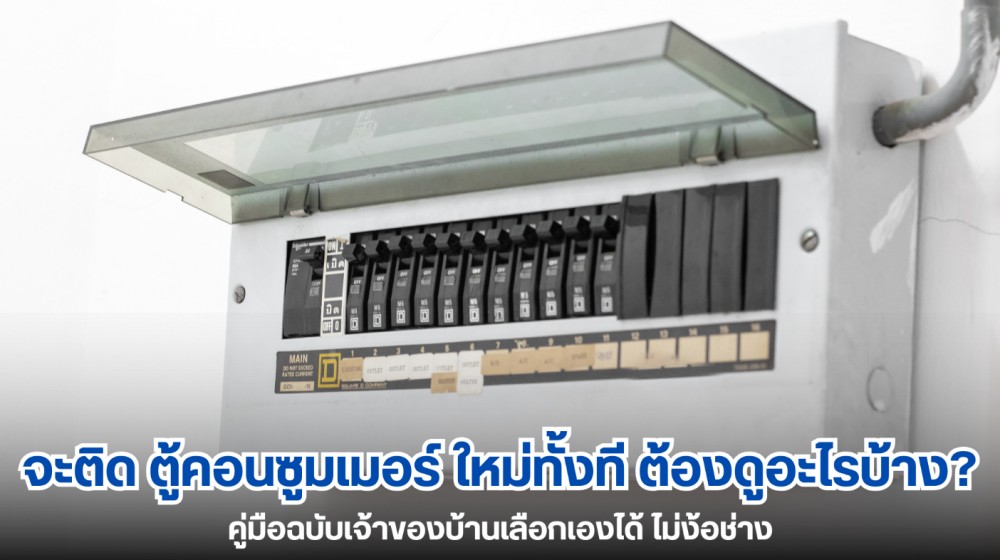
When we start planning our dream home or decide to renovate an old house to make it look even better, we often dedicate time to picking tile colors, searching for the softest sofa, or arguing with the architect about sunlight direction. But there is one crucial core of the house that we often "overlook" or leave 100% to the electrician, and that is the "Consumer Unit" or what we commonly call the "Consumer Units & Enclosures" that's what it is.
Many might think, "Oh... electrical work is too complicated, just let the technician handle it. Whatever you buy is pretty much the same."
Hold on! As the homeowner who has to live there, plug appliances in, and entrust your life to the house's safety, choosing a consumer unit carelessly could become a "ticking time bomb" or cause endless frustration later on. Whether it's the circuit constantly tripping for no apparent reason, running out of slots so wires end up dangling all over, or worst of all... when an electrical leakage occurs, the system fails to trip at all.
Today, Nong Chang will break down these complex topics into simple terms with this "Homeowner's Guide to Choosing a Consumer Unit." It will help you walk into a building materials store with confidence, pick top-tier specs at a great value, and most importantly, "speak the same language as your electrician."
Getting to Know the Consumer Unit: The "Heart" of Your Home's Electrical System
Before shopping for one, we need to understand what this simple-looking metal or plastic box actually does. If wiring is compared to blood vessels, the consumer unit is the "heart" and "brain" of the home's electrical system. Its 3 main functions are:
- Receiving power: Receives high-voltage electricity from the utility provider into the house.
- Distributing power: Distributes power into branch circuits to supply different points—whether lighting, power outlets, air conditioners, or water heaters—ensuring systematic and organized operation.
- Safety Protection: This is the most critical function: "cutting off power" immediately when 3 types of abnormalities occur, namely overload, short circuit, and earth leakage / electric shock.
As you can see, a consumer unit is not just an ordinary on/off switch; it is like a home security guard keeping watch over your electrical system 24 hours a day. That is why choosing a standardized consumer unit that suits your usage is definitely something you shouldn't overlook.
4 Essential Checklists to Review Before Paying
When you walk into the electrical equipment aisle, you will see rows of consumer units from multiple brands and in various sizes, with prices ranging from hundreds to tens of thousands. If you don't want to stand confused in front of the shelves, use these 4 guidelines to make your decision.
1. Number of "Ways": The golden rule is "better to have too many than not enough"
The first question the salesperson will ask you is, "How many ways do you need?" The word "way" here refers to the number of miniature circuit breakers (MCBs) that can be installed inside the unit.
Many people stumble here because they simply count the number of rooms in their home and buy exactly that amount—such as 3 bedrooms, 1 kitchen, 1 living room, so they think 5 ways will do... That is completely wrong!
The correct calculation method must be based on the electrical "load" or appliances.
- Air conditioners: How many units? (1 unit = uses 1 way) Must be strictly separated, no daisy-chaining.
- Water heaters: How many units? (1 unit = uses 1 way) Must be strictly separated.
- Water pump / Electric gate: (1 way)
- Power outlets (receptacles): Should be separated into zones, e.g., downstairs 1 way, upstairs 1 way, and most importantly, the "kitchen" must have its own dedicated 1 way, as it is the area with the heaviest power consumption (microwave, rice cooker, electric kettle).
- Lighting (bulbs): Separate downstairs 1 way, upstairs 1 way, perimeter fence 1 way.
Secret formula: Whatever total you count, always add 2–4 extra ways (spares). Why buy spares in advance? Imagine that 3 years from now, you buy an EV or your child grows up and wants an extra air conditioner installed in the small bedroom. If your panel is completely full with no spare ways left, you will have to tear out the old panel, buy a new one, and hire an electrician to rewire the entire system—definitely a massive undertaking and a budget overrun.
Therefore, buying a 10-way panel is definitely more worthwhile than a 6-way panel in the long run.
2. Match the "Main Breaker" to Your Electric Meter
In a consumer unit, the largest circuit breaker is always located on the far left. We call it the "Main Breaker" This is the big boss controlling the electricity for the entire house. The rating of the main breaker (unit in Amperes - A) "must not be chosen at will" but must be selected in accordance with the "electric meter" in front of your house.
- 5(15)A meter: (Garden house or very small house) -> use a main breaker of 16A or 20A
- 15(45)A meter: (Typical housing estate home, townhouse) -> use a main breaker of 45A or 50A
- 30(100)A meter: (Large detached house, home office, or house with an EV) -> use a main breaker of 63A, 80A, or 100A
Cautions: Do not try to "oversize" the main breaker beyond the meter's capacity (for example, having a tiny meter but installing a 63A main breaker). If electricity usage exceeds the limit, the utility authority's meter will burn out and be damaged before your home's breaker trips, resulting in very expensive fines!
3. Safety System: How necessary is earth leakage protection (RCBO)?
In the past, electrical panels were only meant to protect against short circuits and overloads (drawing too much power until the wires overheat), but they didn't protect against "electric shocks to people" ... meaning if we stuck a finger into an outlet or power leaked from a water heater, a standard breaker wouldn't trip. But in this year 2026, an earth leakage protection system (RCBO) is a "must-have", especially for risk areas near water.
Choosing a consumer unit with residual current protection comes in 2 main configurations to suit your lifestyle:
Type A: Centralized Control (Main RCBO)
- The main circuit breaker itself functions as the residual current device (RCBO).
- Pros: Ultimate safety—100% protection against electric shock for every outlet and point in the house.
- Disadvantage: If there is any moisture or a minor current leak (such as ants in the front doorbell or dampness in the water pump), power to the entire house will shut off! This makes troubleshooting difficult and very frustrating, especially during the rainy season.
Type B: Individual Zone Control (Split / Individual RCBO)
- Uses a standard main breaker, but select "branch breakers" are replaced with RCBOs.
- Recommended approach: Install RCBO branch breakers only on high-risk circuits, such as water heaters, bathroom outlets, kitchen outlets, and outdoor outlets. For lighting circuits or high-mounted air conditioners, standard breakers are sufficient.
- Pros: When a current leak occurs at the water heater, only that circuit trips. The AC stays on, lights stay on, and your life isn't interrupted.
4. Mounting Types: Plug-on vs DIN Rail
This is a minor technical detail, but knowing it will help you find the right spare parts. There are 2 breaker mounting standards in our local market:
Plug-on type:
- Commonly found in American brands (such as Schneider Electric / Square D).
- Features: The back of the circuit breaker has clip prongs. Simply push it in until it "clicks" into place securely.
- Highlights: Very easy to install, neat, organized, without cluttered visible wiring. Electricians prefer it because jobs finish fast.
DIN Rail type:
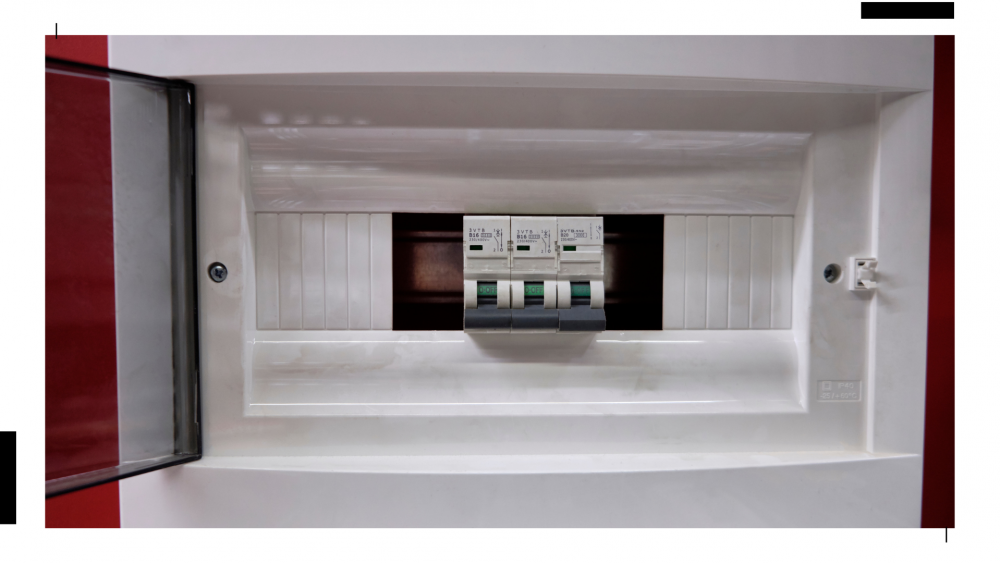
- Found in European and Asian brands (such as ABB, Chang, and select Panasonic models).
- Features: Consists of a long metal rail onto which the circuit breakers are mounted.
- Highlights: It is an international standard (Universal). The advantage is that spare parts are very easy to find; any brand can fit on the same rail, offering flexibility when replacing or upgrading devices.
Which type should you choose? Safety performance is no different. It depends on your preference: if you like neatness, choose Plug-on; if you prefer flexibility and easily sourced spare parts, choose DIN Rail.
Where should it be installed to be considered a "prime location"?
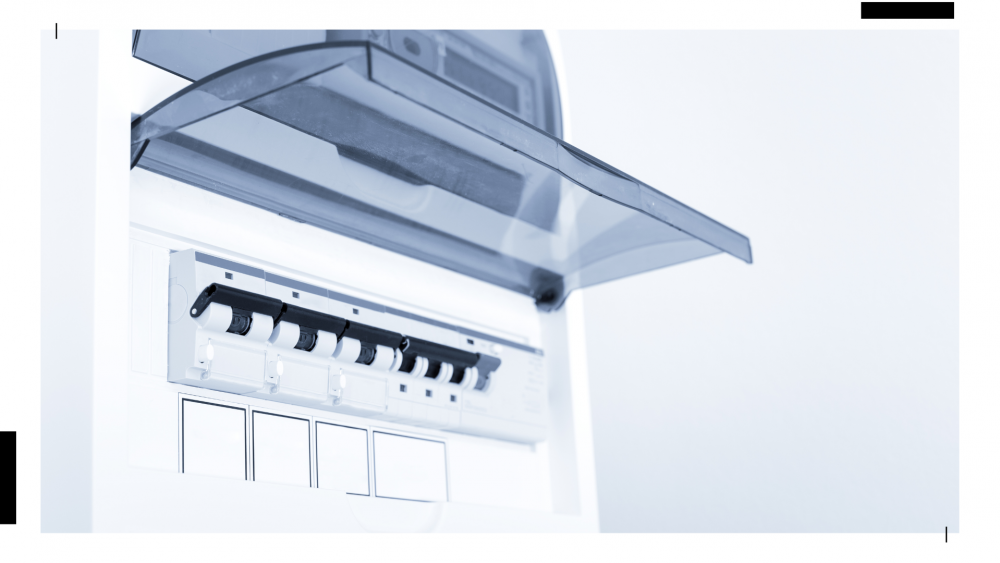
Once you have the consumer unit, don't let the technician install it just anywhere. Choosing the right location for the consumer unit affects long-term safety.
- Must be easily accessible, yet out of children's reach: It should be installed at an adult's eye level (around 1.6 - 1.8 meters from the floor) so that in an emergency, you can immediately run to switch off the breaker, rather than having to climb a ladder or squeeze into a storage room under the stairs.
- Never install in bathrooms or near water faucets: Moisture and electricity are enemies.
- Adequate lighting: The panel area should have emergency lighting or be situated where outside light can reach it, because when the power goes out, you need to be able to see the panel.
- Aesthetics: Nowadays, there are beautifully designed consumer units that look like home decor furniture. Or if you don't want it on display, you can conceal it inside a built-in cabinet—but it must be "easy to open, and strictly never deadlocked."
Conclusion
Consumer Units It's not just an ordinary plastic box, but an investment in the safety of everyone in the family Spending a few hundred or a few thousand more to buy a standardized unit with spare ways for the future and detailed circuit separation is far more worthwhile than regretting it after a fire or having to tear down walls to rewire when it's too late.
We hope this guide gives everyone the confidence to choose and supervise electricians to install the system exactly as you want.
Always remember: A beautiful house brings happiness, but a house with a safe electrical system... lets you sleep peacefully!