


 EN
 ไทย


Customers Also Purchased




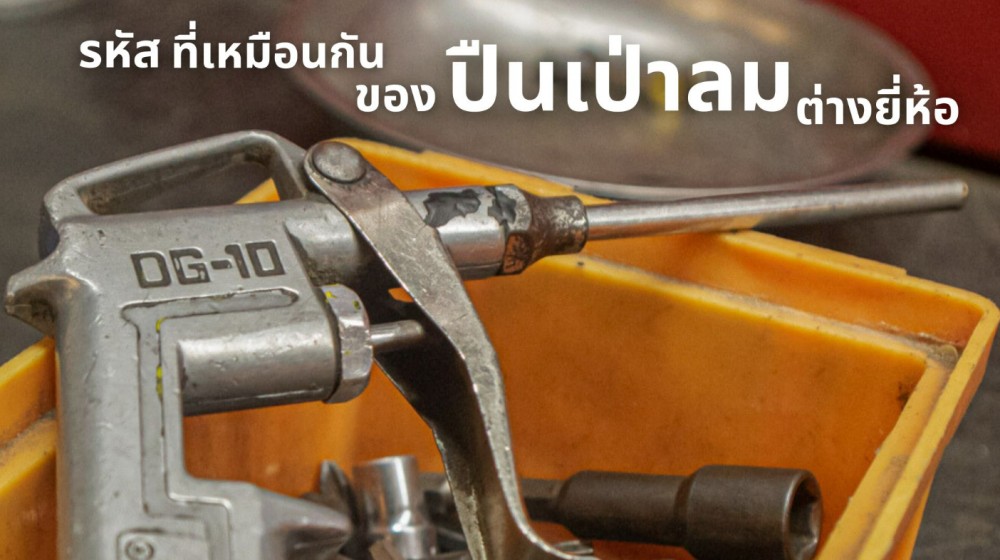
Have you ever seen Air Duster Gun and couldn't help wondering what the "DG-10" code stamped like a model name across many different brands actually means? Where did these letters and numbers come from, what do they mean, or were they just randomly made up?
Many people, especially those who use one regularly, might never have stopped to seriously think about this question. In daily work, we usually only care about whether it blows powerfully, saves air, and feels comfortable to use, rather than looking into the origin of its model name. But once you have to buy one, compare multiple brands, or see the DG-10 name pop up again and again, curiosity inevitably sets in.
In this article, we'll answer the question of where the DG-10 air blow gun comes from, what its design reflects, and what this code is really telling us, along with the meanings, reasons, and details that will help you choose equipment that better matches your actual usage.
Air blow guns: an essential tool for every garage and workbench
Before diving into the DG-10 code, let's start with a basic question: what exactly is an air blow gun? And why should anyone with an air compressor have an air blow gun at home?
In-depth: What is an air blow gun, and why is it so popular in mechanical work? In simple terms, an air blow gun is a tool that controls compressed air from an air compressor, directing it in a targeted stream through a nozzle. It is used to blow away dust, water, debris, or clean workpieces after repairs and manufacturing. Yet behind that simplicity lies a wealth of small details—from the body shape, grip, and trigger, to the nozzle that directly impacts blowing force.
Many technicians agree that no matter how expensive your tools are, if you lack an air blow gun, your work will noticeably slow down immediately. That is because it is like an extra hand that helps manage debris both during the work and after the job is done.
Why do air blow guns have model codes?
If you look closely, all kinds of tools from every brand—whether power tools, pneumatic tools, hand tools, or various consumables—all come with model codes that might arouse your curiosity.
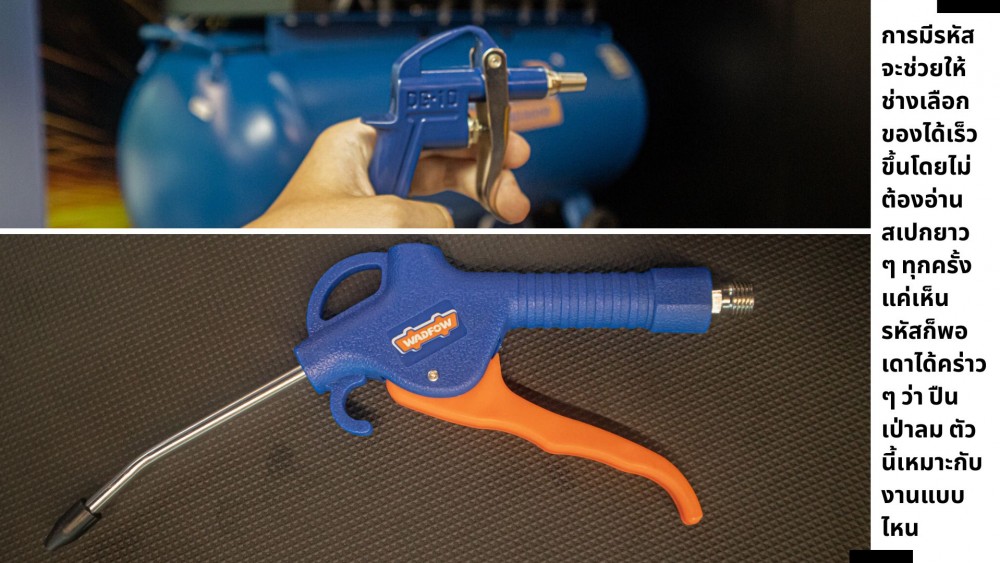
Importantly, these codes are not just cool names, but act as a shorthand language that manufacturers use to communicate key information, such as design structure, application type, suitable pressure levels, or target user groups.
Understanding the DG-10 code for air blow guns
When talking about the DG-10 air blow gun, the first question we might ask is what the letters DG and the number 10 actually mean. Is it an international standard, or specific naming by certain manufacturers? And how does it reflect the tool's specifications?
- In the industrial sector DG refers to Dust Gun or Direct Gun (Dust Gun / Straight type), indicating usage characteristics focused on agility and a secure grip
- The number 10 refers to the standard size that is "neither too short to reach nor too long to be cumbersome," making it the most suitable for general use.
Structural design of the air blow gun
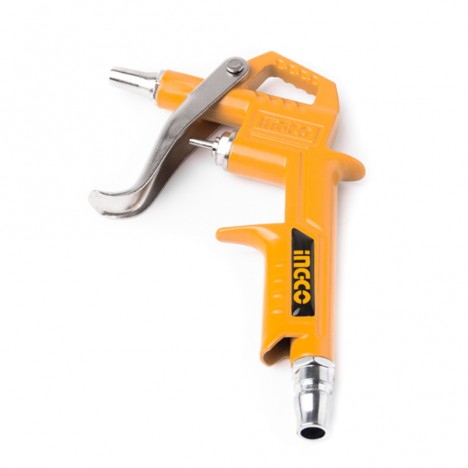
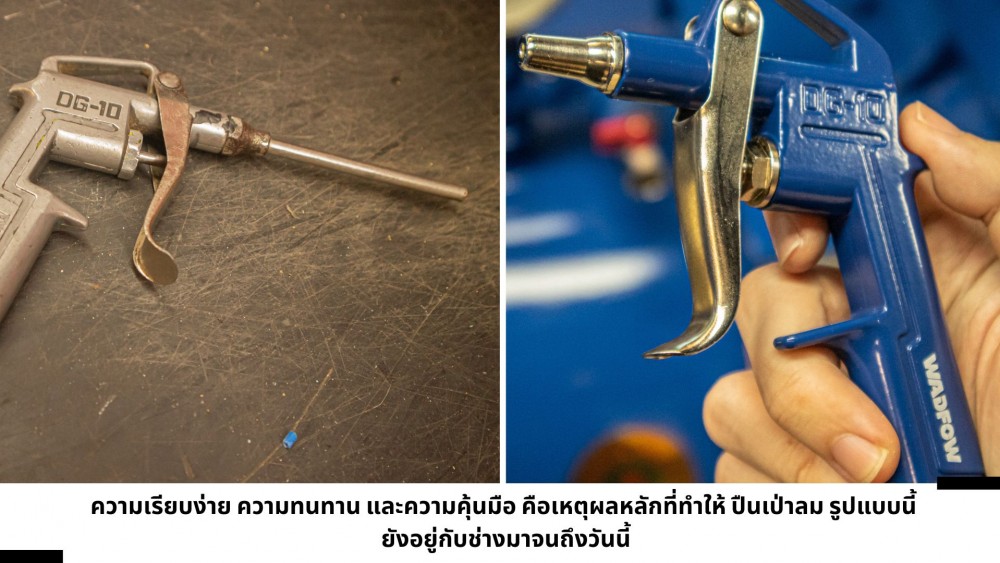
If we take a closer look at a DG-10 air blow gun, you will see that its design is quite classic: a pistol grip handle, a spring-loaded trigger, and a straight nozzle at a length that is neither too short nor too long.
This shape did not happen by chance, but is the result of decades of practical use. The pistol grip helps control air direction precisely and prevents hand fatigue during continuous use, while the trigger is designed for easy pressing and immediately cuts off the airflow upon release, enhancing operational safety.
Therefore, an air blow gun with a balanced shape like the DG-10 is ideal for jobs requiring repetitive blowing throughout the day, such as blowing dust in a garage, clearing metal shavings off a workbench, or cleaning parts before assembly.
Materials used in air blow guns
Another frequently overlooked question is what impact the blow gun's material has on real-world use. Many people might think that since it's just passing air, any material would be the same, but that is actually not the case at all.
Most DG-10 air blow guns are made from alloy or aluminum die-cast, which withstands pressure well. The body is sturdy enough to handle continuous air pressure, while the nozzle does not easily bend or wear out, as that would directly affect the direction and power of the airflow.
Everything you should know before choosing an air blow gun: is it true that buying the wrong one will cause breakdowns? Because with cheap air blow guns made of poor materials, after a short period of use the nozzle begins to crack, air leaks, pressure drops, and work that was once fast slows down immediately. This made me understand why standards like the DG-10 remain continually popular.
Why do many brands use the same "DG-10" model name?
If you've ever browsed through air blow guns at tool shops or flipped through multiple brand catalogs at once, I bet you've noticed the same striking detail: why do air blow guns from so many different brands share the exact same model name, "DG-10"—even though they have different brand logos, different prices, and seemingly different levels of quality?
There isn't just a simple one-sentence answer to this question; it's tied to the entire manufacturing structure of pneumatic tools, especially the OEM system behind countless air blow guns on the market.
DG-10 is an "OEM Factory Generic Code"
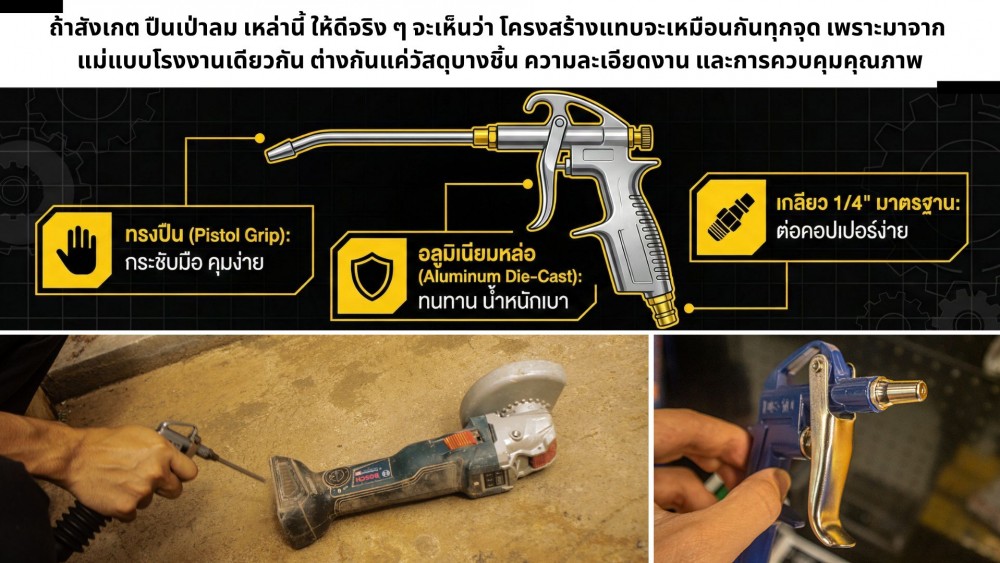
In reality, the DG-10 air blow gun is a design for which manufacturing plants already have standard molds. The design of the body, handle, trigger, and overall proportions allows it to cover general-purpose tasks. Anyone who places an order for production can apply their own logo and brand name to it.
If you look closely, you will see that:
- of the brand Aeropro also has the model name DG-10
- of the brand Wadfow also has the model name DG-10
- As for other brands in our market, DG-10s are everywhere.
DG-10 is a "Type Code," not a specific brand model name
Another common misconception is thinking that DG-10 is a proprietary model name from a specific brand. But from the actual manufacturers' perspective, DG-10 acts more like the name for a "type of air blow gun."
DG-10 is a standard model code used to refer to pistol grip air blow guns that feature a specific shape and mechanism, which are extremely popular in the market.
This is similar to paint spray guns that craftsmen commonly refer to as "F75," where many brands use the same code. Don't assume they are copying each other; it is simply a design name/factory code used to denote the same shape and structure.
Therefore, when you see the designation DG-10, don't assume it's any special model. Just understand that this is the baseline air blow gun shape that many brands choose as their starting point.
- Pistol Grip: The handle is designed like a gun grip, ensuring a firm hold and easy airflow direction control by squeezing the trigger.
- High Durability: The body is made of metal, making it more resistant to drops, impacts, and oily or chemical environments in auto repair shops compared to plastic models.
- Standard Thread: The inlet features a 1/4" PT (or NPT) female thread for connecting to fittings.
- Nozzle: Detachable, with the tip thread being a standard size that can fit extended nozzles (Long Nozzles) or other specialty attachments.
DG-10 is not an international standard (not ISO / JIS)
This is a very important point, and I want to emphasize clearly that the DG-10 code is not an industrial standard; it does not guarantee air pressure, and it does not indicate CFM rating or manufacturing quality.
The DG-10 code simply tells us, "This is an air blow gun of this shape, this design, and uses a standard mold." As for the actual quality—whether good or bad—it depends entirely on the materials, assembly, and QC systems of each individual brand.
The Hidden Practical Meaning Behind the DG-10 Code
Beyond its structural meaning, the DG-10 code also reflects the "easy to use, everyday use" operational concept of the air blow gun.
It is not an air blow gun for extreme, niche applications; it is not designed for ultra-high pressures or ultra-fine air control. Instead, it is an air blow gun that comprehensively meets the needs of general tasks, ranging from light to medium duty. In my view, this is the charm of the DG-10: it's like a trusty go-to tool that you can grab and use right away without overthinking.
The DG-10 Air Blow Gun and Real-World Technician Experiences
If you ask me who the DG-10 air blow gun is suitable for, the answer is: anyone looking for a reliable tool for repetitive, everyday use without having to worry about fussy issues. An auto shop, workbench, or technician's workstation might have many types of blow guns, but in the end, the one picked up most often is the basic DG-10 style because it gets the job done quickly, is durable, and is easy to repair.
Compared to air blow guns with short or angled nozzles, the DG-10 style offers greater versatility for general tasks. While not specialized, it doesn't overly limit itself either. I see it like a multi-tool pocket knife: not the absolute best for every specific task, but usable in almost any situation. And in an era where new tools come out every year, the fact that the DG-10 air blow gun is still being produced and used proves that it truly answers real needs, not just fancy names or codes.
Summary: What Does the DG-10 Code Tell Us About Air Blow Guns?
To summarize as briefly and clearly as possible for a complete overview, here is my takeaway:
- DG-10 is an OEM factory template code.
- Multiple brands can use the same name because they may come from the same production source.
- The name DG-10 does not directly reflect quality.
- The actual quality of an air blow gun requires looking at details beyond just the model name.
Ultimately, the DG-10 code is not just letters and numbers, but represents a design philosophy for air blow guns focused on simplicity, practicality, and fitness for everyday tasks.
If you are looking for Air Duster Gun If you want something you can grab and use without overthinking, that will stay with you for a long time, the DG-10 series is an easily accessible, no-brainer answer.