


 EN
 ไทย



Customers Also Purchased


"Work is running smoothly, everything's fine... BAM! The power cuts out!" I bet this is something that frustrates many of you—whether the breaker keeps tripping repeatedly or, worse yet, you smell something burning, touch the plug and it's almost blistering hot, and the power cord has softened up completely! When you trace it down to the actual root cause, ninety-nine times out of a hundred, it's not the tools at all. You know what causes it? ...It happens because "we chose a Power Box that doesn't match the job!"
In this article, we'll break down the calculation formulas for you. Powerbox To handle heavy tools effortlessly, what do you need to consider? How do you calculate to ensure it's safe, practically usable, and won't require rework later!
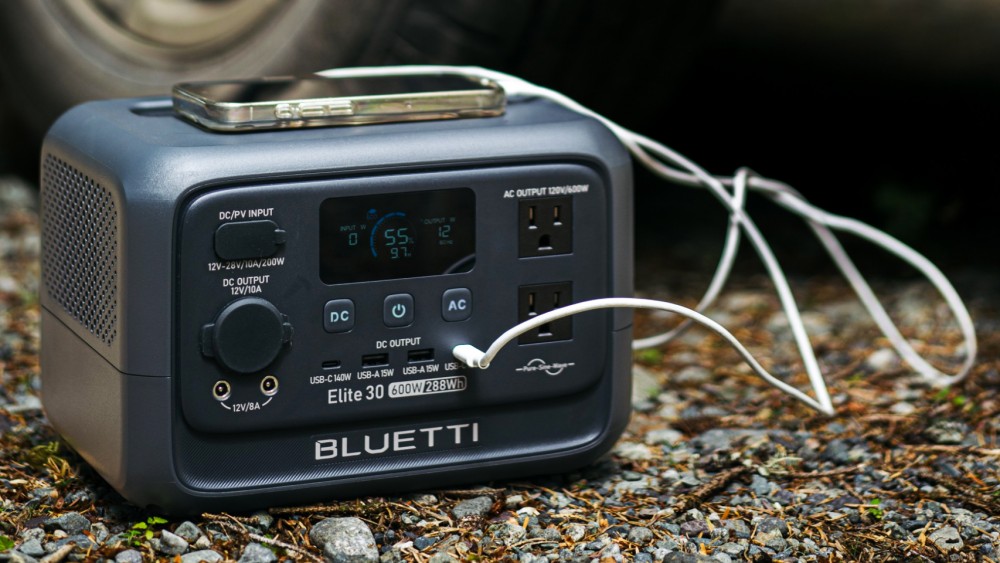
What is a Power Box?
Why "miscalculations" cause breakdowns mid-job: In simple terms, a power box is a "portable mini power station" that acts as the frontline, receiving power from main sources like temporary power poles or generators, organizing it, and distributing it to power tools.
Why do you need one? Simply put, its function isn't just to add more outlets, but to:
- Load Control: Instantly cuts off power when combined power draw exceeds the limit.
- Life Saver: Equipped with an RCBO (residual current breaker with overcurrent protection) to protect technicians from electric leaks or short circuits.
- Cable Management: Reduces tangled cable messes, which are the main cause of tripping hazards and internal wire breakage.
The "Many outlets, cheap price" trap is a classic issue: people choose based solely on "how many outlets?" and "how much does it cost?" without checking internal components. The result is buying a box with plenty of sockets but internal wires as thin as noodles. Once you plug in a demolition hammer and an angle grinder simultaneously... the internal wiring melts, or the breaker trips repeatedly, halting work completely.
Before calculating, you must understand these 3 values (easy to grasp, no memorization needed)
Reading power box specifications isn't complicated. Just understand these 3 key factors, and you'll choose accurately and safely for sure.
Volt (V) – Voltage
Golden Rule: The source voltage and appliance voltage "must match exactly"—no guesswork.
- 220–230V (1 Phase): Standard household power, Blue Plug, most commonly encountered.
- 380–400V (3 Phase): Industrial power, Red Plug, for large machinery.
Warning: Plugging a 110V imported tool into 220V domestic power without a transformer = immediate blowout.
Amp (A) – Current
This is the crucial variable that most easily causes equipment to fail.
- 16A: Standard for general work (drills, angle grinders, lighting).
- 32A: Heavy-duty work (welding machines, abrasive chop saws, large motors).
Common mistake: Many people adapt a 32A plug into a 16A socket. The result... the breaker trips constantly, or even worse, the wires burn out because the pipe is small but the water pressure is too strong.
Watt (W) – Power
This number indicates how much power that tool "actually consumes," which is usually printed on the machine, such as a vacuum cleaner at 1,200W, a cut-off machine at 2,000W, or a welding machine at 5,000W+. The higher the wattage, the more power it consumes. Quick math: Add up the wattage of all tools that will run simultaneously; it must strictly not exceed the power box's specifications!
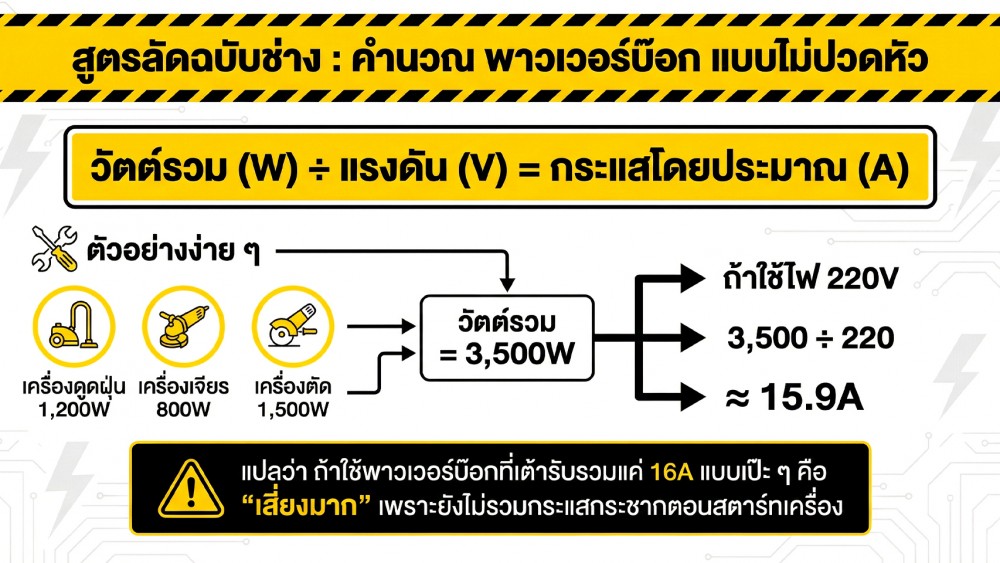
Don't forget inrush current when machines start up
Has this ever happened to you? You calculated the watts down to the exact spec, but as soon as you turned on the water pump or vacuum cleaner, the breaker tripped immediately like a prank. It’s not a ghost—it’s caused by something called "inrush current."
What is it? Imagine pushing a stationary car. The initial push (Start) always requires significantly more effort than when the car is already rolling (Run). The same goes for power tools with motor coils.
- Water pumps / Air compressors: Startup power can surge up to 2-3 times normal operating levels.
- Cut-off machines / Demolition hammers: The initial impact spike pulls an extremely high current.
If you calculate specifications "exactly at 100%" (e.g., a 15A load on a 16A breaker), the breaker perceives that momentary current surge as a "short circuit" and trips immediately for safety.
How to choose between 16A and 32A sockets without mistakes
What are 16A sockets suitable for?
- General maintenance work
- Small to medium power tools
- Not running multiple heavy-duty machines simultaneously
What are 32A sockets suitable for?
- Welding machines
- Machinery
- Job sites that require plugging in multiple machines simultaneously
- Use with large generators
Personal experience: If I ever hesitate on a job, I opt for 32A first. It won't damage the machine and prevents the system from being overloaded.
Breakers in a power box are more important than many people think
- MCB (Miniature Circuit Breaker) trips on overload or short circuits. Limitation: "It does not protect against electric shock." If you get shocked, the MCB will just sit there watching until the wires burn.
- RCD / ELCB trips when there is current leakage from the system (such as leaking through a person into the ground). Limitation: Some models do not protect against overloads and must be paired with a fuse or MCB.
- RCBO (Residual Current Breaker with Overcurrent protection): a "2-in-1" device combining both an MCB and an RCD in a single unit. It protects against overloads, short circuits, and most importantly, "electric shocks to people."
Why an RCBO? Construction and technical work carry inherent risks: wet floors, frayed cables, sweaty hands—the chance of current leakage is always present. An RCBO is therefore the "most balanced and worthwhile solution" because it protects property (from fires) and protects lives (from fatalities) in a single device.
Calculation Example from an Actual Job Site
Building Renovation Work
- Industrial Vacuum Cleaner 1,800W
- Angle Grinder 1,000W
- Power Drill 800W
Total = 3,600W 3,600 ÷ 220 ≈ 16.4A
In this case, we would definitely not choose a 16A power box, but instead move up to a 32A model with an RCBO to allow for continuous all-day operation.
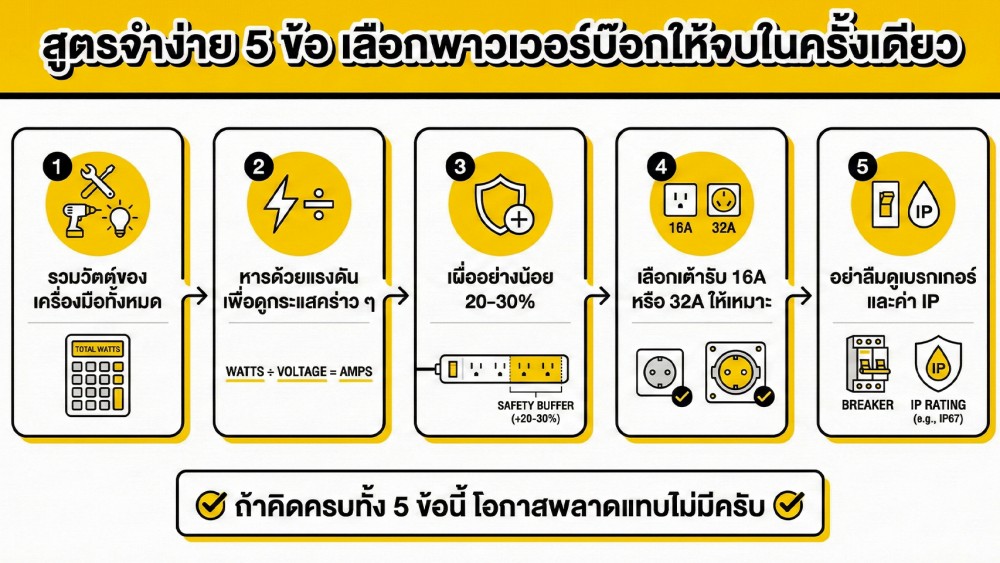
Conclusion
A power box isn't something you buy often, but if you choose the wrong one, it can cause long-term headaches. I’ve personally been at the point where I thought “anything works just the same,” only to end up spending money twice. If you calculate your power box specifications precisely from the start, your work will run smoothly and safely, without the headache of troubleshooting on site.
Select Powerbox to suit the application