


 EN
 ไทย


Customers Also Purchased
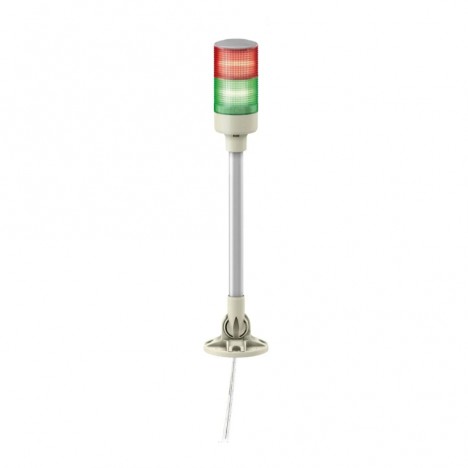
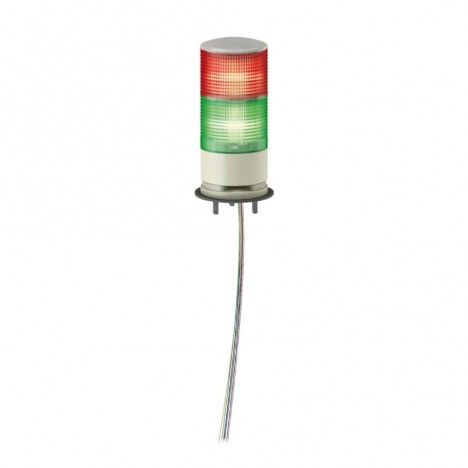
If you have ever walked into an industrial plant—whether a food processing factory, an automotive parts plant, an electronics manufacturing facility, or even an automated warehouse—one thing almost all of them share in common is multicolored light columns mounted on machines or production lines.
On some machines, a steady green light indicates that production is running smoothly. At other points, a yellow light blinks as if warning that "a problem will occur shortly." And on some machines, a clear red light glows brightly enough to be seen from the far end of the line, as if shouting, "Stop! Something is wrong!"
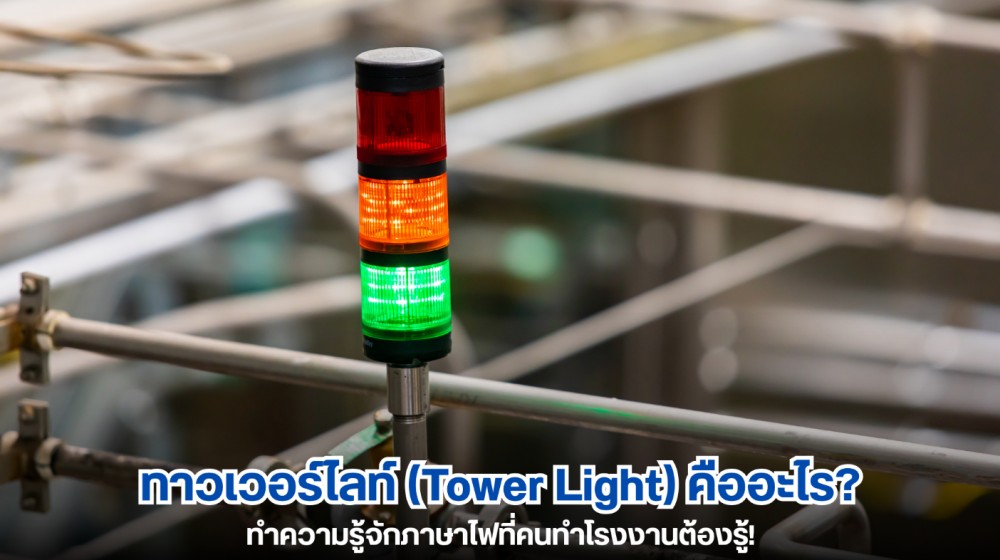
These lights are not there for decoration, nor are they merely minor accessories on the machinery; rather, they are the factory's primary communication tool known as Tower Lights (Tower Light). This article will take you in-depth into tower lights—from their definition and operating principles to color meanings and real-world industrial applications.
What is a Tower Light?
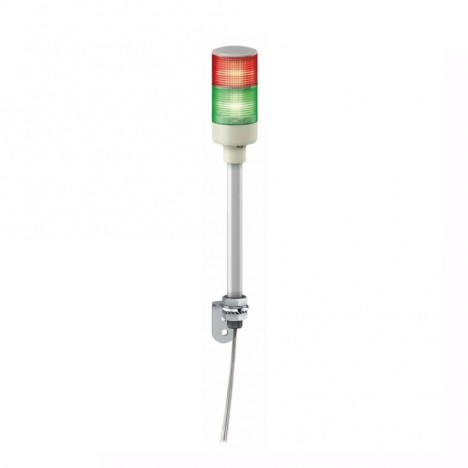
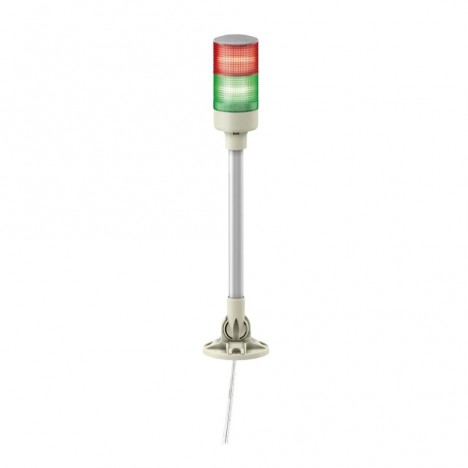
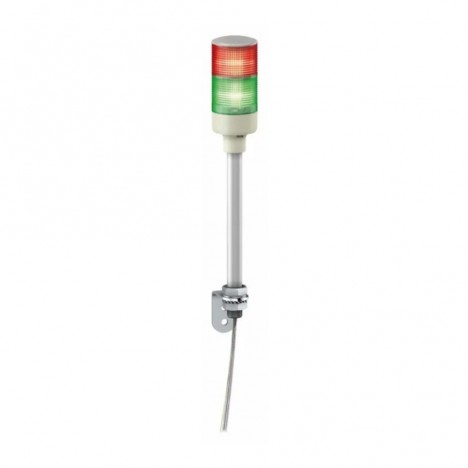
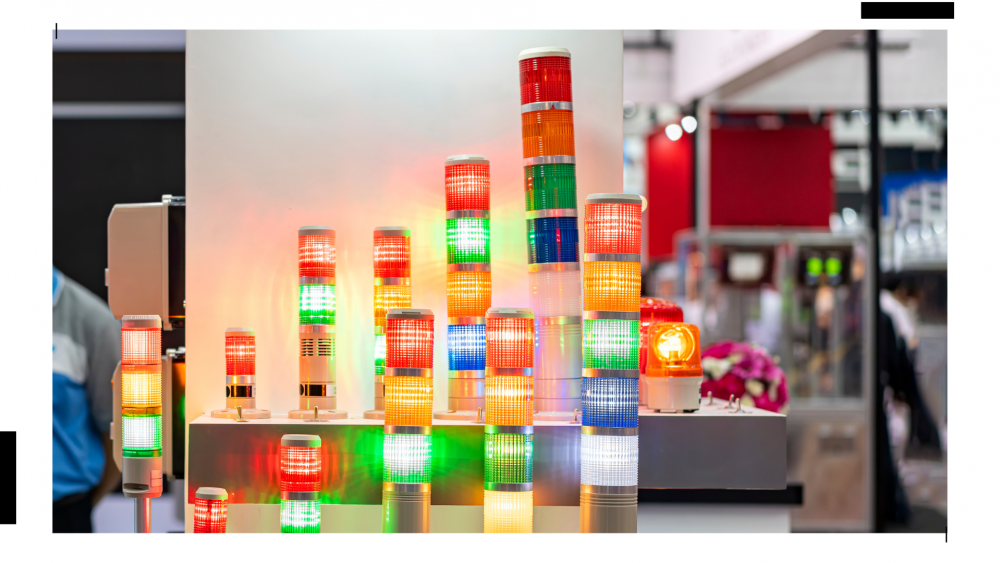
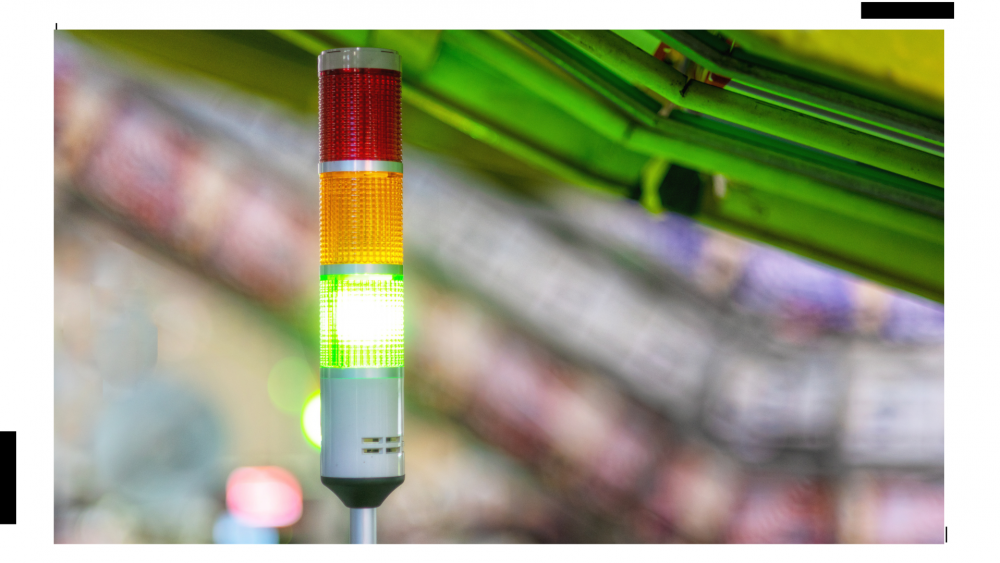
A Tower Light, also known as a factory signal light, machine status light, or industrial signal light, is a device that indicates the operational status of machinery, systems, or production processes using various colored lights, with some models incorporating audio alarms (buzzer / alarm) as well.
The role of a tower light is not to control machinery directly, but to communicate critical information to human operators as quickly as possible without having to check an HMI screen or computer system reports.
Simply put, a tower light is
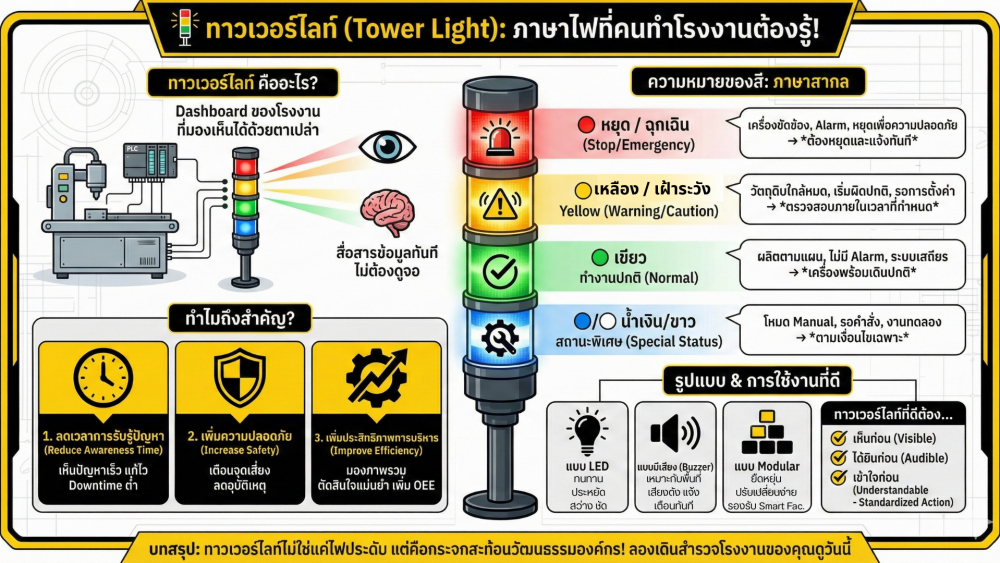
"The factory's dashboard, visible to the naked eye and understandable in a matter of seconds."
Why are Tower Lights important to industrial factories?
Imagine a real factory scenario: during peak production, a critical line machine suddenly shuts down without anyone immediately noticing. A few minutes pass, raw materials pile up, operations stall, and costs begin draining away unnoticed.
In the real world of manufacturing, even the slightest delay can translate into massive losses. A machine stoppage of just 5 minutes can mean losing tens or hundreds of thousands of THB per incident. If such issues recur without a proper warning system, the factory can unknowingly lose its competitive edge.
Therefore, tower lights are not designed merely as ordinary status indicators, but are built to solve "the factory's most fundamental problem"—the failure to see a problem when it needs to be seen—serving 3 key roles:
1. Reduce Awareness Time
In a factory without tower lights, when a machine starts having issues, what typically happens is:
- Machine operators might not even realize that the machine has stopped or is malfunctioning.
- Production line supervisors must walk around and inspect each station one by one.
- The maintenance department is notified late, after the problem has already escalated.
However, with tower lights, as soon as a red light turns on, everyone in the area immediately understands the situation. There is no need to wait for orders, make phone calls, or give lengthy explanations. A single light can replace communication across the entire system. The result is shorter response times, quicker problem resolution, and downtime kept to a minimum.
2. Enhance Workplace Safety
Industrial plants are full of hazard zones, whether it be:
- Automated moving machinery
- Industrial robotic arms performing repetitive tasks at high speeds
- Conveyor systems that cannot stop immediately
Tower lights act as "preventative warning signals" informing everyone of the current state of an area or machine. Clear warning lights help reduce accidents caused by unawareness, misunderstandings, or inadvertently approaching danger zones.
In many factories, tower lights are therefore considered an integral part of the safety system, not just an accessory.
3. Improve Production Management Efficiency
For production supervisors or plant managers, tower lights are a powerful bird's-eye monitoring tool. Simply scanning across the line allows immediate assessment of:
- Which machines are operating normally
- Where abnormalities are starting to emerge
- Which points must be addressed first as top priority
Decision-making no longer relies on feelings or guesswork, but on the actual status displayed right in front of them. The resulting benefit is optimal allocation of personnel, time, and resources, reducing downtime and tangibly boosting OEE (Overall Equipment Effectiveness).
How do tower lights work with control systems?
Behind the simple colored lights we see on machinery, tower lights actually work closely with factory control systems. They act like a "speaker" that broadcasts the voice of the machine in a form humans can immediately understand.
Typically, tower lights are connected to the heart of the automation system, such as:
- PLC (Programmable Logic Controller)
- Sensors detecting various statuses, such as temperature, pressure, or raw material levels
- Machine or production line control systems
When a machine is running, the control system continuously processes data from sensors. When an event occurs according to preset conditions, such as:
- The machine stops or malfunctions
- Pressure, temperature, or electric current exceeds safe limits
- Raw materials are running low or the production process becomes unbalanced
The PLC immediately sends an electrical signal to the tower light to display the corresponding color, light, or sound for that status in real time.
The strength of this system is that it does not require technical interpretation. Operators do not need to read code, check graphs, or open an HMI screen. Simply seeing the light color allows them to understand the situation and take corrective action immediately.
It can be said that tower lights are the vital link between the "world of machines" and the "world of workers," enabling complex data to be communicated straightforwardly and quickly while effectively reducing communication errors.
Tower Light Color Meanings: The Universal Language of the Factory
Looking deeper, a tower light is not just a multicolored lamp; it is a non-verbal language system designed for everyone in the factory to understand uniformly—whether it is the machine operator, a maintenance technician walking by, or a manager observing the overall picture from the end of the line.
Although each factory can set its own color standards, in practice, tower light colors generally follow universal guidelines to avoid confusion and ensure the fastest communication possible, because on the shop floor, there is no time for misinterpretation.
Red Light: Stop / Emergency
A red light is like a silent siren. It is a signal indicating that "something is wrong and should not be ignored." Typically, it means:
- Machine Fault
- An alarm occurs that requires immediate correction
- The system has shut down automatically for safety
When the red light turns on, the goal is not just to indicate that there is a problem, but to grab the attention of everyone in the area simultaneously and prompt an immediate response, because every minute the red light remains on means increasing downtime.
Yellow Light: Warning / Caution
The yellow light is not a stop signal, but a signal indicating "can still proceed, but be careful." It is often used in situations where the system begins to send advance warnings, such as:
- Raw materials are running low, but production can still continue
- The machine is starting to malfunction, but has not yet reached the point of stopping
- Operating modes are changing, or awaiting setup
The critical role of the yellow light is to give the factory an opportunity to solve the problem before it turns into a red light, which helps reduce unexpected machine stoppages and keeps production flowing smoothly.
Green Light: Normal Operation
The green light is the signal that every factory wants to see the most, because it means:
- The machine is operating according to set conditions
- Production is on schedule
- There are no alarms or abnormalities to worry about
From management's perspective, a continuously illuminated green light reflects a stable system, personnel who understand their duties, and a well-controlled production process. It is therefore not surprising that many factories use green light uptime percentage as an indirect KPI indicator.
Blue or White Light: Special Status
In addition to the primary colors, many factories choose to use blue or white lights to communicate specific statuses that do not fall into the normal or emergency categories, such as:
- Manual mode or machine setup mode
- Waiting for commands from an operator or supervisor
- Special jobs, testing, or process improvements
These colors add an extra dimension to tower lights, making them not just warning lights, but flexible communication tools that accommodate more complex and diverse production processes.
Types of Tower Lights Found in Factories
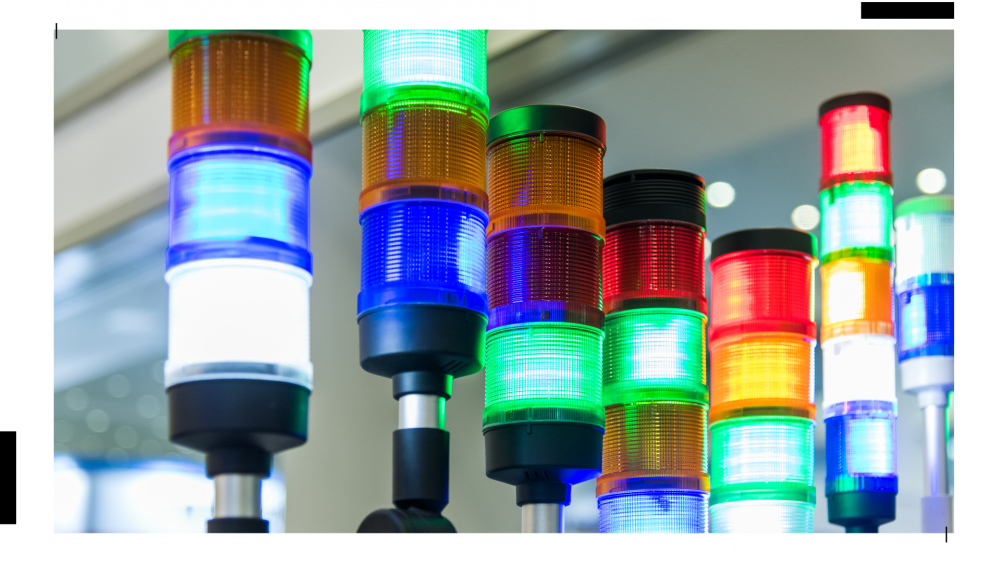
Although tower lights may seem like basic equipment, in reality there are quite a few details to choose from. Selecting the appropriate model not only affects communication clarity, but also directly impacts durability, long-term costs, and the response behavior of on-site workers.
Each type of tower light is therefore designed to meet different environments and application requirements, as follows:
1. LED Tower Lights
LED tower lights are considered the standard in modern factories and the first choice across many industries due to key strengths that solve practical on-site needs, including:
- Long service life, reducing the burden of replacing spare parts and maintenance work
- Energy-efficient, ideal for continuous operation throughout production shifts
- Provides consistent brightness, clearly visible from a distance
On production lines that require stability and reduced downtime from auxiliary equipment, LED tower lights are both a cost-effective and reliable solution.
2. Tower Lights with Audible Alarm (Buzzer / Alarm)
In certain areas, light alone may not be sufficient, especially in factories with constant loud machinery noise. Tower lights with sound therefore play an essential role, ideally suited for work sites that:
- Have high ambient noise, such as foundries, stamping plants, or lines with numerous motors
- Require an immediate response when abnormalities occur
- Involve safety risks or frequent emergencies
The buzzer reinforces awareness when operators are not looking directly at the machine, making alerts more effective and reducing the chance of issues being overlooked.
3. Modular Tower Lights
Modular tower lights are designed for factories with complex or constantly changing processes. Their main highlight is operational flexibility, allowing you to:
- Add or reduce the number of light tiers according to the statuses you need to display
- Easily change colors or display patterns
- Adapt to new processes without having to replace the entire unit
This type is particularly suitable for factories evolving toward advanced automation or Smart Factories, because the tower light is not just a status indicator, but part of a system that grows alongside the production process.
Tower lights don't just indicate machine status; they indicate “factory culture”.
Superficially, a tower light might just seem like a small light stick on a machine, but from the perspective of real factory practitioners, these lights reflect “work culture” with incredible clarity. A factory where a red light turns on and no one goes to check is often a factory where problems are left to “wait it out”. Conversely, a factory where someone checks in within minutes of a yellow light appearing is usually one that prioritizes prevention over downstream troubleshooting.
A tower light is therefore not just a communication tool, but a mirror reflecting organizational behavior —whether it views problems as trivial matters or as warning signs that require immediate action.
Why do some factories have tower lights but still face recurring problems?
This question is very common on the actual shop floor. The answer is not because tower lights are ineffective, but because “the lights are used without a supporting system”.
Commonly encountered issues include:
- There is a warning light, but no one knows who is responsible.
- Light colors are defined, but never communicated clearly to new employees.
- Red lights turn on so regularly that they become a familiar, ignored sight.
When a tower light is used merely as a machine decoration, it generates zero value. However, when each color light is tied to a clear action, the tower light becomes an exceptionally powerful management tool.
Tower lights and downtime reduction with tangible numbers
Many factories begin seeing real results after “standardizing their light language” across the entire production line.
Common examples include:
- Reduces waiting time for technicians, because it is immediately known which machine needs whom
- Reduces repeated breakdowns, because the yellow light serves as an early warning signal
- Reduces confusion during shifts, because everyone sees the same status
These results might seem small in each individual incident, but when combined over a month, the reduced downtime numbers translate into real cost savings.
A good tower light must be "seen first, heard first, and understood first"
A well-functioning tower light is not just bright, but it must:
- Be clearly visible under the actual lighting conditions of the factory
- Have an appropriate audible alarm—not too loud to be annoying, and not too quiet to be ignored
- Use colors and patterns that everyone understands consistently
Professional factories often set clear standards, such as:
- Red light = must stop and report immediately
- Flashing yellow light = inspect within the specified time
- Green light = machine ready and running normally
When everyone "translates the light language" in the same way, communication errors decrease significantly.
Without a tower light, a factory loses more than you think
Not having Tower Lights does not just mean lacking status indicator lights but it means relying on
- walking over to check
- Calling to ask
- Verbal reporting
All of which take time and open the door for errors to occur. Tower lights are the easiest way to make machine data "stand out right in front of everyone" without uttering a single word. Try walking around your factory today to see whether your tower lights communicate clearly enough—or if they are merely machine decorations.