


 EN
 ไทย


Customers Also Purchased





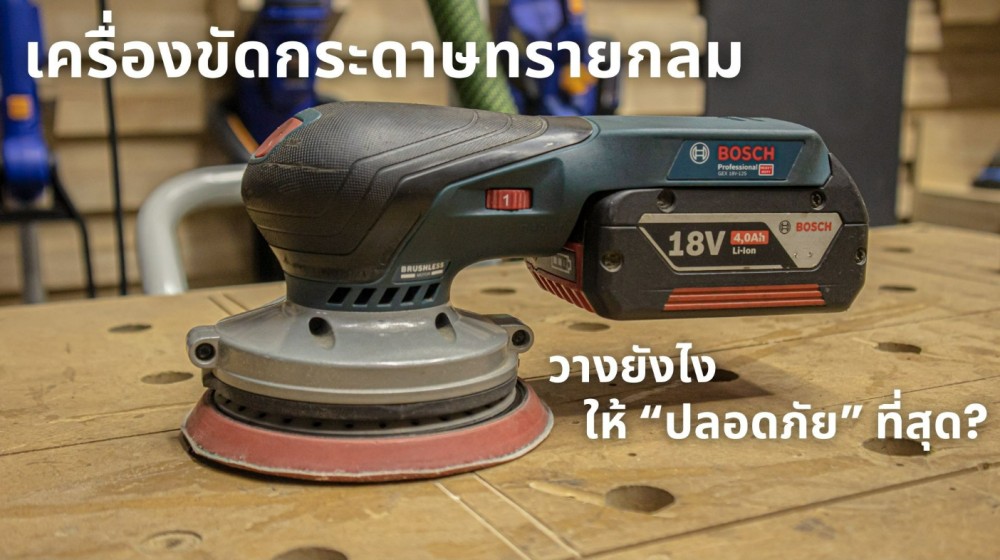
After using Orbital Random Sander Where is the first place you set it down? On the workbench, next to the workpiece, on the floor, or resting carelessly on a shelf?
Many might answer immediately without hesitation because it has become an ingrained habit with power tools—not just orbital sanders. This question might seem trivial and hardly even a safety issue. However, many accidents don't occur while the orbital sander is turned on or actively sanding, but rather unexpectedly after the tool has been put down.
In this article, I’d like to encourage you to reflect on and question how risky placing an orbital sander in those familiar spots we use for all our tools really is—even though some locations look safe to our eyes, in practice, they can cause far more mishaps than expected.
“Just Setting Down an Orbital Sander”—A Bigger Deal Than You Think?
When using power tools like an orbital sander, we focus on safety during operation—such as tool grip, grit selection, or wearing protective gear, right? Furthermore, questions like Misaligning the holes causes any negative effects on a random orbital sander? also make the act of setting down the tool seem insignificant. Rushing, habit, and the assumption that nothing will happen unconsciously lead us to overlook this small yet vital step.
Looking deeper, setting down an orbital sander is not just about finding a temporary resting spot. If you place the orbital sander on an unsuitable surface or in an unstable position, damage can occur even when the tool appears to be "turned off."
Even with a pad brake, an orbital sander does not come to an immediate halt the moment you let go. The sanding disc keeps spinning, vibration lingers, and the weight of the tool itself makes it ready to slide or roll if the resting surface is unsuitable or if environmental factors like dust, wood chips, and moisture come into play.
Consider the potential risks of setting the tool down carelessly, such as:
- The sanding disc is still spinning, causing the random orbital sander to slowly glide away from its original position.
- The machine vibrates, unknowingly creeping toward the edge of a table or shelf.
- The power cord gets pulled or tangled, causing the machine to flip over or fall from where it is resting.
- Users or bystanders accidentally bump into, trip over, or step on the tool.
- The workpiece, table, or surrounding surfaces get unintentionally gouged or damaged by the sanding disc.
Is placing a random orbital sander on a workbench safe or not?
A workbench is where many people choose to place their random orbital sander because it is close at hand, convenient to grab, and feels the most orderly within the workspace. Many may already know How to choose a random orbital sander suitable for each surface However, an important question that is often overlooked is: what kind of table are you using? Is it stable enough? Is the surface really suitable for resting a vibrating power tool like a random orbital sander?
A smooth, solid, and stable table is safer
If it is a thick wooden table, a steel table, or a workbench with a smooth and sturdy surface, placing down a random orbital sander after turning it off is reasonably safe—especially if placed face-up so the sandpaper does not make direct contact with the table surface. However, many people might inadvertently place the tool face-down without noticing whether the sanding disc has completely stopped spinning.
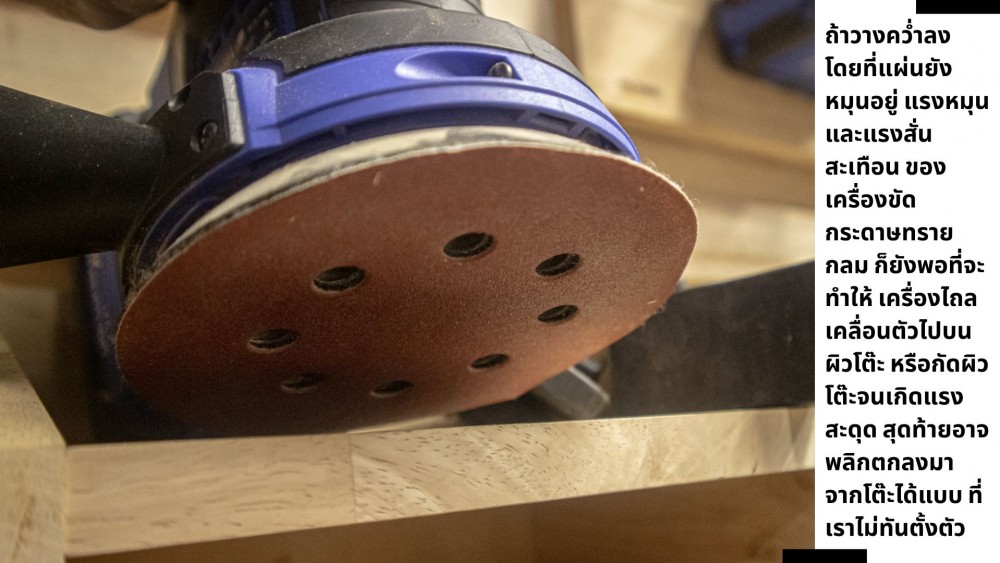
What risks are hidden on tables with wood chips, dust, or moisture?
A table that looks smooth but has accumulated fine dust or wood chips can reduce friction. A still-vibrating random orbital sander might "creep" all the way to the edge of the table—a real scenario that happens more often than you'd think. If the table is damp or has oil stains, the risk is even higher because the base of a random orbital sander is designed to slide smoothly for control during use, not to grip onto a wet table.
Placing a random orbital sander on the floor: is it better or worse than you think?
Some people might choose to just set the random orbital sander on the floor, thinking it can't fall any further with no risk of dropping from a height, which seems like a safe choice to the general public. In reality, though, the floor is one of the places I consider to have the greatest "silent risk," and From an industrial perspective, placing any kind of tool on the floor is a safety violation.
Concrete floors, tile floors, garage floors
Hard floors may seem stable, but if the random orbital sander is still vibrating, it can spin itself around, tangling the cord or bumping into other objects. What's even more concerning is the risk of accidentally stepping on the machine or the power cord.
Do wood or rubber floors really reduce the risk?
While wooden or rubber floors do help increase friction, they don't solve all the main problems, especially stepping on the tool. Moreover, floor level is at foot height, requiring you to repeatedly bend down to pick up the tool, increasing the risk of muscle strain. In an actual workplace, placing tools on the floor directly increases the risk of tripping.
Therefore, from a safety perspective, the floor is not suitable as the primary resting place for a random orbital sander, though it can be used temporarily during work.
Placing a Random Orbital Sander on a Tool Shelf
In a workshop or workspace with multiple tools, having a dedicated shelf for your random orbital sander helps make it easy to access and keeps things organized. However, there are still precautions to keep in mind, because a shelf is not a "one-size-fits-all" storage surface. There are many small details to consider carefully, and overlooking them might trade convenience for unexpected risks.
High Shelf vs. Waist-Level Shelf
A shelf that is too high significantly increases risks when picking up and placing down the tool, especially considering the weight of a random orbital sander—which is neither light nor as easy to grip as smaller hand tools. Lifting the tool high repeatedly requires more muscle exertion, increasing the chance of slipping or losing balance. If it does slip, the shelf's height will amplify the damage if the sander falls.
A shelf at waist level or slightly around chest level is more appropriate because it allows users to control the tool well, clearly see where it is being placed, and avoid excessive bending or reaching. Placing and retrieving a random orbital sander at this height is safer and more ergonomically friendly in the long run.
Open Shelves Without Raised Edges: More Dangerous Than You Think
An open shelf without raised retaining edges is another detail many overlook. If the tool is placed with its power cord dangling off the edge, that single cord can easily pull or slide the tool off. Sometimes, just brushing past and catching the cord lightly is enough to dislodge the random orbital sander and send it crashing to the floor, instantly causing damage to both the tool and the workspace.
Storing With or Without Sandpaper: Which Is Safer?
When resting a random orbital sander, should you leave the sandpaper attached or remove it first? While this might seem like a trivial question, it actually affects safety, the tool's lifespan, and the long-term quality of the sandpaper.
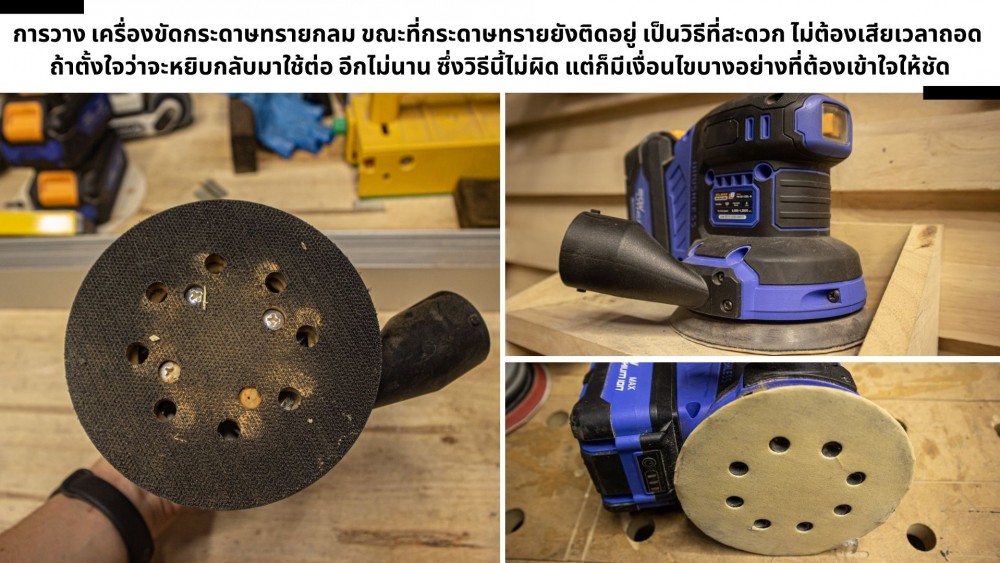
What Are the Risks of Leaving Sandpaper Attached?
When resting a random orbital sander with the sandpaper still attached, the biggest concern is contact between the sanding pad and surrounding surfaces. If placed face down on a bench or floor while still spinning down to a complete stop, the abrasive pad can gouge the surface, cause the tool to slide, or damage both the work surface and the sandpaper itself.
In addition, sandpaper that comes into contact with dust, moisture, or oil residue deteriorates faster than normal. In the case of resting it face up, while generally safer, you must still be cautious of hard objects or debris falling onto the abrasive surface, which could deform the sanding pad or tear the paper.
Is Removing the Sandpaper Before Resting Always Better?
Removing the sandpaper before setting down a random orbital sander is very safe and helps preserve your equipment, especially if you know it won't be used again immediately. This eliminates the risk of the abrasive pad contacting other surfaces and reduces the chance of the sandpaper absorbing moisture or collecting dust.
However, removing the sandpaper every single time may not be practical for continuous workflow, as it interrupts your work rhythm. Therefore, the choice should primarily depend on the context of your task.
So, What Is the Safest Way to Place a Random Orbital Sander?
The safest way to place a random orbital sander is to choose a location and resting method that minimizes risks from all angles. It's not just about keeping it out of reach or making it look tidy; you must also consider residual vibration, the orientation of the tool, and the surrounding environment of the resting spot, such as:
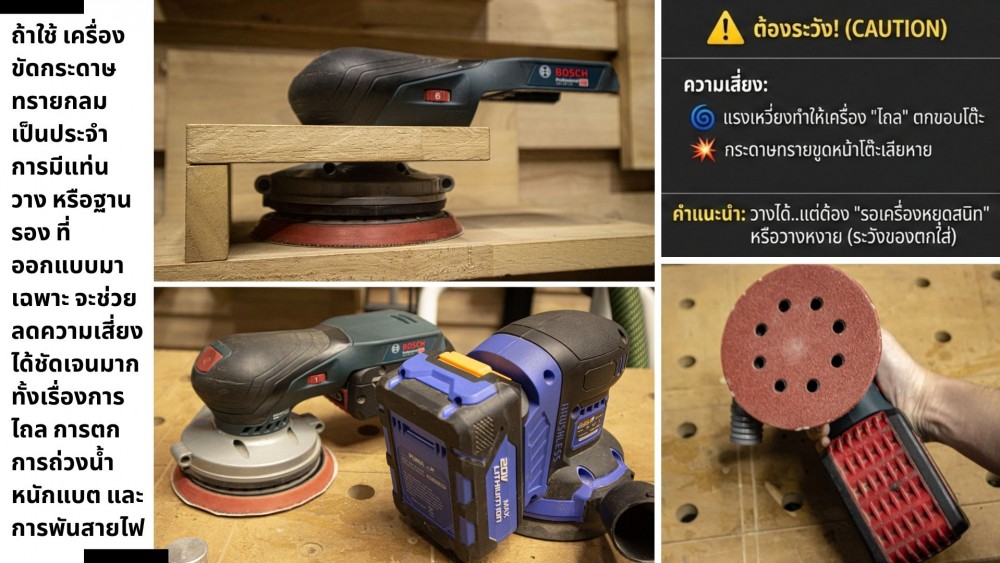
- Place it on a sturdy table or shelf in a dedicated spot; the table or shelf must be flat, solid, and wobble-free.
- Place the tool with the sanding pad facing up first.
- Turn off the tool and wait for the pad to come to a complete stop before letting go.
- Manage the power cord so it doesn't hang loose or pull on the tool.
- For cordless random orbital sanders, remove the battery if not using it for an extended period to reduce the risk of accidental switch activation and help extend battery life.
- The weight of the battery can cause the tool to tip backward or roll onto its side more easily, so be sure to check the stability of where you place it.
Conclusion
Placing down a random orbital sander is no small matter, and it shouldn't be done purely out of habit, because these small, repeated daily habits are often the unsuspected cause of accidents.
Setting it down too quickly, placing it in a spot that looks convenient but is unstable, or leaving it without considering the surrounding environment can lead to issues. Moreover, tables, floors, and shelves all have different pros and cons, and no single location is automatically safe if the tool isn't placed properly.
If you ask what the safest way to place it is, my answer is that truly safe placement for a random orbital sander means putting it in a stable, controlled spot specifically designed to support the tool, which genuinely reduces risks in the long run.
If you pay attention to small details like proper tool placement, Orbital Random Sander risks will decrease more than you think, making your work much more worry-free in the long run.


