


 EN
 ไทย


I believe many people starting out in aluminum welding have a similar question in mind: "I already have a TIG Welder , can I use it to weld aluminum?" Some may have heard that if you choose the wrong one, the weld won't fuse, the bead won't look good, and the machine might break easily too. Which sounds like a scare tactic, but in reality, these warnings exist for a reason. Aluminum welding is truly the ultimate test in TIG welding, because it's not a job where you can just turn on the machine and weld like ordinary steel.
Many people start with the idea that aluminum is just another metal and shouldn't be much different to weld. But when they actually get to work, they run into problems—ranging from an unstable arc and poor bead appearance to failing to fuse at all. This happens even with the amperage set high and using a dedicated TIG welder, not an MMA machine with added Lift TIG.
That brings the same old question echoing back: is the problem with our skill, the machine, or our understanding?
Therefore, in this article, we'll take a hands-on look at what you really need to consider if you want to weld aluminum with a TIG welder. We'll cover everything from basics like electrical systems, AC/DC currents, and heat control to accessories and the unique characteristics of aluminum itself. Without a proper understanding, no matter how expensive your TIG welder is, your work can still easily fail.
Why is welding aluminum not as easy as welding steel?
Before looking into TIG welders, I'd like you to pause and consider the workpiece itself. Aluminum is a very "impatient" metal; it conducts heat exceptionally well. As soon as you strike the arc, the heat dissipates immediately. What beginners encounter is that the heat seems insufficient despite setting the current high, or sometimes a slight increase burns straight through, leaving a hole right before their eyes.
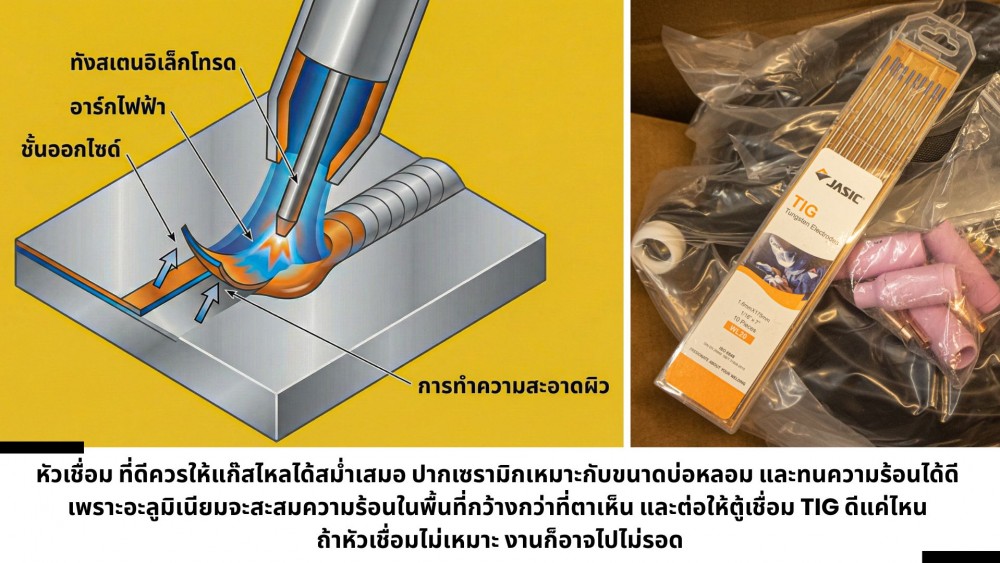
That's not all. Aluminum always has an oxide layer coating its surface, and this layer has a melting point several times higher than the aluminum itself. If you don't handle it properly, welding will feel like trying to melt ice with a lighter: the weld won't progress, won't fuse, and the bead will be extremely dirty.
This is why choosing a TIG welder for aluminum requires "thinking deeper" than just having the word TIG in the specs or being able to switch to "TIG" mode.
Can every TIG welder weld aluminum?
Now coming to our main question: can every TIG welder weld aluminum? The short answer is no , and this is the first trap that easily catches people off guard. Don't confuse a dedicated TIG welder with Lift TIG—they are not the same! How do they differ?
TIG welders come in various tiers, ranging from DC TIG, which often comes with 2-in-1 or 3-in-1 MMA welders, up to high-end welders that are full-featured AC/DC TIG units. For aluminum work, what you strictly need is exclusively the AC TIG system. AC, or Alternating Current, helps "switch roles" between welding and cleaning oxide surfaces simultaneously.
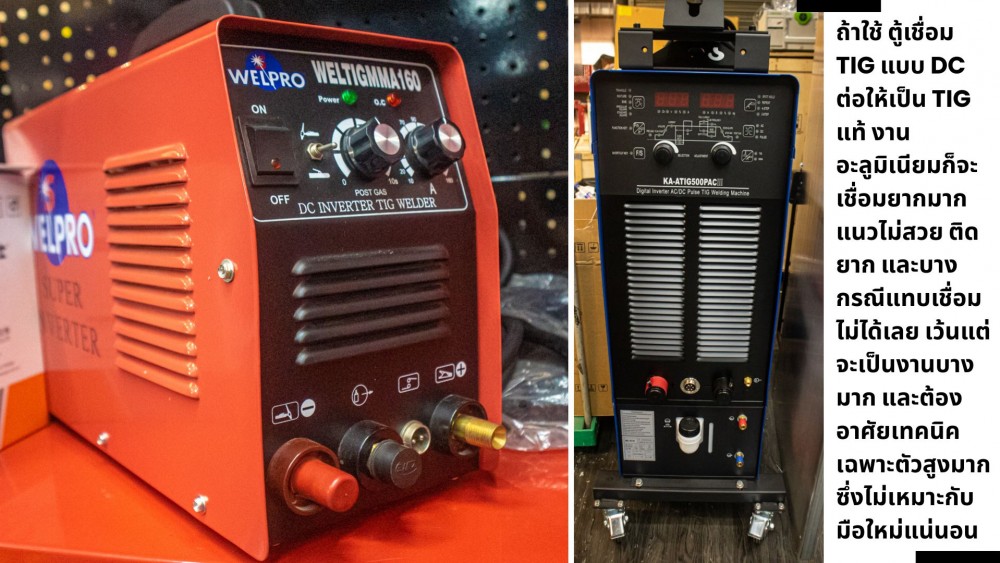
AC TIG welders specifically for aluminum work
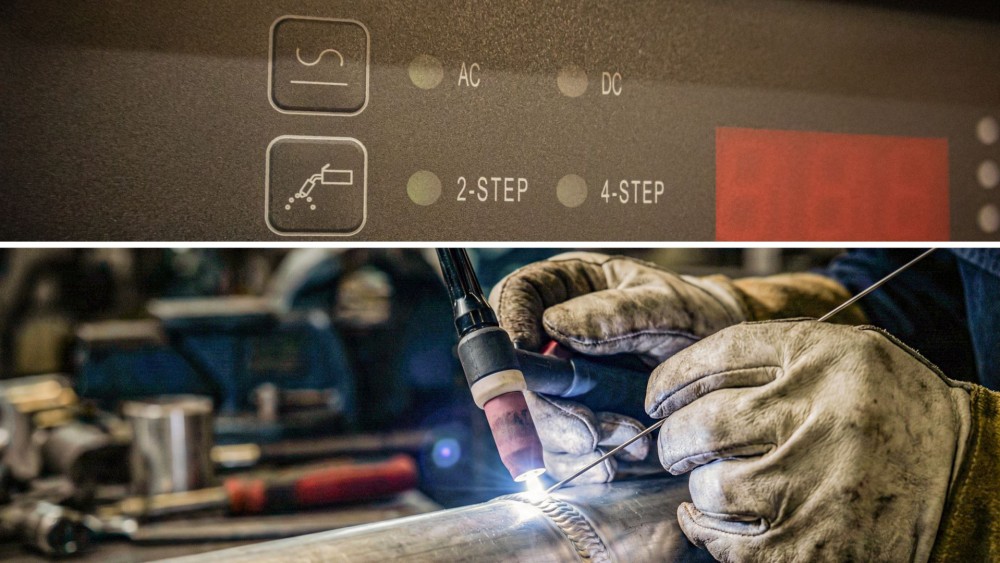
Speaking of AC TIG welders, an AC system isn't just a single mode; it is an "aluminum surface management mechanism" built into the electrical system. Alternating current causes the electrical polarity to alternate roles constantly: one phase focuses on breaking up the oxide layer on the surface, while the other phase focuses on genuinely melting the metal pool together consistently.
Without AC, this process remains incomplete. It feels like welding where the arc doesn't flow, the bead isn't clear, and you have to crank up the amperage, which ultimately leads to blow-through or workpiece warping. A TIG welder genuinely designed for aluminum allows you to control the behavior of the AC current—not just turning it on or off, but "tuning the arc characteristics" to match your specific work.
To put it in welder's terms, AC TIG is the system that makes aluminum "allow us to weld it." The alternating current creates a phase where the arc breaks the oxide layer and a phase where the arc melts the actual metal, cycling back and forth continuously.
Adjusting AC Balance
The AC Balance value is the ratio between the surface cleaning phase and the penetration (melting) phase on a TIG welder. If set incorrectly, the weld bead will immediately look flawed. Set it too low, and the surface turns black; set it too high, and the base metal melts too slowly, halting progress. This is where budget machines and quality machines begin to clearly diverge.
AC Frequency
AC frequency is another setting that many overlook, yet it distinctly defines the "character of the weld bead." Lower frequencies produce a wider puddle and a softer-looking bead suitable for thick workpieces, but it is harder to control. In contrast, higher frequencies yield a narrower puddle, a crisper bead, and easier directional control, making it ideal for thin materials or precision work.
However, higher frequencies demand greater stability from the TIG welder. If the TIG machine cannot deliver a steady current or lacks robust internal components, arc stuttering may occur, disrupting bead continuity and forcing you to exert more effort to maintain control.
This is precisely what sets professional-grade TIG welders apart from basic models, because the difference isn't just in the numbers, but in the actual "quality of the arc" delivered.
How important is current for aluminum work?
Theoretically speaking, aluminum requires a relatively high current compared to steel of the same thickness. But in real-world use, what matters more than the amperage rating is the "arc response"—how fast it ramps up, how fast it tapers down, and whether it remains stable.
A TIG welder suitable for aluminum should be able to increase and decrease current smoothly, especially during arc start and crater fill. If the initial arc strikes too aggressively, it burns the surface and makes puddle control difficult. Conversely, if the current tapers down too slowly at the finish, crater holes or hairline cracks can form in the weld bead.
Additionally, the duty cycle is something that should not be overlooked. If you need to weld continuously but the machine frequently shuts off due to heat buildup, your rhythm is ruined and the weld bead will look noticeably uneven.
Many people focus purely on high amperage first, thinking that more power is always better. The truth is that aluminum requires an arc that is "balanced and controllable" rather than just raw power.
Therefore, a TIG welder suited for aluminum should deliver a continuous, stable current along with an adequate duty cycle. If you need to weld long workpieces and the machine trips frequently from overheating, your workflow will stall and the bead will definitely suffer.
Don't overlook the Pulse TIG system
Pulse TIG is a feature that allows a TIG welder to alternate the current rhythmically between "high and low." It is ideal for thin materials and work that demands fine, aesthetically pleasing weld beads. It helps regulate the filler rod dab timing, resulting in beautifully uniform ripples like robotic welds.
TIG welding torches and other accessories
Many people invest heavily in a TIG welder but use a basic welding torch that is not suitable for aluminum work. The result is welding that requires intense manual control, causes quick fatigue, and yields inconsistent quality.
Valve-controlled torches vs. machine-controlled torches
Aluminum welding requires precise gas control. A torch that allows gas flow to be controlled directly from the TIG welder delivers better weld bead quality and reduces the risk of porosity in the weld.
Wrong tungsten choice leads to poor welds
Naturally, all types of TIG welders require a tungsten rod or tungsten electrode. For aluminum work, it plays a far greater role than just conducting current—it is the source of all weld bead stability. Choosing the wrong type will cause the arc to wander, fail to focus, and make the weld pool spatter.
Shielding gas: a small detail that can ruin your work
Shielding gas is like a protective shield for the weld pool. If this shield is imperfect, no matter how good the TIG welder is, the weld bead can easily fail because aluminum is extremely sensitive to contamination from even tiny amounts of moisture, air, and dirt.
The gas flow rate must also correspond to the size of the weld pool and the torch. Simply put, if it is too low, the bead will become porous; but if it is too high, it creates air turbulence and draws surrounding air in instead. This is where many people misunderstand that "more gas is always better." This is often why aluminum welds turn out poorly—not because of a bad TIG welder, but due to impure gas or an improper flow rate.
Choosing a TIG welder without wasting money
Choosing a TIG welder for aluminum should start with Understanding the various systems of a TIG welder and what you need to check before making a choice, And asking yourself what kind of work you do, how thick or thin the material is, and what level of precision is required. You do not always need to pick the machine with the highest specs, but rather choose one that you can "actually control" for your specific work.
A good TIG welder should feel stable during operation, with the arc responding to your hand movements without needing constant compensation, and featuring intuitive, uncluttered controls so you can focus on the work rather than fiddling with the machine.
If you ask me, I would say do not choose a TIG welder based solely on the claim that it "can weld aluminum." Consider other factors as well, such as:
- Is it a true AC/DC TIG machine?
- How adjustable are the AC Balance and AC Frequency?
- Is the current output stable?
- Is the Duty Cycle suitable for your work?
- Are spare parts and after-sales service available?
Conclusion
Aluminum welding is not out of reach or reserved exclusively for professionals, but at the same time, it is not so simple that just having the equipment will immediately yield great results.
If you genuinely understand the nature of aluminum and choose the right TIG welder suited to the type of work and required level of control, welding will turn from a stressful task into a noticeably more enjoyable one. Your weld beads will become steadier, cleaner, and better-looking. Most importantly, it helps prevent wasted time, wasted materials, and recurring expenses from choosing the wrong welder or equipment.
If you are about to buy TIG Welder to weld aluminum, don't just ask "can it weld it?" Because in the end, great work isn't measured by high heat, but by heat you can truly control.