


 EN
 ไทย


Customers Also Purchased


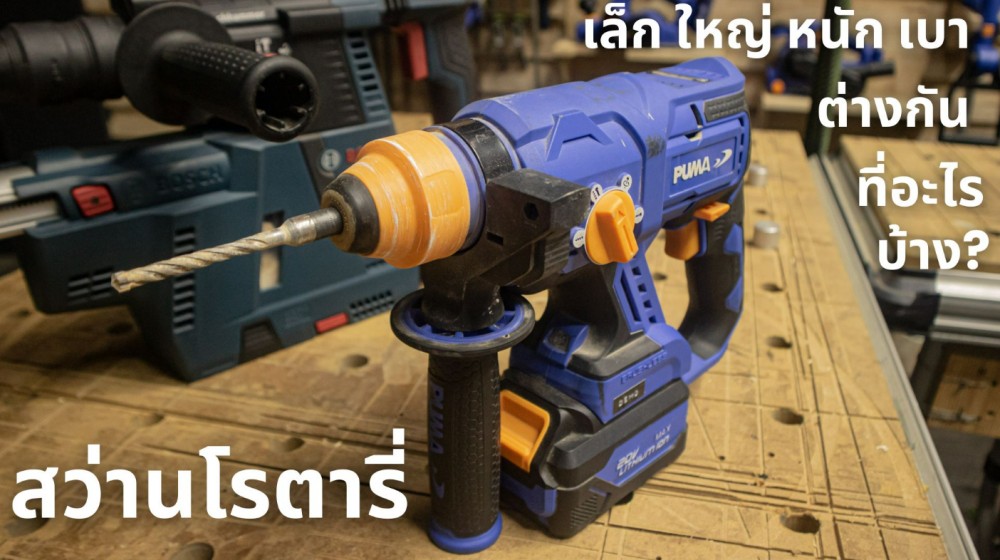
Have you ever browsed through a catalog and couldn't help but wonder: Rotary hammer "Why are there so many sizes?" The compact one seems capable of drilling and uses SDS plus bits just like the medium one, while the larger, more expensive one seems fully equipped for heavy-duty work, but at the cost of weight that leaves your hands aching! "Do we really need something that heavy-duty?" I believe you're not the only one asking these questions.
Rotary hammers seem like straightforward tools. Many people think it's just about "drilling into concrete," but in real work, the size, weight, and build of a rotary hammer matter much more than most think. Some buy one that is too large and get exhausted using it; some buy one that is too small and it can't drill through, ultimately needing a replacement—costing extra money and wasted time.
That's why, in this article, we'll take a step-by-step look, asking questions point by point: What are the differences between small, medium, and large rotary hammers, how do they differ in actual use, and what should we base our choice on—beyond just the numbers on the box.
Rotary Hammers: Why Does Size Matter?
Before we go any further, we need to understand that A rotary hammer is not just a standard drill with more power. And if you look deep into the mechanism of a rotary hammer, especially the piston-driven impact system, you will realize that it is a specialized tool that uses "impact force from an internal piston" to generate rhythmic hammering blows, delivering power directly to the drill bit, rather than relying solely on the rotation of a conventional drill.
The result is that drilling into concrete, brick, or hard mortar—which previously required heavy pushing force—becomes easier, faster, and far less exhausting, especially during repetitive, continuous work.
The "size" of a rotary hammer means much more than most people think. The physical dimensions do not merely indicate whether it is big or small; they reflect the entire internal construction, from the impact mechanism to its heavy-duty load capacity. Tool size directly correlates with performance-defining specifications, such as:
- Piston size
- Compressed air volume and impact energy
- Structural durability
- Weight that the user must bear
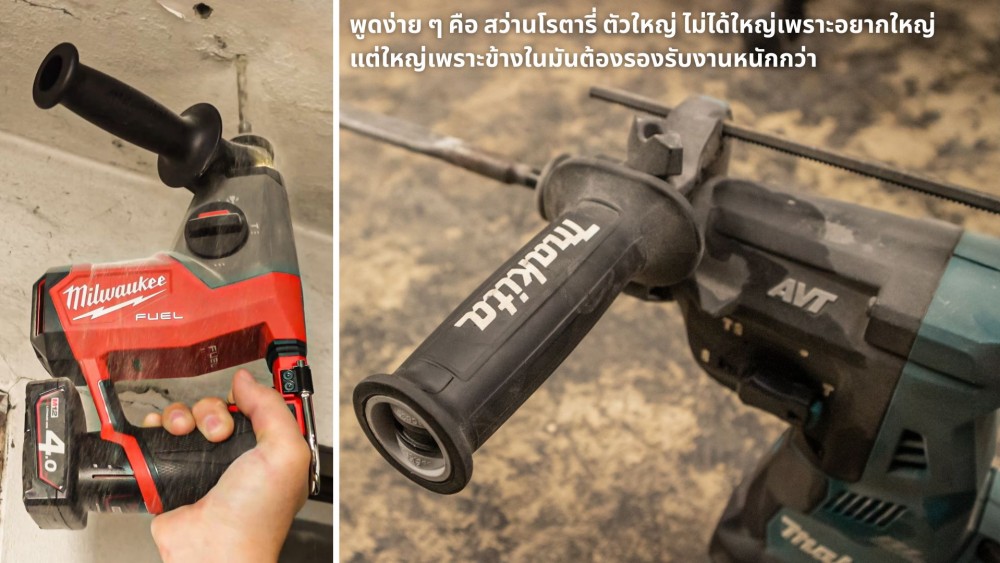
Compact Rotary Hammers (12V): Light, Maneuverable, but with Limits
I think small rotary hammers are interesting tools because they look easy to use, fit comfortably in the hand, and don't feel overwhelmingly heavy-duty. It makes you think it's worth keeping one at home to drill walls for hanging items, mounting equipment, or handling small repairs without overthinking it.
But the more intriguing question is: how well does this "compact and light" form factor truly fit your actual workload? How long will it hold up in real working conditions? And most importantly, where is the line you shouldn't cross before today's convenience turns into tomorrow's limitation?
Who are compact rotary hammers suitable for?
In tradesman terms, a compact rotary hammer is a tool for "general home drilling and installation jobs," such as drilling into concrete walls to set anchors, hang TVs, install curtain rods or shelves, and light electrical or HVAC work that doesn't require deep holes.
The most obvious advantage is Lightweight it causes no fatigue during extended use, is easy to lift for overhead drilling, and offers excellent directional control.
But the question is... does it have limitations?
Limitations
Looking at store specs or catalogs, you'll see rotary hammers use SDS bits—either SDS-Plus or SDS-Max for very large models. However, the difference isn't just the chuck type; it lies in the single-impact energy and internal construction. If you push an underpowered model to drill through thick concrete, dense rebar-reinforced structures, or large-diameter holes continuously, the tool will overheat quickly, drill slowly, and its lifespan will be shortened without you realizing it. Therefore, checking the specs is just as crucial as checking how light the tool feels.
Many people think, "Buy small first, and just push it harder if needed," which in the long run turns out to be much more expensive and far more exhausting.
Medium Rotary Hammers (18/20V, Corded 800-1000W)
If you ask me which size of rotary hammer is seen most often on job sites, the answer is almost always "medium size." That is because it is the size that many people feel is "just the right fit and just the right power," practical for everyday use from light installation work up to more serious structural drilling, without feeling like you are straining yourself or forcing the machine.
Why Are Medium-Sized Rotary Hammers So Popular?
If there is one category of rotary hammers that could be called "all-purpose," I would give that title to Medium without hesitation, because it sits right in the sweet spot between sufficient impact energy for heavy-duty drilling and a weight that is still manageable to hold for long periods. Plus, there are many models and variations, including mid-range models that support SDS-Max bits as well.
Many people choose a medium-sized rotary hammer as their main tool because it can handle general installation work, renovation work, and medium-level structural drilling.
The point where you truly start to feel the power of real "hammer drilling"
Medium-sized rotary hammers often deliver a distinctly different feel from small ones. While drilling, you will feel that the bit does not easily bind, the tool does not kick back, and it drills deep consistently. This is where many people begin to realize that a good rotaryhammer is not just about raw power, but also about stability.
Large Rotary Hammers: Raw Power at the Cost of Weight
When talking about large rotary hammers today, what people often get confused about is the "cordless models." Because there is no power cord to reference, many inadvertently compare battery voltage numbers like 18V, 36V, or 40V directly with the power of corded tools. In reality, what defines the power of a large rotary hammer more clearly is not just battery voltage, but the continuous power the tool can deliver. On the corded side, we are used to looking at wattage ratings, while on the cordless side, we must consider voltage, battery capacity, and motor power management together.
If you ask more specifically, "What should the overall specs of a large rotary hammer look like?" The image that usually comes to mind is a machine delivering high impact energy, with internal construction engineered to withstand continuous impact, not just short bursts. For corded tools, we usually see high wattage ratings. For cordless tools, while there is no direct wattage figure, it is compensated by high-voltage battery systems, multiple high-capacity batteries, and motors designed for continuous power output. And if you ask, Using a rotary hammer for chiseling: How much can it handle? How is it different from a demolition hammer? this is the tool designed specifically for this kind of work.
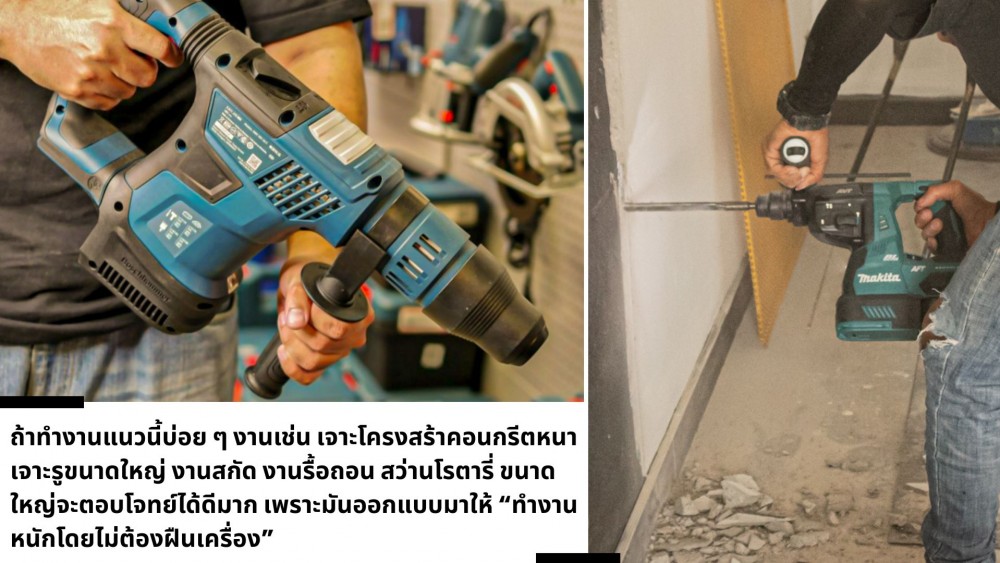
But the question is, should everyone use one?
The straightforward answer is no, it is not necessary, and in many cases, "not suitable" at all. The weight of a large rotary hammer causes fatigue when used for long periods, makes directional control harder, and is unsuitable for detailed work or tight spaces.
Some people might choose to buy a large rotary hammer thinking "more power is better," but ultimately end up not wanting to pick it up because it is simply too heavy and exhausting to use.
Lightweight vs. Heavyweight: Not Just About Comfort
If there is one phrase I hear very often when choosing a rotary hammer, it is "Is it too heavy?" or "It is nice and light, probably easy to use." While it sounds purely subjective, the weight of a rotary hammer affects the work much more than you might think. It is not just about getting tired or not, but about drilling stability, hole precision, and user safety, especially for tasks requiring long holding times or drilling in awkward positions.
How does weight affect real-world work?
- Lighter tools are easier to control and quick to adjust angles, making them ideal for detailed work, tasks requiring precise alignment, or drilling in awkward positions like overhead or in tight spaces.
- Heavier tools feel more stable when drilling hard materials, reducing bounce or kickback, especially when drilling dense concrete or making large holes.
A heavier rotary hammer absorbs impact vibration better, resulting in steadier, straighter, and easier-to-control drilling during continuous heavy-duty work. At the same time, this comes at the cost of greater physical effort required from the user; holding it for extended periods or working in awkward postures will lead to noticeably faster fatigue and soreness.
There is no "best"—only "best for you"
This is something I really want to emphasize. There is no single rotary hammer size that is the best for everyone. Because the type of work, operating method, and job site conditions differ for each person, what really matters isn't choosing the most powerful or the largest model, but selecting a rotary hammer size suited to your specific tasks—one that doesn't overtax the tool, strain your body, and lets you work continuously with peace of mind in the long run.
Questions to ask yourself before buying a rotary hammer
Instead of asking "Which model is the most powerful? Which model is the lightest? Which model is the heaviest?", I'd like you to pause for a moment and shift to questions that better reflect your actual usage. While "most powerful" might sound appealing when shopping, it's by no means a guarantee that it will be comfortable to use, suited to your tasks, or cost-effective in the long run. Ask yourself:
- What will you mainly use the rotary hammer for?
- How often will you drill—continuously or occasionally?
- Does most of your work involve drilling small or large holes?
- Do you need to hold and operate it for extended periods?
Conclusion
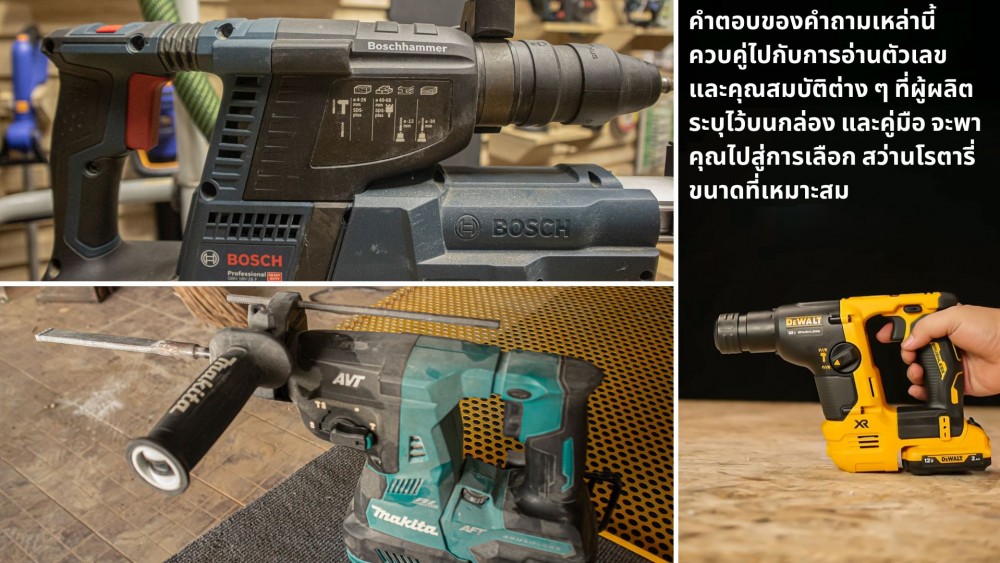
Ultimately, A good rotary hammer isn't the most powerful, the biggest, the most expensive, or the heaviest/lightest one. Rather, it is the tool that:
- Meets the demands of your job
- Doesn't put undue strain on your body
- Can be picked up and practically used whenever you need it
If your work consists of general installation tasks, a small or medium size may be sufficient. But if you handle heavy structural work such as chipping, demolition, or all-day drilling, consider a larger size as an alternative. However, if you're still undecided, I can tell you that the medium size is usually designed to be the safest starting point.
Rotary hammer Not just an extra tool, but a "work partner" that should be chosen to suit you